
Category: Various timelines
Wednesday, June 17, 2015
Major Additions To Meredith Kercher Case Wiki To Provide Complete Impartial Overview in English
Posted by azoza
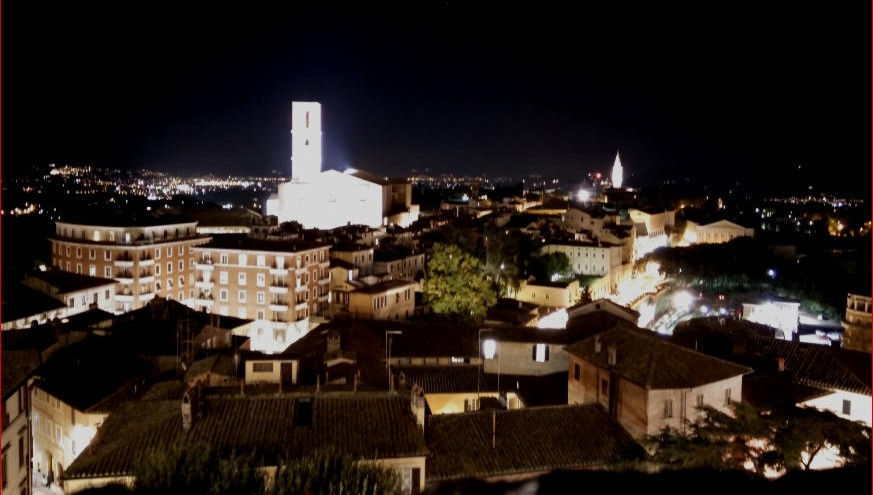
Image is of the very beautiful Perugia at night
Origin and mission
The impartial Murder of Meredith Kercher Wiki began in 2013.
The seed was people discussing how to overcome the flawed Wikipedia article of the case. That article relied on sources like Candace Dempsey, Nina Burleigh and American media. In other words, biased or incomplete sources.
In May 2013, Edward McCall set up the website, with the help of volunteer editors from the Perugia Murder File community. Its mission statement was:
Were Amanda Knox, Raffaele Sollecito, and Rudy Guede responsible for the death of Meredith Kercher? This wiki style site was created by a group of volunteer editors to inform the public about the case, by providing translations of original documents and evidence presented at trial.
This continues to be the aim of the Wiki: to make available documents and translate them properly. Our interest is not selectively posting documents, like the Knox campaign has done. We want to make all the facts available, without bias or selecting. We believe all the facts support the notion that all three defendants are responsible for Meredith Kercher’s murder.
Purpose of this post
The purpose of the article here is to let people know of recent changes to the website.
The Wiki is revised when new documents and translations continue to be received. Existing webpages are tweaked when time allows. Webpages are sometimes changed so information can be better presented. Or the website structure is changed when a significant page is introduced.
For example, a new page listing a lot of evidence was added in November 2014. This page can be directly accessed from the main page. That evidence list page has links to other sections of the website, like “˜wikified’ testimony, for easier reference. More links will be added and more evidence noted as more documents become available.
Major redesigns
The website had two major redesigns earlier this year. The main page was redesigned to provide clearer “˜at a glance’ updates. We did this primarily to keep everyone up-to-date with the March 2015 Cassazione decision. The boxes on the main page also note updates to other parts of the website. Also, we added buttons so any webpage on the site can be shared on various social media.
The other major redesign has been the addition of the “˜file library’.
Completing the picture
For those long familiar with the case, source material had been seriously lacking. There have been large gaps. The Knox campaign has posted some documents, but their “˜collection’ has always been incomplete. As examples:
1) The crime scene photos start at “˜dsc016’. What about photos 1 through 15?
2) No photos of Sollecito’s place, Guede’s place, via Sperandio or elsewhere
3) They posted many Massei transcripts, but not all. They never posted the 2nd day of Knox’s testimony, or the days when the Kercher family and consultants testified.
4) Some Massei transcripts they posted had pages missing.
5) They have posted many defense consultant reports, but few prosecution consultant reports.
6) They only posted a few Hellmann transcripts, but not all.
7) They only posted one Micheli transcript, but not the others.
8) Hardly any depositions.
9) A lot of police reports are still missing.
In the past six months, we have been trying to correct this. We have set up a file library, which will be the repository of as many case-related files as can be gotten. Files will ultimately include documents, photos, videos and audio- whatever is part of the public record of this tragic case. The files are made available as links for downloading. Eventually many will also be “˜wikified’ so anyone can do a word search through the documents. And when time allows, key documents will be translated.
There are thousands of files related to this case - too many to put on one page. A single file page would take forever to scroll and would be terribly confusing. So the library is structured into subsections. The basic idea is “˜nested boxes’. Once you select a section, you “˜drill down’ through pages to get to document links. Then you click “˜back up’ to the higher levels so you can move to other sections.
Some pages have a mixture of links to documents and links to subpages. These will eventually be simplified for clarity.
Not all file library pages have been created. More pages will be required as more files come in. Once the document files (PDFs) portion is nearly complete, pages will be reviewed and the library layout will be tweaked. At that point, when we’re comfortable with all the pages and their names, links will be added to allow browsing across sections or in sequential order. This hasn’t been done yet to avoid redoing a lot of work later.
A directory tree is a strong possibility too.
The seven sections
The library has over 900 PDFs and photos scattered across 7 major sections.
The 1st section
This section Context and people is empty for now. It will have photos of Perugia, the cottage, nearby locales and pictures of the people involved in the case. We are sifting through photos and erasing duplicates. Once that’s done, this section will quickly fill out.
The 2nd section
This section 2007 Investigations has files related to police investigations in 2007, the arrest and crime scene photos and videos. As mentioned, not all crime scene photos and videos have been made public. We hope to gather as complete a collection as possible. Of course, anything showing Meredith Kercher’s body will be censored, in line with the wishes of the Kercher family, and to maintain dignity. In the past 1.5 months, we’ve gotten over 80 depositions of witnesses and other documents related to early investigations. Things like preliminary police reports and police correspondence. Here you can also find phone and prison taps.
The 3rd section
This section Arrest trials has filed related to the cautionary arrest trials. This includes the Matteini court, the Ricciarelli court and the 2008 Cassazione court, presided by judges Gemelli & Gironi. Files include court hearing transcripts, motivation reports and other files pertinent to these hearings. This is missing quite a bit still, but we hope to correct that.
The 4th section
This section 2008 Investigations has files related to police investigations in 2008. While the murder was discovered on Nov 2, 2007, and arrests were made that month, the actual police investigation continued until the following year, finishing in June 2008. Files here include additional phone and prison taps, police reports from Rome and Perugia, additional depositions and other related documents.
The 5th section
This section Statements and writings contains writings and depositions of the three defendants. GKS = “Guede Knox Sollecito”.
The 6th section
This section Trials and Appeals and Reports is the largest section. We may revise or split this section further. Currently it contains all documents related to the main trials. All three defendants took part in the first main trial, the 2008 Micheli court. Micheli indicted Guede and found enough evidence against Knox and Sollecito. After the Micheli court, Guede’s trial path separated from the other two because he chose a fast-track option. So there are 3 subsections: Micheli, Guede trials and Knox + Sollecito trials. The Knox + Sollecito trials page has further subpages for the Massei court, the Hellmann appeals court, the Nencini appeals court. In this section, one can find court transcripts and reports, correspondence or depositions introduced during court proceedings. So a lot of files.
The 7th section
This section is extra material.This will contain documents, photos and videos indirectly related to the case. Things like interviews, documents on forensics, lab manuals, crime scene analyses, documentaries, related trials like the police calumnia trials, etc.
A few quick notes:
1. There are many versions of the Massei motivations report on the Internet. Most are missing two pages. Another version comes in four parts. We edited ours so this is a complete version with the “˜famous’ missing pages.
2. Similarly with the Borsini-Belardi motivation report. Many versions out there, most of them improperly OCR’ed, with sections missing. Our version is a scan version, not the OCRed one.
3. As noted before, recent additions include a lot of depositions of witnesses taken in the first week of police investigation. You can find these in the “2007 police work” page.
4. Police summaries of the crime scene surveys, and fingerprint reports, are at the bottom of that same page.
5. There’s a PDF containing a “˜5 volume’ police photo report. This PDF has photos of Via Sperandio currently not in the crime scene photos. But certainly those photos are part of the same Nov. 2007 crime scene photo survey. Anyway, you can find it in the Crime Scene page at the bottom. It’s called Photo-photographic-file-censored. We edited out pictures of the body, to preserve dignity of the victim.
6. Towards the bottom of the “2008 investigations” page, we recently added two police charts, and the first “shoeprint report” by Rinaldi & Boemia, which has more data on shoeprints. Their second report concentrated on the footprints.
7. We have the Cassazione March 2015 dispositivo. We will be posting that along with other documents shortly.
In conclusion
The file library is an ongoing thing. We hope to make real progress here, so everyone can look at all the facts of the case, not just a few picks. A bright light is needed on as much material as is possible to offer, in honor of Meredith Kercher, the victim.
When we post a new file batch, we add an update note on the Wiki home page.
The Meredith Kercher Wiki is committed to being the essential record of all publicly available documents and testimonies about the case, to benefit the general public and the media. Please circulate this widely, and check in regularly. There are more changes to come.
ADDED 12 JULY
On 2007 Investigations: Police work page
2007-11-03-Log-cellphone-KercherM-English.pdf
2007-11-03-Log-cellphone-Sollecito.pdf
2007-11-07-Log-landphone-Sollecito.pdf
2007-11-27-Police-deposition-Capezzali.pdf
On 2007 Investigations: Arrests page
2007-11-07-Prosecutor-notice-Request-to-validate-Arrest-Knox-Lumumba-Sollecito.pdf
On Arrest trials page
2008-01-21-Testimony-Bernaschi-Sollecito.pdf
2008-05-15-Motivazioni-Matteini-reconfirming-cautionary-arrest-Knox.pdf
On Arrest trials: KSL: Matteini trial page
2007-11-08-Testimony-Matteini-Knox.pdf
On Arrest trials: KS: Ricciarelli trial page
2007-11-30-Motivazioni-Ricciarelli-Arresto-Appello-Knox-Sollecito.pdf (forever missing Ricciarelli report)
On 2008 Investigations page
2008-11-08-Deposition-Monacchia.pdf
On Trials: Micheli court page
2008-09-16-Testimony-Summary-and-Rulings-Micheli.pdf (first Micheli hearing)
2008-10-27-Report-Fioravanti-Vodaphone.pdf
On Trials: KS: Massei and Cristiani trial page
2009-11-20-Closing-arguments-Mignini.pdf (forever missing)
2009-11-21-Closing-arguments-Comodi-Knox.pdf (forever missing- Comodi describes 3D reconstruction)
On Trials: KS: Hellmann and Zanetti trial page
2010-12-11-Testimony-Lawyers-Knox-Parisi-Maori-Ghirga-Vedova.pdf (missing Hellmann hearings)
2010-12-18-Testimony-Costagliola-Comodi-Perna.pdf
2011-01-22-Testimony-Lawyers.pdf
2011-03-12-Testimony-Mandarino-Pucciarini-Ciasullo-Bevilacqua-IniG-IniR.pdf
2011-03-26-Testimony-Brughini-Curatolo-Lucarelli.pdf
2011-05-21-Testimony-Napoleoni-Conti-Vecchiotti-Knox.pdf
2010-12-11-Court-doc-Zanetti-case-review.pdf
On Trials: KS: Nencini and Cicerchia trial page
2014-01-20-Testimony-Maori-Crini-Pacelli-Fabiani-Perna-Maresca-Donati-Colotti.pdf (missing Nencini hearing)
On Trials: Knox and Sollecito trials page
2015-03-30-Sentenza-Cassazione-Dispositivo-Knox-Sollecito.pdf (sentence, not motivations report)
Posted by azoza on 06/17/15 at 01:59 PM •
Permalink for this post •
Archived in Evidence & Witnesses, Various timelines, Real locations, Real crimescene, Faked breakin, Other witnesses, The two knives, DNA and luminol, Computer activity, Cellphone activity, Other physical •
Comments here (25)
Friday, May 29, 2015
Those Pesky Certainties Cassation’s Fifth Chamber May Or May Not Convincingly Contend With #4
Posted by Cardiol MD

1. SERIES OVERVIEW
This post continues a response to the March 27th, 2015 announcement of Cassation’s Fifth Chamber that it had decided that Amanda Knox and Raffaele Sollecito were Not Guilty of the November 2007 Murder in Perugia of Meredith Kercher.
The Fifth Chamber’s Reporting Judge Antonio Paolo Bruno, was reported to have said that the trials had “not many certainties beyond the girl’s death and one definitely convicted”.
In fact Judge Bruno was wrong.
Post #1 and Post #2 and Post #3 reported dozens of Certainties contained in “the trials”.
As previously noted, the Existence, Timings, Durations, and General-Locations of all the telephone calls are a very fertile source of Certains, or Certainly-Nots. This is because civil telephone time-keeping all over the Earth’s surface, including in Italy, the U.S. and the U.K, use, and specifically did use in November 2007’s Perugia, the Coordinated Universal Time Protocol (CUT).
Coordinated time-keeping assures that the time assigned to a telephone event is accurate and very precise, independent of where it occurs. It’s almost as if these November, 2007’s Perugia “˜phone users were wearing criminal-offender’s ankle bracelets. CUT records enable decisive challenge to the credibility of a false witness (impeachment).
(Uncoordinated Time-keeping could have resulted in wrong times being assigned to a telephone event)
2. MORE SUCH CERTAINTIES
(A) SOLLECITO’S PHONE
43. IT IS CERTAIN THAT SOLLECITO’S PHONE WAS EITHER AFFIRMATIVELY SWITCHED-ON, OR HAD-BEEN-MOVED, AT 6:02:59 AM, 2 NOVEMBER 2007
Therefore, contrary to the Defense “reasoning”, cited below, there is Certain proof that Sollecito’s phone was switched on or had been moved at 6:02:59 am on 2 November 2007, and that Sollecito &/or Knox were awake at that time, contrary to their assertions, which are Certainly false:
Nencini Page 158:
“If in fact one can agree with the Defense reasoning by which there is no certain proof that at 6:02:59 am on 2 November 2007 Raffaele Sollecito’s phone was switched on (by himself or by Amanda Marie Knox, the only two present in the apartment) allowing [142] reception of the SMS sent to him by his father a good six hours earlier, the only logical alternative is that someone obviously moved the phone inside the apartment from the location in which it was positioned, and where it was not receiving the “signal”, to a different location in the apartment, where the “signal” was received.What matters, and what the Court finds proved, is that at 6:02:59 am on 2 November 2007 in the apartment at 130 Via Garibaldi, they were not in fact asleep, as the defendants claim, but rather the occupants were well awake, so much as to switch on or move the phones.”
More in this case:
(B) WITNESS ANTONIO CURATOLO
Antonio Curatolo had testified at the Massei Trial that he had seen Amanda Marie Knox and Raffaele Sollecito, from 9:30pm to around midnight of 1 November 2007 in Piazza Grimana”
However, the Hellmann Court of Appeal’s motivazione had rejected the reliability of Curatolo’s Testimony.
The SCC Panel, Annulling the Hellmann Court of Appeal’s motivazione had, in turn rejected and annulled Hellman’s Analysis of Curatolo’s Testimony, stating on pp 67-69:
“The Hellmann Court of Appeal rejected the reliability of the testimony of Antonio Curatolo which, in the reconstruction of the First Instance Court, had been taken as a basis of proof that the negative alibi offered by the two accused was false, and which constituted one of the tesserae of the mosaic which led to their being held to have been present at the scene of the crime. Incidentally, it is worth recalling that the First Instance Court held, via reasoning that was correct from both a legal and logical point of view, that the false alibi must be considered as evidence against [the accused], to be placed in relation to the other elements of proof in the context of the entire body of evidence.
This method of analysing the testimony, as observed by the Prosecutor General submitting the appeal, is absolutely subject to censure in that it displays a lack of the prerequisite thorough examination of the facts and circumstances, so that the conclusion that was reached [by the Hellman Court of Appeal] ““ that in indicating the two accused students as having been present in Piazza Grimana, he confused the evening of 31 October and the evening of 1 November ““ clashes with ascertained facts that seriously contradict such an absolutely certain assumption, so as to shed full light on the well”foundedness of the charge that the justifying discourse is contradictory and thus manifestly lacking in logic (it was in fact proven by other facts that on the evening of 31 October that neither Knox nor Sollecito, who were both occupied, the former at Lumumba’s pub where she was preparing for the normal activity associated with the Halloween festival, the latter at a graduation party, could have been present in Piazza Grimana at around 11 PM).
The assertion that the sighting of the two young people by the witness should be shifted to 31 October (page 50 of the sentencing report) because the context described was more suitable to that day than the next day, since [the latter] did precede the arrival of the Scientific Police but [50] [was] taken out of context, is a manifestly illogical assertion, not only because it contradicts facts which unequivocally demonstrate that the two were not in the piazza on the evening of 31 October (a fact of fundamental importance in the context of the evaluations) and thus the impossibility of squaring the circle in the sense proposed, but also because it follows an utterly weak inferential rule.
Starting from the need to undo the knot of contradiction presented by the testimony (he saw the two young people the evening before the investigation of the Scientific Police and he saw them in the context of the Halloween festival), the Hellmann Court of Appeal, after having heard the witness testify a second time and after having verified that he erroneously placed Halloween on the night of 1”2 November, they heard the witness reiterate that his temporal placement of the fact was anchored to the described presence of people who were all dressed in white and that, after midday on the day after he saw the two young people, he caught sight of the men in white in via della Pergola (a fact with a very high level of certainty, more than any other) together with the police: this notwithstanding, the Court reached the conclusion that his testimony could not be accepted due to the man’s deteriorating intellectual faculties and due to his lifestyle, since he was a detainee for drug dealing when he testified the second time and was a habitual heroin user.
Once again, the progression of the argument emerges as obviously illogical, in that the evaluation of the testimony should have been correlated (regardless of the conclusions, this being a discussion of evaluation methods) to the unique objective fact of absolute reliability (the presence of individuals wearing the white suits, the day after the sighting of the two in the piazza, at a time earlier than 11 PM”midnight) because that is a fact whose existence is certain, which was a unique identifying circumstance, which could not but remain imprinted on the mind more than any other; while instead, once again, character issues were considered and asserted, furthermore, without any scientific examination that could ascertain whether the man’s intellectual faculties had deteriorated. Moreover, Curatolo showed up when called upon to testify, in both the first and second instance trials and, even well after the fact, he never had any difficulty recognizing the two accused as those whom he had seen in Piazza Grimana the evening before he noticed the men dressed in white (whom he called “extra”terrestrials”) and the police in via della Pergola.The fact that he had been a homeless man who spent all day in the piazza was not a reason for dismissing him as an unreliable witness out of hand, at the cost of colliding with the accepted principles on the matter of the reliability of testimony. In conclusion, [51] a contribution [that was] expressed with certainty and noted in the trial transcripts of the witness, and again during his second testimony (“as certain as I’m sitting here” he said of having seen the two accused the evening before the day in which he saw the men in white suits and the police), cannot be circumvented by merely referring to the character of the author of the contribution; this would have required a process of evaluation through facts with equally strong probative evidence.
Moreover, the opinion must be annulled and remanded, since the explanations of the reliability of the witness Curatolo are incomplete (as they did not take into consideration the facts that contradicted the conclusion reached by the Court), vitiated by an incorrect application of the laws governing the matter. The “˜precise and serious’ nature of the evidence provided by the testimony was dismissed in the [Appeal] opinion without testing its concordance with other evidence, on the basis of a conjecture (that the witness superimposed the evening of 31 October onto that of 1 November) that was not even confronted with the facts contradicting its conclusions”
In summary, this SCC Panel ruled that Hellmann’s Motivazione “must be annulled and remanded” because it ignored facts contradicting Hellmann’s conclusion, and incorrectly applied “the laws governing the matter”, “without testing its concordance with other evidence”, not even confronting Curatolo “with the facts contradicting (Hellmann’s) conclusions”.
Therefore:
44. IT IS CERTAIN THAT CURATOLO WAS PRESENT IN PIAZZA GRIMANA ON THE EVENING OF NOV. 1st, 2007
45. IT IS CERTAIN THAT CURATOLO TESTIFIED THAT HE SAW MEN IN WHITE SUITS, AND POLICE PRESENT IN PIAZZA GRIMANA ON THE MORNING AFTER HIS SIGHTING OF AMANDA KNOX AND RAFFAELE SOLLECITO IN PIAZZA GRIMANI.
3. AND MORE BEYOND REASONABLE DOUBTS
(A) WITNESS ANTONIO CURATOLO
The SCC Chamber’s reasons, given above, for Annulling And Remanding Hellmann’s conclusions re Curatelo’s misremembering the Date, in spite of his specifically remembering that it was the evening before he saw the Official Commotions relating to Meredith’s murder, justify the Conclusion that:
8. IT IS BEYOND REASONABLE DOUBT THAT CURATOLO SAW AMANDA KNOX AND RAFFAELE SOLLECITO IN PIAZZA GRIMANA ON THE EVENING OF NOV.1st, 2007 ON MULTIPLE OCCASIONS. A FEW YARDS FROM THE COTTAGE AT NO. 7, VIA DELLA PERGOLA, WHERE, IN THE SAME SPAN OF TIME, THE MURDER TOOK PLACE.
WITNESS MARCO QUINTAVALLE
Nencini p 156:
“Amanda Marie Knox went to Marco Quintavalle’s Conad shop around 7:45am on 2 November 2007, obviously in search of something to buy that she could not find. She was noticed by Mr. Quintavalle who, at the trial, identified her with certainty in the courtroom. So we are able to affirm that Amanda Marie Knox was lying when she claimed to have slept at Mr. Sollecito’s house in his company until 10am in the morning on 2 November 2007.
Having already been proven false by witness testimony, the alibi given by the accused is also proven false by comparing it with objective data, which tallies with the witness testimony referred to above.”
SCC. Annulling H/Z p 50
“In this case, [the Defence argues that] a re”evaluation of the witness is not allowed, given that his testimony was correctly examined by the Hellmann Court of Appeal, knowing the lapse of time after which he offered his contribution to investigators. The witness’s statements were, for the rest, compared with those of his co”workers, who referred to the doubts expressed by Quintavalle on the exactitude of his identification. There is therefore no lack of logic in the reasoning, since the lack of logic must be manifestly perceived, whereas minimal inconsistencies must have no influence”
SCC ANNULLING H/Z p 70-71
“In reality, the notice taken of the witness’s statements, as pointed out by the Prosecutor General, is absolutely biased, since the sighting out of the corner of the eye referred to the girl’s exit from the shop, whereas the witness specified having seen her at a close distance (between 70”80 centimetres), adding that she remained imprinted on his mind “because of her very light blue eyes”, her “extremely pale face”, and “a very tired expression”.
Moreover, the witness clarified in his testimony that he became convinced that the girl who appeared in the newspapers was the one he saw in the early morning of 2 November 2007, given that the colour of her eyes could not be ascertained from the photo, but that he became certain once that he saw the girl in the courtroom. The selection made from the pool of information was absolutely one”sided, which distorted the evidence to the point of making it appear uncertain, whereas the witness explained the reasons for his perplexity and the development of his conviction in terms of certainty.
As noted by the Prosecutor General in the appeal documents filed, this portion of the report assumed relevance within the framework of the reconstruction and required an explanation based on an examination of the entire testimony; instead, through a process of unacceptable selection, only some of the testimony was considered to be of value, indeed, only that portion considered to be consistent with a [specific] conclusion, one that in fact required rigorous demonstration.
The result, once again, is blatantly and manifestly illogical. What is at issue is not a re”evaluation of the evidence ““ which is obviously prohibited by this Court, as the Defence for the accused has justly pointed out ““ but rather the need to point out a glaringly evident flaw that consists of an intolerable chasm between what is stated by the witness and what is acknowledged in the justifying arguments, on a point of significant importance, since it concerns the foundation of the alibi.
On this point also, the new judgment will have to be conducted in light of the preceding observations.”
Given the above:
9. IT IS BEYOND REASONABLE DOUBT THAT MARCO QUINTAVALLE SAW AMANDA KNOX IN HIS CONAD SHOP AT AROUND 7:45 am ON 2 NOVEMBER 2007.
Amanda Marie Knox was lying when she claimed to have slept at Mr. Sollecito’s house in his company until 10am in the morning on 2 November 2007.
To be continued, though we may need to wait until the end of June 2015 when SCC’s Motivazione is due.
Posted by Cardiol MD on 05/29/15 at 02:02 AM •
Permalink for this post •
Archived in Defendants in court, Amanda Knox, Raff Sollecito, Evidence & Witnesses, Various timelines, Real locations, Real crimescene, Other witnesses, Appeals 2009-2015, Cassation 2015, Cassation critiques, Cardiol critique •
Comments here (10)
Thursday, May 21, 2015
Those Pesky Certainties Cassation’s Fifth Chamber May Or May Not Convincingly Contend With #3
Posted by Cardiol MD
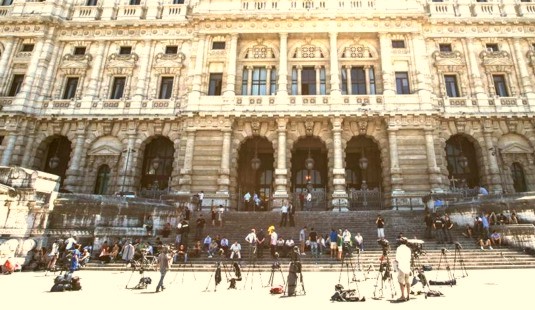
Media staff waiting in front of the Supreme Court
1. This Series’ Foreboding Context
On March 27th, 2015 Cassation’s Fifth Chamber announced that it had decided that Amanda Knox and Raffaele Sollecito were not guilty of the November 2007 Murder in Perugia of Meredith Kercher.
The Fifth Chamber is but one of Cassation’s more than 75 Panels. It’s reporting Judge is Antonio Paolo Bruno. He mas dismissive of the massive evidence. He was quoted as having said that the trials had “not many certainties beyond the girl’s death and one definitely convicted.”
Posts #1-#2 addressed the fact that, contrary to Judge Bruno’s pronouncement, the trials had Many Certainties, listing them under 30 enumerated Headings, but in total, there were many more Certainties and Certainly-Nots, listed in sub-headings.
The existence, timings, durations, and general locations of All the telephone calls are Certains, or Certainly-Nots. They bring the Total up to Many; Many more than 30; Certainly Not “not many”, as Judge Bruno asserted, Inappropriately, Deceptively, and Prejudicially.
Note the distinctions between when, and where Message-Received, and -Sent, versus When, Where and Whether Message-Read, e.g. Knox was near the Women’s Villa when her Telephone received Lumumba’s crucial message, but allegedly at Sollecito’s Flat when she First-Read his message. In Knox’s officially reported Q&A Testimony there was Confusion and Ambiguity over this issue, exploited to Knox’s advantage
2. Certainties 31 to 42
31 THE FINAL FATAL SEQUENCE
Details of the Fatal Sequence have been masked, over the years, apparently for humanitarian considerations, but such details should be available to readers who wish to more-objectively assess culpability. Here is what we have deduced:
Massei disagreed with the Reconstruction proposed by the Prosecution, which depicted Meredith on her knees, facing the floor:
a. Massei concluded that Meredith was in a standing position, facing her attackers:
MASSEI PAGE372-373: “”¦considering the neck wounds sustained, it must be believed that Meredith remained in the same position, in a standing position, while continuously exposing her neck to the action of the person striking her now on the right and now on the left. Such a situation seems inexplicable if one does not accept the presence of more than one attacker who, holding the girl, strongly restrained her movements and struck her on the right and on the left because of the position of each of the attackers with respect to her, by which it was easier to strike her from that [ End of p372; Start of p373: ] side. “¦”
b. Meredith’s autopsy was performed by Dr. Luca Lalli, but his detailed findings are not included in Massei’s report, they await their Translation into English.The Massei report includes only a limited paraphrase of Lalli’s findings.
32 CERTAINTY ONE re FINAL FATAL SEQUENCE
In “Darkness Descending - the Murder of Meredith Kercher” Paul Russell (Author), Graham Johnson (Author), and Luciano Garofano (Author) give clearer, more detailed descriptions of Dr. Lalli’s findings than Massei does.
On pages 72-74 of DD it emerges that the cut (Stab A) made by A large knife in Meredith’s neck was on the left-side, ran obliquely from left-to-right, almost parallel to her jaw, and slightly Upwards.
33 CERTAINTY TWO re FINAL FATAL SEQUENCE
DD does state that the knife entered 8cm vertically below her left ear, 1.5cm horizontally towards the front of her neck, but does not specify the cut’s length.
34 CERTAINTY THREE re FINAL FATAL SEQUENCE
A large knife created a gaping wound, visible only through the opened-skin of the Left-Side, continuing its travel under the skin, traveling across the mid-line plane, towards the right-side, exposing the oral cavity, fatty tissues and throat glands. Important jaw muscles were also severed.
35 CERTAINTY FOUR re FINAL FATAL SEQUENCE
As DD states, there was another stab wound (Stab B) on the right-hand side of Meredith’s neck, 1.5 cm long, penetrating 4 cm subcutaneously.
36 CERTAINTY FIVE re FINAL FATAL SEQUENCE
Stab B was made by a Knife smaller than the above large knife.
37 CERTAINTY SIX re FINAL FATAL SEQUENCE
The wound was shallow, did not create a gaping wound, did not cut important subcutaneous structures, but did create a route to the exterior through which blood from Stab A, then created by the large knife on Meredith’s left side could also exit to Meredith’s right side.
38 CERTAINTY SEVEN re FINAL FATAL SEQUENCE
g. The large knife had damaged no significant vessels of the Left-Side.
39 CERTAINTY EIGHT re FINAL FATAL SEQUENCE
i. Blood also flooded the subcutaneous tissues around the breech in the right-hand side of Meredith’s airway caused by the knife-stab on the left-side of her neck.
40 CERTAINTY NINE re FINAL FATAL SEQUENCE
j. This resulted in Meredith’s inhalation of her own blood.
41 CERTAINTY TEN re FINAL FATAL SEQUENCE
k. Meredith stops screaming, but now her blood seems to be everywhere, including over her attackers, and they quickly abandon her, already evading the accountability they are fully aware is theirs.
42 CERTAINTY ELEVEN re FINAL FATAL SEQUENCE
l. As DD comments, during Meredith’s Autopsy surprise was expressed that the Jugular Veins and Carotid Arteries (of both right and left sides) were intact.
Others who read about this murder, had concluded-then that the killers must have known about the major blood vessels (MBVs), but not about branches-of-Carotid-branches such as little RSTA.
3. Plus Beyond Reasonable Doubts
BEYOND ANY REASONABLE DOUBT ONE re FINAL FATAL SEQUENCE
c. Accepting Massei’s conclusion, Knox and Sollecito were standing-up and facing Meredith in Meredith’s room. Knox, Sollecito and/or Guede, were participating in the restraining of Meredith.
BEYOND ANY REASONABLE DOUBT TWO re FINAL FATAL SEQUENCE
d. Sollecito (or Guede) was holding the smaller Knife, probably in his right hand. This smaller knife made Stab B.
BEYOND ANY REASONABLE DOUBT THREE re FINAL FATAL SEQUENCE
Stab B preceded Stab A, and caused Meredith’s scream.
f. When Meredith screams Knox plunges Knife36 into Meredith’s neck in the above long-axis direction, from left to right, transecting Meredith’s Hyoid bone, first opening Meredith’s airway to the atmosphere, then transecting Meredith’s Right Superior Thyroid Artery.
BEYOND ANY REASONABLE DOUBT FOUR re FINAL FATAL SEQUENCE
e. Knox was holding Knife36, probably in Knox’s right hand, holding Knife36 against the left side of Meredith’s neck with Knife36’s point directed slightly upwards the right side of Meredith’s neck, the blade-label facing towards Knox, the palm of Knox’s right hand also facing towards Knox and the long-axis of Knife36 angled a few degrees above horizontal.
BEYOND ANY REASONABLE DOUBT FIVE re FINAL FATAL SEQUENCE
f. When Meredith screams Knox plunges Knife36 into Meredith’s neck in the above long-axis direction, from left to right, transecting Meredith’s Hyoid bone, first opening Meredith’s airway to the atmosphere, then transecting Meredith’s Right Superior Thyroid Artery.
BEYOND ANY REASONABLE DOUBT SIX re FINAL FATAL SEQUENCE
h. A thin stream of bright-red blood spurted from this artery to its exterior environment, probably through the cuts made in her skin to the outside by both knives.
(Consistent with bleeding from both cuts, Follain, in his book “A Death In Italy” states that Guede saw that blood was coming out of the left side of Meredith’s neck. Follain also states that Francesco Camana of the Rome forensic police, in Camana’s written report, that spurts of blood in the middle of Meredith’s chest made her sweatshirt more bloody on the right side than on the left side)
BEYOND ANY REASONABLE DOUBT SEVEN re FINAL FATAL SEQUENCE
i. The large knife was Knife-36, which had been brought to the murder room from Sollecito’s kitchen.
This series continues here.
Posted by Cardiol MD on 05/21/15 at 04:10 AM •
Permalink for this post •
Archived in Various hypotheses, Various scenarios, The officially involved, Supreme Court, Evidence & Witnesses, Various timelines, Appeals 2009-2015, Cassation 2015, Cassation critiques, Cardiol critique •
Comments here (32)
Thursday, April 30, 2015
Those Pesky Certainties Cassation’s Fifth Chamber May Or May Not Convincingly Contend With #2
Posted by Cardiol MD
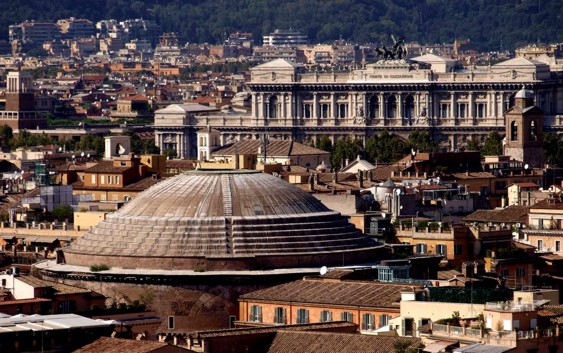
The Italian Supreme Court is in the background
1. This Series’ Ominous Context
On Friday, 27th March, 2015 a Panel of five Court of Cassation judges of the Fifth Criminal Chamber of the Supreme Court in Rome, found Amanda Knox, and Raffaelle Sollecito, Not Guilty of the Murder of Meredith Kercher.
The President Judge of the Fifth Criminal Chamber of this Supreme Court Panel is Gennaro Marasca, The Prosecutor General is Mario Pinelli, and the Reporting Judge for the Meredith Panel is Antonio Paolo Bruno.
Near the start of the above SCC hearings Judge Bruno was quoted as having said that the trials had “not many certainties beyond the girl’s death and one definitely convicted.”
We consider that to be flat-out wrong. Absurd in fact, as the hapless Hellmann & Zanetti could testify. So do numerous professionals well-briefed on the case in Italy. We expect soon articles in Italian similar to this one.
In fact if the forthcoming Marasca Sentencing Report attempts to brush the numerous real factual certainties under the table there is a near-certainty that the perverse verdict can be overturned by way of a lawsuit or a petition to the President of the Italian Republic.
Post #1 of 10 April described some 26 of the factual headaches facing the SCC under the strict Italian Legal Requirements for classification of Evidence as Circumstantial-Evidence.
The fact that the trials actually had very many certainties was demonstrated in Post #1, and continues in this Post.
2. Note On Circumstantial Evidence
Defendants typically trivialize Circumstantial-Evidence as “Only Circumstantial-Evidence”.
Actually, Circumstantial-Evidence is often the most potent evidence leading Finders-of-Fact to their Verdict. This is even more true in Italian Law because its Circumstantial-Evidence classification-requirement provides that an evidentiary circumstance or fact must be true to the level of being a Certainty. Therefore, for example, the unverifiable RS/AK broken water-pipe story can not be classified as Circumstantial Evidence and cannot legally be admitted as Evidence at all.
Continuing the review of the Massei Motivazione, the Nencini Motivazione, and the several past SCC rulings, demonstrating the large number of Certainties:
3. Certainties 27 To 30
27. THE SIMULATED BURGLARY
:
This Subject has already been commented-upon in Pesky #1, under the Heading “13. Crimescene Meddling?”:
“Having accomplished the Phone-Dump, Meredith’s killers next re-model the crime-scene, minimising the evidences of their identities, cleaning-up the evidences that it was “˜an inside job’, and simulating the appearances that it was “˜an outside job’.”
According to the Massei Summary, Part 3:
“8. The staged break-in
The Massei Report examined the evidence surrounding the broken window and disarray in Filomena Romanelli’s bedroom in order to determine whether a real break-in had occurred or the appearance of one had been staged….....
The court concluded that the disorder in Romanelli’s room and the breaking of the window pane constituted an artificial representation created in order to misdirect the investigations towards a person who, not having the key to the front door, was supposed to have entered through the previously broken window and then effected the violent acts on Meredith which caused her death.”
So Massei, having carefully analysed all the Evidence, and the Arguments on both sides Concluded that there was No Burglary at all, and that Meredith’s killers had deliberately created the appearance of a Burglary, in order to misdirect the Investigators of Meredith’s death.
According to the Hellmann-Annulling SCC Panel wrt the Simulated Burglary:
Page 56:
“The compartmentalisation of the single pieces of evidence thus weakened their value and their depth, since a piecemeal evaluation of their relationship and of the required synthesis inevitably followed, ignoring the increase in value that the pieces of the mosaic of circumstantial evidence assume when synergistically evaluated.”
The Panel begins its justification for Annulling Hellmann/Zanetti.
The Hellmann-Annulling SCC Panel Page 66:
“.....the simulation of the burglary should have been evaluated in light of the investigative data collected immediately after the event, such as Rudy’s shoeprints (along the path of his flight) and the traces of the victim’s blood detected in many spots in the bathroom used by Ms Knox and [49] Ms Kercher, surely carried there by third parties present in the house after the murder.”
The Panel takes-for-granted that the “Burglary” was Simulated by the Perps, and focuses on its improper evaluation by H/Z.
The Hellmann-Annulling SCC Panel Page 82-83:
“The Hellmann Court of Appeal preferred ““ in full agreement with the defence pleadings ““ to favour the information the unreliable Rudy Guede had conveyed in his chat with his friend Benedetti, i.e., that he was in via della Pergola around 9.00/9.30 PM on the first of November 2007; this information was correlated with the victim’s telephone records which registered:
a) an unanswered call at 8.56 PM
b) the dialling of the number 901, corresponding to an answering service at 9.58 PM, immediately after which the call was blocked
c) at 10.00 PM the dialling of the first number in the list of phone numbers for the Abbey bank, without however the dialling of the required dialling code
d) at 10.13 PM a GRPS connection of the length of nine seconds, most probably linkedto a multimedia message, without the necessity of human interaction.On the basis of these facts, the Hellmann Court reached the conclusion that Miss Kercher had not called her family again in the period of time between 8.56 and 11.00 PM, since shortly after the first attempt an unexpected event may have occurred, such as for example the attack, and the dialling of the number at 10.00 PM could have been done [61] by another person, who was not familiar with that mobile phone, while attempting to silence it, a fact which would place the time of death at before 10.13 PM.
The reconstructive path is permeated with factual deductions deriving from a series of conjectures and baseless suppositions, without any reliable, demonstrative basis, in spite of [other] findings of significant value which conflict with those [deductions] and have a greater probative value, which were reduced in their importance on the basis of an unsatisfactory reasoning, which stands out because multiple passages contradict other passages of the statement of reasons, and because of manifest illogicality which must be rightfully censured in this venue. “
The Panel implicitly includes H/Z’s failure to recognize the “Burglary"as simulated, as part of its “unsatisfactory” and improperly “baseless” reasoning.
NENCINI Page 175:
“In the cottage at 7 Via Della Pergola, on the day of 2 November 2007, in the early hours of the day and up until approximately 12.00 pm, nobody had a shower, just as no burglar had gottenin through the window of Filomena Romanelli’s room; more simply the totality of the circumstantial evidence examined to this point gives us a plain picture of how the defendants put into action a clean-up of the traces of the murder committed and activity to “derail” the investigations that involved a series of actions, a number of which are still to be described.”
So, having stated at length “the totality of the circumstantial evidence examined” Nencini concludes, that the defendants (Knox and Sollecito) had faked the “Burglary” and,
Nencini Page 335:
“...we exclude, for the reasons already expressed, that the murder was committed by a burglar caught in the act of entering the flat after breaking Filomena Romanelli’s window…”
The Nencini Appellate Court Judges, presumably recognise that their conclusion Knox and Sollecito had faked a burglary didnot implicitly exclude the co-existence of a real burglar.
So now they explicitly “exclude” the conclusion that the murder was committed by any burglar.
What will the Marasca Panel make of that?
28: THE SCREAM
Amanda Knox is herself the very first person to refer to the Scream, in her voluntarily insistent Written-Note of November 6th, 2007.
This allegation is generally accepted to be so factually Certain that its factual existence has never been plausibly disputed.
Massei Pages 98-99:
“.....it can thus be held that, in fact, towards 23:30 pm on November 1, 2007 there was a loud, long scream from a woman which came from [91] the house at 7 Via della Pergola.
After this scream, Nara Capezzali heard running on the metal stairs located below her residence in the S. Antonio car park towards the section used as the exit for the cars, and straight afterwards she heard running on the path situated in front of the house in Via della Pergola.The harrowing scream heard a little before must have caused a strong agitation in Mrs. Capezzali, who was rendered particularly sensitive and attentive to what might happen and who knows the area; therefore, it is to be held that she referred to noises on the metal steps and on the path because there actually were such noises and she was able to hear them.
Furthermore, the deposition of the witness Dramis, who referred to “šrunning steps”› heard about 23:30 pm on that same November 1st in Via del Melo, which is very close, almost a continuation of the path of the houseIp in Via della Pergola, could constitute some confirmation of this.
The running on the path in front of the house at 7 Via della Pergola shortly after the heart-rending scream leads this Court to hold that the heart-rending scream came from the house at 7 Via della Pergola; likewise, whoever’s running steps were heard on the metal steps and whoever’s running steps were heard a little later on the gravel path and leaves in front of the house at 7 Via della Pergola lead the Court to hold that more than one person came out of that house.”
So Massei “held” as a specific “fact” that the scream, came from the 7 Via Della Pergola cottage, rented by Meredith Kercher and Amanda Knox, among others, at about 23:30 pm on November 1st, 2007.
However, Hellmann/Zanettii, and the miscellaneous FOA systematically trivialized the Scream, e.g.: the Police made AK invent it; the Police suggested it to AK; the Police tricked AK into writing it down; there are so many Screams-in-the-Perugia-Night that the scream the Witnesses testified to having heard was not Meredith’s Scream; the scream the Witnesses testified to having heard was at some other time; and Meredith’s Scream was at yet another time. So-many imagined doubts were marshaled that Hellmann/Zanettii argued that there was too much Reasonable Doubt.
The Hellmann-Annulling SCC Panel Page 86:
“Before concordant pieces of data convergent towards a time necessarily later than the one established by the court, back to which the heart”rending scream of the unfortunate Meredith needs to be tracked, the appeals court preferred to draw the threads from Guede’s presentation of facts, [which he] delivered in a context outside the court, and anyway absolutely false (given that the accused declared himself to be uninvolved in the murder).
The conclusions drawn appear even more jarring if one only considers that the heart”rending scream was mentioned even by Amanda herself in her handwritten letter when the fact was not yet in the public domain. Not only this, but the reconstruction made by the Hellmann Court of Appeal is not even in line with the relevant post-mortem findings, which indicated a time of death range from 6.50 PM to 4.50 AM on 2 November, thus at a time around 11.00 to 11.30 PM according to the calculated average, so as the First Instance Court had argued, with greater adherence to the available evidence.
Thus, the statement of reasons suffers from a grave lack of logic and from inconsistency with other available evidence also on this point, openly showing an obvious explanatory inadequacy to which the judge of remand will have to bring remedy.”
So this SCC Panel Excoriates Hellmann/Zanetti’s biased and illogical reasoning wrt the scream, constructively ordering the judge of remand “to bring remedy”.
NENCINI stated on pages 117-118:
“.....from her very first statements, Amanda Marie Knox provides the picture that, at some point during the attack, Meredith was screaming. Indeed, it was only because of the poor girl’s scream [102] that the defendant imagined “what might have happened”. This scream, so excruciating that it caused her to move her hands to her ears to block it out, is introduced in the written statement on the same morning at the offices of the Perugia police. Significantly, this is the scream that was clearly heard by the witnesses Nara Capezzali and Antonella Monacchia. It was so “excruciating” that Nara Capezzali was beside herself, something that she told the First Instance Court hearing on 27 March 2009, having previously only spoken about it to the police, about a year after that night of November 2007.”
Thus does “the judge of remand” bring remedy, expressing no doubt that the scream Knox claims to have imagined “might have happened”, Certainly Did-Happen.
It will be interesting to see Bruno’s take if his SCC Panel submits its Motivazione.
29. THE KNIFE COLLECTED IN SOLLECITO’‘S FLAT
This Knife was mentioned in Post #1, in which the use of at least 2 knives in Meredith’s murder was established.
Massei Page 194:
“Seven samples were taken from the exhibit [reperto] acquired by the Flying Squad of Perugia (i.e, Exhibit [reperto] 36) and consisting of a large knife, 31 centimetres long; on the handle, from the trace indicated as “štrace A”›, the genetic profile of Amanda Knox was found and in a point on the blade, the genetic profile of the victim was found. All of the other samples gave negative results. “
Here, calling this knife Exhibit 36, Massei reports that Meredith’s DNA was found on this knife (In spite of the fact, corroborated by Knox herself, that Meredith had never been in Sollecito’s flat), as well as Knox’s DNA.
Massei Page 264:
“EXHIBIT 36 (THE DOUBLE-DNA KNIFE)
[282] On November 6, 2007, during the search carried out in the apartment in Perugia where Raffaele Sollecito lived, the 31cm-long knife was found.”
Here, Massei refers-back to when and where this knife was found.
Massei Pages 373-375:
“Of Raffaele Sollecito’s habit of carrying a pocket knife, Corrado De Candia also made reference, recalling that the blade of Raffaele Sollecito’s pocket knife had a length around 6-7cm and a width of 1cm or less.
In relation to the preceding (Raffaele Sollecito actively present at the scene of the murder, finding himself behind Meredith, pulling on the bra with violence, finally deciding to cut it), it must be affirmed that Raffaele Sollecito not only found himself at the scene of the murder and pursuing, with violence, the same objective as RudyGuede, but he is there with a well-sharpened knife (dangerous and thus capable of cutting a resistant material, such as that of a bra, [401] especially in the part that was cut, which may be seen in photos 117 and 119 in the second volume of photographic evidence) and having a blade probably around 4cm long, as De Martino and Binetti have referred to (the length of this, 4cm, appears more consonant with the type of pocket knife described, and Raffaele Sollecito’s habit of always carrying a pocket knife attached with a clip to his trousers, and therefore to be considered rather short and manageable, with respect to a blade of 6 or 7 cm, as indicated by Candia).
Elements which lead one to consider that the 4cm in depth wound was inflicted by Raffaele Sollecito with the pocket knife that he was always carrying around with him, and was inflicted immediately after having cut the bra, while Rudy penetrated the unfortunate victim ““ who had been almost completely stripped naked ““ probably with his fingers because the biological trace on the vaginal swab did not present anything of a spermatic nature.
That the knife used by Raffaele Sollecito on that occasion, according to what has been said, has not been found, is an irrelevant circumstance when it is a case of blade weapons [arma bianca] of easy availability and easy enough to conceal (cf. on this specific point, Cassation 30 June 2004, no 48349).
This progression of violence, from advances to gripping, from which derive the numerous bruises, to ultimately injuring the girl with a knife, finds a possible explanation in the fact that Meredith, it must be held, continued to put up the resistance that she could (there are in fact no signs of yielding, of any acquiescence occurring and, as a matter of fact, the scream that Nara Capezzali and Maria Ilaria
Dramis have declared to having heard confirm this behaviour of the young lady), and, to the end of completely subduing her, even to her will as well, probably, as an angry and almost punitive reaction against a girl continuing in this behaviour, there was the blow inflicted upon the neck producing the 4cm deep wound (corresponding to about the length of the blade described by Binetti and De Martino), a blow that, as observed above, is to be held to have been inflicted with the same pocket knife used to cut off the bra and therefore by the [402] same person who had sliced the bra itself and who had the use of this pocket knife, and this is Raffaele Sollecito.
The very loud scream (as described by Maria Ilaria Dramis) of pain and, at this point, also of terror, made by Meredith and of which it was said, not causing any repentance among the attackers, but the final definitive progression of violence, and while her already-cut bra was being removed (the bra that, coming into contact with the part of the body that had begun to be covered in blood from the wound in the neck, itself became partially stained with blood), the hand of one of the attackers sealed Meredith’s mouth, so that she could not scream again, and another of her attackers struck her again on the neck, but on the left side because, probably, they were on the other side with respect to the person who had inflicted the 4cm deep wound, causing [in their turn] a lesion 8cm deep. Meredith tried to withdraw the part of her body that was once again and more deeply attainted but, held by the hand of whoever was holding her mouth shut and countered by the presence of the one who had caused the 4cm-deep wound, she ended up being driven back towards the knife that still remained in the wound itself, and occasioned a second incision on the epiglottis, as has been seen, almost as if it were [a case of] a second blow being inflicted upon her.
This dynamic requires the presence of a second attacker, of a second knife. This Court holds that the second attacker is Amanda Knox and the second knife is Exhibit 36. The outcome of the genetic investigation with a quantity of DNA indicated as “štoo low”› was placed under censure and doubts about reliability. Equally, the incompatibility of this knife with the wounds suffered by Meredith was affirmed.
On these matters, the considerations already made must be recalled, which led this Court to evaluate the outcome of the genetic investigation as reliable, and this knife as absolutely compatible with the most serious wound. The inquiry elements allow, still, further observations.
This knife, which attracted the attention of Inspector Finzi during the search in Raffaele Sollecito’s house such that it was taken, unlike the other knives that were in the same drawer, must have presented itself as different from the others, with [403] its own individuality with respect to the other knives present in the Corso Garibaldi house. The owner of this house, were this knife not to be found in the Corso Garibaldi house, would have been able to remember its presence and note the absence of this utensil, and this circumstance would have been able to constitute a trace, an investigative hypothesis upon which Raffaele Sollecito may have been called in to supply an explanation for. In relation to this, it is to be held that Amanda and Raffaele would have evaluated as opportune to carry the knife back to the house from which it had been removed, considering also that its cleaning (it was in fact found extremely clean, as has been noted) would have ensured the non-traceability of the wounds suffered by Meredith to it itself.”
Massei here explains the sequence of events at the murder-scene, the knives used, who used them, the wounds inflicted, the scream, why there must have been at least one more attacker additional to Guede, and why it is Certain that 2 knives were used, one of which was Exhibit 36, and why the Court concludes the second attacker to be Amanda Knox and the killing-knife to be Exhibit 36.
Massei also discusses the transport, cleaning and return of Exhibit 36 to Sollecito’s rented flat.
The Hellmann-Annulling SCC Panel Pages 88-90:8
“In the course of their investigation, the appointed experts found a third trace on the blade of the knife taken from Sollecito’s flat (Exhibit 36), apart from the one attributed without objection to Knox and the one attributed with strong objections to the victim, right near the trace from which the DNA attributed to the victim was extracted. This [third] trace was not submitted for genetic analysis due to a decision made unilaterally by one of the experts, Prof. Vecchiotti, without written authorisation from the Court, which had in fact precisely charged her with the task of attributing the DNA found on the knife and bra clasp, because the previous traces] were deemed to be of insufficient quantity to yield a reliable result, being low copy number. Her decision was later approved by the [Hellmann Court of Appeal] on the assumption that the [new] quantity was [also] too small to permit the two amplifications needed to ensure reliability of the result (page 84 of the [appeal] judgment).
Therefore, [65] when the Prosecutor General and the Counsel for the Civil Partiessubmitted a request to complete the analysis on the basis of the scientific explanation provided by Prof. Novelli, a geneticist of undisputed repute recognized by the [appeal] court itself (page 79 statement of reasons), regarding the availability of instrumentscapable of reliably analysing quantities even smaller than ten picograms in diagnostic fields (such as embryology) in which the need for certainty is no less important than in thecourts, the Hellmann Court of Appeal refused on the assumption that the methods mentioned by Prof. Novelli were “in an experimental phase” (page 84), thereby freely interpreting and misrepresenting the testimony of the professor, who on the contrary mentioned the use of such techniques in diagnostic domains in which the certainty of the Presult is essential.
All in all, the modus operandi of the Hellmann Court of Appeal which, unacceptably delegating its own function, entrusted to the unquestioned evaluation of the expert the decision of whether or not to submit the new trace for analysis, is open to understandable and justified censure, considering that the test requested by the Court should have been done, lying as it did within the scope of the expert’s mission, subject to a discussion of the results if they were not deemed reliable. In any case, a member of the panel of experts could not assume responsibility for unilaterally narrowing the scope of the mission, which was to be carried out without hesitation or reservation, in full intellectual honesty, giving a complete account of the possible insufficiency of the material or unreliability of the result.All the more so as the repeat of the genetic tests was requested in 2011, four years after the initial tests; a lapse of time during which significant progress had been made in the instruments and techniques of analysis, as Prof. Novelli, a consultant to the Prosecutor General, stressed. Precisely on receiving the information from this consultant, who spoke of cutting”edge techniques while under oath ““ the Court fell into another gross misinterpretation, in a significant argument concerning the reliability of the results of the analyses made, by assuming the impossibility of repeating the tests even on traces found at a later time, thereby affecting the logic of the statement of reasons (Section I, 25.6.2007, n. 24667).
The Hellmann Court of Appeal also completely ignored the authoritative points offered by Professor Torricelli, who shed serious doubt on the fact that a very small quantity was found; she quantified the useful material in the new trace as 120 picograms (hearing of 6 September 2011, page 91 of transcript), which is sufficient to execute a double amplification, and she opposed the methodology by which Prof. Vecchiotti reached the decision not to proceed, in a report obviously not endorsed by the Prosecutor General and the Civil Parties. The authoritative nature of the observations of the two consultants of the parties [66] would have required that the Court deal with their points, which irremediably conflicted with the assumptions of Prof. Vecchiotti, whose points could indeed be accepted by the Court, but only after evaluation of the opposing points, which were of equal scientific value.
It must be concluded that when it rejected the request of the Prosecutor General and of the Counsel to the Civil Parties to complete the expert investigations by analysing the new traces found on the blade of the knife collected in Sollecito’s flat, as initially mandated to the experts “” a request that was supported by more than adequate scientific knowledge “” the Court made a flawed decision, by reason of its failure to comply with the relevant laws which mandate the safeguarding of all parties in their access to evidence (article 190 of the Criminal Procedure Code), especially in an area in which the expert report (as a means of seeking evidence) was requested by the Defence, and was arranged, but was not completed regarding the new trace, even though it demanded a response more than any other.”
The Panel Excoriates both Hellmann, and it’s appointed expert, Prof. Vecchiotti. The latter for not examining Exhibit 36 as ordered-to by Hellmann, and Hellmann for letting Vechiotti get away with her dis-obedience.
Finally the Panel Criticised Hellman for “failure to comply with the relevant laws”.(Referring specifically to “laws which mandate the safeguarding of all parties in their access to evidence”)
Nencini Pages 337-338 :
“The Court believes that the other blade, the one that caused the wound on the left side of the neck from which most of the blood came out and that caused the death of Meredith Kercher was held by Amanda Marie Knox. It is the knife that was seized from the flat of Raffaele Sollecito by the State Police and labeled as Exhibit 36, on which it is now appropriate to make some considerations.The knife with the blade of 31cm was seized by the State Police from Raffaele Sollecito’s flatduring the first search performed there. [321]The State Police officer who physically took it from the cutlery drawer declared in testimonygiven during the First Instance trial that his attention was caught by this knife, and not others in the drawer, as it was much cleaner than the rest of the cutlery, so as to imagine that it had beencarefully and recently washed. This circumstance, which might appear to be an irrelevantpersonal perception, brought important conclusions to the trial. The Scientific Police analyzedBthe knife and found, on the blade, inside a series of streaks almost invisible to the naked eye, themixed DNA of two contributors: Meredith Kercher and Raffaele Sollecito [sic].[see Footnote 28 below]
This evidence, strongly contested by the Defense, was analyzed by this Court in the section related to the genetic analyses and there is no reason to repeat those arguments. Surely it is an attribution that cannot be considered definite evidence, for the reasons reported above related to the failed repetition of the analysis of the trace, but it remains a strong piece of circumstantial evidence of the fact that this weapon is the second one used in the murder of Meredith Kercher.
On the knife there was a second different trace with sufficient DNA for an analysis, carried out by Dr. Patrizia Stefanoni, who attributed this trace to the DNA of Amanda Marie Knox. This attribution was not challenged by the Defense and can be taken as conclusive evidence.
Furthermore, after having ordered in this remand trial an analysis of the trace (I) extracted during the course of the expert analysis performed at the behest of the Judges of the Court of Assizes of Appeal of Perugia, the Carabinieri of R.I.S. [Reparto Investigazioni Scientifiche, Scientific Investigative Unit] of Rome highlighted DNA that could be analyzed and alsoattributed it to Amanda Marie Knox, without any particular challenge.
[Footnote 28:This is certainly an oversight of the Court, as everywhere else in the report they mention the DNA of Meredith Kercher on the streaks, as is widely known. The DNA of Raffaele Sollecito on the knife is never mentioned anywhere else and is not part of the case documentationScientific Investigative Unit of Rome highlighted DNA that could be analyzed and also attributed it to Amanda Marie Knox, without any particular challenge.]
Both traces attributed to Amanda Marie Knox were extracted from the handle of the knife, from the part closer to the blade.
The evaluation of all the elements extracted from the seized knife leads this Court to believe that it is one of the two weapons used in the murder and that it was held by Amanda Marie Knox, who therefore struck Meredith Kercher on the left side of the neck, thus causing the only mortal wound. “
Nencini rebuts the Defence arguments and concludes that Knox stabbed Meredith on the Left side of Meredith’s neck, using Knife Exhibit 36, causing Meredith’s death.
Nencini Page 339:
“...Whoever struck Meredith Kercher on the left side of the neck with a stab that penetrated 8cm (the entire length of the cut) caused violent and abundant bleeding, as shown by the quantity of blood that came out and the splashes of blood on the furniture, so as to hide completely the surface of entry of the blade, thus making [323] impossible the reintroduction of the weapon in the same cut where it was introduced with the first blow.
It must be stated therefore that whoever struck Meredith Kercher on the left side of her neck did so only once, causing a devastating wound from which, pushed by arterial pressure, a great gush of blood came out, as shown by the splashes of blood on the furniture near the spot where the young woman was struck.
Thus, it must be concluded that the weapon seized is not incompatible with the wound on the left side of Meredith Kercher’s neck, certainly a mortal wound, and that the finding of Meredith Kercher’s DNA on the blade of the knife is evidence fully compatible both with the nature of the weapon and with its use.”
Nencini summarizes-finally its conclusions, rejecting Defence arguments that the Knife, Exhibit 36, is “incompatible” with the wound on the left side of Meredith Kercher’s neck, but is certainly “fully compatible both with the nature of the weapon and with its use.”
Here is the Wiki Site opinion:
“Conclusion
Given there is no doubt that the profile discovered on the knife is Meredith Kercher’s profile and that both contamination and secondary transfer have been excluded the only possible conclusion is that the DNA got on the knife because it was used in the murder of Meredith. That Sollecito would so quickly fabricate a lie to explain why Meredith’s DNA would have been expected on the knife rather than protest that it is impossible just adds support to a position that needs no support. Sollecito’s knife was used to kill Meredith.”
30. THE ANALYSIS OF FOOTPRINTS AND OTHER TRACES
[Note the difference between Footprints/Soleprints and Shoeprints; this difference is crucial]
Micheli post-trial interview 2008, according to the Guardian:
“while footprints there might not definitely belong to Knox and Sollecito, they did indicate more than one attacker.”
Excellent example of how Facts may not indicate “Who?”, but Do indicate, with Certainty, “How Many” (“more than one”)°
Massei Pages 352-353 :
“Professor Vinci stressed the value of some particularly individualising details of the right foot of Raffaele Sollecito, revealed by the said examination, consisting of: the fact that his second toe does not touch the ground (the so-called “hammer” position of the distal phalange) connected to a slight case of valgus on the right big toe, and the fact that the distal phalange of the big toe also does not touch the ground, (meaning that there is a distinct separation between the print of the ball of the foot and the print of the big toe in the footprint of the accused). Given these two features which make Sollecito’s foot morphologically distinctive, Professor Vinci’s study basically arrives at the assertion that, while the second toe of Raffaele Sollecito’s right foot is entirely absent from the footprints known to be made by him, on the contrary the footprint on the bathmat does contain the imprint of the second toe. [378] Professor Vinci reached these conclusions based on a close examination of the weave of the bathmat, and also by varying the colours of the footprint, as shown in the photograph album of the Scientific Police, so that via the use of different filtres it could be viewed in black and white or in a more intense red colour which emphasised the traces of blood.
A morphological examination of the footprint alone led the professor to consider it as irreconcilable, due to its general shape and size, with the footprint taken directly from Sollecito’s right foot. Indeed, the consultant hypothesised that the measurement calculated by the Scientific Police of the width of the big toe of the bathmat footprint was to be reconsidered: he rejected the measurement of about 30mm in favour of a much smaller measurement of 24.8mm, which he obtained by detaching a mark of haematic substance which he did not consider to be a mark from the surface of the big toe, but from a separate body, namely the imprint of the second toe, which is totally absent from the print taken from Sollecito’s right foot.”
In standard English-Language medical terminology, Sollecito’s Right Foot has a distinctive “Hammer Toe”.
It is certain that None of the other suspects have this abnormality.
This Fact is key to the Certainty that Sollecito was barefoot-at-the-crime-scene!
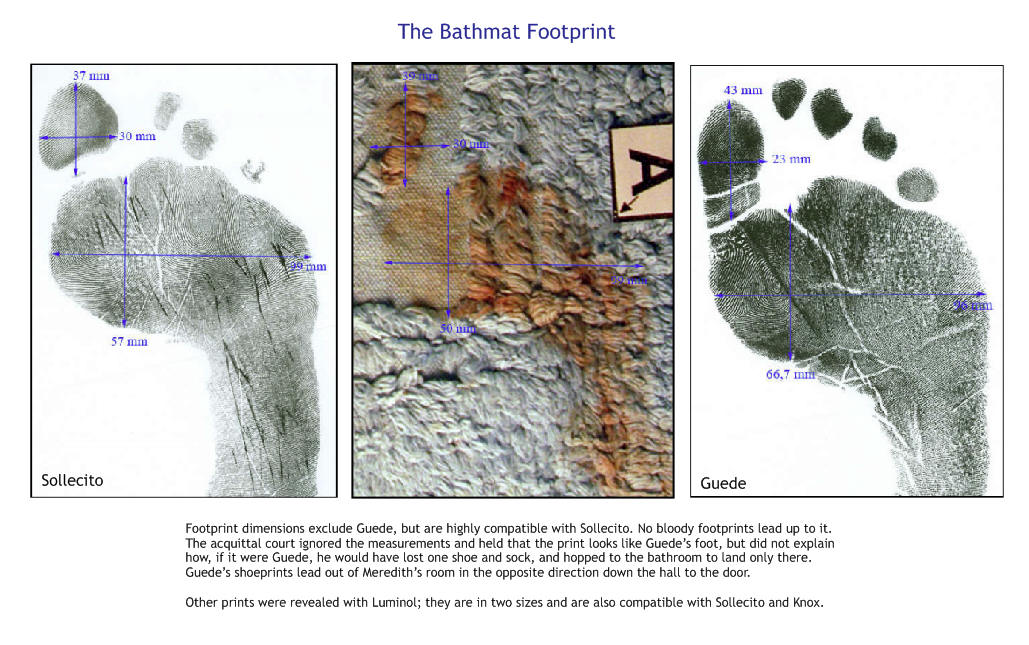
Note missing 2nd toe-print on Sollecito’s Right Footprint:

The Hellmann-Annulling SCC Panel Page 96-98:
“13 ““ Analysis of footprints and other traces
The criticisms expressed on the subject of the obvious lack of logic of the reasoning Oconcerning the evaluation of the genetic evidence are well”founded.
The [appeal] court evaluated two technical consultancies on the footprint in the victim’s blood left by a bare foot on the bathmat of the small bathroom of the flat where the crime was committed, with [identification] capacity limited to negative comparisons. As a matter of evaluation, this in itself is not subject to censure, however the court of second degree has again fallen into [the error of making] a statement in open contradiction with the available evidence, ending by attributing the contested footprint to Guede, by making an assumption contrary to all the evidence that “after having left a print on the pillow”, he slipped out of his right shoe “in the course of the violent aggressive manoeuvres to which he subjected Ms Kercher” and stained his foot with blood, which he supposedly then washed in the small bathroom, since if it had not happened this way, his right shoe would have also left some bloody traces in the corridor (compare page 100 of the statement of reasons).Not only is this assumption deeply implausible, considering that the print left by Guede on the pillow was made by his hand, which is easily explained by the dynamics of the event, but it is much harder to explain how he might have lost his Adidas sneaker, given a situation in which Guede, jointly with others, as stated in the verdict that convicted him, overpowered the young Englishwoman so as to immobilise her. Not only that, but the above assumption also clashes with the available evidence regarding the bloody shoe prints which indicate that he left the room where the crime was committed to proceed directly to the exit door of the flat.The fact that only the left shoe was stained does not that his right foot was unshod, since at most it proves that only his right (sic) shoe signify stepped in the pool of blood which formed due to the numerous wounds inflicted on the unfortunate victim, very probably with two knives.
Just as deficient is the logic adopted in a further step of the statement of reasons, relating to the discovery of the presence of traces revealed by luminol (not visible to the naked eye), which yielded Knox’s profile and the mixed profiles of Knox and Kercher, found in Romanelliʹs room, in Knoxʹs room and in the corridor. These traces could not be attributedto footprints left on other occasions, as the appeal court implausibly accepted [them to be], since luminol reveals traces of blood and it is not really conceivable that Knoxʹs feet might have been stained with Kercherʹs blood on some other occasion.As pointed out by the party submitting the appeal, no justification is given for the coincidence of the presence of Knoxʹs DNA in every trace mixed with the blood of the victim, whereas [71] the hypothesis formulated by the judgment of first degree is much more plausible: it emphasized the mixed nature of the traces (including those found in the small bathroom) which, via adequate inductive logic, led to the conclusion that with feet washed of the victimʹs blood but still bearing some residue, Knox went into her own room and Romanelliʹs room passing through the corridor during the staging operation as assumed in the initial reconstruction, which is based on the objective fact that only after midnight did the victim’s telephones stop connecting to the cell tower of via della Pergola and connect instead with the one on via Sperandio, where they were eventually found; this meant that only after midnight were they removed by unknown hands from the flat in via della Pergola.
While according to the prosecution’s hypothesis, the mixed traces found in the small bathroom suggested a cleaning activity by Knox, who transferred the victim’s blood from the crime room to various points in the small bathroom (on the sink faucet, on the cotton swabs box, the toilet seat, the bidet, the light switch, the bathroom door) where the traces were collected, the Hellmann Court of Appeal entrenched itself behind a position of absolute certainty, without acknowledging what the First Instance Court had observed in disagreement with the defence arguments espoused by the Hellmann Court of Appeal, which decided, in essence, that if the two defendants had remained in the flat of via della Pergola to clean themselves up from the victim’s blood traces, thus functioning as vehicles carrying blood to the small bathroom, then some trace of Sollecito would have been found, whereas in response to this objection the First Instance Court plausibly noted that Sollecito could have washed himself in the shower stall with an abundance of water, so as to eliminate traces, perhaps without even any rubbing, leaving to Knox the task of cleaning the sink and bidet with the traces of the victim’s blood.
The alternative explanation offered in the first instance judgment to the Defence’s objections was not taken into consideration, and thus the Hellmann Court of Appeal fell into another error of reasoning, having neglected various circumstances which, in the course of their analysis, they should have examined and if necessary refuted with more weighty arguments. As pointed out by the party submitting the appeal, no justification is given for the coincidence of the presence of Knoxʹs DNA in every trace mixed with the blood of the victim, whereas [71] the hypothesis formulated by the judgment of first degree is much more plausible:
It emphasized the mixed nature of the traces (including those found in the small bathroom) which, via adequate inductive logic, led to the conclusion that with feet washed of the victimʹs blood but still bearing some residue, Knox went into her own room and Romanelliʹs room passing through the corridor during the staging operation as assumed in the initial reconstruction, which is based on the objective fact that only after midnight did the victim’s telephones stop connecting to the cell tower of via della Pergola and connect instead with the one on via Sperandio, where they were eventually found; this meant that only after midnight were they removed by unknown hands from the flat in via della Pergola.
While according to the prosecution’s hypothesis, the mixed traces found in the small bathroom suggested a cleaning activity by Knox, who transferred the victim’s blood from the crime room to various points in the small bathroom (on the sink faucet, on the cotton swabs box, the toilet seat, the bidet, the light switch, the bathroom door) where the traces were collected, the Hellmann Court of Appeal entrenched itself behind a position of absolute certainty, without acknowledging what the First Instance Court had observed in disagreement with the defence arguments espoused by the Hellmann Court of Appeal, which decided, in essence, that if the two defendants had remained in the flat of via della Pergola to clean themselves up from the victim’s blood traces, thus functioning as vehicles carrying blood to the small bathroom, then some trace of Sollecito would have been found,
Whereas in response to this objection the First Instance Court plausibly noted that Sollecito could have washed himself in the shower stall with an abundance of water, so as to eliminate traces, perhaps without even any rubbing, leaving to Knox the task of cleaning the sink and bidet with the in the moments immediately after the murdertraces of the victim’s blood.The alternative explanation offered in the first instance judgment to the Defence’s objections was not taken into consideration, and thus the Hellmann Court of Appeal fell into another error of reasoning, having neglected various circumstances which, in the course of their analysis, they should have examined and if necessary refuted with more weighty arguments.”
Hellmann’s Annulment is here not only fully justified, but is essential to avoid a gross miscarriage of justice.
Nencini Pages 328-329 :
“We know with certainty that, on the evening of 1 November 2007, Rudy Hermann Guede was present inside the Via della Pergola cottage, not only because he said so and it is reported in thefinal verdict that convicted him, but also on the basis of investigations and analyses carried out by the State Police inside the cottage contained in the case file. We also know with certainty that Rudy Hermann Guede could remain inside [312] the flat with absolute ease… [for] considerable time, as he left his “traces” in the large bathroom [of the flat].
We know with certainty, as this is shown by the evidence, that immediately after the homicide inside the Via della Pergola cottage three people were present, surely two men and a woman. This can be observed from the genetic investigations and the results of the traces highlighted using luminol. We can also say that one of the men who walked over Meredith’s blood left a very visible trace of his foot on a blue bathmat found inside the small bathroom of the flat. This footprint was attributed by investigators to the right bare foot of Raffaele Sollecito, with an analysis this Court finds correct on the basis of the considerations already made. One of the footprints detected using luminol was then attributed to a woman’s foot compatible, in size, to that of Amanda Marie Knox; in addition, mixed DNA traces found in the small bathroom of the flat (washbasin, bidet and cotton-swab box) were attributed to Amanda Marie Knox.
We have, in substance, pieces of circumstantial evidence of certain reliability, multiple and concordant, that place Rudy Hermann Guede, Amanda Marie Knox, and Raffaele Sollecito inside the Via della Pergola flat on the evening of the murder of Meredith Kercher, in the moments immediately after the murder, when the three left traces of their passage by depositing [marks in] the victim’s blood, abundantly released from wounds.”
Emphasizing the Certainty of its knowledge regarding “traces”, blood, luminol, genetic investigations, DNA, and footprints, Nencini rules Guede, Knox, and Sollecito to have been at the crime-scene “in the moments immediately after the murder” of Meredith Kercher.
4. Other Worries For Judge Marasca
However far-fetched the Motivazione of this SCC Panel turns-out to be, it can hardly have-been unaware of the facts that Sollecito is scheduled to be back in a Lower-Court in Florence on 30th April, 2015, facing his first-set of charges in the Sollecito & Gumbel trial for diffamazione and vilipendio (slander of officials and of the system), nor that Knox is scheduled to be back in a Lower-Court in Florence on 9th June, 2015, facing her new, expanded-set of Calunnia charges.
This series continues here.
Posted by Cardiol MD on 04/30/15 at 07:38 PM •
Permalink for this post •
Archived in Defendants in court, Amanda Knox, Raff Sollecito, Evidence & Witnesses, Various timelines, Real locations, Real crimescene, Other witnesses, Cassation critiques, Cardiol critique •
Comments here (32)
Saturday, April 11, 2015
Those Pesky Certainties Cassation’s Fifth Chambers May Or May Not Convincingly Contend With #1
Posted by Cardiol MD

The Italian Supreme Court is in the background
1. How Overload Can Overwhelm The Checks And Balances
The Italian Supreme Court (SCC) has 396 Judges in Rome and elsewhere.
Because of the enormous pro-defendant tilt in the system, the SCC hears about 80,000 appeals a year - more than all other Supreme Courts in the rest of Europe combined.
The SCC operates in panels, typically of 5 justices; that scales to about 4 appeals/panel/workweek, or about 1 appeal/panel/workday. A huge workload impinging on carefulness and promoting distraction and exhaustion.
Even with a law-clerk infrastructure, and the most ingenious exploitation of human concentrated-attention-span, highly questionable outcomes such as that for Meredith’s case would seem inevitable.
The four SCC judges panels (2008, 2010, 2013, 2015) which have ruled on various issues arising as Meredith’s murder case inched its way through the Italian legal system have been composed of different judge-combinations, with different skills, different knowledge, different education, and different experiences.
In many cases high-tech issues are an integral part of the evidence before the courts. This requires the enlistment of expert opinions because the judges may not be versant in the relevant high-tech issues. All sides, the defence, the prosecution, other interested parties, and even the judges, can cherry-pick experts for hire, who often use brazen sophistry to persuade the judges in the experts’ favour.
These facts may help to explain if not justify the unexpected conclusion of this current SCC judges panel which is now drafting the Motivazione.
2. Circumstantial Evidence And The Italian Requirement For Certainty
Near the start of the 2015 SCC hearings Judge Bruno, one of the 5 members of the Marasca SCC-Panel, was quoted as having said that the trials had “not many certainties beyond the girl’s death and one definitely convicted.”
As we await this particular Motivazione intended to explain its decision, we will review the Massei Motivazione, the Nencini Motivazione, and the several past SCC rulings to establish what do constitute the certainties - of which in fact as Italian law defines them there is actually a large number.
In order to be classified as Circumstantial Evidence in Italian Law an evidentiary circumstance or fact must be true to the level of being a certainty. Note that this rule does not supersede BARD, it applies only to the the acceptance of individual items of evidence as circumstantial, so it can mislead and confuse authors and readers.
As will be noted below, under this Italian requirement the unverifiable RS/AK broken water-pipe story can not be classified as pro-defense Circumstantial Evidence. Therefore it cannot legally be argued as corroboration of the excuses of Knox & Sollecito, including their mop claims.
Sollecito’s father, Dr. Francesco Sollecito, did say that RS had mentioned the alleged-leak of Nov. 1st, 2007, in the father’s 221 seconds, 20:42:56 call of Nov.1st, 2007. Hellmann/Zanetti bought into this story, discussing it in their Motivazione.
AK is quoted by Nencini as referring to the alleged-leak in her testimony, but neither Galati nor the 2013 Hellmann/Zanetti-annulling SCC panel mentioned the alleged-leak. All seemed aware that there was no certainty.
3. An Explanation Of Why This Will Matter So Much In Future
In 2013 the SCC itself annulled most of the Hellmann-Zanetti verdict in part because there was an obvious parceling-out of the pieces of circumstantial evidence and a lack of assessment of each piece of circumstantial evidence. Hellmann-Zanetti had failed to check whether the possible flaws and lacks in the logical value of each single piece of evidence could be resolved by cross-checking them and taking in account the whole.
Have the SCC judges themselves now made this same mistake? It is especially at this level that informed legal analysis in Italy of the pending SCC Motivazione will concentrate, future books on the case will concentrate, and the final degree of legitimacy will be established.
Given the peculiarity that the case was not referred back down to Florence for adjustment, worries at this level especially could be driving the very obvious nervousness of all of the defense counsels, shushing and restraining their clients in the presumed hope that the SCC judges really can square the circle and achieve legitimacy.
4. Certainties And Certainly-Nots In The Circumstantial Evidence
1. Fracture Of Hyoid Bone?
The SCC-Panel for Guede’s Sentencing (English Translation) wrote on Pages 4-5:
c) The body presented a very large number of bruising and superficial wounds ““ around 43 counting those caused by her falling ““ some due to a pointed and cutting weapon, others to strong pressure: on the limbs, the mouth, the nose, the left cheek, and some superficial grazing on the lower neck, a wound on the left hand, several superficial knife wounds or defence wounds on the palm and thumb of the right hand, bruises on the right elbow and forearm, ecchymosis on the lower limbs, on the front and inside of the left thigh, on the middle part of the right leg, and a deep knife wound which completely cut through the upper right thyroid artery fracturing the hyoid bone, a wound which caused a great deal of bleeding from the vessels of both lungs.
This caused a haemorrhagic shock and asphyxiation by the presence of blood in the respiratory passages, an exitus [decease] placed at around 23:00 of Nov. 1 by the forensic pathologist.
The emphases are mine. The knife cut through the hyoid bone rather than fractured it (in the English version it should say that it severed the hyoid bone; this is a translation issue). A Certainly-Not then.
The wound certainly did not cause any bleeding at all from the vessels of either lung; this is not a translation issue. This is a factual error in the original Italian Sentencing Report. A Certainly-Not then.
(This shows how the SCC-Panel Reports are not infallible. Unfortunately the Marasca Panel will have to dredge-up some past, fallible SCC-Panel Reports in order to explain its own reasoning.)
2. Two Knives?
Massei Translation p377: “There must necessarily have been [405] two knives at the scene of the crime.”
Certainly! There were 2 major, penetrating knife-wounds into Meredith’s neck; one entering on the left-side, and one entering on the right-side, which was made by a pocket-knife of the size Sollecito customarily carried. The latter wound could not have been made by whatever knife entered on the left-side. Therefore 2 knives were Certainly used.
3. Single Blow?
Massei Translation p 371 “”¦a single blow was apparently halted by the jawbone”¦”
Certainly Not.
The statement that a blow could be “apparently halted” by Meredith’s jawbone is at best a figure of speech, and the quotes of Prof Cingolani on page 152 of the Massei Translation clearly indicate that any cause and effect inference from the phrase “apparently halted”, “did not”¦. have elements of certainty to establish” it was “stopped by the jawbone.” Prof Cingolani “did not, however, have elements of certainty to establish that the blade which had caused the wound 4 centimetres deep had stopped at the said depth because [it was] stopped by the jawbone.”
Maybe there is a Judicial, translational, or typographical glitch and “by” the jawbone should have been “near” the jawbone. Skin is soft and bone is harder but there is no way that the knife striking the jawbone or hyoid bone would halt the knife in this case, they would just roll with the blow, depending on the angle of attack.
Furthermore, contact between the knife and jawbone or hyoid bone would not mark the knife because living-bone is softer than the knife. When your pet gnaws on a non-living cow-bone, neither the bone nor your pet’s teeth can bend; both your pet’s teeth and the bone can be broken, and the bone gets scratches on it because it is still softer than the teeth, but your pet’s teeth do not get scratches on them, because they are harder even than the non-living bone.
If someone is stabbed in the back with a kitchen carving knife, penetrating ribs on its way to the heart, the knife may have no scratches at all, nor show any signs of damage caused by that action. Any implication in the statement quoted above that stabbing Meredith’s neck with enough force to penetrate the layers of her neck and then strike bone would have the effect of signs of damage to the knife-blade, is a mistaken implication.
It is an old rule of materials-physics that a softer substance cannot mark a harder substance. [To some people this may be counter to their intuition, so I have passed it by an eminent MIT physicist, and he agrees with me that the knife blade would certainly not show signs of damage caused by the stabbing in this case.]
4. SMS Message?
It is Certain that at 20:18:12 on Nov.1st, 2007 Amanda Knox’s mobile-phone received the SMS sent to her by Patrick Lumumba, which let her off from having to go to work at the “šLe Chic? pub on the evening of 1 November.
Remember that mobile-phones are equivalent to convicts’ ankle-monitor bracelets, their use creates with Certainty a record of the Times of cell-phone activities, the Location of the corresponding transmitter-cell, and hence the general location of the mobile-phone, especially Ruling-Out particular Locations e.g. Proving whether the carrier of the phone was in or out of the range of their home transmitter-cell. Call Verbal-Content is not publicly available.
Here the mobile-phone Record proves that Knox’s mobile-phone was Certainly-Not in Sollecito’s lodging-house at 20:18:12 on Nov.1st, 2007:
At the time of reception, Knox’s phone connected to the cell on Via dell’Aquila 5-Torre dell’Acquedotto sector 3, whose signal does not reach Raffaele Sollecito’s house. Amanda Knox’s mobile phone, and therefore Knox herself, was therefore far [i.e. absent] from Corso Garibaldi 30 when the SMS reached her, as she was walking in an area which was shown to be served by the Via dell’Aquila 5-Torre dell’Acquedotto sector 3 cell.
This point of her route could correspond to Via U. Rocchi, to Piazza Cavallotti, to Piazza IV Novembre, bearing in mind that Lumumba’s pub is located in Via Alessi, and that Amanda Knox would have had to travel along the above-mentioned roads and the piazza in order to reach the pub.
Knox was therefore Certainly Not at Sollecito’s Corso Garibaldi Lodging at that time, contrary to the allegation that she was, and Knox Certainly-Could have been at her Cottage.
5. SMS Reply?
At 20.35.48 on Nov.1st, 2007, Amanda Knox Certainly sent an SMS in reply to Patrick, at No. 338-7195723; the message was sent when her on Nov.1st, 2007 mobile phone was in Corso Garibaldi 30 or in the immediate neighbourhood. The cell used, in fact, was that of Via Berardi sector 7 - no other [use] was shown for the day of 1.11.07, noting that Amanda declared during hearings that she had switched her mobile phone off once she had returned 323 to Raffaele’s house, claiming she was more than happy she did not have to go to work and could spend the evening with her boyfriend.
(Knox may also have been LESS than happy that Lumumba preferred Meredith instead of Knox as an employee. This was perhaps humiliating enough to Knox for Knox to decide that the time to cut Meredith down-to-size was now.)
6. Bomb Threat?
Massei Translation page 25: On “the evening of November 1, 2007 at around 10:00 pm, someone called and warned Elisabetta Lana not to use the toilet of her dwelling because it contained a bomb which could explode. Mrs. Lana immediately notified the police of this phone call; and they came to the house but did not find anything….”
This call was Certainly received, the Police Certainly came to Mrs. Lana’s home, presumably not long after 10: pm on the evening of November 1, 2007 (Time & Duration of Police presence apparently not publicly-available).
The Courts must know those times accurately and precisely; reasonably assuming them to be after Meredith’s murder, and near the time of the Phone-Dump (Otherwise, the necessary combination of coincidences is too implausible).
It is most likely that the visible, and possibly audible, presence of Police triggered the panicked disposal of the Cell-Phones down the steep slope that falls sharply into the valley below.
There is no need to invoke any awareness by the phone-dumper[s] of the reason(the hoax-call) that the Police were near Mrs. Lana’s residence.
So if the killers saw flashing police-lights, or any other sign of police near Mrs. Lana’s place, that sign could be enough to explain panic phone-dumping - then and there (not considering whether the phones were switched-on or switched-off).
According to John Follain the slope is heavily overgrown with trees and bushes, an ideal place to dispose of evidence. If the phones had fallen just a few yards further, they would certainly have gone over the edge of the cliff, down into a 50m gully, straight into a thick scrub of nettles, and probably been lost forever”¦.
7. Phone Dialings?
There were four dialings on Meredith’s mobile phones after her arrival home on the evening of 1 November ‘07:
i. 20:56 hours on 1 November 07, attempted call to Meredith’s mother’s home in England.
ii. 21:58 hours on 1 November 07, attempted call to mobile phone’s answering service, voicemail “˜901’.
iii. 22:00 hours on 1 November 07, dial to Meredith’s London bank “˜ABBEY’.
iv. 22:13:29 hours (9 seconds) on 1 November 07, attempted internet connection. Connection consistent with being attempted from cottage, but inconsistent with being attempted from Mrs.Lana’s.
These dialings are Certain with regard to Existence, Timings, and Location.
Massei Translation, page 331, attributes the above 4 dialings to Meredith absent-mindedly playing with the mobile phone in her hand, and her phone may well have still been in her hand when her attackers surprised her.
8. Phone Location?
Was Meredith’s Phone still in the cottage at Via della Pergola at 22:13:29 hours on 1 November 07? Yes. Certainly.
9. A Tow Truck?
At about 22:30 hours Car broken-down nearby. Tow-Truck called-for.
At about 23:00 hours Tow-Truck arrives to load car.
At about 23:13 hours Tow-Truck leaves with loaded car.
These events Certainly occurred, but those times are approximate.
10. Francesco Called?
@23:41:11 RS’s father attempts phone-call but makes no oral contact. Father leaves message which is not received until 06:02:59 on 2.11.07.
This 23:41:11 call was attempted during the very time-frame of the attack on Meredith, her murder, and the flight of her killers with her mobile telephones. Meredith’s Phone[s] were removed from her cottage by about Midnight, less than 20 minutes after this attempted call.
These phone calls are Certain wrt Existence, Timings, and Locations.
11. Phone Location?
For 2.11.07 the first record is that of MKP - [0]0:10: 31, (i.e. Very early in the a.m. 10 minutes and 31 seconds after midnight) “when it has been established as an incontrovertible fact that Meredith’s English mobile phone was no longer in Via della Pergola, the mobile phone having received the contact under the coverage from Wind signal [cell] ..25622, which is incompatible with the cottage.”
Was Meredith’s Phone still in the cottage at Via della Pergola at 00:10: 31, 2.11.07? No!
Therefore Meredith’s English mobile phone had been removed from her cottage between 10.13.39 p.m. on 1.11.07 (more likely about 11.13 p.m. when tow-truck departed) and 0:10:31 on 2:11:07; about 10 ½ minutes after midnight ““ say Meredith’s Phone[s] Removed By About Midnight, allowing for the time-elapse before being dumped near Mrs. Lana’s place. (Hellmann falsified this time-span on page 14 of his report, stating it to be more than 10 hours after midnight rather than about 10 ½ minutes after midnight.)
12. Phones Stolen?
At some time before Meredith’s attackers fled, they had seized her mobile telephones, probably near the beginning of the attack, having started their attack with a pre-emptive strike to intimidate Meredith, remove all hope, surround her, display knives, seal all possible escape-routes, and remove any possibility of phone-calling for help.
Immediately after Meredith’s scream her attackers had silenced her with the fatal stabbing, and then fled immediately.
They fled with her already-seized but still switched-on mobile telephones, probably without locking anything, including Meredith’s door.
Their over-riding and 1st imperative was not-to-be-caught-at-the-crime-scene.
See item 6. above.
13. Crimescene Meddling?
Having accomplished the Phone-Dump, Meredith’s killers next re-model the crime-scene, minimising the evidences of their identities, cleaning-up the evidences that it was “˜an inside job’, and simulating the appearances that it was “˜an outside job’.
One should bear in mind that these killers should have still been overwhelmed by their having actually committed a crime beyond their wildest imaginings.
Their panic impaired their thinking, and their ignorance, immaturity, inexperience, lack of technical resources and their arrogance precluded their selecting deceptions more effective against knowledgeable, experienced professional crime-investigators with a large fund of resources. They probably think that throwing the stone from inside Filomena’s room was a brilliant deception.
They wish it had never happened.
They wish they could make it unhappen (Hellmann/Zanetti got close to fulfilling this wish, but got themselves unhappened by Cassation)
They wish they could prevent the discovery of Meredith’s murder.
They cannot prevent the discovery of Meredith’s murder.
They may be able to postpone its discovery, but not longer than the inevitable return of the cottage-mates, later that day.
They believe that the person who “˜discovers’ a murder may become 1st-suspect.
They may be able to manouevre others-than-themselves into being the ones that make the discovery ““ quite a wily aim.
It is beyond reasonable doubt that:
Meredith’s killers seized her mobile telephones, and that
Her killers did not switch-off these mobile telephones, and that.
Her killers threw the telephones into an apparent ravine, landing in Mrs.Lana’s garden, and that
This phone-dump was accomplished before 00:10: 31, 2.11.07, and that
Amanda Knox caused:
- i. the English phone to ring at 12:07:12 (16 seconds) and be discovered by Mrs.Lana’s daughter only because it rang , and
ii. the other phone, registered to Filomena Romanelli, to ring, very briefly, at 12:11:02 (3 seconds) and,
iii. the English phone to ring again, also very briefly, at 12:11:54 (4 seconds), after being brought into Mrs.Lana’s house. 6. Sollecito had more than 5 days, from about 11.30 pm on November 1st, 2007 until November 6, 2007, to remove from the killing-knife the traces of Meredith’s DNA.
In the opinion of the Court of Assizes (Massei Translation p.325), Amanda Knox’s call to Meredith’s phone was
...the first indispensible step before putting the [348] planned staging into action. The lack of a reply, since the poor girl was obviously already dead, gave a reason for reassurance about the fact that the young woman’s phone had not somehow been retrieved, [and] was therefore safe in the spot where it had been thrown, which, according to the expectations [in the minds] of the murderers was a precipice or some other inaccessible spot, rather than in the garden of a villa located barely outside the city, where the vegetation concealed it from view.
Knox may well have expected that she was safe from phone-discovery, but these calls turned out to be the very instrument of a phone-discovery.
Had Knox not made these obfuscatory stabs, in the time-frame she made them Meredith’s phone would not have rung when it did ring and would therefore not have been discovered by Mrs. Lana’s daughter when she did discover it.
14. Phone Switched On?
For the day of 2.11.07, when Meredith was already dead, the traffic registered for the Vodafone number was shown to be the following:
00:10:31; duration and caller unspecified, but Wind signal [cell] incompatible with cottage, but compatible with Mrs. Lana’s place.
Therefore, Meredith’s mobile cell-phone had already been taken away from the cottage by her killers. It is not possible to determine from this phone-record whether the phone was switched on or off, but this phone was discovered at Mrs. Lana’s place because it was ringing, and therefore was “on”.
12:11:02 (duration of 3 seconds): Knox’s phone call reached the phone and was diverted to the answering service. The Vodafone cell used by Meredith’s service provider was situated in Strada Vicinale S. Maria della Collina sector 1.
12:11:54 (4 seconds): another call is made by Knox’s phone towards Meredith’s English mobile phone number (the cell used is the one in Via dell’Aquila 5-Torre dell’Acquedotto sector 3, thus compatible with Sollecito’s house)
Three more phone-calls Certain wrt Existence, Timings, and Locations.
15. Francesco SMS Received?
At 06:02:59 Raffaele Sollecito received the SMS from his father allegedly wishing Raffaelle a good night; from the evidence of the mobile phone record printouts of Dr. Francesco Sollecito, it was shown that the sending of the message occurred at, as has been said, 23:41:11 of 1.11.07. This was the last SMS sent from that mobile phone during the whole day of 1.11.07
3+ Hours after receiving his father’s message from 23:41:11 of 1.11.07:
At 09:24 Raffaele Sollecito received a phone call from his father lasting 248 seconds]
At this time RS’s consiousness would be dominated by his guilty knowledge, and probably far-advanced in the accomplishment of the 3rd imperative.
Did RS and father spend 4+ minutes discussing the weather?
This is the first father/son opportunity to formulate the two-pronged water-leak story.
Although AK had already been to the hardware store 2 hours before, they may well not have known the potential DNA problems with the knife, the need to scrub it vigorously, to clean-out, and repair the drain-pipes under the sink, and the need to return the knife to RS’s kitchen drawer.
As it turned-out, Sollecito had more than 5 days, from about 11.30 pm on November 1st, 2007 until November 6, 2007, to remove from the killing-knife the traces of Meredith’s DNA.
They probably did not know that incriminating stains could be invisible, but can be revealed by Luminol.
16. Francesco Calls Received?
At 09:29 another call was received lasting 38 seconds
At 09:30 (duration unspecified?) the father called Raffaele; the call connected to the Vial Belardi sector 7 cell.(the best server cell for Corso Garibaldi 30).]
These two calls, Certain wrt Existence, Timings, and Locations, were probably spent dotting “˜i’s, crossing “˜t’s, and exchanging options, such as enlisting sister Vanessa’s skills and contacts.
17. More Calls Later?
Another 2+ Hours later:
At 12:07:12 (duration of 16 seconds) Amanda calls the English phone number 00447841131571belonging to Meredith Kercher. The mobile phone connects to the cell at [346] Via dell’Aquila 5-Torre dell’Acquedotto sector 9 (the signal from this cell is picked up at Sollecito’s house)
At 12.08.44 (lasted 68 seconds) Amanda calls Romanelli Filomena on number 347-1073006; the mobile phone connects to the Via dell’Aquila 5-Torre dell’Acquedotto sector 3 cell (which covers Sollecito’s house)
Discovery will be inevitable when Filomena eventually arrives-back at the cottage.
AK/RS have accepted that they have to “˜stand-pat’ with their efforts so-far to accomplish not-to-be-the-“discoverers”-of-Meredith’s-body.
Amanda did not say a word in this phone-call to Filomena about Amanda’s phone call to Meredith, thereby withholding information that should have led Amanda to initiate discovery of Meredith’s body, and help Amanda to manouevre someone other than Amanda into being the one who “˜discovers’ Meredith’s body.
At 12:11:02 (3 seconds) the Vodafone number 348-4673711 belonging to Meredith (this is the one [i.e. SIM card] registered to Romanelli Filomena) is called and its answering service is activated (cell used: Via dell’Aquila 5-Torre dell’Acquedotto sector3)
18. Yet More Calls?
For the day of 2.11.07, when Meredith was already dead, the traffic registered for the Vodafone number was shown to be the following 5 calls, Certain wrt Existence, Timings, and Locations:
- i. 12:11:02 (duration of 3 seconds): Amanda’s phone call reached the phone and was diverted to the answering service. The Vodafone cell used by Meredith’s service provider was situated in Strada Vicinale S. Maria della Collina sector 1.
ii. 12:11:54 (4 seconds): another call is made towards Meredith’s English mobile phone number (the cell used is the one in Via dell’Aquila 5-Torre dell’Acquedotto sector 3, thus compatible with Sollecito’s house)
iii. 12:12:35 (lasting 36 seconds) Romanelli Filomena calls Amanda Knox (No. 348-4673590); Amanda receives the call connecting to the cell on Via dell’Aquila 5-Torre dell’Acquedotto sector 3 (still at Raffaele’s house)
iv. 12:20:44 (lasting 65 seconds) Romanelli F. calls Amanda, who receives the call connecting to the cell in Via dell’Aquila 5-Torre dell’Acquedotto sector 9 (good for Corso Garibaldi 30)
v. 12:34:56 (48 seconds): Filomena calls Amanda who receives it from the cottage on Via della Pergola 7 (the cell used is that on Piazza Lupattelli sector 7. As mentioned, Raffaele also used the same cell when he called the service centre at 12:35 hours to recharge [the credit of] his mobile phone)
19. RS Phone Location?
At 12:35: Raffaele’s mobile phone contacted a service centre for a phone [credit] recharge (the cell used was that of Piazza Lupattelli sector 7, which gives coverage to the little house on Via della Pergola 7. The signal in question does not reach Corso Garibaldi 30, which instead is served by the signal from Piazza Lupattelli sector 8)
At 12:38: Vodafone sent R.Sollecito a message of confirmation of phone [credit] recharge (Piazza Lupattelli sector 7 cell, good for Via della Pergola 7)
At 12:40: incoming call from RS’s father’s mobile phone (lasting 67 seconds; connection through Piazza Lupattelli sector 7 cell, compatible with the Sollecito’s presence near the little house)]
At 12:47:23 (duration of 88 seconds): Amanda calls the American (USA) number 00120069326457, using the cell on Piazza Lupatetlli sector 7; the phone call takes place prior to the one which, at 12.51.40, Raffaele Sollecito will make to “š112?, connecting to the cell on Via dell’Aquila 5-Torre dell’Acquedotto sector 1, which gives coverage to Via della Pergola 7]
In “Waiting To Be Heard” Knox can hardly deny having made this 1st call, acknowledges making the call, and purports, now, to recall its substance, providing the reader with her version of what was said.
At 13:24:18 (duration of 162 seconds): Amanda calls the same American number which corresponds to the home of her mother, Mrs Edda Mellas, using the same cell. It is obvious that the young woman is inside the cottage, where by this point, several minutes earlier, the Postal Police had shown up, [347] represented by Inspector Battistelli and Assistant Marzi, who were engaged in the task of tracking down Filomena Romanelli, who was the owner of the Vodafone phonecard contained in the mobile phone found earlier in the garden of the villa on Via Sperandio]
In “Waiting To Be Heard” Knox can hardly deny having made this 2nd call either, she acknowledges making the call, and provides the reader with her current version of what was said.
20. More Phone Locations?
At 12:50:34 outgoing call directed at mobile phone 347-1323774 belonging to Vanessa Sollecito, sister of the defendant; duration 39 seconds. Connection to Piazza Lupattelli sector 7 cell 320
At 12:51:40 Raffaele Sollecito called “š112? to inform the Carabinieri of the presumed theft in Romanelli’s room (duration 169 seconds; connection to Via dell’Aquila 5-Torre dell’Acquedotto sector 1 cell, which covers Via della Pergola 7)
At 12:54: a second call by Raffaele to “š112? (57 sec.; connection to Piazza Lupattelli sector 7 cell)
Three more Sollecito calls Certain wrt Existence, Timings, and Locations.
21. More Phone Locations?
At 13:17:10 (lasting 1 second) to Meredith’s phone: the cell used was located in the same place, sector 7
At 13:27:32 (duration of 26 seconds): Amanda calls the American number 0012069319350, still using the cell at Piazza Lupattelli sector 7.
At 13:29:00 (duration of 296 seconds) Amanda receives [a call] from No. 075/54247561 (Piazza Lupattelli sector 7 cell)
Three more Knox calls Certain wrt Existence, Timings, and Locations.
22. Another Phone Location?
At 13:40:12: incoming call from his father to RS (94 sec.; Via dell’Aquila 5-Torre dell’Acquedotto sector 1 cell)
Another Sollecito call Certain wrt Existence, Timings, and Locations.
23. More Knox Calls?
At 13:48:33 (1 second): this is an attempted call to AK’s mother’s number
At 13:58:33 (1 second): this is an attempted call to her mother’s number
The above item is a faithful translation from the Massei Motivazione section on Amanda Knox’s mobile phone traffic, but is listed out-of-time-sequence; the assigned-time is probably a “˜typo’ ““ “13:48:33” is much more likely correct.
Two more Knox calls Certain wrt Existence, Timings, and Locations.
24. Francesco Call?
14:33: Sollecito’s father called Sollecito for 21 seconds (as above)]
Do RS and father exchange more caveats in their call Certain wrt Existence, Timings, and Locations?
25. More Knox Locations?
At 14:46:14 (102 seconds) Amanda receives a call from the German number 494154794034, most likely belonging to her aunt Doroty Craft
Call to Meredith’s phone at 15:13:43 (5 seconds) cell not indicated.
At 15:31:51 (1 second): Knox receives an SMS sent from the number 389/1531078; at this point the cell being used is the one on Via Cappuccinelli 5/A sector 2, where the Questura [police headquarters] is located.
Two more Knox-related calls Certain wrt Existence, Timings, and Locations.
In the hours that followed the [mobile phone record] printouts show that the answering service of Amanda’s number 348-4673590 was activated due to a lack of signal coverage.
Massei Translation p.324:
Finally, the analyses of the [phone record] printouts highlight that the first phone call made by Amanda on the day of 2 November was to Meredith Kercher’s English number.
The American student called her English flatmate even before contacting Romanelli Filomena to whom she intended to express, as she testified in court, her fears about the strange things she had seen in the cottage, which she had returned to at about 11 o’clock in order to shower in preparation for the excursion to Gubbio which she and Raffaele had planned.
It is strange that Amanda did not say a word to Filomena about the phone call to their flatmate, when the call, not having been answered, would normally have caused anxiety and posed some questions as to why Meredith did not answer the phone at such an advanced hour of the day.
26. Sollecito Locations?
At 17:01: RS’s father called RS for 164 seconds; cell used is that of Via Cappucinelli 5/A sector 2, corresponding to the location of the Perugia Police Station
At 17:42: RS’s father called RS for 97 seconds (as above).
With regard to Raffaele Sollecito’s landline home phone (No. 075-9660789)
The above 2 calls presumably covered final agreements on the Father/son stories.
For the entire day of 1 November and then of 2 November, Raffaele Sollecito’s fixed line was not affected by any calls, either incoming or outgoing.
This series continues here.
Posted by Cardiol MD on 04/11/15 at 04:49 AM •
Permalink for this post •
Archived in The officially involved, Supreme Court, Evidence & Witnesses, Various timelines, Real locations, The two knives, Cellphone activity, Other physical, Trials 2008 & 2009, Massei prosecution, Appeals 2009-2015, Cassation 2015, Cassation critiques, Cardiol critique, Hoaxes Knox & team, 15 Single alibi hoax, Hoaxes Sollecito etc, 27 Single alibi hoax •
Comments here (26)
Monday, March 09, 2015
The Meredith Case Wiki Now Has The Key Sollecito Statement 6 Nov 2007 In Full
Posted by Our Main Posters
Perugia’s central police station where Sollecito made the statement posted here
The ever-expanding Wiki can of course be found here.
A post follows soon with guidance to the numerous new documents it contains. This was an extremely well documented case with discussions carefully recorded and decisions explained every step of the way.
We have frequently noted for example that RS and AK were provided with an extraordinary total of SIX opportunities in 2007 and 2008 to head off a trial and to be released.
Each opportunity is very well documented (Matteini hearings, Ricciarelli hearings, Mignini hearings, Supreme Court rulings, and the two Micheli rulings) and the transcripts and reports make very clear why RS and AK failed each time.
Not one of those transcripts or rulings has been “explained” or rebutted by the RS and AK apologists. It is very clear now that their falsifying efforts are being left way back there in the dust.
Document after document after document proving the case is going live in English for which they have been able to create no response. For example, the “brutal” Knox “interrogation” on 6 November is absolutely vital to their body of claims.
But document after document has shown that to be simply a huge hoax. Dumb silence is the only response.
This new translation of Sollecito’s statement of 6 November 2007 in the central police station, complete for the first time, has just gone live on the Wiki here. As always, we sure appreciate the translation help.
Note: Many of the claims here were proved wrong by phone and computer records and those dropping Knox in the soup contradict claims by Knox.
Sollecito never agreed to testify or be cross-examined on this or many other statements . Smart move, from his point of view. At the same time from 20007 to 2016 Sollecito NEVER testified that Knox was simply at his home all of the 5 November 2007 night.
Perugia Police Headquarters
Flying Squad
General Affairs Area.SUBJECT: Witness statement of person informed of the facts given by SOLLECITO Raffaele, already identified.
On November 5th 2007 at 22:40 in the offices of the Flying Squad of the Perugia Police Headquarters. Before the undersigned of the Criminal Investigation Dept. Deputy Commissioner MONICA NAPOLEONI, Chief Inspector Antonio FACCHINI Vice Superintendent of Police Daniele MOSCATELLI, Assistant Chief Ettore FUOCO is present the above-mentioned who, to supplement the declarations made [November] in these Offices, in regards to the facts being investigated, declares as follows: [*A.D.R. = Question Answer = QA]
QA I have known Amanda for about two weeks. From the night that I met her she started sleeping at my house. On November 1st, I woke up at around 11, I had breakfast with Amanda then she went out and I went back to bed. Then around 13:00-14:00 I met her at her house again. Meredith was there too. Amanda and I had lunch while Meredith did not have lunch with us.
QA Around 16:00 Meredith left in a hurry without saying where she was going. Amanda and I stayed home until about 17:30-18:00.
QA We left the house, we went into town, but I don’t remember what we did.
QA We stayed there from 18:00 until 20:30/21:00. At 21:00 I went home alone because Amanda told me that she was going to go to the pub Le Chic because she wanted to meet some friends.QA At this point we said goodbye and I headed home while she headed towards the center.
QA I went home alone, sat at the computer and rolled myself a spliff. Surely I had dinner but I don’t remember what I ate. Around 23:00 my father called at my home number 075.9660789. During that time I remember Amanda had not come back yet.
QA I browsed at my computer for another two hours after my father’s phone call and only stopped when Amanda came back presumably around 1:00.
QA I don’t remember how she was dressed and if she was dressed the same way as when we said goodbye before dinner.
QA I don’t remember if we had sex that night.
QA The following morning around 10:00 we woke up, she told me she wanted to go home and take a shower and change clothes.
QA In fact at around 10:30 she went out and I went back to sleep. When she went out that morning to go to her house, Amanda also took an empty bag telling me she needed it for dirty clothes.
QA At around 11:30 she came back home and I remember she had changed clothes; she had her usual bag with her.
QA I don’t know the contents of her bag.
QA I remember we immediately went to the kitchen, we sat down and talked for a while, perhaps we had breakfast. In that circumstance Amanda told me that when she got to her house she found the entrance door wide open and some traces of blood in the small bathroom and she asked me if it sounded strange. I answered that it did and I also advised her to call her housemates. She said she had called Filomena but that Meredith was not answering.
QA At around 12:00 we left the house; passing through Corso Garibaldi we arrived in Piazza Grimana, then we went through the Sant’ Antonio parking lot and reached Amanda’s house. To walk there it took us about 10 minutes.
QA As soon as we got there she opened the door with her keys, I went in and I noticed that Filomena’s door was wide open with some glass on the floor and her room was in a complete mess. The door to Amanda’s room was open and I noticed that it was tidy. Then I went towards Meredith’s door and saw that it was locked. Before this I looked to see if it was true what Amanda had told me about the blood in the bathroom and I noticed drops of blood in the sink, while on the mat there was something strange - a mixture of blood and water, while the rest of the bathroom was clean.
QA I went to the kitchen and saw that everything was in order, then went around the rest of the house, I went to Laura’s room and noticed it was tidy. In that moment Amanda went inside the big bathroom, next to the kitchen and came out frightened and hugging me tight telling me that earlier, when she took the shower, she had seen feces inside the toilet, while now the toilet was clean. QA I just took a rapid glance at the bathroom trusting what Amanda had told me.
QA At that point I was asking myself what could have happened and I went out to find Meredith’s window to see if I could climb to it. I went outside with Amanda and she tried to climb to it, I immediately stopped her telling her to not do it because it was dangerous. I then told Amanda that the best solution was to break down the door, I tried to kick it and shoulder it open but I didn’t manage to open it. Then I called my sister on her cellphone and asked her what I should do since she is a Carabinieri lieutenant. My sister told me to call the Carabinieri (112, the Italian emergency number), which I did, but in the meantime the Postal Police showed up.
QA In my previous statement I told a load of rubbish because Amanda had convinced me of her version of the facts and I didn’t think about the inconsistencies. I heard the first statements that she made to the Postal Police who intervened at the place.
QA She always carried a big bag that she also had the night of November 1st.
The investigating officials acknowledge that the deposition ends at 3:30 (AM) of November 6th 2007.
Posted by Our Main Posters on 03/09/15 at 01:45 PM •
Permalink for this post •
Archived in The officially involved, Police and CSI, The prosecutors, Evidence & Witnesses, Various timelines, Real crimescene, Cellphone activity, Hoaxes Knox & team, 13 AK persona hoax, 14 AK/RS got-on hoax, 15 Single alibi hoax, 16 Interrogation hoax, Hoaxes Sollecito etc, 25 RS persona hoax, 26 RS/AK got-on hoax, 27 Single alibi hoax, 28 Not at house hoax, Hoaxers from 2007, Raff Sollecito #1, Hoaxers from 2011, Raff Sollecito #2 •
Comments here (20)
Sunday, February 15, 2015
Sollecito v Italy & Guede: My Subtitled YouTubes Of Rudy Guede’s Interview with Leosini
Posted by Eric Paroissien
Posted by Eric Paroissien on 02/15/15 at 09:30 AM •
Permalink for this post •
Archived in Defendants in court, Rudy Guede, Evidence & Witnesses, Various timelines, Real locations, Real crimescene, Faked breakin, The pack attack, DNA and luminol, Hoaxes against Italy, 2 Italian mileu hoax, 3 No evidence hoax, 5 No pack attack hoax, 6 No staging hoax, 8 No motive hoax, 9 Mignini v Knox hoax, Hoaxes Knox & team, 14 AK/RS got-on hoax, 15 Single alibi hoax, Hoaxes Sollecito etc, 25 RS persona hoax, 26 RS/AK got-on hoax, 27 Single alibi hoax, 30 Alessi hoax, Hoaxes re Guede, 33 Sole attacker hoax, 34 Bad guy hoax, Hoaxers from 2007, Amanda Knox #2, Raff Sollecito #2 •
Comments here (0)
Friday, January 30, 2015
Summaries Of The Nencini Report #1: The Attention Directed To Various Crucial Timings
Posted by Cardiol MD
[Florence Palace of Justice at night]
1. Overview Of This Series
The court-ordered repeat of Knox’s and Sollecito’s appeal concluded in Florence a year ago.
On 25 March of this year Paolo Antonio Bruno, the Supreme Court lead reviewing judge, will present to his colleagues on the bench his findings and recommendations on Judge Nencini’s findings and verdict.
Between now and then we will be posting on areas of the report which make the final conclusions firm and, we believe, have the defenses pretty stumped
The Nencini version we use is the PMF translation introduced here. The full report can be read in HTML format on the Wiki and downloaded in Acrobat format from PMF.
2 Approach To This Summation
The Nencini reports builds on and essentially endorses the outcomes of three previous courts: Micheli 2008, Massei 2009, and Cassation 2013.
Despite the lengths of those reports, no court described from all angles every piece of evidence, and the most persuasive 1/4 of the trial in closed court in 2009 (the autopsy and the recreation of the attack) have never been publicly fully reported upon.
TJMK has posted summaries of all of those reports: see the Micheli Report, the Massei Report. and the Cassation report.
Summarizing requires selection, deciding what to include and what to omit. The aim here is to emphasize the points to which the Judges seemed to attach the most weight. What was in the minds of the Judges can be inferred only from the words of the report; their sequence tends to be chronological, rather than determined by relative importances they conclude.
The Knox, Mellas and Sollecito misinformation campaigns dont wat you to know this, but with the exception of translations by Andrea Vogt, no main stream media in the US or UK has yet translated or summarized or even excerpted any of those reports. Most did not even mention them at all.
3. Phone Records On Coordinated Universal Time Protocol
The CUT protocol is used for civil telephone time-keeping all over the Earth’s surface, including in Italy, the U.S. and the U.K.
Coordinated time-keeping assures that the time assigned to a telephone event is accurate and very precise, independent of where it occurs. Uncoordinated Time-keeping can result in a time being assigned to a telephone event even before it actually did occur.
Although not explicitly pointed-out in the Nencini Report or other official reports and documents, CUT is the protocol used for all telephone-traffic times, mobile and landline, involving all users referred-to; they are precisely recorded, their very existence, their start, their end, their duration, and even their location. Only their content is protected.
Therefore there is a wealth of information about which there is no doubt at all with regard to the existence and the time-sequence of ‘phone traffic, which is selected for inclusion in Nencini here:It’s almost as if the ‘phone users are wearing criminal-offender’s ankle bracelets. CUT records enable decisive challenge to the credibility of a false witness (impeachment).
1. Timing of The Lumumba Text Traffic
Nencini finds that Amanda Knox was not at Sollecito’s at 20:18 and 12 seconds when she received Patrick Lumumba’s text message, but was at Sollecito’s at 20:35 and 48 seconds when she responded to Patrick Lumumba’s text message. and her claim that she was there both times is false.
{Ed: Furthermore, although mentioned in TJMK but not mentioned by Nencini, Knox was not due at "Le Chic" until 10: pm, it is implausible that at 8:18 pm she was on her way to work. More than 17 minutes are left unaccounted-for. Given the local geography, those 17 minutes unaccounted-for provide ample time for Knox to go to her own apartment and, before Meredith's return at 9:pm, take the rent money never-otherwise accounted-for.}
2. Timing of Meredith’s Murder #1
The murder of Meredith Kercher was committed between 9:00 pm on 1 November 2007, when she returned to her rented apartment at the Via della Pergola cottage, and 00:10:31 am on 2 November 2007 when “her” stolen mobile phone was found by its receipt of CUT-timed call to have been located at the garden of the residence of Elisabetta Lana at no. 5\bis Via Sperandio, in Perugia.
The phone had last been used to make an attempted internet connection from the cottage at 10:13:29 hours (9 seconds duration) on 1 November 07.
3. Timing of Meredith’s Murder #2
[63-64] “It is certain that at about 9:00 pm Meredith Kercher said goodbye to her friend before going home, and was therefore still alive at that time.
Investigations of the phone records establish that the mobile phone containing the English SIM card issued a signal at 00:10:31 am on 2 November 2007 that was intercepted by the cell tower no. 25622, a cell tower that could not be affected by signals coming from Via della Pergola, but that intercepts signals coming from Via Sperandio, a road where the mobile phone had been abandoned after the murder by the homicide perpetrators.”
Therefore at 00:10:31 am (ten and a half minutes past midnight) on 2 November 2007, Meredith’s murder had already occurred.
4. Timing Of Alibis of AK And RS
[140] “Thus, it can be affirmed at this point that, on the basis of the statements of both the witnesses, and on the basis of the picture emerging from the phone records previously noted, Amanda Marie Knox was lying when she was provided her second version of the events that occurred on the afternoon of 1 November and on the morning of 2 November 2007.
The alibi provided by Amanda Marie Knox ““ of having returned to Raffaele Sollecito’s home in the late afternoon of 1 November 2007 and of having remained there, in the company of the co-accused, until 10:00am in the morning on 2 November 2007 ““ does not correspond to the truth.
Based on the precise witness testimony of Antonio Curatolo and Marco Quintavalle, which this Court finds credible for the reasons expressed, Amanda Marie Knox and Raffaele Sollecito, from 9:30pm to around midnight of 1 November 2007 were seen in Piazza Grimana on multiple occasions, a few yard from the cottage at no. 7, Via della Pergola, where, in the same span of time, the murder took place.
Amanda Marie Knox went to Marco Quintavalle’s Conad shop around 7:45am on 2 November 2007, obviously in search of something to buy that she could not find. She was noticed by Mr. Quintavalle who, at the trial, identified her with certainty in the courtroom. So we are able to affirm that Amanda Marie Knox was lying when she claimed to have slept at Mr. Sollecito’s house in his company until 10am in the morning on 2 November 2007.
Having already been proven false by witness testimony, the alibi given by the accused is also proven false by comparing it with objective data, which tallies with the witness testimony referred to above.
[141] First of all, the examination of the phone records.
From the phone records in the court file, it is apparent that Raffaele Sollecito’s mobile phone remained inactive from 8:42:56 pm on 1 November 2007 until 6:02:59 am on 2 November 2007; switched off or in any case “out of range” of the signal.
It emerges from the records that the last telephone contact engaging his device dated 1 November 2007 is the call at 8:42:56 pm received by the father, Francesco Sollecito, during which Raffaele spoke to the father about the broken pipe in the kitchen; the subsequent contact at 6:02:59 am on 2 November 2007 was the SMS [text message] sent to him by the father, Francesco Sollecito, and which was generated by this latter’s telephone at 11:14 pm on 1 November 2007.
Both contacts linked via the “cell” that serves number 130, Via Garibaldi, and so it must be concluded that the timings indicate that the mobile phone was present inside Raffaele Sollecito’s residence at number 130, Via Garibaldi.
From the critical examination of what results from the phone records, it can objectively be held as proved not only that Raffaele Sollecito’s phone was not “active” from 8:42:56 pm on 1 November 2007 to 6:06:59 am [sic] on 2 November 2007, but that, reasonably, at 6:02:59 am on 2 November 2007 Raffaele Sollecito was in fact not sleeping, as stated by Amanda Marie Knox and averred to by Mr. Sollecito; rather, he was wide awake, enough to switch on his own mobile phone and be able to receive the SMS sent to him by his father the night before.
The Defense, supported by the conclusions of their technical consultants, argued that the fact of having received the SMS sent by Francesco Sollecito to his son on the evening of 1 November 2007 only at 6:02:59 am on the morning of 2 November 2007 would not necessarily be proof that the accused had switched his phone on at that time, since the phone, until that time, could have simply been positioned at a spot in the house where it was not able to receive the “signal”, on the assumption that special measurements had been made showing that not all points in the apartment at 130 Via Garibaldi were able to effectively receive the phone “signal”.
This Court finds that the Defense argument is not justified.
If in fact one can agree with the Defense reasoning by which there is no certain proof that at 6:02:59 am on 2 November 2007 Raffaele Sollecito’s phone was switched on (by himself or by Amanda Marie Knox, the only two present in the apartment) allowing [142] reception of the SMS sent to him by his father a good six hours earlier, the only logical alternative is that someone obviously moved the phone inside the apartment from the location in which it was positioned, and where it was not receiving the “signal”, to a different location in the apartment, where the “signal” was received.
What matters, and what the Court finds proved, is that at 6:02:59 am on 2 November 2007 in the apartment at 130 Via Garibaldi, they were not in fact asleep, as the defendants claim, but rather the occupants were well awake, so much as to switch on or move the phones.
And that the situation inside the apartment at 130 Via Garibaldi was not in fact that of a house in which the occupants spent a peaceful night also emerges from an examination effected on one of Raffaele Sollecito’s computers by the Postal Police.
It appears that at 5:32 am on 2 November 2007 the computer connected to a “site” for listening to music, remaining connected for around half an hour. Therefore, at 5:32 am someone in the house occupied by Amanda Marie Knox and Raffaele Sollecito sat in front of the computer and listened to music for around half an hour and then, at 6:02:59 am, either switched on Raffaele Sollecito’s mobile phone or put it in a different place in the apartment.
At the conclusion of the critical examination of the statements made by the defendants it can therefore be affirmed not only that the statements made to the investigating police at 1:45 am and to the Prosecutor at 5:45 am on 6 November 2007 by Amanda Marie Knox constitute a malicious incrimination as regards Patrick Lumumba, but also that the same was constructed for the specific purpose of distancing police suspicion from the defendants, offering the investigators a “guilty party” on which to focus their attention.”
Here, Nencini is clearly summarizing his own conclusions regarding Knox’s statements re Patrick Lumumba.
Posted by Cardiol MD on 01/30/15 at 06:31 PM •
Permalink for this post •
Archived in Evidence & Witnesses, Various timelines, Cellphone activity, Appeals 2009-2015, Nencini Report •
Comments here (15)
Saturday, November 29, 2014
The PMF/TJMK Master Evidence List: First Of Our Projects To Make The Final Picture Whole
Posted by Our Main Posters
High-achiever Meredith Kercher was born less than one mile south of this famous London landmark
Building An Evidence Mountain
There are really three pictures, not just the one, still to be fully made whole.
- That of Meredith. We believe a family site will soon add to the fine book published by Meredith’s dad.
- That of all of the evidence the court acquired in 2009, which is the sole picture the Italian citizenry takes seriously.
- That of the misleading campaign by the Knox and Sollecito PR shills, leaving some in the UK and US misled.
The Master Evidence List is a key part of the second picture and there are several other media-friendly pages still to come.
Please click here for more
Posted by Our Main Posters on 11/29/14 at 02:53 AM •
Permalink for this post •
Archived in Evidence & Witnesses, Various timelines, Real locations, Real crimescene, Other witnesses, The two knives, DNA and luminol, Computer activity, Cellphone activity, Other physical, Trials 2008 & 2009, Massei prosecution, Massei defense, The Massei Report, Hoaxes against Italy, 3 No evidence hoax, Hoaxes Knox & team, 15 Single alibi hoax, Hoaxes Sollecito etc, 27 Single alibi hoax, Hoaxers from 2007, Amanda Knox #2, Raff Sollecito #2 •
Comments here (10)
Saturday, November 15, 2014
The Status Of The Various Computers In The Case #2 New Developments
Posted by Sallyoo
Please first see my previous post and my several updates in the Comments thread.
There has been a new flurry of interest in Raffaele’s computers following the publication, on iip, of a report prepared by Prof. Alfredo Milani. It is available in both in Italian and English, (translation prepared by iip.)
The report isn’t dated, but it was prepared after the Massei report had been published, and it was taken into evidence at the Hellmann appeal. Milani credits another defence computer expert, D’Ambrosio, with a lot of the content.
There have been (to my knowledge) three “˜defence computer expert reports’ prepared. The first, signed by Angelucci in March 2008, is concerned primarily with the damaged hard disks of the Asus of Sollecito, and the computers of Meredith Kercher and Amanda Knox. This report was commissioned by Dalla Vedova and has not (as far as I can determine) ever been taken into evidence, or even mentioned in court.
The salient point in this document is that the data was recovered from the disks of Sollecito’s Asus and Meredith Kercher’s computer.
Then we have D’Ambrosio testifying at Massei (available), accompanied by a report written by D’Ambrosio and Gigli taken into evidence (not available).
At Hellmann we have the Milani report. Raffaele mentions Alfredo Milani in his book as one of his professors.
There isn’t a lot of (strictly computer) information in it which goes beyond D’Ambrosio’s testimony, although the tone is very different. While D’Ambrosio was relatively generous to the police computer analysts, appreciating the procedural retrictions which they worked under, Milani gets close to being offensively insulting to those tehnicians. (Compare with the Conti/Vecchiotti tactics”¦)
Milani attempts to make us believe that two “˜grave methodological errors’ committed by the postal police have concealed data which would provide an alibi.
Firstly he spends much time outlining the MacOS, in every release, and tells us that because the postal police used an “˜analogous but not identical’ MacBook a tiny difference in the release number of the operating system renders their analysis unreliable. This is impossible to acept for two reasons - firstly that the OS employed resided on the cloned disk from Sollecito’s own MacBook, but more importantly the precise OS release would not affect in any way the reading of the log files.
Secondly, he unwisely reminds us of inodes (log files). These files are regularly archived, in compressed form, and this archive is not overwritten. The archive isn’t very simple for an ordinary user to search, but such a search is certainly within the capabilities of an “˜expert computer consultant’. If Milani had discovered anything - such as a use of the Samba utility via the Asus which would have been recorded - he would have told us about it.
He also includes some gratuitous comments - which are rather fun - so we can move onto those now!
Milani has trawled up a keyboard interaction (on Sollecito’s Mac), at 22.04 on November 5, when he assures us that Sollecito was in the questura. Well, every other piece of evidence has Sollecito not arriving at the questura that evening until at least 22.30 - but Raffaele has always claimed to have been eating with a friend when he received the phone call at 21.30 asking him to attend the questura. Was Sollecito at Riccardo’s? Did he nip home (why) before going to the questura? We shall never know, but Milani has given us reason to speculate.
He also offers us the playlist of the music tracks both listened to and skipped between 05.40 and 06.20 (approx) on the morning of Nov 2 - which for some reason he erroneously asserts that the postal police failed to identify as an interaction. You can form your own opinion on the musical taste of the listeners, Nirvana and Bon Jovi feature.
Additionally we learn that one of the films “˜recently viewed’ was Suicide Club, a Japanese cult movie, which can charitably be described as Extreme Fantasy. We also discover that in the CD drive was music from Blind Guardian - a German heavy metal band who used fiction/fantasy themes in their lyrics. (I am left with the impression that Sollecito and Knox were determined not to live in the real world during this period).
A further couple of snippets, the first from an intercepted conversation in prison between Raffaele, his father and his stepmother, Marisa Papigni:
FS:....have nothing to do with [rude in italian] ... and they understood ... now this morning or Monday there will be also the checking of your computer ... they have already cloned the hard disk .. “
RS: “”¦ my concern of the computer is basically that if I came ...”
Marisa Papagni: “Hey ... there is a monster on your computer ... there is a monster ... “
RS: “Forget it ... the fact about the computer is if I have spent much time with Amanda ... there is not all this time I have spent with the computer ...”
FS: “If Amanda was home ... if she was out, wtf were you doing? ... were you at the computer?” .....
And from Honor Bound:
Papà told him about the data from my computer”¦.but still Maori was skeptical. “Why don’t you let me see it?” he asked.
My father didn’t have the data with him, but he said his brother, Giuseppe, could fax it over.
Below: Professor Milani; Perugia University School of Mathematics & Computers
Posted by Sallyoo on 11/15/14 at 12:33 PM •
Permalink for this post •
Archived in Defendants in court, Raff Sollecito, The officially involved, Police and CSI, The prosecutors, Evidence & Witnesses, Various timelines, Computer activity, Trials 2008 & 2009, Massei prosecution, Massei defense, The Massei Report, Hoaxes against Italy, 3 No evidence hoax, Hoaxers from 2007, Raff Sollecito #2 •
Comments here (12)