
Headsup: The deep expose with associated comments below was first posted by Finn MacCool on 12/20/13. Knox's failed calunnia trial in 2009, failed 1st appeal in 2011, and failed final appeal in 2013 had come and gone. Some 500 zombie misrepresentations had recently reappeared in Knox's English-only 2013 book. See main support documents here and also (vitally) this and this and this.
Category: Cellphone activity
Wednesday, June 17, 2015
Major Additions To Meredith Kercher Case Wiki To Provide Complete Impartial Overview in English
Posted by azoza
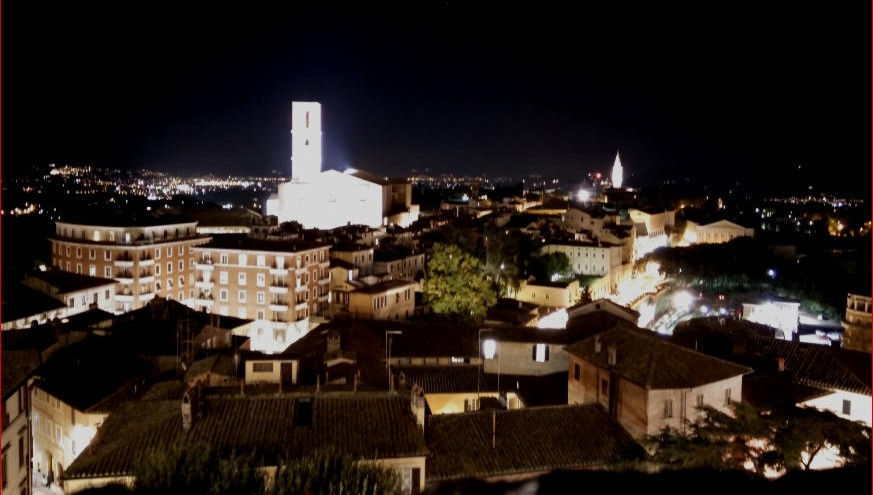
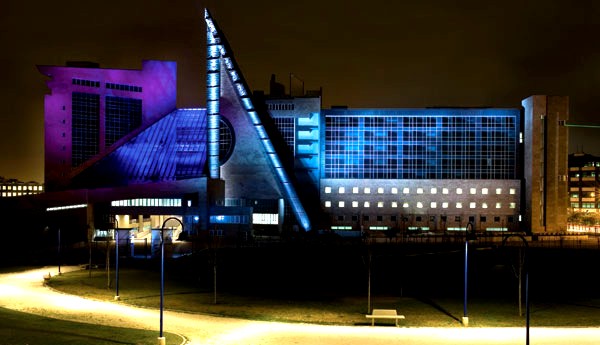
Image is of the very beautiful Perugia at night
Origin and mission
The impartial Murder of Meredith Kercher Wiki began in 2013.
The seed was people discussing how to overcome the flawed Wikipedia article of the case. That article relied on sources like Candace Dempsey, Nina Burleigh and American media. In other words, biased or incomplete sources.
In May 2013, Edward McCall set up the website, with the help of volunteer editors from the Perugia Murder File community. Its mission statement was:
Were Amanda Knox, Raffaele Sollecito, and Rudy Guede responsible for the death of Meredith Kercher? This wiki style site was created by a group of volunteer editors to inform the public about the case, by providing translations of original documents and evidence presented at trial.
This continues to be the aim of the Wiki: to make available documents and translate them properly. Our interest is not selectively posting documents, like the Knox campaign has done. We want to make all the facts available, without bias or selecting. We believe all the facts support the notion that all three defendants are responsible for Meredith Kercher’s murder.
Purpose of this post
The purpose of the article here is to let people know of recent changes to the website.
The Wiki is revised when new documents and translations continue to be received. Existing webpages are tweaked when time allows. Webpages are sometimes changed so information can be better presented. Or the website structure is changed when a significant page is introduced.
For example, a new page listing a lot of evidence was added in November 2014. This page can be directly accessed from the main page. That evidence list page has links to other sections of the website, like “˜wikified’ testimony, for easier reference. More links will be added and more evidence noted as more documents become available.
Major redesigns
The website had two major redesigns earlier this year. The main page was redesigned to provide clearer “˜at a glance’ updates. We did this primarily to keep everyone up-to-date with the March 2015 Cassazione decision. The boxes on the main page also note updates to other parts of the website. Also, we added buttons so any webpage on the site can be shared on various social media.
The other major redesign has been the addition of the “˜file library’.
Completing the picture
For those long familiar with the case, source material had been seriously lacking. There have been large gaps. The Knox campaign has posted some documents, but their “˜collection’ has always been incomplete. As examples:
1) The crime scene photos start at “˜dsc016’. What about photos 1 through 15?
2) No photos of Sollecito’s place, Guede’s place, via Sperandio or elsewhere
3) They posted many Massei transcripts, but not all. They never posted the 2nd day of Knox’s testimony, or the days when the Kercher family and consultants testified.
4) Some Massei transcripts they posted had pages missing.
5) They have posted many defense consultant reports, but few prosecution consultant reports.
6) They only posted a few Hellmann transcripts, but not all.
7) They only posted one Micheli transcript, but not the others.
8) Hardly any depositions.
9) A lot of police reports are still missing.
In the past six months, we have been trying to correct this. We have set up a file library, which will be the repository of as many case-related files as can be gotten. Files will ultimately include documents, photos, videos and audio- whatever is part of the public record of this tragic case. The files are made available as links for downloading. Eventually many will also be “˜wikified’ so anyone can do a word search through the documents. And when time allows, key documents will be translated.
There are thousands of files related to this case - too many to put on one page. A single file page would take forever to scroll and would be terribly confusing. So the library is structured into subsections. The basic idea is “˜nested boxes’. Once you select a section, you “˜drill down’ through pages to get to document links. Then you click “˜back up’ to the higher levels so you can move to other sections.
Some pages have a mixture of links to documents and links to subpages. These will eventually be simplified for clarity.
Not all file library pages have been created. More pages will be required as more files come in. Once the document files (PDFs) portion is nearly complete, pages will be reviewed and the library layout will be tweaked. At that point, when we’re comfortable with all the pages and their names, links will be added to allow browsing across sections or in sequential order. This hasn’t been done yet to avoid redoing a lot of work later.
A directory tree is a strong possibility too.
The seven sections
The library has over 900 PDFs and photos scattered across 7 major sections.
The 1st section
This section Context and people is empty for now. It will have photos of Perugia, the cottage, nearby locales and pictures of the people involved in the case. We are sifting through photos and erasing duplicates. Once that’s done, this section will quickly fill out.
The 2nd section
This section 2007 Investigations has files related to police investigations in 2007, the arrest and crime scene photos and videos. As mentioned, not all crime scene photos and videos have been made public. We hope to gather as complete a collection as possible. Of course, anything showing Meredith Kercher’s body will be censored, in line with the wishes of the Kercher family, and to maintain dignity. In the past 1.5 months, we’ve gotten over 80 depositions of witnesses and other documents related to early investigations. Things like preliminary police reports and police correspondence. Here you can also find phone and prison taps.
The 3rd section
This section Arrest trials has filed related to the cautionary arrest trials. This includes the Matteini court, the Ricciarelli court and the 2008 Cassazione court, presided by judges Gemelli & Gironi. Files include court hearing transcripts, motivation reports and other files pertinent to these hearings. This is missing quite a bit still, but we hope to correct that.
The 4th section
This section 2008 Investigations has files related to police investigations in 2008. While the murder was discovered on Nov 2, 2007, and arrests were made that month, the actual police investigation continued until the following year, finishing in June 2008. Files here include additional phone and prison taps, police reports from Rome and Perugia, additional depositions and other related documents.
The 5th section
This section Statements and writings contains writings and depositions of the three defendants. GKS = “Guede Knox Sollecito”.
The 6th section
This section Trials and Appeals and Reports is the largest section. We may revise or split this section further. Currently it contains all documents related to the main trials. All three defendants took part in the first main trial, the 2008 Micheli court. Micheli indicted Guede and found enough evidence against Knox and Sollecito. After the Micheli court, Guede’s trial path separated from the other two because he chose a fast-track option. So there are 3 subsections: Micheli, Guede trials and Knox + Sollecito trials. The Knox + Sollecito trials page has further subpages for the Massei court, the Hellmann appeals court, the Nencini appeals court. In this section, one can find court transcripts and reports, correspondence or depositions introduced during court proceedings. So a lot of files.
The 7th section
This section is extra material.This will contain documents, photos and videos indirectly related to the case. Things like interviews, documents on forensics, lab manuals, crime scene analyses, documentaries, related trials like the police calumnia trials, etc.
A few quick notes:
1. There are many versions of the Massei motivations report on the Internet. Most are missing two pages. Another version comes in four parts. We edited ours so this is a complete version with the “˜famous’ missing pages.
2. Similarly with the Borsini-Belardi motivation report. Many versions out there, most of them improperly OCR’ed, with sections missing. Our version is a scan version, not the OCRed one.
3. As noted before, recent additions include a lot of depositions of witnesses taken in the first week of police investigation. You can find these in the “2007 police work” page.
4. Police summaries of the crime scene surveys, and fingerprint reports, are at the bottom of that same page.
5. There’s a PDF containing a “˜5 volume’ police photo report. This PDF has photos of Via Sperandio currently not in the crime scene photos. But certainly those photos are part of the same Nov. 2007 crime scene photo survey. Anyway, you can find it in the Crime Scene page at the bottom. It’s called Photo-photographic-file-censored. We edited out pictures of the body, to preserve dignity of the victim.
6. Towards the bottom of the “2008 investigations” page, we recently added two police charts, and the first “shoeprint report” by Rinaldi & Boemia, which has more data on shoeprints. Their second report concentrated on the footprints.
7. We have the Cassazione March 2015 dispositivo. We will be posting that along with other documents shortly.
In conclusion
The file library is an ongoing thing. We hope to make real progress here, so everyone can look at all the facts of the case, not just a few picks. A bright light is needed on as much material as is possible to offer, in honor of Meredith Kercher, the victim.
When we post a new file batch, we add an update note on the Wiki home page.
The Meredith Kercher Wiki is committed to being the essential record of all publicly available documents and testimonies about the case, to benefit the general public and the media. Please circulate this widely, and check in regularly. There are more changes to come.
ADDED 12 JULY
On 2007 Investigations: Police work page
2007-11-03-Log-cellphone-KercherM-English.pdf
2007-11-03-Log-cellphone-Sollecito.pdf
2007-11-07-Log-landphone-Sollecito.pdf
2007-11-27-Police-deposition-Capezzali.pdf
On 2007 Investigations: Arrests page
2007-11-07-Prosecutor-notice-Request-to-validate-Arrest-Knox-Lumumba-Sollecito.pdf
On Arrest trials page
2008-01-21-Testimony-Bernaschi-Sollecito.pdf
2008-05-15-Motivazioni-Matteini-reconfirming-cautionary-arrest-Knox.pdf
On Arrest trials: KSL: Matteini trial page
2007-11-08-Testimony-Matteini-Knox.pdf
On Arrest trials: KS: Ricciarelli trial page
2007-11-30-Motivazioni-Ricciarelli-Arresto-Appello-Knox-Sollecito.pdf (forever missing Ricciarelli report)
On 2008 Investigations page
2008-11-08-Deposition-Monacchia.pdf
On Trials: Micheli court page
2008-09-16-Testimony-Summary-and-Rulings-Micheli.pdf (first Micheli hearing)
2008-10-27-Report-Fioravanti-Vodaphone.pdf
On Trials: KS: Massei and Cristiani trial page
2009-11-20-Closing-arguments-Mignini.pdf (forever missing)
2009-11-21-Closing-arguments-Comodi-Knox.pdf (forever missing- Comodi describes 3D reconstruction)
On Trials: KS: Hellmann and Zanetti trial page
2010-12-11-Testimony-Lawyers-Knox-Parisi-Maori-Ghirga-Vedova.pdf (missing Hellmann hearings)
2010-12-18-Testimony-Costagliola-Comodi-Perna.pdf
2011-01-22-Testimony-Lawyers.pdf
2011-03-12-Testimony-Mandarino-Pucciarini-Ciasullo-Bevilacqua-IniG-IniR.pdf
2011-03-26-Testimony-Brughini-Curatolo-Lucarelli.pdf
2011-05-21-Testimony-Napoleoni-Conti-Vecchiotti-Knox.pdf
2010-12-11-Court-doc-Zanetti-case-review.pdf
On Trials: KS: Nencini and Cicerchia trial page
2014-01-20-Testimony-Maori-Crini-Pacelli-Fabiani-Perna-Maresca-Donati-Colotti.pdf (missing Nencini hearing)
On Trials: Knox and Sollecito trials page
2015-03-30-Sentenza-Cassazione-Dispositivo-Knox-Sollecito.pdf (sentence, not motivations report)
Posted by azoza on 06/17/15 at 01:59 PM •
Permalink for this post •
Archived in Evidence & Witnesses, Various timelines, Real locations, Real crimescene, Faked breakin, Other witnesses, The two knives, DNA and luminol, Computer activity, Cellphone activity, Other physical •
Comments here (25)
Saturday, April 11, 2015
Those Pesky Certainties Cassation’s Fifth Chambers May Or May Not Convincingly Contend With #1
Posted by Cardiol MD

The Italian Supreme Court is in the background
1. How Overload Can Overwhelm The Checks And Balances
The Italian Supreme Court (SCC) has 396 Judges in Rome and elsewhere.
Because of the enormous pro-defendant tilt in the system, the SCC hears about 80,000 appeals a year - more than all other Supreme Courts in the rest of Europe combined.
The SCC operates in panels, typically of 5 justices; that scales to about 4 appeals/panel/workweek, or about 1 appeal/panel/workday. A huge workload impinging on carefulness and promoting distraction and exhaustion.
Even with a law-clerk infrastructure, and the most ingenious exploitation of human concentrated-attention-span, highly questionable outcomes such as that for Meredith’s case would seem inevitable.
The four SCC judges panels (2008, 2010, 2013, 2015) which have ruled on various issues arising as Meredith’s murder case inched its way through the Italian legal system have been composed of different judge-combinations, with different skills, different knowledge, different education, and different experiences.
In many cases high-tech issues are an integral part of the evidence before the courts. This requires the enlistment of expert opinions because the judges may not be versant in the relevant high-tech issues. All sides, the defence, the prosecution, other interested parties, and even the judges, can cherry-pick experts for hire, who often use brazen sophistry to persuade the judges in the experts’ favour.
These facts may help to explain if not justify the unexpected conclusion of this current SCC judges panel which is now drafting the Motivazione.
2. Circumstantial Evidence And The Italian Requirement For Certainty
Near the start of the 2015 SCC hearings Judge Bruno, one of the 5 members of the Marasca SCC-Panel, was quoted as having said that the trials had “not many certainties beyond the girl’s death and one definitely convicted.”
As we await this particular Motivazione intended to explain its decision, we will review the Massei Motivazione, the Nencini Motivazione, and the several past SCC rulings to establish what do constitute the certainties - of which in fact as Italian law defines them there is actually a large number.
In order to be classified as Circumstantial Evidence in Italian Law an evidentiary circumstance or fact must be true to the level of being a certainty. Note that this rule does not supersede BARD, it applies only to the the acceptance of individual items of evidence as circumstantial, so it can mislead and confuse authors and readers.
As will be noted below, under this Italian requirement the unverifiable RS/AK broken water-pipe story can not be classified as pro-defense Circumstantial Evidence. Therefore it cannot legally be argued as corroboration of the excuses of Knox & Sollecito, including their mop claims.
Sollecito’s father, Dr. Francesco Sollecito, did say that RS had mentioned the alleged-leak of Nov. 1st, 2007, in the father’s 221 seconds, 20:42:56 call of Nov.1st, 2007. Hellmann/Zanetti bought into this story, discussing it in their Motivazione.
AK is quoted by Nencini as referring to the alleged-leak in her testimony, but neither Galati nor the 2013 Hellmann/Zanetti-annulling SCC panel mentioned the alleged-leak. All seemed aware that there was no certainty.
3. An Explanation Of Why This Will Matter So Much In Future
In 2013 the SCC itself annulled most of the Hellmann-Zanetti verdict in part because there was an obvious parceling-out of the pieces of circumstantial evidence and a lack of assessment of each piece of circumstantial evidence. Hellmann-Zanetti had failed to check whether the possible flaws and lacks in the logical value of each single piece of evidence could be resolved by cross-checking them and taking in account the whole.
Have the SCC judges themselves now made this same mistake? It is especially at this level that informed legal analysis in Italy of the pending SCC Motivazione will concentrate, future books on the case will concentrate, and the final degree of legitimacy will be established.
Given the peculiarity that the case was not referred back down to Florence for adjustment, worries at this level especially could be driving the very obvious nervousness of all of the defense counsels, shushing and restraining their clients in the presumed hope that the SCC judges really can square the circle and achieve legitimacy.
4. Certainties And Certainly-Nots In The Circumstantial Evidence
1. Fracture Of Hyoid Bone?
The SCC-Panel for Guede’s Sentencing (English Translation) wrote on Pages 4-5:
c) The body presented a very large number of bruising and superficial wounds ““ around 43 counting those caused by her falling ““ some due to a pointed and cutting weapon, others to strong pressure: on the limbs, the mouth, the nose, the left cheek, and some superficial grazing on the lower neck, a wound on the left hand, several superficial knife wounds or defence wounds on the palm and thumb of the right hand, bruises on the right elbow and forearm, ecchymosis on the lower limbs, on the front and inside of the left thigh, on the middle part of the right leg, and a deep knife wound which completely cut through the upper right thyroid artery fracturing the hyoid bone, a wound which caused a great deal of bleeding from the vessels of both lungs.
This caused a haemorrhagic shock and asphyxiation by the presence of blood in the respiratory passages, an exitus [decease] placed at around 23:00 of Nov. 1 by the forensic pathologist.
The emphases are mine. The knife cut through the hyoid bone rather than fractured it (in the English version it should say that it severed the hyoid bone; this is a translation issue). A Certainly-Not then.
The wound certainly did not cause any bleeding at all from the vessels of either lung; this is not a translation issue. This is a factual error in the original Italian Sentencing Report. A Certainly-Not then.
(This shows how the SCC-Panel Reports are not infallible. Unfortunately the Marasca Panel will have to dredge-up some past, fallible SCC-Panel Reports in order to explain its own reasoning.)
2. Two Knives?
Massei Translation p377: “There must necessarily have been [405] two knives at the scene of the crime.”
Certainly! There were 2 major, penetrating knife-wounds into Meredith’s neck; one entering on the left-side, and one entering on the right-side, which was made by a pocket-knife of the size Sollecito customarily carried. The latter wound could not have been made by whatever knife entered on the left-side. Therefore 2 knives were Certainly used.
3. Single Blow?
Massei Translation p 371 “”¦a single blow was apparently halted by the jawbone”¦”
Certainly Not.
The statement that a blow could be “apparently halted” by Meredith’s jawbone is at best a figure of speech, and the quotes of Prof Cingolani on page 152 of the Massei Translation clearly indicate that any cause and effect inference from the phrase “apparently halted”, “did not”¦. have elements of certainty to establish” it was “stopped by the jawbone.” Prof Cingolani “did not, however, have elements of certainty to establish that the blade which had caused the wound 4 centimetres deep had stopped at the said depth because [it was] stopped by the jawbone.”
Maybe there is a Judicial, translational, or typographical glitch and “by” the jawbone should have been “near” the jawbone. Skin is soft and bone is harder but there is no way that the knife striking the jawbone or hyoid bone would halt the knife in this case, they would just roll with the blow, depending on the angle of attack.
Furthermore, contact between the knife and jawbone or hyoid bone would not mark the knife because living-bone is softer than the knife. When your pet gnaws on a non-living cow-bone, neither the bone nor your pet’s teeth can bend; both your pet’s teeth and the bone can be broken, and the bone gets scratches on it because it is still softer than the teeth, but your pet’s teeth do not get scratches on them, because they are harder even than the non-living bone.
If someone is stabbed in the back with a kitchen carving knife, penetrating ribs on its way to the heart, the knife may have no scratches at all, nor show any signs of damage caused by that action. Any implication in the statement quoted above that stabbing Meredith’s neck with enough force to penetrate the layers of her neck and then strike bone would have the effect of signs of damage to the knife-blade, is a mistaken implication.
It is an old rule of materials-physics that a softer substance cannot mark a harder substance. [To some people this may be counter to their intuition, so I have passed it by an eminent MIT physicist, and he agrees with me that the knife blade would certainly not show signs of damage caused by the stabbing in this case.]
4. SMS Message?
It is Certain that at 20:18:12 on Nov.1st, 2007 Amanda Knox’s mobile-phone received the SMS sent to her by Patrick Lumumba, which let her off from having to go to work at the “šLe Chic? pub on the evening of 1 November.
Remember that mobile-phones are equivalent to convicts’ ankle-monitor bracelets, their use creates with Certainty a record of the Times of cell-phone activities, the Location of the corresponding transmitter-cell, and hence the general location of the mobile-phone, especially Ruling-Out particular Locations e.g. Proving whether the carrier of the phone was in or out of the range of their home transmitter-cell. Call Verbal-Content is not publicly available.
Here the mobile-phone Record proves that Knox’s mobile-phone was Certainly-Not in Sollecito’s lodging-house at 20:18:12 on Nov.1st, 2007:
At the time of reception, Knox’s phone connected to the cell on Via dell’Aquila 5-Torre dell’Acquedotto sector 3, whose signal does not reach Raffaele Sollecito’s house. Amanda Knox’s mobile phone, and therefore Knox herself, was therefore far [i.e. absent] from Corso Garibaldi 30 when the SMS reached her, as she was walking in an area which was shown to be served by the Via dell’Aquila 5-Torre dell’Acquedotto sector 3 cell.
This point of her route could correspond to Via U. Rocchi, to Piazza Cavallotti, to Piazza IV Novembre, bearing in mind that Lumumba’s pub is located in Via Alessi, and that Amanda Knox would have had to travel along the above-mentioned roads and the piazza in order to reach the pub.
Knox was therefore Certainly Not at Sollecito’s Corso Garibaldi Lodging at that time, contrary to the allegation that she was, and Knox Certainly-Could have been at her Cottage.
5. SMS Reply?
At 20.35.48 on Nov.1st, 2007, Amanda Knox Certainly sent an SMS in reply to Patrick, at No. 338-7195723; the message was sent when her on Nov.1st, 2007 mobile phone was in Corso Garibaldi 30 or in the immediate neighbourhood. The cell used, in fact, was that of Via Berardi sector 7 - no other [use] was shown for the day of 1.11.07, noting that Amanda declared during hearings that she had switched her mobile phone off once she had returned 323 to Raffaele’s house, claiming she was more than happy she did not have to go to work and could spend the evening with her boyfriend.
(Knox may also have been LESS than happy that Lumumba preferred Meredith instead of Knox as an employee. This was perhaps humiliating enough to Knox for Knox to decide that the time to cut Meredith down-to-size was now.)
6. Bomb Threat?
Massei Translation page 25: On “the evening of November 1, 2007 at around 10:00 pm, someone called and warned Elisabetta Lana not to use the toilet of her dwelling because it contained a bomb which could explode. Mrs. Lana immediately notified the police of this phone call; and they came to the house but did not find anything….”
This call was Certainly received, the Police Certainly came to Mrs. Lana’s home, presumably not long after 10: pm on the evening of November 1, 2007 (Time & Duration of Police presence apparently not publicly-available).
The Courts must know those times accurately and precisely; reasonably assuming them to be after Meredith’s murder, and near the time of the Phone-Dump (Otherwise, the necessary combination of coincidences is too implausible).
It is most likely that the visible, and possibly audible, presence of Police triggered the panicked disposal of the Cell-Phones down the steep slope that falls sharply into the valley below.
There is no need to invoke any awareness by the phone-dumper[s] of the reason(the hoax-call) that the Police were near Mrs. Lana’s residence.
So if the killers saw flashing police-lights, or any other sign of police near Mrs. Lana’s place, that sign could be enough to explain panic phone-dumping - then and there (not considering whether the phones were switched-on or switched-off).
According to John Follain the slope is heavily overgrown with trees and bushes, an ideal place to dispose of evidence. If the phones had fallen just a few yards further, they would certainly have gone over the edge of the cliff, down into a 50m gully, straight into a thick scrub of nettles, and probably been lost forever”¦.
7. Phone Dialings?
There were four dialings on Meredith’s mobile phones after her arrival home on the evening of 1 November ‘07:
i. 20:56 hours on 1 November 07, attempted call to Meredith’s mother’s home in England.
ii. 21:58 hours on 1 November 07, attempted call to mobile phone’s answering service, voicemail “˜901’.
iii. 22:00 hours on 1 November 07, dial to Meredith’s London bank “˜ABBEY’.
iv. 22:13:29 hours (9 seconds) on 1 November 07, attempted internet connection. Connection consistent with being attempted from cottage, but inconsistent with being attempted from Mrs.Lana’s.
These dialings are Certain with regard to Existence, Timings, and Location.
Massei Translation, page 331, attributes the above 4 dialings to Meredith absent-mindedly playing with the mobile phone in her hand, and her phone may well have still been in her hand when her attackers surprised her.
8. Phone Location?
Was Meredith’s Phone still in the cottage at Via della Pergola at 22:13:29 hours on 1 November 07? Yes. Certainly.
9. A Tow Truck?
At about 22:30 hours Car broken-down nearby. Tow-Truck called-for.
At about 23:00 hours Tow-Truck arrives to load car.
At about 23:13 hours Tow-Truck leaves with loaded car.
These events Certainly occurred, but those times are approximate.
10. Francesco Called?
@23:41:11 RS’s father attempts phone-call but makes no oral contact. Father leaves message which is not received until 06:02:59 on 2.11.07.
This 23:41:11 call was attempted during the very time-frame of the attack on Meredith, her murder, and the flight of her killers with her mobile telephones. Meredith’s Phone[s] were removed from her cottage by about Midnight, less than 20 minutes after this attempted call.
These phone calls are Certain wrt Existence, Timings, and Locations.
11. Phone Location?
For 2.11.07 the first record is that of MKP - [0]0:10: 31, (i.e. Very early in the a.m. 10 minutes and 31 seconds after midnight) “when it has been established as an incontrovertible fact that Meredith’s English mobile phone was no longer in Via della Pergola, the mobile phone having received the contact under the coverage from Wind signal [cell] ..25622, which is incompatible with the cottage.”
Was Meredith’s Phone still in the cottage at Via della Pergola at 00:10: 31, 2.11.07? No!
Therefore Meredith’s English mobile phone had been removed from her cottage between 10.13.39 p.m. on 1.11.07 (more likely about 11.13 p.m. when tow-truck departed) and 0:10:31 on 2:11:07; about 10 ½ minutes after midnight ““ say Meredith’s Phone[s] Removed By About Midnight, allowing for the time-elapse before being dumped near Mrs. Lana’s place. (Hellmann falsified this time-span on page 14 of his report, stating it to be more than 10 hours after midnight rather than about 10 ½ minutes after midnight.)
12. Phones Stolen?
At some time before Meredith’s attackers fled, they had seized her mobile telephones, probably near the beginning of the attack, having started their attack with a pre-emptive strike to intimidate Meredith, remove all hope, surround her, display knives, seal all possible escape-routes, and remove any possibility of phone-calling for help.
Immediately after Meredith’s scream her attackers had silenced her with the fatal stabbing, and then fled immediately.
They fled with her already-seized but still switched-on mobile telephones, probably without locking anything, including Meredith’s door.
Their over-riding and 1st imperative was not-to-be-caught-at-the-crime-scene.
See item 6. above.
13. Crimescene Meddling?
Having accomplished the Phone-Dump, Meredith’s killers next re-model the crime-scene, minimising the evidences of their identities, cleaning-up the evidences that it was “˜an inside job’, and simulating the appearances that it was “˜an outside job’.
One should bear in mind that these killers should have still been overwhelmed by their having actually committed a crime beyond their wildest imaginings.
Their panic impaired their thinking, and their ignorance, immaturity, inexperience, lack of technical resources and their arrogance precluded their selecting deceptions more effective against knowledgeable, experienced professional crime-investigators with a large fund of resources. They probably think that throwing the stone from inside Filomena’s room was a brilliant deception.
They wish it had never happened.
They wish they could make it unhappen (Hellmann/Zanetti got close to fulfilling this wish, but got themselves unhappened by Cassation)
They wish they could prevent the discovery of Meredith’s murder.
They cannot prevent the discovery of Meredith’s murder.
They may be able to postpone its discovery, but not longer than the inevitable return of the cottage-mates, later that day.
They believe that the person who “˜discovers’ a murder may become 1st-suspect.
They may be able to manouevre others-than-themselves into being the ones that make the discovery ““ quite a wily aim.
It is beyond reasonable doubt that:
Meredith’s killers seized her mobile telephones, and that
Her killers did not switch-off these mobile telephones, and that.
Her killers threw the telephones into an apparent ravine, landing in Mrs.Lana’s garden, and that
This phone-dump was accomplished before 00:10: 31, 2.11.07, and that
Amanda Knox caused:
- i. the English phone to ring at 12:07:12 (16 seconds) and be discovered by Mrs.Lana’s daughter only because it rang , and
ii. the other phone, registered to Filomena Romanelli, to ring, very briefly, at 12:11:02 (3 seconds) and,
iii. the English phone to ring again, also very briefly, at 12:11:54 (4 seconds), after being brought into Mrs.Lana’s house. 6. Sollecito had more than 5 days, from about 11.30 pm on November 1st, 2007 until November 6, 2007, to remove from the killing-knife the traces of Meredith’s DNA.
In the opinion of the Court of Assizes (Massei Translation p.325), Amanda Knox’s call to Meredith’s phone was
...the first indispensible step before putting the [348] planned staging into action. The lack of a reply, since the poor girl was obviously already dead, gave a reason for reassurance about the fact that the young woman’s phone had not somehow been retrieved, [and] was therefore safe in the spot where it had been thrown, which, according to the expectations [in the minds] of the murderers was a precipice or some other inaccessible spot, rather than in the garden of a villa located barely outside the city, where the vegetation concealed it from view.
Knox may well have expected that she was safe from phone-discovery, but these calls turned out to be the very instrument of a phone-discovery.
Had Knox not made these obfuscatory stabs, in the time-frame she made them Meredith’s phone would not have rung when it did ring and would therefore not have been discovered by Mrs. Lana’s daughter when she did discover it.
14. Phone Switched On?
For the day of 2.11.07, when Meredith was already dead, the traffic registered for the Vodafone number was shown to be the following:
00:10:31; duration and caller unspecified, but Wind signal [cell] incompatible with cottage, but compatible with Mrs. Lana’s place.
Therefore, Meredith’s mobile cell-phone had already been taken away from the cottage by her killers. It is not possible to determine from this phone-record whether the phone was switched on or off, but this phone was discovered at Mrs. Lana’s place because it was ringing, and therefore was “on”.
12:11:02 (duration of 3 seconds): Knox’s phone call reached the phone and was diverted to the answering service. The Vodafone cell used by Meredith’s service provider was situated in Strada Vicinale S. Maria della Collina sector 1.
12:11:54 (4 seconds): another call is made by Knox’s phone towards Meredith’s English mobile phone number (the cell used is the one in Via dell’Aquila 5-Torre dell’Acquedotto sector 3, thus compatible with Sollecito’s house)
Three more phone-calls Certain wrt Existence, Timings, and Locations.
15. Francesco SMS Received?
At 06:02:59 Raffaele Sollecito received the SMS from his father allegedly wishing Raffaelle a good night; from the evidence of the mobile phone record printouts of Dr. Francesco Sollecito, it was shown that the sending of the message occurred at, as has been said, 23:41:11 of 1.11.07. This was the last SMS sent from that mobile phone during the whole day of 1.11.07
3+ Hours after receiving his father’s message from 23:41:11 of 1.11.07:
At 09:24 Raffaele Sollecito received a phone call from his father lasting 248 seconds]
At this time RS’s consiousness would be dominated by his guilty knowledge, and probably far-advanced in the accomplishment of the 3rd imperative.
Did RS and father spend 4+ minutes discussing the weather?
This is the first father/son opportunity to formulate the two-pronged water-leak story.
Although AK had already been to the hardware store 2 hours before, they may well not have known the potential DNA problems with the knife, the need to scrub it vigorously, to clean-out, and repair the drain-pipes under the sink, and the need to return the knife to RS’s kitchen drawer.
As it turned-out, Sollecito had more than 5 days, from about 11.30 pm on November 1st, 2007 until November 6, 2007, to remove from the killing-knife the traces of Meredith’s DNA.
They probably did not know that incriminating stains could be invisible, but can be revealed by Luminol.
16. Francesco Calls Received?
At 09:29 another call was received lasting 38 seconds
At 09:30 (duration unspecified?) the father called Raffaele; the call connected to the Vial Belardi sector 7 cell.(the best server cell for Corso Garibaldi 30).]
These two calls, Certain wrt Existence, Timings, and Locations, were probably spent dotting “˜i’s, crossing “˜t’s, and exchanging options, such as enlisting sister Vanessa’s skills and contacts.
17. More Calls Later?
Another 2+ Hours later:
At 12:07:12 (duration of 16 seconds) Amanda calls the English phone number 00447841131571belonging to Meredith Kercher. The mobile phone connects to the cell at [346] Via dell’Aquila 5-Torre dell’Acquedotto sector 9 (the signal from this cell is picked up at Sollecito’s house)
At 12.08.44 (lasted 68 seconds) Amanda calls Romanelli Filomena on number 347-1073006; the mobile phone connects to the Via dell’Aquila 5-Torre dell’Acquedotto sector 3 cell (which covers Sollecito’s house)
Discovery will be inevitable when Filomena eventually arrives-back at the cottage.
AK/RS have accepted that they have to “˜stand-pat’ with their efforts so-far to accomplish not-to-be-the-“discoverers”-of-Meredith’s-body.
Amanda did not say a word in this phone-call to Filomena about Amanda’s phone call to Meredith, thereby withholding information that should have led Amanda to initiate discovery of Meredith’s body, and help Amanda to manouevre someone other than Amanda into being the one who “˜discovers’ Meredith’s body.
At 12:11:02 (3 seconds) the Vodafone number 348-4673711 belonging to Meredith (this is the one [i.e. SIM card] registered to Romanelli Filomena) is called and its answering service is activated (cell used: Via dell’Aquila 5-Torre dell’Acquedotto sector3)
18. Yet More Calls?
For the day of 2.11.07, when Meredith was already dead, the traffic registered for the Vodafone number was shown to be the following 5 calls, Certain wrt Existence, Timings, and Locations:
- i. 12:11:02 (duration of 3 seconds): Amanda’s phone call reached the phone and was diverted to the answering service. The Vodafone cell used by Meredith’s service provider was situated in Strada Vicinale S. Maria della Collina sector 1.
ii. 12:11:54 (4 seconds): another call is made towards Meredith’s English mobile phone number (the cell used is the one in Via dell’Aquila 5-Torre dell’Acquedotto sector 3, thus compatible with Sollecito’s house)
iii. 12:12:35 (lasting 36 seconds) Romanelli Filomena calls Amanda Knox (No. 348-4673590); Amanda receives the call connecting to the cell on Via dell’Aquila 5-Torre dell’Acquedotto sector 3 (still at Raffaele’s house)
iv. 12:20:44 (lasting 65 seconds) Romanelli F. calls Amanda, who receives the call connecting to the cell in Via dell’Aquila 5-Torre dell’Acquedotto sector 9 (good for Corso Garibaldi 30)
v. 12:34:56 (48 seconds): Filomena calls Amanda who receives it from the cottage on Via della Pergola 7 (the cell used is that on Piazza Lupattelli sector 7. As mentioned, Raffaele also used the same cell when he called the service centre at 12:35 hours to recharge [the credit of] his mobile phone)
19. RS Phone Location?
At 12:35: Raffaele’s mobile phone contacted a service centre for a phone [credit] recharge (the cell used was that of Piazza Lupattelli sector 7, which gives coverage to the little house on Via della Pergola 7. The signal in question does not reach Corso Garibaldi 30, which instead is served by the signal from Piazza Lupattelli sector 8)
At 12:38: Vodafone sent R.Sollecito a message of confirmation of phone [credit] recharge (Piazza Lupattelli sector 7 cell, good for Via della Pergola 7)
At 12:40: incoming call from RS’s father’s mobile phone (lasting 67 seconds; connection through Piazza Lupattelli sector 7 cell, compatible with the Sollecito’s presence near the little house)]
At 12:47:23 (duration of 88 seconds): Amanda calls the American (USA) number 00120069326457, using the cell on Piazza Lupatetlli sector 7; the phone call takes place prior to the one which, at 12.51.40, Raffaele Sollecito will make to “š112?, connecting to the cell on Via dell’Aquila 5-Torre dell’Acquedotto sector 1, which gives coverage to Via della Pergola 7]
In “Waiting To Be Heard” Knox can hardly deny having made this 1st call, acknowledges making the call, and purports, now, to recall its substance, providing the reader with her version of what was said.
At 13:24:18 (duration of 162 seconds): Amanda calls the same American number which corresponds to the home of her mother, Mrs Edda Mellas, using the same cell. It is obvious that the young woman is inside the cottage, where by this point, several minutes earlier, the Postal Police had shown up, [347] represented by Inspector Battistelli and Assistant Marzi, who were engaged in the task of tracking down Filomena Romanelli, who was the owner of the Vodafone phonecard contained in the mobile phone found earlier in the garden of the villa on Via Sperandio]
In “Waiting To Be Heard” Knox can hardly deny having made this 2nd call either, she acknowledges making the call, and provides the reader with her current version of what was said.
20. More Phone Locations?
At 12:50:34 outgoing call directed at mobile phone 347-1323774 belonging to Vanessa Sollecito, sister of the defendant; duration 39 seconds. Connection to Piazza Lupattelli sector 7 cell 320
At 12:51:40 Raffaele Sollecito called “š112? to inform the Carabinieri of the presumed theft in Romanelli’s room (duration 169 seconds; connection to Via dell’Aquila 5-Torre dell’Acquedotto sector 1 cell, which covers Via della Pergola 7)
At 12:54: a second call by Raffaele to “š112? (57 sec.; connection to Piazza Lupattelli sector 7 cell)
Three more Sollecito calls Certain wrt Existence, Timings, and Locations.
21. More Phone Locations?
At 13:17:10 (lasting 1 second) to Meredith’s phone: the cell used was located in the same place, sector 7
At 13:27:32 (duration of 26 seconds): Amanda calls the American number 0012069319350, still using the cell at Piazza Lupattelli sector 7.
At 13:29:00 (duration of 296 seconds) Amanda receives [a call] from No. 075/54247561 (Piazza Lupattelli sector 7 cell)
Three more Knox calls Certain wrt Existence, Timings, and Locations.
22. Another Phone Location?
At 13:40:12: incoming call from his father to RS (94 sec.; Via dell’Aquila 5-Torre dell’Acquedotto sector 1 cell)
Another Sollecito call Certain wrt Existence, Timings, and Locations.
23. More Knox Calls?
At 13:48:33 (1 second): this is an attempted call to AK’s mother’s number
At 13:58:33 (1 second): this is an attempted call to her mother’s number
The above item is a faithful translation from the Massei Motivazione section on Amanda Knox’s mobile phone traffic, but is listed out-of-time-sequence; the assigned-time is probably a “˜typo’ ““ “13:48:33” is much more likely correct.
Two more Knox calls Certain wrt Existence, Timings, and Locations.
24. Francesco Call?
14:33: Sollecito’s father called Sollecito for 21 seconds (as above)]
Do RS and father exchange more caveats in their call Certain wrt Existence, Timings, and Locations?
25. More Knox Locations?
At 14:46:14 (102 seconds) Amanda receives a call from the German number 494154794034, most likely belonging to her aunt Doroty Craft
Call to Meredith’s phone at 15:13:43 (5 seconds) cell not indicated.
At 15:31:51 (1 second): Knox receives an SMS sent from the number 389/1531078; at this point the cell being used is the one on Via Cappuccinelli 5/A sector 2, where the Questura [police headquarters] is located.
Two more Knox-related calls Certain wrt Existence, Timings, and Locations.
In the hours that followed the [mobile phone record] printouts show that the answering service of Amanda’s number 348-4673590 was activated due to a lack of signal coverage.
Massei Translation p.324:
Finally, the analyses of the [phone record] printouts highlight that the first phone call made by Amanda on the day of 2 November was to Meredith Kercher’s English number.
The American student called her English flatmate even before contacting Romanelli Filomena to whom she intended to express, as she testified in court, her fears about the strange things she had seen in the cottage, which she had returned to at about 11 o’clock in order to shower in preparation for the excursion to Gubbio which she and Raffaele had planned.
It is strange that Amanda did not say a word to Filomena about the phone call to their flatmate, when the call, not having been answered, would normally have caused anxiety and posed some questions as to why Meredith did not answer the phone at such an advanced hour of the day.
26. Sollecito Locations?
At 17:01: RS’s father called RS for 164 seconds; cell used is that of Via Cappucinelli 5/A sector 2, corresponding to the location of the Perugia Police Station
At 17:42: RS’s father called RS for 97 seconds (as above).
With regard to Raffaele Sollecito’s landline home phone (No. 075-9660789)
The above 2 calls presumably covered final agreements on the Father/son stories.
For the entire day of 1 November and then of 2 November, Raffaele Sollecito’s fixed line was not affected by any calls, either incoming or outgoing.
This series continues here.
Posted by Cardiol MD on 04/11/15 at 04:49 AM •
Permalink for this post •
Archived in The officially involved, Supreme Court, Evidence & Witnesses, Various timelines, Real locations, The two knives, Cellphone activity, Other physical, Trials 2008 & 2009, Massei prosecution, Appeals 2009-2015, Cassation 2015, Cassation critiques, Cardiol critique, Hoaxes Knox & team, 15 Single alibi hoax, Hoaxes Sollecito etc, 27 Single alibi hoax •
Comments here (26)
Friday, March 13, 2015
Questons For Knox: Adding A Dozen More To The Several Hundred Knox So Far Avoided
Posted by Chimera
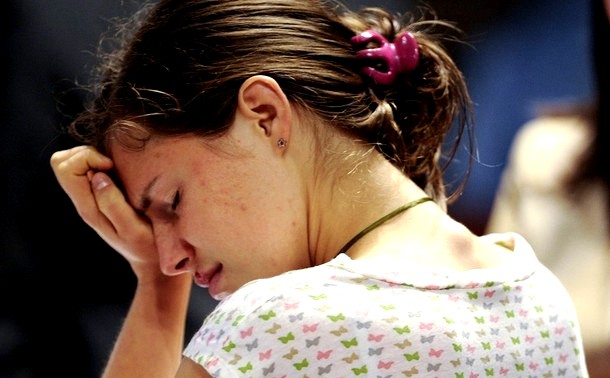
Knox during a pause in questioning at trial; her answers destroyed many Italians’ trust
1. State Of Play On The Questions Front
Sollecito and his father Francesco actually take questions without 99% of them being agreed-on in advance.
They evade a lot and lose a little but they also gain some points, unlike a seemingly terrified Knox and a seemingly terrified PR who now seem stuck in tongue-tied and consistently-losing modes.
In Italy last night on the much-watched crime show Porta a Porta Francesco Sollecito had to go along with the official reconstruction of the prolonged pack attack on Meredith which rules out any lone wolf though he again maintained that Raffaele was not there.
Not by any means does TJMK give Sollecito a pass. He WAS there at the attack, the evidence is very strong. And we do have many dozens of pending questions waiting for him to respond.
But the truly evasive one is Amanda Knox. Previously helped by the fawning arm of the American press.
2. Pending Questions We Have Already Asked
These are ordered chronologically with the first questions, by Kermit in mid trial in 2009, at the bottom of the list.
Click here for: Questions For Knox: Ted Simon Gone? With Legal And Financial Woes Will The Other Paid Help Stay
Click here for: Questions For Knox: Why Does Book Smear Others On Drug Use, Mischaracterize Your Own?
Click here for: Questions For Knox and Sollecito: Why Claim Rudy Guede Did It Alone When So Much Proof Against?
Click here for: Questions For Knox: How Do You Explain That Numerous Psychologists Now Observe You Skeptically?
Click here for: Questions For Knox: Ten Hard Questions That Knox Should Be Asked Monday On ITV’s Daybreak
Click here for: Questions For Knox: Why So Many False Claims In Accounts Of Your Visit To The House?
Click here for: Questions For Knox: Why The Huge Lie About Your ZERO Academic Intentions In Europe?
Click here for: Questions For Knox: Do You Think “False Memories Kassin” Framing Italians Yet Again Will Help?
Click here for: Questions For Knox: Did You Undergo An Illegal Interrogation By Mignini Or Did You Try To Frame Him?
Click here for: Questions For Knox: Diane Sawyer, How To Push Back Against The False Claims And Emotion
Click here for: Questions For Sollecito And Knox and Enablers: Several Hundred On The Hard Evidence
Click here for: Questions For Knox: The Questions That Drew Griffin On CNN Tonight SHOULD Have Asked
Click here for: Questions For AK And RS From Barbie Nadeau As Knox Slander Trial Starts
Click here for: Questions For Knox: (Powerpoints #11) 150 Hard Questions That You Incessantly Avoid
3. My Own Dozen Questions More
I have mentioned before my belief that Meredith Kercher’s attack and possibly death was premeditated, at least on the part of Amanda Knox. Raffaele Sollecito, and Rudy Guede, while accomplices, and also liable, did not plan this out.
Below is my own list of a dozen more hard questions Knox should be asked. This post focuses on questions that point towards forethought and premeditation. And no, crying, having a fit, and refusing to answer just won’t do it. An open challenge to not answer in a Hellmann-court-type wail.
1. Keeping the ‘‘See you later’’ Text to Patrick
You kept the message that you sent to Lumumba, which you wrote in Italian. The literal translation from English implies that you actually intend to meet, rather than the English one that means a parting of ways. As a language student, this common expression was likely one of the first things you learned, if you didn’t know already.
At your voluntary questioning, of November 5th/6th, you give that message to the police, and claim it as proof that you left Raffaele’s apartment to meet him. The police didn’t force this knowledge from you, rather you volunteered it after Raffaele withdrew your alibi. Patrick was falsely arrested, due entirely to your statements, and that message.
I considered, and rejected the idea that you might have kept the message in case Patrick might have wondered why you didn’t show. If that were the case, you would have kept his message not to come in, and not your response.
Here is the 2009 trial video, the relevant part starts at about the 7:30 mark. At the 10:30 mark, she talks about the message. At 12:15, she says she doesn’t know how to delete sent messages.
Question for Knox: Why did you keep Patrick’s message, if not to use later as a backup plan?
2. The Lack of Videotaping for the ‘‘Interrogation’‘
You and your supporters in the U.S. frequently complain that your November 5th/6th ‘‘interrogation’’ was never recorded. You claim that if there was such a record, it would corroborate your claims, and prove you were beaten/smacked around/tortured. A video would go both ways: it could either prove police brutality and misconduct, or it could definitively prove a suspect or witness was lying.
Until that night, you claim nearly 50 hours of interrogation (see December 2013 email to Judge Nencini), yet none of it was recorded. Odd, if you were the suspect all along. Witness summaries routinely are not, but suspect interrogations almost always are, if only to cover the police officer’(s) butt(s).
That night, when you said you witnessed a crime you did not report (Patrick attacking Meredith), your legal status changed from a witness to a possible suspect. You were given a miranda warning, but still continued to talk.
At this point with your new status, the police would have wanted to videotape or audio record any questionings. And if they had, any claims of the ‘‘police beat me’’ would have been very easy to refute. So, by staying away from the camera, it actually creates at least a bit of ambiguity, and gives some wiggle room, should you decide to make complaints later. It turns an open-and-shut matter into your-word-against-theirs where you lose.
Question for Knox: Did the police ever ask to videotape any of your ‘‘questionings’‘? And if so, why did you refuse?
3. Transporting Raffaele’s Knife to Your Apartment
You and Raffaele were charged in addition to murder and sexual assault, with transport of a weapon, namely, a knife to your apartment and back. Despite all the denials of your lawyers, it had Meredith’s DNA on the blade, and your DNA on the hilt (the infamous ‘‘double DNA knife’‘). Most spontaneous violent crimes involve objects in the immediate area, such as the room, whereas this knife was taken from another location and brought to the crime scene. Frankly, it reeks of pre-planning.
I considered, and rejected the argument of needing protection. Knox never claimed she felt unsafe walking around Perugia, heck she sleeps with random people there. If she did feel afraid at times, many women just clench keys in their fists, for something like that.
Even more disturbing, (as you admit you are a CSI fan) the knife was brought back to Raffaele’s apartment, cleaned with bleach, and put back. Had the bleach actually destroyed all the DNA—it tends to miss DNA in cracks and grooves—it would have implicated Raffaele only, being his knife, and would not implicate you. Rather than throw it away, like a ‘‘smart’’ killer would do, it is put back, where it is fairly easy to be found.
Question for Knox: Why did you bring the knife from Raffaele’s apartment, if not to use against someone?
Question for Knox: Why was the knife returned to Raffaele’s kitchen? Were you hoping (as a fallback), that it might lead to him alone?
4. The Staged Break-In
You finally admitted, after long denying, that you staged an April Fool’s Day prank on April 1st, 2007, by simulating a burglary against a housemate. You found it funny, while others found it disturbing. However, in order to do such a prank, you needed to think in advance about how you wanted things to look. In short, this had to be planned out.
Well, the November 1st ‘‘break-in’’ at your apartment when Meredith was killed, was ruled by the courts to be a staged burglary. There are just too many holes in your story, and in the crime scene, to believe it was legitimate.
But what is not clear, is whether the killers staged the burglary as a panicked response to Meredith’s death, or whether some of the details were worked out ahead of time. And you had, as a prank, done this before.
I considered, and rejected the claim that it was a real burglary. However, Judges Micheli, Massei, Nencini and the Court of Cassation disagree, and they can summarize it better.
Question for Knox: Did you think of simulating a break in at your home BEFORE or AFTER Meredith was murdered?
5. Rudy Guede’s Involvement
FoAK has long smeared Guede as a drifter, drug dealer, orphan, burglar, and many other things. There was one bit of truth there: Guede had broken into at least one place, prior to Meredith’s death, although he had not been charged at the time. He recently got his jail time extended though, as a result of this.
Interestingly, while you claim to not know Guede, your book seems to include a lot of detail about him. You knew he was interested you. You say he had done a break in, and you had staged a break in. You allege his was done in Perugia, while your prank was far away, in Seattle, where no police were involved. And let’s be frank: men say dumb things to impress women. What an interesting person to bring along.
Question for Knox: Did you know about Guede’s prior break in BEFORE or AFTER Meredith was murdered?
6. Turning Off the Cellphones (you and Raffaele)
It is now common knowledge that most cellphones contain GPS that can track the movement of a user. Police know this, and can often track suspects’ movements this way. Smart people looking to avoid police attention have figured this out, and can turn their cell phones off (or leave them at home), to make their movements more ‘‘anonymous’‘.
Even smarter police have now figured out that people know, and can now find out if turning off phones is routine, or just a one time thing. Jodi Arias was caught out this way. Thomasdinh (Dinh) Bowman was caught out this way. See this.
You and Raffaele had never turned off your cellphones, but chose to (and together) the evening before Meredith was killed.
You gave multiple excuses. (1) Sollecito says in his book it was so you could fool around undisturbed. (2) You say in your book it was so you wouldn’t receive a message from Patrick if he changed his mind and wanted you to work. (3) You said in your December 2007 questioning with Mignini that it was done to preserve the charge in your phone. (4) At trial, your lawyers disputed that the phones were shut off?
Question for Knox: Why did you and Raffele turn off your phones the night Meredith died, if not to cover your movements?
7. Ditching Meredith’s Phones
Meredith’s phones, both her English and Italian phones, were found well away from the home. While it is normal to have a cell phone, very few people have more than one, and other than a friend, family member, or roommate, who would know this? Meredith’s attackers took them both, and rather try to sell them or use them, dumped them.
Police have speculated that this was done to divert attention, and to give out false leads. However, this amount of thought in a ‘‘hurried and rushed’’ crime seems very much out of place. The unexpected consequence is that it helped narrow the focus.
I considered, and rejected the idea that they were part of an actual robbery. A killer who seems to know so much about evidence, and about cell phone evidence, would take them, knowing the GPS would help track his movements. Really, what smart killer would take a mobile ‘‘ankle bracelet’’ with him?
Question for Knox: Why did you take Meredith’s phones, if not to throw off the police investigation?
8. Keeping Frederico Martini’s Number in Your Phone
It is now well known, even if not reported at the time, that Frederico Martini (a.k.a. the ‘‘Cristiano’’ in your book), was a drug dealer you met on the train to Perugia. You ditched your sister, Deanna, to be with him. And since then, he had been supplying you with free drugs in return for sex.
It is also well known that you gave Frederico’s number to police, probably trying to divert attention from yourself once again, and that he ended up serving time for drug dealing.
You have enough sense to turn your cell phone off prior to phones (see sections 1, 6, and 7), so you clearly knew that phones can provide serious evidence against you. If you truly were worried about the police searching your phone, you could have deleted his number, changed a digit or 2, changed the name, or otherwise hidden that information.
The police weren’t concerned with drugs, only with catching a killer.
Question for Knox: Why did you keep Freddy’s number, and then give it to police, other than just another diversion tactic?
9. The Lamp From Your Room on Meredith’s Floor
The lamp from your room, the only source of light in your room, was found on the floor in Meredith’s room. This would seem odd, as Meredith had two lamps of her own, and your room would be left dark. Police have speculated that the lamp was used during the clean-up, and then forgotten.
This demonstrates a lot of control, as rather than grabbing an available lamp from Meredith’s room (if it were needed for cleanup), the killers would have moved outside the bedroom, grabbed a lamp from another room and brought it back.
It further demonstrates control, as there was no bloody footprints into your room. Therefore, the killer must have cleaned his or her feet, then gone into your room to grab the lamp. And that lamp was found wiped off prints, so whoever took it had the foresight to make sure their own weren’t on it, but had Meredith’s lamp been used, finding it wiped clean would have been a dead give away.
All of this smacks of planning, and had the lamp not been forgotten in the locked room, we would never have known any of this.
Question for Knox: Why was your lamp found on Meredith’s floor, if not to clean or search for evidence?
10. Gloves Used for Cleanup?
The police went through the house. Although they did not test everything, very few fingerprints were found at all in the house, and only one belonging to Knox, on a glass. Of course, it raises the question of why any random burglar or killer would do that, and points to someone who is there regularly—a resident.
Such an undertaking would have taken a long time, again, pointing to a resident of the building. And while a sock or a cloth may be used a few times, it seems extremely impractical to use for any length of time. That leads another obvious suggestion: gloves.
However, Perugia was still warm. Amanda, (in that God-awful interview with Simon Hattenstone), said that she could sunbathe in October. Even if she had them in her luggage, they would probably take time to find. She was not known for wearing gloves as a fashion accessory.
Given her living habits, it is extremely unlikely she had her own cleaning gloves, and Laura and Filomena never reported such things missing. Nor did anyone else. So, where would they come from?
Question for Knox: Did you purchase (or steal) gloves prior to Meredith’s death?
11. Clothes and Supplies
You were seen in Quintavalle’s shop first thing in the morning on November 2nd, even if your lawyers contest it. He claims you were looking in the cleaning section, but then left. Strange, as you are not much of a cleaner, however he has no reason to lie. You also claim that you were not ‘‘missing’’ any clothes, even though Filomena mentions a sweater you were wearing but has not been recovered.
It is also known that you have made many cash withdrawls in the month of October, with seemingly little to spend on. Police and the media have speculated drugs, but with absolutely no paper trail, there is no way to know for sure how much was spent on what.
Question for Knox: Did you purchase any cleaning supplies, or extra clothes, either before or after Meredith’s murder?
12. Concerning The Gubbio Trip
You have travelled to many places, sure, but hadn’t really gone anywhere after settling in Perugia. Yes, you had given serious thought to ditching the town, even buying a ticket to China. Since meeting Raffaele, you two had kept in a relatively small area. Therefore, the trip planned to Gubbio, for the day after Meredith was killed, seems somewhat out of place.
I may very well be wrong, but was this the first road trip you had taken with him? You hadn’t packed anything, and you left your house (after the shower) without taking anything. You apparently also didn’t notice Filomena’s broken window in front of you.
Question for Knox: Was the Gubbio trip for real, or was this a staged cover?
Posted by Chimera on 03/13/15 at 07:05 PM •
Permalink for this post •
Archived in Various hypotheses, Pondering motive, Defendants in court, Amanda Knox, Evidence & Witnesses, Faked breakin, The two knives, Cellphone activity, Hoaxes against Italy, 3 No evidence hoax, Hoaxes Knox & team, 13 AK persona hoax, 15 Single alibi hoax, Hoaxers from 2007, Amanda Knox #1, Knox-Marriott PR, Amanda Knox #2 •
Comments here (16)
Monday, March 09, 2015
The Meredith Case Wiki Now Has The Key Sollecito Statement 6 Nov 2007 In Full
Posted by Our Main Posters
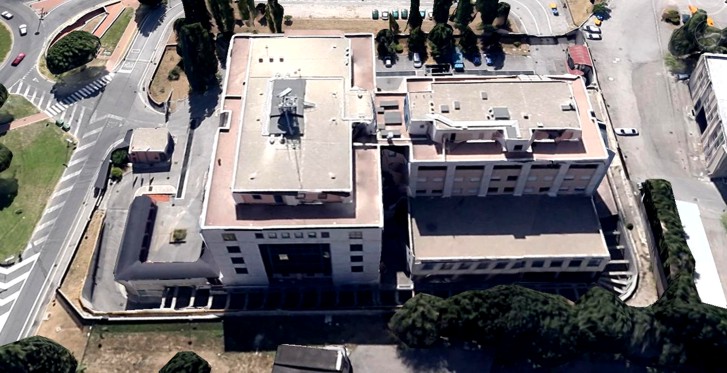
Perugia’s central police station where Sollecito made the statement posted here
The ever-expanding Wiki can of course be found here.
A post follows soon with guidance to the numerous new documents it contains. This was an extremely well documented case with discussions carefully recorded and decisions explained every step of the way.
We have frequently noted for example that RS and AK were provided with an extraordinary total of SIX opportunities in 2007 and 2008 to head off a trial and to be released.
Each opportunity is very well documented (Matteini hearings, Ricciarelli hearings, Mignini hearings, Supreme Court rulings, and the two Micheli rulings) and the transcripts and reports make very clear why RS and AK failed each time.
Not one of those transcripts or rulings has been “explained” or rebutted by the RS and AK apologists. It is very clear now that their falsifying efforts are being left way back there in the dust.
Document after document after document proving the case is going live in English for which they have been able to create no response. For example, the “brutal” Knox “interrogation” on 6 November is absolutely vital to their body of claims.
But document after document has shown that to be simply a huge hoax. Dumb silence is the only response.
This new translation of Sollecito’s statement of 6 November 2007 in the central police station, complete for the first time, has just gone live on the Wiki here. As always, we sure appreciate the translation help.
Note: Many of the claims here were proved wrong by phone and computer records and those dropping Knox in the soup contradict claims by Knox.
Sollecito never agreed to testify or be cross-examined on this or many other statements . Smart move, from his point of view. At the same time from 20007 to 2016 Sollecito NEVER testified that Knox was simply at his home all of the 5 November 2007 night.
Perugia Police Headquarters
Flying Squad
General Affairs Area.SUBJECT: Witness statement of person informed of the facts given by SOLLECITO Raffaele, already identified.
On November 5th 2007 at 22:40 in the offices of the Flying Squad of the Perugia Police Headquarters. Before the undersigned of the Criminal Investigation Dept. Deputy Commissioner MONICA NAPOLEONI, Chief Inspector Antonio FACCHINI Vice Superintendent of Police Daniele MOSCATELLI, Assistant Chief Ettore FUOCO is present the above-mentioned who, to supplement the declarations made [November] in these Offices, in regards to the facts being investigated, declares as follows: [*A.D.R. = Question Answer = QA]
QA I have known Amanda for about two weeks. From the night that I met her she started sleeping at my house. On November 1st, I woke up at around 11, I had breakfast with Amanda then she went out and I went back to bed. Then around 13:00-14:00 I met her at her house again. Meredith was there too. Amanda and I had lunch while Meredith did not have lunch with us.
QA Around 16:00 Meredith left in a hurry without saying where she was going. Amanda and I stayed home until about 17:30-18:00.
QA We left the house, we went into town, but I don’t remember what we did.
QA We stayed there from 18:00 until 20:30/21:00. At 21:00 I went home alone because Amanda told me that she was going to go to the pub Le Chic because she wanted to meet some friends.QA At this point we said goodbye and I headed home while she headed towards the center.
QA I went home alone, sat at the computer and rolled myself a spliff. Surely I had dinner but I don’t remember what I ate. Around 23:00 my father called at my home number 075.9660789. During that time I remember Amanda had not come back yet.
QA I browsed at my computer for another two hours after my father’s phone call and only stopped when Amanda came back presumably around 1:00.
QA I don’t remember how she was dressed and if she was dressed the same way as when we said goodbye before dinner.
QA I don’t remember if we had sex that night.
QA The following morning around 10:00 we woke up, she told me she wanted to go home and take a shower and change clothes.
QA In fact at around 10:30 she went out and I went back to sleep. When she went out that morning to go to her house, Amanda also took an empty bag telling me she needed it for dirty clothes.
QA At around 11:30 she came back home and I remember she had changed clothes; she had her usual bag with her.
QA I don’t know the contents of her bag.
QA I remember we immediately went to the kitchen, we sat down and talked for a while, perhaps we had breakfast. In that circumstance Amanda told me that when she got to her house she found the entrance door wide open and some traces of blood in the small bathroom and she asked me if it sounded strange. I answered that it did and I also advised her to call her housemates. She said she had called Filomena but that Meredith was not answering.
QA At around 12:00 we left the house; passing through Corso Garibaldi we arrived in Piazza Grimana, then we went through the Sant’ Antonio parking lot and reached Amanda’s house. To walk there it took us about 10 minutes.
QA As soon as we got there she opened the door with her keys, I went in and I noticed that Filomena’s door was wide open with some glass on the floor and her room was in a complete mess. The door to Amanda’s room was open and I noticed that it was tidy. Then I went towards Meredith’s door and saw that it was locked. Before this I looked to see if it was true what Amanda had told me about the blood in the bathroom and I noticed drops of blood in the sink, while on the mat there was something strange - a mixture of blood and water, while the rest of the bathroom was clean.
QA I went to the kitchen and saw that everything was in order, then went around the rest of the house, I went to Laura’s room and noticed it was tidy. In that moment Amanda went inside the big bathroom, next to the kitchen and came out frightened and hugging me tight telling me that earlier, when she took the shower, she had seen feces inside the toilet, while now the toilet was clean. QA I just took a rapid glance at the bathroom trusting what Amanda had told me.
QA At that point I was asking myself what could have happened and I went out to find Meredith’s window to see if I could climb to it. I went outside with Amanda and she tried to climb to it, I immediately stopped her telling her to not do it because it was dangerous. I then told Amanda that the best solution was to break down the door, I tried to kick it and shoulder it open but I didn’t manage to open it. Then I called my sister on her cellphone and asked her what I should do since she is a Carabinieri lieutenant. My sister told me to call the Carabinieri (112, the Italian emergency number), which I did, but in the meantime the Postal Police showed up.
QA In my previous statement I told a load of rubbish because Amanda had convinced me of her version of the facts and I didn’t think about the inconsistencies. I heard the first statements that she made to the Postal Police who intervened at the place.
QA She always carried a big bag that she also had the night of November 1st.
The investigating officials acknowledge that the deposition ends at 3:30 (AM) of November 6th 2007.
Posted by Our Main Posters on 03/09/15 at 01:45 PM •
Permalink for this post •
Archived in The officially involved, Police and CSI, The prosecutors, Evidence & Witnesses, Various timelines, Real crimescene, Cellphone activity, Hoaxes Knox & team, 13 AK persona hoax, 14 AK/RS got-on hoax, 15 Single alibi hoax, 16 Interrogation hoax, Hoaxes Sollecito etc, 25 RS persona hoax, 26 RS/AK got-on hoax, 27 Single alibi hoax, 28 Not at house hoax, Hoaxers from 2007, Raff Sollecito #1, Hoaxers from 2011, Raff Sollecito #2 •
Comments here (20)
Friday, January 30, 2015
Summaries Of The Nencini Report #1: The Attention Directed To Various Crucial Timings
Posted by Cardiol MD
[Florence Palace of Justice at night]
1. Overview Of This Series
The court-ordered repeat of Knox’s and Sollecito’s appeal concluded in Florence a year ago.
On 25 March of this year Paolo Antonio Bruno, the Supreme Court lead reviewing judge, will present to his colleagues on the bench his findings and recommendations on Judge Nencini’s findings and verdict.
Between now and then we will be posting on areas of the report which make the final conclusions firm and, we believe, have the defenses pretty stumped
The Nencini version we use is the PMF translation introduced here. The full report can be read in HTML format on the Wiki and downloaded in Acrobat format from PMF.
2 Approach To This Summation
The Nencini reports builds on and essentially endorses the outcomes of three previous courts: Micheli 2008, Massei 2009, and Cassation 2013.
Despite the lengths of those reports, no court described from all angles every piece of evidence, and the most persuasive 1/4 of the trial in closed court in 2009 (the autopsy and the recreation of the attack) have never been publicly fully reported upon.
TJMK has posted summaries of all of those reports: see the Micheli Report, the Massei Report. and the Cassation report.
Summarizing requires selection, deciding what to include and what to omit. The aim here is to emphasize the points to which the Judges seemed to attach the most weight. What was in the minds of the Judges can be inferred only from the words of the report; their sequence tends to be chronological, rather than determined by relative importances they conclude.
The Knox, Mellas and Sollecito misinformation campaigns dont wat you to know this, but with the exception of translations by Andrea Vogt, no main stream media in the US or UK has yet translated or summarized or even excerpted any of those reports. Most did not even mention them at all.
3. Phone Records On Coordinated Universal Time Protocol
The CUT protocol is used for civil telephone time-keeping all over the Earth’s surface, including in Italy, the U.S. and the U.K.
Coordinated time-keeping assures that the time assigned to a telephone event is accurate and very precise, independent of where it occurs. Uncoordinated Time-keeping can result in a time being assigned to a telephone event even before it actually did occur.
Although not explicitly pointed-out in the Nencini Report or other official reports and documents, CUT is the protocol used for all telephone-traffic times, mobile and landline, involving all users referred-to; they are precisely recorded, their very existence, their start, their end, their duration, and even their location. Only their content is protected.
Therefore there is a wealth of information about which there is no doubt at all with regard to the existence and the time-sequence of ‘phone traffic, which is selected for inclusion in Nencini here:It’s almost as if the ‘phone users are wearing criminal-offender’s ankle bracelets. CUT records enable decisive challenge to the credibility of a false witness (impeachment).
1. Timing of The Lumumba Text Traffic
Nencini finds that Amanda Knox was not at Sollecito’s at 20:18 and 12 seconds when she received Patrick Lumumba’s text message, but was at Sollecito’s at 20:35 and 48 seconds when she responded to Patrick Lumumba’s text message. and her claim that she was there both times is false.
{Ed: Furthermore, although mentioned in TJMK but not mentioned by Nencini, Knox was not due at "Le Chic" until 10: pm, it is implausible that at 8:18 pm she was on her way to work. More than 17 minutes are left unaccounted-for. Given the local geography, those 17 minutes unaccounted-for provide ample time for Knox to go to her own apartment and, before Meredith's return at 9:pm, take the rent money never-otherwise accounted-for.}
2. Timing of Meredith’s Murder #1
The murder of Meredith Kercher was committed between 9:00 pm on 1 November 2007, when she returned to her rented apartment at the Via della Pergola cottage, and 00:10:31 am on 2 November 2007 when “her” stolen mobile phone was found by its receipt of CUT-timed call to have been located at the garden of the residence of Elisabetta Lana at no. 5\bis Via Sperandio, in Perugia.
The phone had last been used to make an attempted internet connection from the cottage at 10:13:29 hours (9 seconds duration) on 1 November 07.
3. Timing of Meredith’s Murder #2
[63-64] “It is certain that at about 9:00 pm Meredith Kercher said goodbye to her friend before going home, and was therefore still alive at that time.
Investigations of the phone records establish that the mobile phone containing the English SIM card issued a signal at 00:10:31 am on 2 November 2007 that was intercepted by the cell tower no. 25622, a cell tower that could not be affected by signals coming from Via della Pergola, but that intercepts signals coming from Via Sperandio, a road where the mobile phone had been abandoned after the murder by the homicide perpetrators.”
Therefore at 00:10:31 am (ten and a half minutes past midnight) on 2 November 2007, Meredith’s murder had already occurred.
4. Timing Of Alibis of AK And RS
[140] “Thus, it can be affirmed at this point that, on the basis of the statements of both the witnesses, and on the basis of the picture emerging from the phone records previously noted, Amanda Marie Knox was lying when she was provided her second version of the events that occurred on the afternoon of 1 November and on the morning of 2 November 2007.
The alibi provided by Amanda Marie Knox ““ of having returned to Raffaele Sollecito’s home in the late afternoon of 1 November 2007 and of having remained there, in the company of the co-accused, until 10:00am in the morning on 2 November 2007 ““ does not correspond to the truth.
Based on the precise witness testimony of Antonio Curatolo and Marco Quintavalle, which this Court finds credible for the reasons expressed, Amanda Marie Knox and Raffaele Sollecito, from 9:30pm to around midnight of 1 November 2007 were seen in Piazza Grimana on multiple occasions, a few yard from the cottage at no. 7, Via della Pergola, where, in the same span of time, the murder took place.
Amanda Marie Knox went to Marco Quintavalle’s Conad shop around 7:45am on 2 November 2007, obviously in search of something to buy that she could not find. She was noticed by Mr. Quintavalle who, at the trial, identified her with certainty in the courtroom. So we are able to affirm that Amanda Marie Knox was lying when she claimed to have slept at Mr. Sollecito’s house in his company until 10am in the morning on 2 November 2007.
Having already been proven false by witness testimony, the alibi given by the accused is also proven false by comparing it with objective data, which tallies with the witness testimony referred to above.
[141] First of all, the examination of the phone records.
From the phone records in the court file, it is apparent that Raffaele Sollecito’s mobile phone remained inactive from 8:42:56 pm on 1 November 2007 until 6:02:59 am on 2 November 2007; switched off or in any case “out of range” of the signal.
It emerges from the records that the last telephone contact engaging his device dated 1 November 2007 is the call at 8:42:56 pm received by the father, Francesco Sollecito, during which Raffaele spoke to the father about the broken pipe in the kitchen; the subsequent contact at 6:02:59 am on 2 November 2007 was the SMS [text message] sent to him by the father, Francesco Sollecito, and which was generated by this latter’s telephone at 11:14 pm on 1 November 2007.
Both contacts linked via the “cell” that serves number 130, Via Garibaldi, and so it must be concluded that the timings indicate that the mobile phone was present inside Raffaele Sollecito’s residence at number 130, Via Garibaldi.
From the critical examination of what results from the phone records, it can objectively be held as proved not only that Raffaele Sollecito’s phone was not “active” from 8:42:56 pm on 1 November 2007 to 6:06:59 am [sic] on 2 November 2007, but that, reasonably, at 6:02:59 am on 2 November 2007 Raffaele Sollecito was in fact not sleeping, as stated by Amanda Marie Knox and averred to by Mr. Sollecito; rather, he was wide awake, enough to switch on his own mobile phone and be able to receive the SMS sent to him by his father the night before.
The Defense, supported by the conclusions of their technical consultants, argued that the fact of having received the SMS sent by Francesco Sollecito to his son on the evening of 1 November 2007 only at 6:02:59 am on the morning of 2 November 2007 would not necessarily be proof that the accused had switched his phone on at that time, since the phone, until that time, could have simply been positioned at a spot in the house where it was not able to receive the “signal”, on the assumption that special measurements had been made showing that not all points in the apartment at 130 Via Garibaldi were able to effectively receive the phone “signal”.
This Court finds that the Defense argument is not justified.
If in fact one can agree with the Defense reasoning by which there is no certain proof that at 6:02:59 am on 2 November 2007 Raffaele Sollecito’s phone was switched on (by himself or by Amanda Marie Knox, the only two present in the apartment) allowing [142] reception of the SMS sent to him by his father a good six hours earlier, the only logical alternative is that someone obviously moved the phone inside the apartment from the location in which it was positioned, and where it was not receiving the “signal”, to a different location in the apartment, where the “signal” was received.
What matters, and what the Court finds proved, is that at 6:02:59 am on 2 November 2007 in the apartment at 130 Via Garibaldi, they were not in fact asleep, as the defendants claim, but rather the occupants were well awake, so much as to switch on or move the phones.
And that the situation inside the apartment at 130 Via Garibaldi was not in fact that of a house in which the occupants spent a peaceful night also emerges from an examination effected on one of Raffaele Sollecito’s computers by the Postal Police.
It appears that at 5:32 am on 2 November 2007 the computer connected to a “site” for listening to music, remaining connected for around half an hour. Therefore, at 5:32 am someone in the house occupied by Amanda Marie Knox and Raffaele Sollecito sat in front of the computer and listened to music for around half an hour and then, at 6:02:59 am, either switched on Raffaele Sollecito’s mobile phone or put it in a different place in the apartment.
At the conclusion of the critical examination of the statements made by the defendants it can therefore be affirmed not only that the statements made to the investigating police at 1:45 am and to the Prosecutor at 5:45 am on 6 November 2007 by Amanda Marie Knox constitute a malicious incrimination as regards Patrick Lumumba, but also that the same was constructed for the specific purpose of distancing police suspicion from the defendants, offering the investigators a “guilty party” on which to focus their attention.”
Here, Nencini is clearly summarizing his own conclusions regarding Knox’s statements re Patrick Lumumba.
Posted by Cardiol MD on 01/30/15 at 06:31 PM •
Permalink for this post •
Archived in Evidence & Witnesses, Various timelines, Cellphone activity, Appeals 2009-2015, Nencini Report •
Comments here (15)
Saturday, November 29, 2014
The PMF/TJMK Master Evidence List: First Of Our Projects To Make The Final Picture Whole
Posted by Our Main Posters
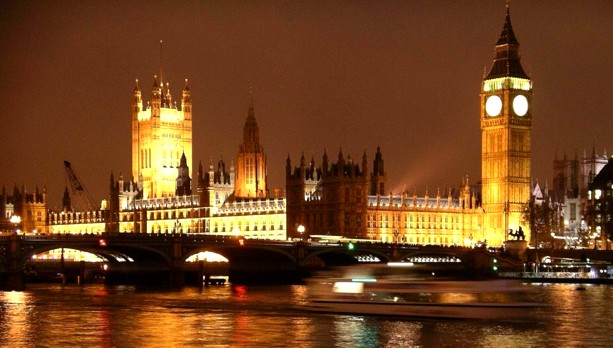
High-achiever Meredith Kercher was born less than one mile south of this famous London landmark
Building An Evidence Mountain
There are really three pictures, not just the one, still to be fully made whole.
- That of Meredith. We believe a family site will soon add to the fine book published by Meredith’s dad.
- That of all of the evidence the court acquired in 2009, which is the sole picture the Italian citizenry takes seriously.
- That of the misleading campaign by the Knox and Sollecito PR shills, leaving some in the UK and US misled.
The Master Evidence List is a key part of the second picture and there are several other media-friendly pages still to come.
Please click here for more
Posted by Our Main Posters on 11/29/14 at 02:53 AM •
Permalink for this post •
Archived in Evidence & Witnesses, Various timelines, Real locations, Real crimescene, Other witnesses, The two knives, DNA and luminol, Computer activity, Cellphone activity, Other physical, Trials 2008 & 2009, Massei prosecution, Massei defense, The Massei Report, Hoaxes against Italy, 3 No evidence hoax, Hoaxes Knox & team, 15 Single alibi hoax, Hoaxes Sollecito etc, 27 Single alibi hoax, Hoaxers from 2007, Amanda Knox #2, Raff Sollecito #2 •
Comments here (10)
Wednesday, October 29, 2014
Analysis #3 Of Testimony Of Dr Chiacchiera, Organized Crime Section: Contradictions Between RS & AK
Posted by Cardiol MD
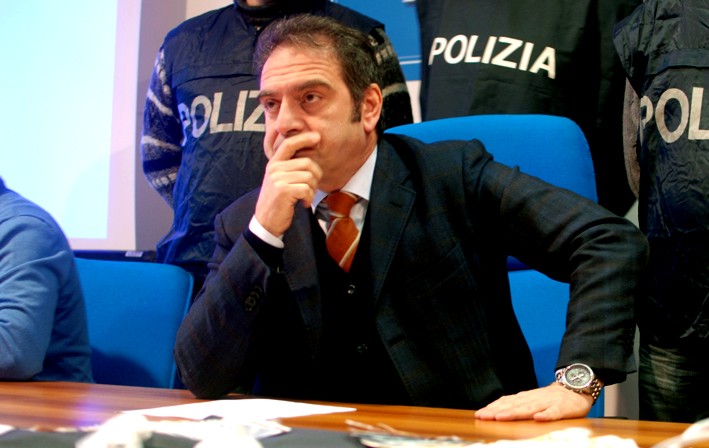
1. Overview Of This Series
In 2007 Dr Chiacchiera was the Director of the Organized Crime Section and the Deputy Director of the Flying Squad.
He was one of the most senior and experienced law enforcement officers to testify at the trial. His testimony and his cross examination by the defenses occupied a lot of time of the court late in February 2009. He covered the following ground.
(1) He found Knox and Sollecito uncooperative when he asked them questions.
(2) Saw evidence contradicting any lone burglar theory and indicating that the “break-In” to Romanelli’s room was faked.
(3) Phone records and the police investigation into the accused phone activity the night of the murder.
(4) Discovery of pornographic magazines at Sollecito’s house.
(5) Details of how the large knife, Exhibit 36, was collected from Sollecito’s and the evidence that it is the murder knife.
Dr Chiacchiera was submitted to cross-examination on the above 5 items by 4 Attorneys for the Defence of Knox and Sollecito, by 2 Civil Party Attorneys, and to Re-examination by the Prosecution. He had a gruelling time as a witness.
All the translation is by the ever-dedicated main poster ZiaK. This series is highlighting some key portions. Here is the full 50-page transcript which will be posted in the trial testimony area of McCall’s great Wiki.
(GCM=Giancarlo Massei; MC=Manuela Comodi; MaCh=Marco Chiacchiera; GB=Giulia Bongiorno; DD=Donatella Donati; CP=Carlo Pacelli; LG=Luciano Ghirga; CDV=Carlo Dalla Vedova; FM=Francesco Maresca)
Continuation of Dr Chiacchiera’s Evidence-in-Chief:
MaCh: It emerged that normally Sollecito kept his cellphones, and also Amanda Knox, they kept their cellphones on until a late hour, evening, [sic] there is no telephone traffic from 20:40 hours. A thing of this “¦
{Witness begins Testimony re cellphones and is interrupted}
MC: But did this emerge from the declarations or did it emerge from the analysis of the [phone] records in the preceding days?
{Examiner interrupts witness with good Q re source of telephone-usage information}
MaCh: It emerged from the analysis of the [phone] records in the preceding days.
{Witness answers clearly}
GCM: Excuse me. Let me understand. In other words you say: the cellphone was switched off and there was no telephone traffic, these are two different things.
{Court asks good clarifying Q}
MaCh: I’m saying, Mr President. Two things. The first, normally Sollecito’s telephone and the telephone of Amanda, were switched on until the late hours. The fatal evening, they were switched off from 20:42 hours until “¦ one [of the phones] from 20:42 onwards and the other from about 20:50 onwards. One. Two, the traffic “¦
{Witness is Answering Court's Q in 2 parts. When he gets to his part #2, Court interrupts}
GCM: Before going on to “Two”, excuse me: “normally” ““ what does that mean? You had “¦
{Court is asking good Q re witness's Part #1, but is interrupted}
MaCh: We had done a comparative analysis of the telephone traffic of that evening with the telephone traffic of the preceding evenings. Shall we say the habits ...
{Witness interrupts Court with narrative response, and is also interrupted}
GCM: And so the “normally” emerges from this?
{Court interrupts witness's response with good Q}
MC: How many evenings? If you recall, or not?
{Examiner asks witness relevant Q, adding redundant Q}
MaCh: Months, no “¦ honestly, I don’t remember how many [evenings], but months.
{Witness stumbles, seeming uncertain re 'evenings' vs 'months'}
MC: I mean to say, not “¦
{Examiner preambles re her redundant Q but is interrupted}
MaCh: Not three days, no. The telephone traffic habits were evaluated. [This is point] one. [Point] Two, the element that emerged, that contradicted the declarations, I can’t report on the declarations but I can report on the element that contradicted [sic. i.e. provided the contradiction], that in effect no telephone call had arrived at 23:00 hours, as had been declared: on the phone line that was declared to have received that “¦ the recipient of that very phone-call. Another element: no interaction with the computer emerged, unlike what was declared. So there were a few objective elements of comparison from the analysis and from the technical checks that contradicted what had previously been revealed.
{Witness interrupts Examiner with narrative response to Examiner's Q, witness indicating contradiction between suspects' declarations and objective records of telephone and computer activity}
MC: For Amanda Knox, were there incongruities of this type?
{Examiner asks if incongruities/contradictions existed for Amanda Knox}
MaCh: Yes, there were incongruities because Amanda Knox was, how to say, contradicted by Sollectio, and then she contradicted herself, if I may “¦
{Witness answers affirmatively, amplifying applicability both to Sollecito & Knox, but is interrupted}
GB: President, if we continue in this way, then we might as well do the old [trial] procedure.
{Giulia Bongiorno, Sollecito's lawyer interjects, objecting-subjectively to Court, but submitting no legal basis for her objection}
GCM: Excuse me, please.
{Court seems to politely rule GB out-of-order}
MaCh: The elements, these are [sic], Mr President, I don’t know how to do.
{Witness communicates uncertainty to Court}
MC: But it is so difficult, however.
{Examiner chimes-in apparently commiserating with her witness's uncertainty}
MaCh: Mr President, I really don’t know what to do.
{Witness seems to repeat statement addressed to Court, who possibly interrupts}}
GCM: Excuse me”¦
{Court seems to begin response to Witness, but is possibly interrupted}
MaCh: If I have to describe the investigation activity “¦
{Witness may be interrupting Court or is continuing Witness's unfinished statement to Court}
MC: He’s not referring to declarations.
{Examiner chimes-in with his opinion re Witness's reference to Defendants' contradictions/incongruities - GB's interjection seems to have side-tracked court procedure}
GCM: Regarding these declarations, you can report on this [sic. i.e. in this instance?], and with regard to Raffaele Sollecito, you reported ““ citing the telephone traffic and citing the use of the computer. There now, and this is one point. With regard to Amanda Knox, you cannot report the declarations. But you may, however, say ““ following these declarations ““ what type of investigations you carried out, and the outcome of these. So, following the declarations given by Amanda Knox, did you do similar investigations, as [those you did] for Sollecito Raffaele on the [phone] records? Or was there nothing to do, except to “¦?
{Court rules on subject of testimony re Defendants' declarations, seeming to rule admissibility of Sollecito's declarations re telephone traffic and computer usage, but inadmissibility of Knox's declarations. Court does seem to permit description of investigations that followed Knox's declarations, without describing Knox's actual declarations, and Court asks whether phone-record investigations similar to those done for Sollecito were done for Knox.}
MaCh: Mr President, all the necessary checks were made, but in that immediate moment the most important element “¦ that is to say, in [this] place [NdT: i.e. “in this Court”], in this moment, in this place, that is to say, when they were “¦ I said [that] when the arrests were made, I don’t, I don’t know how to do, however, the incongruity of the declarations with the facts that we had found, and with the declarations that Sollecito had previously given us, [this] was the most important element. I don’t know if I have managed to “¦
{Witness seemingly responding to Court that he doesn't know how to deal with the declarations, is interrupted.}
GCM: No, excuse me (overlapping voices). So, with regard to Raffaele Sollecito, we have
understood these checking activities were carried out on the declarations made, the verification activities carried out, and [that’s all] very well. With regard to Amanda Knox, if you also carried out “¦ maybe there were no objective elements for possible checking, there were no “¦ or else, there were activities carried out of “¦
{Court, interrupting over witness's testimony, seems to be explaining his Q to witness, but is interrupted by witness}
MaCh: Later, there emerged a series of further elements.
{Witness interrupts with statement re unspecified further elements}
GCM: Not evaluations on the congruity, incongruity, likelihood, these are evaluations and will be done, there you go, comparably. I’m thinking of the [phone] records, of the use, if she had given indications on the basis of which [you] could carry out investigative activity “¦
{Court seems to want evidence in Knox's phone records justifying further investigation.}
Here ends the Testimony Of Dr Chiacchiera covering the relevant Phone Records, elicited by the Prosecution.
Next comes the Testimony Of Dr Chiacchiera elicited by the Prosecution, covering Discovery of pornographic magazines at Sollecito’s house, Details of how the large knife, Exhibit 36, was collected from Sollecito’s and the evidence that it is the murder knife
Posted by Cardiol MD on 10/29/14 at 04:27 AM •
Permalink for this post •
Archived in The officially involved, Police and CSI, Evidence & Witnesses, Faked breakin, The pack attack, Other witnesses, The two knives, Cellphone activity, Trials 2008 & 2009, Massei prosecution, Hoaxes against Italy, 5 No pack attack hoax, Hoaxes re Guede, 33 Sole attacker hoax •
Comments here (5)
Thursday, September 25, 2014
Analysis #2 Of Testimony Of Dr Chiacchiera, Organized Crime Section: Discounting Any Lone Wolf
Posted by Cardiol MD
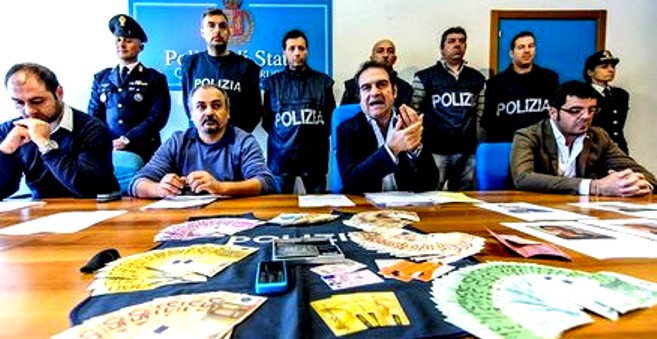
Dr Chiacchiera (talking) with his team explaining reason for charges in another case
Overview Of This Series
In 2007 Dr Chiacchiera was the Director of the Organized Crime Section and the Deputy Director of the Flying Squad.
He was one of the most senior and experienced law enforcement officers to testify at the trial. His testimony and his cross examination by the defenses occupied a lot of time of the court late in February 2009. He covered the following ground.
- (1) He found Knox and Sollecito uncooperative when he asked them questions.
(2) Saw evidence contradicting any lone burglar theory and indicating that the “break-In” to Romanelli’s room was faked.
(3) Phone records and the police investigation into the accused phone activity the night of the murder.
(4) Discovery of pornographic magazines at Sollecito’s house.
(5) Details of how the large knife, Exhibit 36, was collected from Sollecito’s and the evidence that it is the murder knife.
All the translation is by the ever-dedicated main poster ZiaK. This series is highlighting some key portions. Here is the full 50-page transcript which will be posted in the trial testimony area of McCall’s great Wiki.
This post continues analysis of the evidence that the lone burglar/lone wolf theory was not credible to those that were first on the crime scene and that the “break-In” to Filomena Romanelli’s room was to them obviously faked.
(GCM=Giancarlo Massei; MC=Manuela Comodi; MaCh=Marco Chiacchiera; GB=Giulia Bongiorno; DD=Donatella Donati; CP=Carlo Pacelli; LG=Luciano Ghirga; CDV=Carlo Dalla Vedova; FM=Francesco Maresca)
Public Prosecutor Comodi [MC] Leads Testimony
Judge Massei [GCM}: Excuse me a moment, just to give some guidelines, but of the evaluations that the witness is expressing, obviously it’s not that they can be taken account of, however we will acquire them [for the trial files] in order to understand the investigation activities, the appropriateness of the investigations that were carried out, directed in one way or in another, there you go. However, maybe, “¦ there you go, yes, maybe if we can manage to keep with the bare essentials this will help everybody.
{Court proceedings seem to have been diverted into a free-for-all colloquy, with multiple participants chiming-in, and creating confusion. Court-President, GCM, now politely intervenes, apparently trying to restore order, ruling that the professional evaluations made by the witness, testified-to by the witness, should be admitted for the trial files. The appropriateness of the witness's evaluations can be dealt with separately and later.}
Manuela Comodi [MC}: Well, in short, they were called “¦ they are the only ones who can describe the whole progression of the investigations - Dr Profazio and Dr Chiacciera ““ because they are directors, they are the only ones who will come to describe for me, thus, what was the progression of the investigations. Clearly, in order to pass from one investigative act to another rather than “¦ and the choice of the subsequent investigative acts. It’s clear that they have to describe, in order to make a complete reasoning, even the lines of thought that, as Dr Chiacchiera said, it sometimes happens that they make. However, one point: apart from the break-in, apart from the broken window, there are “¦ did you acquire further elements that corroborated the idea that there had been a burglary? Nothing from Romanelli’s room had been carried off? Valuable things had been taken?
{Examiner acknowledges Court's admonition, argues importance of her witness's testimony, and segués into triple-Q addressed to witness re elements corroborating idea of burglary.}
Dr Chiacchiera [MaCh]: This ... in fact, in the progress ...
{Witness begins to answer, but is interrupted by Examiner}
MC: Was a declaration/complaint of theft made then, with a list of the things taken?
{Examiner interrupts witness with new double-Q}
MaCh: In the logical progression, if I may in some way still, in summary, say what “¦.
{Witness begins narrative response but is interrupted by Court}
GCM: Say the objective facts, if you have “¦.
{Court interrupts witness, beginning to admonish him to respond by testifying to objective facts, but is itself interrupted by witness}
MaCh: Nothing disappeared, so a burglar would have had difficulty “¦
{Witness answers 3rd Q of Examiner's above triple Q, but then launches into a narrative beginning: "so…", but Court interrupts}
GCM: Excuse me, nothing had disappeared? Before all else, what thing .... you knew what things were in that room that did not disappear?
{Court interrupts, questioning basis for witness's statement that "Nothing disappeared"}
MaCh: Yes, because, shall we say, the investigation elements that then subsequently emerged, allowed us to deduce that from Romanelli’s room absolutely nothing disappeared. There was a complete mess/chaos, but nothing disappeared from Romanelli’s room. And this is another element to [lead us] to obviously deduce that the desired hypothesis of a burglar and of a theft was objectively “¦ But then the burglar does not [sic] close the door and throw away the key. The burglar does not cover the victim. The burglar “¦
{Witness answers Court's Q, with narrative explanation including reference to "the key", and Court interrupts}
GCM: Excuse me. They key. What is this detail about the key? What is it?
{Court asks Q simple Q re "the key" - with apparent transcriptional error: "They key"}
MaCh: There was no key.
{Witness answers Court's Q}
GCM: There was no key where?
{Court asks simple Q}
MaCh: Those who entered into the inside of the house first found the door closed. A closed door that then aroused the suspicions and that then gave concern and then it was decided to “¦ to break [it] down.
{Witness responds to Court's Q with narrative explanation}
GCM: Excuse me, on [sic] Romanelli’s room there was no key?
{Court asks another simple Q}
MaCh: No, I’m talking of Meredith’s room, Mr President; Meredith’s room was locked by key.
This is another “¦ how to say, the investigative deductions that we drew from these details that emerged, also from the declarations that we gathered.
{Witness responds to Court's Q, and informatively amplifies A}
MC: Was it normal that Meredith closed herself [sic. i.e. her room] by key?
{Examiner asks witness a simple Q}
MaCh: No.
{Witness gives simple A}
MC: And did you find the key of Meredith’s room?
{Examiner asks witness a simple Q}
MaCh: No.
{Witness gives simple A}
MC: So it was closed by key, but there was no key inside?
{Examiner summarises witness's testimony re key and poses a simple Q}
MaCh: But there was no key inside, so that it was necessary to break down the door in order to enter. Also the almost inexplicable detail of the presence of two cellphones in a garden of a house, doesn’t tend to favour the thesis of someone who enters and who accidentally, so to speak, finds a person and then kills them, because [he] is forced to kill them because they have seen [his] face.
{Witness responds to Q in form of confirming-repetition and amplifies A in expanded narrative-form}
MC: But is via Sperandio far from via della Pergola?
{Examiner poses vague Q re proximity of 2 streets}
MaCh: No. And there we tried to deduce. And via Sperandio, as I said earlier, Doctoressa, is not far from the house. We discussed [this] to understand why these telephones went and ended up there “¦
{Witness answers simply, and respectfully, introducing " the house" on one of the streets, seguéing into subject of the mobile telephones and is interrupted by the Court}
GCM: Excuse me. When you say it is not far from the house, can you specify at what distance? How one reaches it?
{The Court's interruption is also vague, with double-Q, referring to an unspecified "it"}
MaCh: Not far from the house means that, by following a route that any Perugian knows, Mr President, one passes through a park and one arrives, let’s say, near the gateway of Porta Sant’Angelo. So for this reason, as the crow flies, how much would it be, but less [sic] “¦ three hundred, four hundred metres. But to reach it by foot from via della Pergola to via Sperandio I think that it doesn’t take more than 5, [or] 7 minutes.
{Witness responds to Court in explanatory narrative form
MC: But do you have to pass by via Garibaldi?
{Examiner asks simple Q}
MaCh: Yes. But you can also pass through the park ““ there’s a park that then comes out right in front.
{Witness answers Q, and amplifies his response}
MC: Of the villa?
{Examiner seeks clarification of witness's response}
MaCh: In front of the villa, at the entry to the villa. Looking from the street that crosses with the provincial [road], the one that, shall we say, borders the villa, whoever is looking at it, I repeat, I ““ who am 44 years old, am Perugian ““ I did not know that there was a garden behind there.
{Witness clarifies his response, amplifying further}
MC: And how far away is via Sperandio from via Garibaldi, corso Garibaldi?
{Examiner asks apparently simple Q}
MaCh: it’s parallel. It’s very close, very very close. It’s 200 metres away, as the crow flies. I think even much less, because they are almost parallel, let’s say. Even that is something that in some way made us understand that there was an interest in getting rid of those cellphones, clearly, by whoever did that thing there.
{Witness gives detailed response;
See: "Just seeing police could panic the killers into instant dumping of the telephones, without even needing to know why the police were where the police were (There is no need to invoke any awareness by the phone-dumper[s] of the reason the Police were near Mrs. Lana's place - the hoax-call.). So if the killers saw flashing police-lights, or any other sign of police near Mrs. Lana's place, that sign could be enough to explain panic phone-dumping - then and there (not considering whether the phones were switched-on or switched-off)." In TJMK: "Updating Our Scenarios And Timelines #2: An Integrated Comparison Of The Timing of the Phone-Events." 6/28/2013}
MC: When you arrived for the first time in via della Pergola, did you enter the room of the crime?
{Examiner asks simple Q}
MaCh: Immediately, no. I went in afterwards, when Dr Mignini also arrived; and later with Dr Lalli. Then I had, how to say, occasionally entered when the crime-scene inspection of the Forensic Police, of the colleagues arrived from Rome, was already begun, so late. I didn’t stop long inside the house, I say the truth, also because the measures/orders that I issued immediately were those, yes, of deducing, [of] drawing out all the investigative elements that might emerge in the immediate surroundings [and/or immediately after the facts] to seek to immediately direct the investigation activity, but also to “freeze” [sic. i.e. to solidify, or to make concrete] another aspect, which was that of hearing/questioning all the people who might tell us details on Meredith’s stay in Perugia, in general, but above all on her final hours, on her visits/visitors, everything about those who Meredith had known in some way and “¦ This was the thing that we considered logical to do precisely in relation to this, to these first investigative deductions that we drew from the [above]-described crime-scene.
{Witness gives detailed narrative reply}
MC: And so that same day you were present when they began to hear/question…
{Examiner begins preamble to presumed Q, but is interrupted}
MaCh: Yes.
{Witness interrupts Examiner with witness's answer to assumed Q}
MC: “¦ the people [who were] acquainted with the facts.
{Examiner completes interrupted Q-in-the-form-of-a-statement, which omits Q-mark}
MaCh: I was present. I did not participate personally in the examination [of witnesses], but I was present, in the sense that both with [my] colleague Profazio and with [my] other colleague from the central operative service”¦
{Witness responds with narrative description of circumstances, but is interrupted}
MC: from Rome.
{Examiner interrupts with her assumed next part of witness's response}
MaCh: from Rome. We began to put the pieces together, excuse my [use of] the expression; that is to say all the “¦ all the elements that emerged from the examination of witnesses, were checked, were gradually verified/cross-checked. Both with cross-checks that enlarged the group of witnesses, of the people to be heard/questioned, and with the checking of the alibis of many people, [as well as] with a technical activity that was carried out.
{Witness confirms Examiner's assumption, and completes his narrative description of circumstances}
MC: That is to say?
{Examiner enquires as to witness's reference to indefinite "technical activity"}
MaCh: A technical activity. A bugging activity was carried out. There was also an activity carried out also for the cross-checking of the phone [activity] printouts. There was an activity to understand also the cross-checking of the [phone] cells. There was a very wide-range activity carried out. Without excluding, I repeat, all also [sic] ... shall we say, the minor hypotheses. For example, the news arrived of a Maghrebi who had been in a rush to wash his own clothes in a launderette, not too far from the scene of the crime. This piece of information was excluded for a very simple reason, because from the first results of the investigative inquiries, he had arrived there in the early afternoon, but instead, in the early afternoon of the day before her death, Meredith was still alive [sic]. Because from the witness examinations we had determined that the last person who had seen her alive, saw her in the late afternoon. After which, we also did another series of checks relative to the one [sic] that there was a strange telephone call that the people who found the cellphones in the famous villa, the beautiful one on via Sperandio, had received in the evening. However, we had, how to say, understood that it was a case of a boy who had made a call from Terni and of a strange coincidence, but absolutely irrelevant for the investigation activity. Indeed, we made checks on all the hospitals in order to evaluate, to check, whether maybe there were [patients] who had presented blade/cutting wounds that in some way might have been compatible with a wound, let’s say, or at any rate with a reaction by the victim. Only one had presented, it was a [person] from Foligno who, [while] cutting salami, had cut their hand during the trip back from an away-game with Foligno ““ he was a football fan. Nothing else. So no investigative hypothesis was rejected. It was, obviously, because this is how it is done, and thus I believe that it is logic, we began to discuss/think in a certain way, because we had deduced from all this scen, another series of further elements, that is to say that the person “¦.
{Witness responds with prolonged narrative re "technical activity" and seems to pause}
MC: Speak. Don’t be afraid to say it.
{Examiner urges witness to continue}
MaCh: No, no. I’m not afraid.
{Witness argues with Examiner}
MC: That is, let’s say, when was it that the investigations turned to, [started] to focus on today’s defendants?
{Examiner asks simple Q}
MaCh: When on the evening of “¦ they did not focus on today’s defendants, that is to say, progressively the analysis of the investigative elements made us “¦ made us start, even us, to suspect. Because going into a house, finding a [sic] door of Meredith’s room closed, a [sic] door of the apartment opened, faeces in the toilet [bowl], while I take a shower, a series of bloody prints”¦
{Witness responds in narrative form and is interrupted}
MC: However the faeces were in which of the two bathrooms?
{Examiner interrupts witness with clarifying Q}
MaCh: Of the bathrooms. Me, if I take a shower in a bathroom where there are faeces, instinctively I flush the toilet, in short.
{Witness makes non-responsive subjective statement and is interrupted}
MC: Yes, but the faeces were in the other bathroom.
{Examiner engages witness in argument}
MaCh: Yes, yes, I understood. However, in short, in some way it comes instinctively, no?, to flush the toilet? The fact is that “¦.
{Witness joins argument and is interrupted}
GCM: Excuse me, do you know how many bathrooms there were in the house?
{Court interrupts argument with simple Q}
MaCh: Two.
{Witness ignores actual Q and responds with answer to assumed follow-up Q}
GCM: Two bathrooms. Excuse me, please. Do you know that a shower was taken?
{Court asks another simple Q, using vernacular ref. to whether a person used the shower, rather than that the the shower device was taken away.}
MaCh: Yes.
{Witness answers Court's actual Q}
GCM: How do you know?
{Court asks simple follow-on Q}
MaCh: I know because it is a thing that I cannot, I believe, report because it was “¦.
{Witness seems to answer in non-responsive, subjective narrative form, and is interrupted}
GCM: But you checked”¦?
{Court seeks objective answer to his simple Q}
MaCh: I am trying to be very very careful.
{Witness hints that he has reasons for apparent evasion}
Giulia Bongiorno [GB]: Mr President, we are talking of nothing.
{Sollecito's lawyer chimes in with distracting comment}
GCM: Excuse me, Attorney.
{Court appears to admonish GCM not to chime-in without specified legal-objection}
MaCh: Well, the main point [is] that very slowly we began to understand that there were strong inconsistencies in the revelations that were made. And there were behaviours that on the part of above all, indeed exclusively, of Sollecito and Knox, appeared to us as [being], at the very least, particular. Behaviours both immediately after the event ““ a sort of impatience/irritability shown [with regard to] the investigation activity that we were carrying out, and obviously we could not but ask [NdT: i.e. “we had to ask”] those who were close to Meredith [about] elements that we considered useful, even necessary, in order to continue the investigation activity.
{Witness launches into apparent justification for his evasiveness}
MC: Excuse me if I interrupt you. I’ll just make a few precise questions, thus: you checked, let’s say, let’s call them alibis, even if it’s a term that’s very so [sic] from American TV films, but in any case [it’s] understandable”¦ Did you check the alibis of the people closest, let’s say, to Meredith?
{Examiner, after preamble, asks relatively simple Q}
MaCh: Yes.
{Witness answers Q as phrased}
MC: In particular, did you check the alibis of the young men from the [apartment on] the floor below?
{Examiner asks simple Q}
MaCh: Yes.
{Witness answers Q as phrased}
MC: Results?
{Examiner poses Q in casual form}
MaCh: Positive for them, in the sense that they were at home, in their own home, that is to say their respective houses, because they were here for reasons of study, so they were not present in Perugia during the days when “¦
{Witness responds with allusive casual A, begins to amplify, but is interrupted}
MC: Because they had left for “¦
{Examiner interrupts with suggestion for next part of witness's response}
MaCh: Yes, for the All Souls’ Day long-weekend, let’s call it that.
{Withess reacts to Examiner's suggestion by stating reason for upcoming week-end absence, but not stating week-end destination}
MC: Did you check the alibi of Mezzetti and of Romanelli?
{Examiner asks double Q}
MaCh: Yes.
{Witness answers for both Qs}
MC: Results?
{Examiner poses Q in casual form}
MaCh: The result in this case also [is that] Mezzetti and Romanelli were not there, so “¦
{Witness gives clear Answer, apparently begins explanation, but is interrupted}
GCM: Excuse me, can you say what checks you did?
{Court interrupts witness's testimony to ask Q re witness's method}
MaCh: We carried out a whole series of checks that brought us to evaluate, establish, that these persons were not present in the premises that evening.
{Witness ignores Court's Q as phrased and answers anticipated next Q}
MC: Let’s say, I imagine that you heard/questioned them.
{Examiner makes statement-in-form-of-Q with ?-mark omitted}
MaCh: Yes.
{Witness answers presumed Q}
MC: Did they tell you where they were that evening, what they did that evening”¦?
{Examiner seems to interrupt and asks double-Q}
MaCh: And in effect, we assessed/considered that “¦
{Witness ignores Q-as-phrased and is apparently interrupted}
MC: And you ascertained that in effect “¦
{Examiner apparently interrupts A and continues his interrupted multiple Q}
MaCh: That it was true what they had told us. I can report on the circumstance.
{Witness seems to continue his interrupted answer and offers to expand his narrative.
Q &A cycle is confused and confusing because of repeated multiple Qs, instead of orderly single Q & A}
MC: Did you check the alibi of Amanda Knox and of Raffaele Sollecito? Was there a comparison between the declarations of Amanda Knox and of Raffaele Sollecito with regard to the night of the murder, and what you were able to compare, shall we say, objectively, through the other declarations, through the phone records?
{Examiner asks multiple Qs}
MaCh: Through the phone records and through the checks [that were], shall we say, objective, it was found that what Sollecito had declared was not truthful because there was a phone call that was never received [i.e. answered] by Sollecito at 23:00 hours. Because it turned out that there was no interaction with the computer, but I believe that this “¦ as declared [sic]. But above all there was an absolute incongruity of the “¦.
{Witness summarizing findings wrt phone records, is interrupted}
GCM: There now. Excuse me. Maybe we will not ask the question in these terms: following the declarations, on which you cannot report, that you got from and that were given by Amanda Knox and Sollecito Raffaele, what type of investigations you carried out”¦
{Court interrupts to restrict Qs but is interrupted}
MaCh: We carried out ...
{Witness interrupts Court's interruption and is interrupted}
GCM: ... and the outcome of these investigations. There now. This is where we’re at.
{Court completes it's interruption, seeming to believe he has made himself clear, but confusion still reigns}
MaCh: Well, in summary ...
{Witness begins a summary, but is interrupted}
GCM: Following the declarations given by them, you had “¦ With regard to Sollecito Raffaele, what did you do and what [information] emerged?
{Court interrupts witness with double-Q}
MaCh: It emerged that, unlike “¦
{Witness begins to answer Court's 2nd Q, but Court interrupts}
GCM: What did you do, first?
{Court repeats1st Q}
MaCh: We did an analysis of the telephone traffic, and from the analysis of the telephone traffic it emerged that Sollecito had absolutely not received/answered the 23:00 hours phone call as he had declared. From the analysis of the telephone traffic, there then emerged a very strange detail, in the sense that the cellphones “¦
{Witness answers 1st Q, begins answering 2nd Q, and is interrupted by Sollecito's lawyer}
GB: (overlapping voices) “¦ continue with the opinions/judgements, with all the opinions/judgements.
{Sollecito's lawyer seems to demand comprehensive testimony}
GCM: That which emerged.
{Court makes seemingly cryptic statement which is probably a Q relating to witness's interrupted A to Court's 2nd Q above: "It emerged that, unlike "¦" }
MaCh: A detail/particular emerged ... unlike what “¦. (overlapped voices).
{Witness resumes testimony but is interrupted, multiple voices are heard}
GCM: Excuse me. What emerged?
{Court asks witness to clarify what witness was saying}
_____________________________________________
Here ends the Analysis of the Evidence #2, discussing that the lone burglar theory is not credible, and that “Break-In” to Romanelli’s room was faked.
The next Post: Analysis of the Evidence #3, will Analyse the Phone records and the police investigation into the accused phone activity the night of the murder.
Posted by Cardiol MD on 09/25/14 at 03:22 AM •
Permalink for this post •
Archived in Defendants in court, Rudy Guede, The officially involved, Police and CSI, Evidence & Witnesses, Faked breakin, The pack attack, The two knives, Cellphone activity, Trials 2008 & 2009, Massei prosecution, Hoaxes against Italy, 5 No pack attack hoax, 6 No staging hoax, Hoaxes re Guede, 33 Sole attacker hoax •
Comments here (31)
Tuesday, October 22, 2013
The Meredith Case Wiki: A Highly Objective Summation Of The Case From Original Docs And Transcripts
Posted by James Raper
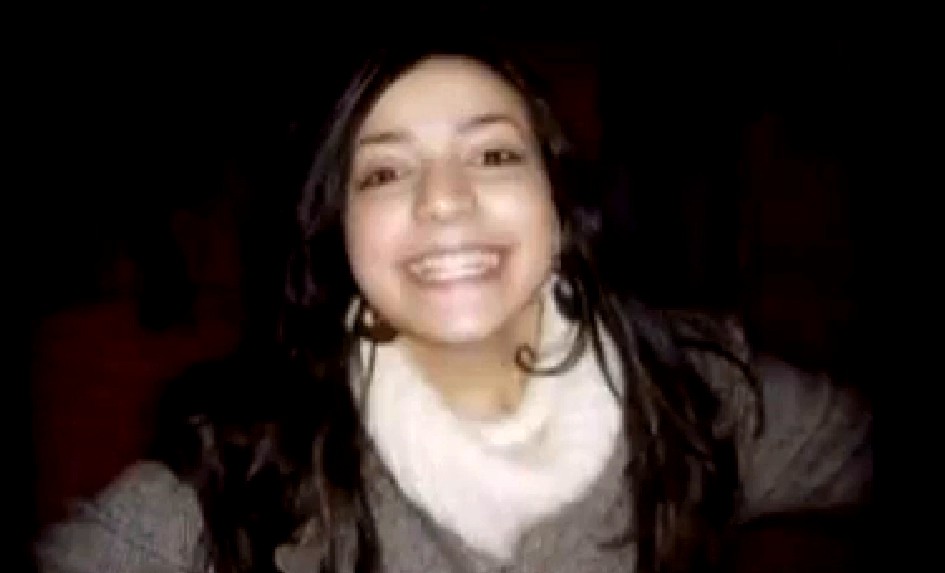
Some of our readers may not have noticed the new link to The Meredith Case Wiki to be found in the left hand column of this front page. I had not noticed it myself until recently.
This is an important link to a new website that is now a vital additional resource for those interested in understanding this case.
The website - The Murder of Meredith Kercher - is run by Edward McCall, with the assistance of other contributors, and TJMK is pleased to acknowledge and promote its distinctive and concise approach to presenting the facts of the case.
The site is modelled on the format of a page from the Wikipedia free encyclopedia. As with a Wiki page it is easily navigable. The data presented under the various headings is the consequence of much research but it still remains a work in progress. Wherever possible the material used is referenced in footnotes.
It starts on the Main page with a Mission Statement and an Introduction to the case. It then considers the evidence and has a good section entitled Myths Debunked.
The reader can easily access significant court documents: the Massei Report, the Hellmann Report, the Galati Appeal and the Supreme Court of Cassation Motivations Report. There is an accessibly summary of the Matteini and Micheli Reports.
In particular, for the researcher, there is a most welcome section entitled Court Transcripts. Here can be found transcripts of witness testimony from the Massei and Hellmann trials, experts reports, and the various writings and testimony of Amanda Knox, Raffaele Sollecito and Rudy Guede. At least that is to be the hope ultimately as there exist a good number of gaps at present.
Already some of the witness statements have been translated from Italian to English but there are a number of transcripts still to be translated. If there are any translators who would wish to help, please contact us and we shall be pleased to put your name forward.
McCall wishes to acknowledge the massive contribution made by True Justice for Meredith Kercher. TJMK has perforce grown organically and exponentially over the years and has accumulated a breadth and wealth of data, in-depth analysis and informed comment on the case which is unsurpassed on the internet, or indeed anywhere.
It will continue to do so and report developments until the conclusion of all aspects of the case.
Posted by James Raper on 10/22/13 at 06:09 PM •
Permalink for this post •
Archived in Evidence & Witnesses, Various timelines, Questionings, Real locations, Real crimescene, Faked breakin, Other witnesses, The two knives, DNA and luminol, Computer activity, Cellphone activity, Other physical •
Comments here (45)
Friday, June 28, 2013
Updating Our Scenarios And Timelines #2: An Integrated Comparison Of The Timing of the Phone-Events
Posted by Cardiol MD
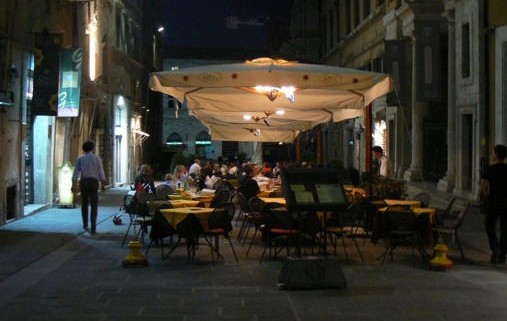
[Above and below: what Meredith missed, outside dining in Perugia at night]
1. Point of our series
TMJK’s core focus has long been upon “What happened at 7 Via della Pergola, in Perugia, on the night of November 1-2, 2007?”
Over the last 4+ years, more than 20 TJMK posts, with more than 400 comments, have addressed the subject of possible scenarios and timelines for those events. They represent a lot of thought and many are worth reading if you haven’t come across them before.
This post is the second in a series that will reappraise the more probable speculations, using the current state of our information. The first post was four weeks ago.
Reader comments in response to Part 1 amply reflect readers’ interest in exploring the various “˜open Questions’ referred-to, and how efforts to make Knox and Sollecito confront the true answers are obfuscated by their falsehoods.
The Truth of the actions of Knox and Sollecito on November 1st & 2nd, 2007, is so precious to them that they attend that Truth with a “˜Bodyguard of Lies’, to borrow Winston Churchill’s famous WW11 dictum. They even further obfuscate the answers to our questions by selectively employing a Bodyguard of Actual Truths.
The aim of their broken drain-pipe under the sink story (see previous post) was to persuade investigators, and everyone else:
1. That there was a broken drain-pipe under the sink (Massei Translation p.67), and
2. That the alleged water-leak occurred BEFORE the murder.
Their obfuscations include:
1. The omission of references to incriminating truths, e.g. omission of references to the hammer-toe on RS’s right-foot, one of his most incriminating physical attributes (see representative image of a right-foot hammer-toe below), and
2. The inclusion of “Half” truths, and
3. The inclusion of references to non-incriminating truths.
2. Integrated timing of phone events
This post is an integrated comparison of the timing of the phone-events byy coordinated universal time, merging Massei’s sections on Amanda Knox [AKP], and Meredith Kercher [MKP], as well as that of Rafaelle Sollecito [RSP].
[For the day of 31.10.07 it was shown that Meredith’s mobile phone with service provider Vodafone 348-4673711 sent an SMS at 18:27:50 hours using the cell at Piazza Lupattelli sector 7. (this signal is received in Via della Pergola 7.)
The same number received an SMS at 18:29:05 hours (this exchange of messages took place with the number 388-8921724) connecting to the same cell.
[RSP]: − on 31.10.07 Raffaele received *a call+ from the father’s fixed line (No. 080-3958602) at 22:14 for 44 seconds.
With respect to Sollecito’s mobile phone 340-3574303, attention was paid to the entire day of 1.11.07 with the following results]
Which help establish a less-suspicious baseline for comparison with later, more-suspicious results.
[RSP]− 00:00:39 an outgoing call, just after midnight
The phone traffic with regard to the day of 1.11.07 was reconstructed in the following terms (cfr. statement of Assistant Stefano Sisani at the hearing of 20.3.09).
AKP− 00:41:49 hours: outgoing phone call of 20 seconds, to a number whose holder was not identified
RSP− on 1.11.07 *he+ called the father’s house at 00:02:41 for 262 seconds
AKP− 00:57:20: Amanda’s mobile phone sent an SMS, using the cell on Via dell’Aquila 5-Torre dell’Acquedotto sector 3 (which does not provide coverage to Sollecito’s house, since it pertains to Via Ulisse Rocchi, Piazza Cavallotti, etc. and therefore at the heart of Perugia’s historic center). This consisted of the SMS which the young woman exchanged with Raffaele at the end of the Halloween evening to arrange meeting up with her boyfriend and be accompanied home
RSP− 00:57 an incoming SMS 319
AKP− 1:04:58: Amanda’s mobile phone received *a call+ for 53 seconds from the number 075/9660789, located in Piazza Danti 26
RSP− 14:25 an incoming call which lasted 58 seconds
RSP− 16:50 an incoming call, coming from the mobile phone of the father, lasting 214 sec.
RSP− 16:56 another call from the father (64 sec.)
AKP− 20:18:12: Amanda receives the SMS sent to her by Patrick Lumumba, which let her off from having to go to work at the “šLe Chic”› pub on the evening of 1 November. At the time of reception the phone connected to the cell on Via dell’Aquila 5-Torre dell’Acquedotto sector 3, whose signal does not reach Raffaele Sollecito’s house. The young woman was therefore far [i.e. absent] from Corso Garibaldi 30 when the SMS reached her, as she was walking in an area which was shown to be served by the Via dell’Aquila 5-Torre dell’Acquedotto sector 3 cell. This point of her route could correspond to Via U. Rocchi, to Piazza Cavallotti, to Piazza IV Novembre, bearing in mind that Lumumba’s pub is located in Via Alessi, and that Amanda Knox would have had to travel along the above-mentioned roads and the piazza in order to reach the pub
AKP− 20.35.48 Amanda sent an SMS in reply to Patrick, at No. 338-7195723; the message was sent when the young woman’s mobile phone was in Corso Garibaldi 30 or in the immediate neighbourhood. The cell used, in fact, was that of Via Berardi sector 7 − no other [use] was shown for the day of 1.11.07, noting that Amanda declared during hearings that she had switched her mobile phone off once she had returned 323 to Raffaele’s house, since she was more than happy she did not have to go to work and could spend the evening with her boyfriend.]
Knox may also have been LESS than happy that Lumumba preferred Meredith instead of Knox as an employee. This was humiliating-enough to Knox for Knox to decide that the time to cut Meredith down-to-size was now.
[RSP− 20:42:56 call from the father (221 seconds: this is the conversation which Dr. F. Sollecito referred to, made at the end of the film he had just seen in the cinema, which the father recommended to the son, at which point [it is said that] Raffaele informed his father of a problem with a broken drain-pipe under the sink in the kitchen”. ]
Massei Translation page 25: On “the evening of November 1, 2007 at around 10:00 pm, someone called and warned Elisabetta Lana not to use the toilet of her dwelling because it contained a bomb which could explode. Mrs. Lana immediately notified the police of this phone call; and they came to the house but did not find anything. Mrs. Lana and her husband were nonetheless asked to go to the Postal Police the next day to report said telephone call.”
MKP ““ 20:56 hours on 1 November 07, attempted call to Meredith’s mother’s home in England.
MKP ““ 21:58 hours on 1 November 07, attempted call to mobile phone’s answering service, voicemail “˜901’.
MKP ““ 22:00 hours on 1 November 07, dial to Meredith’s London bank “˜ABBEY’.
MKP ““ 22:13:29 hours (9 seconds) on 1 November 07, attempted internet connection. Connection consistent with being attempted from cottage, but inconsistent with being attempted from Mrs.Lana’s.]
Massei Translation, page 331, attributes the above 4 dialings to Meredith absent-mindedly playing with the mobile phone in her hand, and her phone may well have still been in her hand when her attackers surprised her.
Question: Was Meredith’s Phone still in the cottage at Via della Pergola at 22:13:29 hours on 1 November 07? Yes.
At about 22:30 hours Car broken-down nearby. Tow-Truck called-for.
At about 23:00 hours Tow-Truck arrives to load car.
At about 23:13 hours Tow-Truck leaves with loaded car.
[RSP- 23:41:11 RS’s father attempts phone-call but makes no oral contact. Father leaves message which is not received until 06:02:59 on 2.11.07.]
This 23:41:11 call was attempted during the very time-frame of the attack on Meredith, her murder, and the flight of her killers with her mobile telephones. Meredith’s Phone[s] were removed from her cottage by about Midnight, less than 20 minutes after this attempted call.
With regard to the day of 2.11.07:
[for 2.11.07 the first record is that of MKP - [0]0:10: 31, “when it has been established as an incontrovertible fact that Meredith’s English mobile phone was no longer in Via della Pergola, the mobile phone having received the contact under the coverage from Wind signal [cell] ..25622, which is incompatible with the cottage.”]
Question: Was Meredith’s Phone still in the cottage at Via della Pergola at 00:10: 31, 2.11.07? No!
Therefore Meredith’s English mobile phone had been removed from her cottage between 10.13.39 p.m. on 1.11.07 (more likely 11.13 p.m. when tow-truck departed) and 0:10:31 on 2:11:07; about 10 ½ minutes after midnight ““ say Meredith’s Phone[s] Removed By About Midnight, allowing for the time-elapse before being dumped near Mrs. Lana’s place. (Hellmann obfuscated this time-span on page 14 of his report, implying it to be more than 10 hours after midnight rather than about 10 ½ minutes after midnight.)
At some time before Meredith’s attackers fled, they had seized her mobile telephones, probably near the beginning of the attack, having started their attack with a pre-emptive strike to intimidate Meredith, remove all hope, surround her, display knives, seal all possible escape-routes, and remove any possibility of phone-calling for help.
Immediately after Meredith’s scream her attackers had silenced her with the fatal stabbing, and then fled immediately.
They fled with her already-seized but still switched-on mobile telephones, probably without locking anything, including Meredith’s door.
Their over-riding and 1st imperative was not-to-be-caught-at-the-crime-scene.
Having abruptly fled the crime-scene their 2nd imperative was not-to-be-caught-in-possession-of-Meredith’s-telephones.
Avoid Police!
Just seeing police could panic the killers into instant dumping of the telephones, without even needing to know why the police were where the police were (There is no need to invoke any awareness by the phone-dumper[s] of the reason the Police were near Mrs. Lana’s place - the hoax-call.). So if the killers saw flashing police-lights, or any other sign of police near Mrs. Lana’s place, that sign could be enough to explain panic phone-dumping - then and there (not considering whether the phones were switched-on or switched-off).
In “Darkness Descending” page 13, it states:
Mrs. Lana’s backyard overlooks a steep slope that falls sharply into the valley below. It is heavily overgrown with trees and bushes, an ideal place to dispose of evidence. If the phones had fallen just a few yards further, they would certainly have gone over the edge of the cliff, down into a 50m gully, straight into a thick scrub of nettles, and probably been lost forever”¦.
In “Death in Perugia” Follain states (Book page 62; Kindle Locations 343-6), apparently as his opinion re Lana’s daughter finding Meredith’s English phone: “It was hidden in some bushes, and she would never have found it if it hadn’t started ringing.”,
Having accomplished this 2nd imperative, Meredith’s killers paused to attend to their 3rd imperative: re-model the crime-scene, minimising the evidences of their identities, cleaning-up the evidences that it was “˜an inside job’, and simulating the appearances that it was “˜an outside job’.
One should bear in mind that these killers should have still been overwhelmed by their having actually committed a crime beyond their wildest imaginings.
Their panic impaired their thinking, and their ignorance, immaturity, inexperience, lack of technical resources and their arrogance precluded their selecting deceptions more effective against knowledgeable, experienced professional crime-investigators with a large fund of resources. They probably think that throwing the stone from inside Filomena’s room was a brilliant deception.
They wish it had never happened.
They wish they could make it unhappen (Hellmann/Zanetti got close to fulfilling this wish, but got themselves unhappened by Cassation)
They wish they could prevent the discovery of Meredith’s murder.
They cannot prevent the discovery of Meredith’s murder.
They may be able to postpone its discovery, but not longer than the inevitable return of the cottage-mates, later that day.
They believe that the person who “˜discovers’ a murder may become 1st-suspect.
They may be able to manouevre others-than-themselves into being the ones that make the discovery ““ quite a wily aim.
It is beyond reasonable doubt that
1. Meredith’s killers seized her mobile telephones, and that
2. Her killers did not switch-off these mobile telephones, and that.
3. Her killers threw the telephones into an apparent ravine, landing in Mrs.Lana’s garden, and that
4. This phone-dump was accomplished before 00:10: 31, 2.11.07, and that
5. Amanda Knox caused:
- i. the English phone to ring at 12:07:12 (16 seconds) and be discovered by Mrs.Lana’s daughter only because it rang , and
ii. the other phone, registered to Filomena Romanelli, to ring, very briefly, at 12:11:02 (3 seconds) and,
iii. the English phone to ring again, also very briefly, at 12:11:54 (4 seconds), after being brought into Mrs.Lana’s house.
6. Sollecito had more than 5 days, from about 11.30 pm on November 1st, 2007 until November 6, 2007, to remove from the killing-knife the traces of Meredith’s DNA.
In the opinion of the Court of Assizes (Massei Translation p.325), Amanda Knox’s call to Meredith’s phone was
...the first indispensible step before putting the [348] planned staging into action. The lack of a reply, since the poor girl was obviously already dead, gave a reason for reassurance about the fact that the young woman’s phone had not somehow been retrieved, [and] was therefore safe in the spot where it had been thrown, which, according to the expectations [in the minds] of the murderers was a precipice or some other inaccessible spot, rather than in the garden of a villa located barely outside the city, where the vegetation concealed it from view.
A plausible alternative opinion is that Knox’s calls to the obviously already dead Meredith were an obfuscatory stab to simulate what Knox imagined an innocent person would do.
Knox may well have expected that she was safe from phone-discovery, but these calls turned out to be the very instrument of a phone-discovery.
Had Knox not made these obfuscatory stabs, in the time-frame she made them Meredith’s phone would not have rung when it did ring and would therefore not have been discovered by Mrs, Lana’s daughter when she did discover it.
For the day of 2.11.07, when Meredith was already dead, the traffic registered for the Vodafone number was shown to be the following:
[MKS ““ 00:10:31; duration and caller unspecified, but Wind signal [cell] incompatible with cottage, but compatible with Mrs. Lana’s place.
Therefore, Meredith’s mobile cell-phone had already been taken away from the cottage by her killers. It is not possible to determine from this phone-record whether the phone was switched on or off, but this phone was discovered at Mrs. Lana’s place because it was ringing, and therefore was “on”.
MKS− 12:11:02 (duration of 3 seconds): Amanda’s phone call reached the phone and was diverted to the answering service. The Vodafone cell used by Meredith’s service provider was situated in Strada Vicinale S. Maria della Collina sector 1.
AKP− 12:11:54 (4 seconds): another call is made towards Meredith’s English mobile phone number (the cell used is the one in Via dell’Aquila 5-Torre dell’Acquedotto sector 3, thus compatible with Sollecito’s house)
RSP− 06:02:59 Raffaele Sollecito received the SMS from his father wishing
Raffaelle a good night; from the evidence of the mobile phone record printouts of Dr. Francesco Sollecito, it was shown that the sending of the message occurred at, as has been said, 23:41:11 of 1.11.07. This was the last SMS sent from that mobile phone during the whole day of 1.11.07]
3+ Hours after receiving his father’s message from 23:41:11 of 1.11.07:
[RSP− 09:24 Raffaele Sollecito received a phone call from his father lasting 248 seconds]
At this time RS’s consiousness would be dominated by his guilty knowledge, and probably far-advanced in the accomplishment of the 3rd imperative.
Did RS and father spend 4+ minutes discussing the weather?
This is the first father/son opportunity to formulate the two-pronged water-leak story.
Although AK had already been to the hardware store 2 hours before, they may well not have known the potential DNA problems with the knife, the need to scrub it vigorously, to clean-out, and repair the drain-pipes under the sink, and the need to return the knife to RS’s kitchen drawer.
As it turned-out, Sollecito had more than 5 days, from about 11.30 pm on November 1st, 2007 until November 6, 2007, to remove from the killing-knife the traces of Meredith’s DNA.
They probably did not know that incriminating stains could be invisible, but can be revealed byLuminol.
RSP− 09:29 another call was received lasting 38 seconds
RSP− 09:30 (duration unspecified?) the father called Raffaele; the call connected to the Vial Belardi sector 7 cell.(the best server cell for Corso Garibaldi 30).]
These two calls were probably spent dotting “˜i’s, crossing “˜t’s, and exchanging options, such as enlisting sister Vanessa’s skills and contacts.
Another 2+ Hours later:
[AKP− 12:07:12 (duration of 16 seconds) Amanda calls the English phone number 00447841131571 belonging to Meredith Kercher. The mobile phone connects to the cell at [346] Via dell’Aquila 5-Torre dell’Acquedotto sector 9 (the signal from this cell is picked up at Sollecito’s house)
AKP− 12.08.44 (lasted 68 seconds) Amanda calls Romanelli Filomena on number 347-1073006; the mobile phone connects to the Via dell’Aquila 5-Torre dell’Acquedotto sector 3 cell (which covers Sollecito’s house)
Discovery will be inevitable when Filomena eventuallyarrives-back at the cottage.
AK/RS have accepted that they have to “˜stand-pat’ with their efforts so-far to accomplish their 3rd imperative.
Amanda did not say a word in this phone-call to Filomena about Amanda’s phone call to Meredith, thereby withholding information that should have led Amanda to initiate discovery of Meredith’s body, and help Amanda to manouevre someone other than Amanda into being the one who “˜discovers’ Meredith’s body.
AKP− 12:11:02 (3 seconds) the Vodafone number 348-4673711 belonging to Meredith (this is the one [i.e. SIM card] registered to Romanelli Filomena) is called and its answering service is activated (cell used: Via dell’Aquila 5-Torre dell’Acquedotto sector3)
MKS: For the day of 2.11.07, when Meredith was already dead, the traffic registered for the Vodafone number was shown to be the following:
− 12:11:02 (duration of 3 seconds): Amanda’s phone call reached the phone and was diverted to the answering service. The Vodafone cell used by Meredith’s service provider was situated in Strada Vicinale S. Maria della Collina sector 1.
AKP− 12:11:54 (4 seconds): another call is made towards Meredith’s English mobile phone number (the cell used is the one in Via dell’Aquila 5-Torre dell’Acquedotto sector 3, thus compatible with Sollecito’s house)
AKP− 12:12:35 (lasting 36 seconds) Romanelli Filomena calls Amanda Knox (No. 348-4673590); Amanda receives the call connecting to the cell on Via dell’Aquila 5-Torre dell’Acquedotto sector 3 (still at Raffaele’s house)
AKP− 12:20:44 (lasting 65 seconds) Romanelli F. calls Amanda, who receives the call connecting to the cell in Via dell’Aquila 5-Torre dell’Acquedotto sector 9 (good for Corso Garibaldi 30)
AKP− 12:34:56 (48 seconds): Filomena calls Amanda who receives it from the cottage on Via della Pergola 7 (the cell used is that on Piazza Lupattelli sector 7. As mentioned, Raffaele also used the same cell when he called the service centre at 12:35 hours to recharge [the credit of] his mobile phone)
RSP− 12:35: Raffaele’s mobile phone contacted a service centre for a phone [credit] recharge (the cell used was that of Piazza Lupattelli sector 7, which gives coverage to the little house on Via della Pergola 7. The signal in question does not reach Corso Garibaldi 30, which instead is served by the signal from Piazza Lupattelli sector 8)
RSP− 12:38: Vodafone sent a message of confirmation of phone [credit] recharge (Piazza Lupattelli sector 7 cell, good for Via della Pergola 7)
RSP− 12:40: incoming call from the father’s mobile phone (lasting 67 seconds; connection through Piazza Lupattelli sector 7 cell, compatible with the Sollecito’s presence near the little house)]
Do RS and father exchange caveats?
[AKP− 12:47:23 (duration of 88 seconds): Amanda calls the American (USA) number 00120069326457, using the cell on Piazza Lupatetlli sector 7; the phone call takes place prior to the one which, at 12.51.40, Raffaele Sollecito will make to “š112”›, connecting to the cell on Via dell’Aquila 5-Torre dell’Acquedotto sector 1, which gives coverage to Via della Pergola 7]
In “Waiting To Be Heard” Knox can hardly deny having made this 1st call, acknowledges making the call, and purports, now, to recall its substance, providing the reader with her version of what was said.
[AKP− 13:24:18 (duration of 162 seconds): Amanda calls the same American number which corresponds to the home of her mother, Mrs Edda Mellas, using the same cell. It is obvious that the young woman is inside the cottage, where by this point, several minutes earlier, the Postal Police had shown up, [347] represented by Inspector Battistelli and Assistant Marzi, who were engaged in the task of tracking down Filomena Romanelli, who was the owner of the Vodafone phonecard contained in the mobile phone found earlier in the garden of the villa on Via Sperandio]
In “Waiting To Be Heard” Knox can hardly deny having made this 2nd call either, she acknowledges making the call, and provides the reader with her current version of what was said.
[RSP− 12:50:34 outgoing call directed at mobile phone 347-1323774 belonging to Vanessa Sollecito, sister of the defendant; duration 39 seconds. Connection to Piazza Lupattelli sector 7 cell 320
RSP− 12:51:40 Raffaele Sollecito called “š112”› to inform the Carabinieri of the presumed theft in Romanelli’s room (duration 169 seconds; connection to Via dell’Aquila 5-Torre dell’Acquedotto sector 1 cell, which covers Via della Pergola 7)
RSP− 12:54: a second call by Raffaele to “š112”› (57 sec.; connection to Piazza Lupattelli sector 7 cell)
MKS− 13:17:10 (lasting 1 second): the cell used was located in the same place, sector 7
AKP− 13:27:32 (duration of 26 seconds): Amanda calls the American number 0012069319350, still using the cell at Piazza Lupattelli sector 7.
AKP− 13:29:00 (duration of 296 seconds) Amanda receives [a call] from No. 075/54247561 (Piazza Lupattelli sector 7 cell)
RSP− 13:40:12: incoming call from the father (94 sec.; Via dell’Aquila 5-Torre dell’Acquedotto sector 1 cell)]
AKP− ?13:48:33 (1 second): this is an attempted call to her mother’s number
““ see below at 13:58:33
AKP− 13:58:33 (1 second): this is an attempted call to her mother’s number
The above item is a faithful translation from the Massei Motivazione section on Amanda Knox’s mobile phone traffic, but is listed out-of-time-sequence; the assigned-time is probably a “˜typo’ ““ “13:48:33” is much more likely correct.
[RSP− 14:33: the father called for 21 seconds (as above)]
Do RS and father exchange more caveats?
[AKP− 14:46:14 (102 seconds) Amanda receives a call from the German number 494154794034, most likely belonging to her aunt Doroty Craft
MKS− 15:13:43 (5 seconds) cell not indicated.
AKP− 15:31:51 (1 second): Amanda receives an SMS sent from the number 389/1531078; at this point the cell being used is the one on Via Cappuccinelli 5/A sector 2, where the Questura [police headquarters] is located
In the hours that followed the [mobile phone record] printouts show that the answering service of Amanda’s number 348-4673590 was activated due to a lack of signal coverage.]
Massei Translation p.324:
Finally, the analyses of the [phone record] printouts highlight that the first phone call made by Amanda on the day of 2 November was to Meredith Kercher’s English number.
The American student called her English flatmate even before contacting Romanelli Filomena to whom she intended to express, as she testified in court, her fears about the strange things she had seen in the cottage, which she had returned to at about 11 o’clock in order to shower in preparation for the excursion to Gubbio which she and Raffaele had planned.
It is strange that Amanda did not say a word to Filomena about the phone call to their flatmate, when the call, not having been answered, would normally have caused anxiety and posed some questions as to why Meredith did not answer the phone at such an advanced hour of the day.
[RSP− 17:01: the father called for 164 seconds; cell used is that of Via Cappucinelli 5/A sector 2, corresponding to the location of the Perugia Police Station
RSP− 17:42: the father called for 97 seconds (as above).
With regard to Raffaele Sollecito’s landline home phone (No. 075-9660789)
The above 2 calls presumably covered final agreements on the Father/son stories.
For the entire day of 1 November and then of 2 November, Raffaele Sollecito’s fixed line was not affected by any calls, either incoming or outgoing.]
This finishes the merged listings of the Massei sections on AKP, MKP, and RSP, using the UPC telephone traffic, reappraising the more probable scenarios surrounding what happened at 7 Via della Pergola, in Perugia on the night of November 1-2, 2007.
Readers are invited to make their own suggestions on probable scenarios, here below or in email.
Posted by Cardiol MD on 06/28/13 at 04:53 PM •
Permalink for this post •
Archived in Defendants in court, Raff Sollecito, The officially involved, Police and CSI, Evidence & Witnesses, Cellphone activity, Trials 2008 & 2009, The Massei Report, Hoaxers from 2007, Raff Sollecito PR, Raff Sollecito #2 •
Comments here (51)