

Category: Raff Sollecito
Thursday, December 21, 2017
Knox & Sollecito: How From Their Very First Questionings The Cracks & Fissures Start To Appear #2
Posted by KrissyG

Minimetro at left foresightedly located provides quick 2 mile trip up to the center.
1. The Much Mischaracterized Interview Context
You’ve read the PR-driven meme that Perugia investigators zoomed in way too quickly on Amanda Knox?
And also on Raffaele Sollecito? No, probably not Raffaele. He is a really big nuisance in proving any malicious targeting. Hard to manufacture a reason to zoom in on an Italian male with a rich and connected father and mafia ties.
Say that investigators were doing little else but ferociously framing Amanda Knox, as John Douglas, Steve Moore and Michael Heavey have claimed again and again (and even so advised the Department of State).
Well-trained American investigators will say they are lucky to average upward of a dozen sessions a week with people of possible involvement. If Douglas, Moore and Heavey have it right, what is your best guess here? Five? Seven? Maximum ten?
Okay. Take a look. Amazing, right? And there were many more still in progress. Interviewing went on for weeks. They are all loaded on the Case Wiki. Never recorded, as the PR lie has it? No, literally everything was captured.
Unfair zooming-in? These depositions prove quite the opposite. Right through to the fourth and ultimate session on 5 November, the investigators were mainly in the mode of spreading the net wider and wider. Seeking still others maybe involved.
2. Analysis Of Knox’s First Statement Continues
Remember this is still the same day Meredith’s body was discovered. We are still on the 2 November deposition which sets narrow limits on what Knox could credibly claim later. (Path dependency, for scientists.)
Maybe Douglas, Heavey and Moore would have missed them?! But I’ll point out more Knox claims that for competent law enforcement would be big red flags. Points that dont match up with Knox down the road, and points that don’t match up with Sollecito.
This morning, around 10-11am, I returned to my house alone to have a shower and change my clothes, and in this circumstance I noticed that the entrance door of the apartment was wide open whereas the doors to the rooms inside the house were all closed, at least the ones to Filomena’s and Meredith’s rooms, although I didn’t check if they were locked, whereas the one to Laura’s room was ajar and my door was open as usual.
Why would she say the door of the apartment was wide open? Remember, we only have Knox’ word for this. We know it needed a key to lock it. In Honor Bound, Raff says this applied both coming in and going out. Imagine for a minute the real reason for returning was to continue tidying up. The aim had been to finally leave the cottage with the door left flapping open (as though by an unknown intruder). If it had been locked, then the conclusion would be it must be Knox, as she and Meredith were the only house mates around that weekend. So, of course, she has to claim it was open. Distancing herself.
She says she “˜didn’t check if they were locked’ (Filomena’s and Meredith’s rooms). But why would they be locked. This indicates an awareness that Meredith’s room was locked. To explain why she didn’t spot it then, we have the made-up-on-the-spot event, which turns out to be a non-event. Rather like Gubbio. They were going to “˜go to Gubbio’, but then they didn’t go.
We see from Knox’ statement, she wants to tell the story as though she really was innocent. She has to imagine and play role what an innocent person would do. The door was hanging open. She was only there because she wanted to shower and change to go to Gubbio Ah, but what about Meredith’s locked door? Didn’t try it to see if it was locked. Which of course it was. Perhaps Knox has psychic powers to foresee that it might be found to be locked in the future. Pre-empting and forestalling the tricky question of Meredith’s closed door.
These things seemed really strange to me because, like I already said, it is customary for all of us to always close the entrance door with a key since that is the only possible way to close it. So I started to call [the names of] the girls aloud, but without getting an answer. At that moment I thought that maybe one of the girls had gone out to throw the trash into the bins, or to go to see our neighbors, the boys, who occupy the apartment below ours and with whom we hang out.
Knox claimed she didn’t know Laura and Filomena were away for the weekend until Filomena told her on the phone after she rang her at midday on 2 Nov 2007, a couple of hours later. But seriously, if there are three possible housemates around, wouldn’t one just call, “˜Hello! Anybody home?’
Truth is, Knox doesn’t want to say she knew Meredith was the only one around, as the next question would be, “˜So what happened when you called Meredith’s name and knocked on her door, and tried the handle’.
Meredith home alone, would be a real reason to panic. The realisation “˜Meredith might be hurt inside’ mustn’t come ““ for script purposes ““ until after Knox has - in her story - had a shower, changed and gone back to Raff to tell him of her strange experience. She has to account for going back to his abode and ringing Filomena from there. Rather than ring him from the cottage, she has to walk there and then walk back with him. After a leisurely breakfast, of course.
Still imagining herself in the role of innocent, she has to dream up why, if she thought all housemates were around they didn’t seem to be after all, so here comes the precluding: “˜I thought that maybe one of the girls had gone out to throw the trash into the bins, or to go to see our neighbors’.
I remember having closed the front door of the apartment, but I didn’t lock it with the keys, and I went to the bathroom located near to my room, the one that only me and Meredith usually use, to have a shower, when I noticed drops of blood on the floor and a bigger blood stain on the bath math and other blood stains on the sink as if someone had smeared it with a bloody hand. This thing seemed a bit strange to me because we girls are all fairly clean and tidy, and we clean the bathroom [immediately] after we have used it. At first I thought that the blood on the sink could be mine because I did some ear piercings about a week ago, so I immediately checked in the mirror and touched my ear. Then I touched the blood on the sink but seeing that it was not removed immediately, that is, it was not recent, I thought it could be some girl’s menstrual blood and because it disgusted me, I did not attempt to clean it.
Reason for not raising the alarm or becoming concerned? I thought it could be some girl’s menstrual blood and because it disgusted me, I did not attempt to clean it.
Again, a clever lie (or so she thought) whilst expressing her disgust at Meredith’s life blood, it would “˜explain’ why she thought nothing was amiss, just a bit strange (she reasons). As Meredith was the only other person who used that bathroom, we note the careful avoidance of using her name and the use of “˜some girl’ instead. Remember, at this stage, she is not to know anything has become of Meredith. Could be anybody’s blood, is the message, with an innocuous cause (albeit “˜disgusting’.)
No mention of padding back to her room on the “˜disgusting’ bathmat to fetch a towel after the shower, which seems to be a story that evolved later, when her lawyers told her of the five isolated luminol prints in the hallway identified as “˜compatible’ with hers and Raff’s.
Immediately after this I went to the other bathroom, where I usually dry my hair, and after having dried it, I noticed that there were feces in the toilet, that is, someone had used it to relieve themselves, but they had not flushed afterwards. This thing also seemed strange to me for the reasons that I have already stated, and so I avoided flushing it myself.
Again we have the liar’s ready explanation as to why the toilet was left in a disgusting state, even though at this stage, she wasn’t spooked enough to think there was anything to be concerned about. No, the real reason it was “˜strange’, was that according to Knox, nobody who visited the cottage would ever have not flushed the loo. So that explains why it dawned on her when they realised there had been a burglary that this faece must be the burglar’s. She ”˜avoided flushing it’ herself, she explains to police, because she had some kind of uncanny intuition it didn’t belong to anybody in the house, nor their friends.
As for Knox shock at the poop, Sophie Purton testified to the court:
One thing in particular that I remember very well regards Amanda’s habits in the bathroom. Meredith said that Amanda often did not flush the toilet. [This] annoyed her and she wanted to do something about it but did not know what to do without creating problems, not wanting to create embarrassing situations.
Same complaint by those in prison with Knox. She does on:
Later I took the mop, which was located inside a closet, and I left my house to go to my boyfriend’s house to clean his room [kitchen] because we had soiled it the previous night. I remember that when I left, around 11.30 am, but I’m not sure about the precise time as I didn’t look very carefully at the clock, I closed the door of the apartment with a turn of the key.
In Knox’ court testimony and police interviews, her favourite refrains are “˜I wouldn’t know what time it was, as I don’t look at the clock’. One wonders how appropriate this type of sarcasm is in front of murder detectives and a panel of judges. As Francesco put the time of the pipes leaking at before 8:42 and Knox put it back considerably later, changing it from 9:30, to 10:00 and then to 11:00 pm, we see her dilemma. She has to say she only took the mop to Raff’s that morning or she’s admitting she returned to the cottage on the night of the murder.
After arriving at the house of my boyfriend, who lives alone in an apartment near my house and to be more precise in Corso Garibaldi number 110, we stayed there for about an hour, for the time it took to clean the kitchen and have some breakfast, after which we returned to my house together. I want to point out that I immediately told my boyfriend about the strange things that I had detected in my house, and he urged me to call one of the girls.
Immediately? That came and went. Here it’s all action, systems go. The ditzy Knox needed caring Raff to get her to start worrying. So first two calls to Meredith’s phones. Then Filomena. She again has to be told to “˜ring Meredith’, this time by Filomena. So she dutifully rings Meredith again, this time, just a quick couple of seconds each. Been there, done that.
And I did indeed first call [emphasis added] Filomena to ask her if she knew anything about the blood I had found in the bathroom, and she replied that she knew nothing about it as she had slept at her boyfriend’s, Marco’s, house the previous night, and the following morning, that is, this morning, she had gone directly to work without going home first. After Filomena, [emphasis added] I phoned Meredith three times and to be more precise, the first time I called her, I called her English cell phone number 00447841131571, which is the first phone number Meredith gave to me, and which I saved first to my phone card; the phone rang several times, and at one point I heard the line disturbances and interruption of rings. So I tried to contact her on the phone with the number 3484673711, and also this time the phone rang but no-one answered. I tried calling her for the third time with the first cell phone number again, but also this time without getting an answer.
I didn’t call Laura because Filomena had told me in the previous phone call that she had gone to Rome, but I don’t remember if Filomena told me when she had left. So I haven’t seen Laura since the afternoon of October 31st this year. At this point, I returned to my house with my boyfriend, worried about Meredith, because she was the only one whose whereabouts I didn’t know of.
As we know, this call was 12:11 yet Knox & Sollecito didn’t actually get to the cottage until circa 12:35, when by coincidence the postale police arrived and Filomena rang Knox again. This time, she was told of her smashed window. Knox and Sollecito were so “˜worried about Meredith’ it took over twenty minutes to carry out what should be a five-minute walk.
Knox doesn’t tell police that the first call she made, after having switched off her phone 20:45 the night before, was at 12:08 to Meredith’s two phones, before she ring Filomena. So a clear lie, that it wasn’t until Filomena mentioned it that it occurred to her to ring Meredith. She didn’t realise, either, that police could discover just how long she rang for. We see it is a nonsense “˜no-one answered’ if they only rang for three seconds or less. Another sleight of hand, changing the chronology, which takes on a different light when the true time line comes to light.
When I got to my house, around 1 pm, I opened the front door, which I found locked, and entered the apartment. I began to open the doors of the rooms occupied by the other girls. First, I opened Filomena’s bedroom door, that is the first room nearest to the entrance, and together with Raffaele we found that the window, with two shutters, was open and the window glass was broken. I don’t remember if both glasses were broken or only the other one. Broken glass was scattered on the floor, inside the room, near the window. Scared, I thought it could be that a thief had entered the house, and then I quickly glanced around to check that everything was in order, and that nothing had been removed. So I headed to Laura’s room and also there I opened the door and checked that everything was in order. I want to point out that I didn’t go inside the rooms, that I just had a quick look, from the door.
Immediately after that I went into my room, and even there I didn’t notice anything / nothing was different, after which I headed to Meredith’s room, but I couldn’t open the door because it was locked.
Given, having just rang Meredith’s phones three times, and now being told by Filomena that she and Laura were both away for the weekend, you’d think Meredith’s room would be FIRST priority. Instead, in her account, Knox checks the other two instead, even though Sollecito stated Filomena’s door was wide open when he arrived. Laura’s door was “˜ajar’ and had a drawer hanging out, and surprise, surprise, Knox’ hunch about Meredith’s door being locked, turns out to be correct, but she only finds out now, some two hours later.
Knox goes to her room, on a dark November day, and doesn’t notice her table lamp is missing (it is on the floor of Meredith’s room) and she would have had to dry herself after the shower (she claims) and change in the dark, as the room had very little natural light.
At that point I looked out from the bathroom terrace, leaning forward to try and see the window of Meredith’s room, but I couldn’t see anything, after which I returned to the door to look through the keyhole and I could only see Meredith’s handbag on the bed. I retraced my steps to take another look at all the rooms without, however, entering any of them and without noticing anything unusual. Immediately after that I entered the first bathroom near the entrance to the apartment where I very quickly looked around without paying close attention to whether the feces were still inside the toilet.
Knox keeps telling the police she didn’t enter any of the rooms, as though she was being carefully to not contaminate any evidence nor disturb the mise en scene the police see set out before them.
At that point while Raffaele remained in the apartment, I went down to the downstairs students’ apartment, and above all to talk with Giacomo hoping he would have news of Meredith’s whereabouts, but no-one answered the door. After I had returned to the apartment, Raffaele decided to call his sister for advice on what to do, and immediately after that call he called, I don’t know if it was the state police (Polizia) or Carabinieri, to come to the house, and in the meantime, I contacted Filomena at her cell phone number 3471073006 to inform her we had found the window panes in her room broken, and that Meredith’s room was locked. She replied that she would join me at once.
So now, the lead up to the discovery of the body is in full swing. Filomena is on her way, and so are the police. Once again liar Knox changes the chronology and the correct order of things. Note how here, Raff calls his sister (a very brief 39 seconds) before Knox claims she contacted Filomena to tell her of the broken window. Firstly, this would place Raff’s call at 12:35, and we know it was actually 12:47. Secondly, Knox only called Filomena once, and that was at 12:11. Filomena had to ring Knox ““ for the third time ““ at circa 12:35, when she was informed of the mayhem in her room. Police later found out the real time of Sollecito’s call.
Raffaele, who was worried about Meredith’s safety, tried to break the door to her room by kicking it without success, and immediately afterwards we saw the plainclothes police arrive. After they showed us their identification cards, they inquired about our particulars and our cell telephone numbers. Then they asked us what had happened. We told them about the window we had found with the shattered glasses, about the blood stains found in the bathroom, and about Meredith’s room that was strangely locked. The policemen asked us questions about the people who occupied the house and about the telephone calls made, and in the meantime a friend of Filomena whom I know as Marco, and two other friends of hers I didn’t know, arrived. At that point Filomena began to talk to the policemen, and while I stood aside in the kitchen, the others together with the policemen headed for Meredith’s room and broke down the door. I can’t specify who really proceeded to break down the door. At that point I heard Filomena screaming and saying “a foot, a foot” while the police officers ordered us all to go outside the apartment.
At that point while Raffaele remained in the apartment, I went down to the downstairs students’ apartment, and above all to talk with Giacomo hoping he would have news of Meredith’s whereabouts, but no-one answered the door. After I had returned to the apartment, Raffaele decided to call his sister for advice on what to do, and immediately after that call he called, I don’t know if it was the state police (Polizia) or Carabinieri, to come to the house, and in the meantime, I contacted Filomena at her cell phone number 3471073006 to inform her we had found the window panes in her room broken, and that Meredith’s room was locked. She replied that she would join me at once.
At that moment I learned from my boyfriend that inside Meredith’s room, in the wardrobe there was a girl’s body covered with a sheet, and the only thing you could see was a foot. None of those present mentioned the name of Meredith, and as I left the house immediately after that without having seen the body, I can’t state whether it’s her.
What’s interesting is what Knox omits. She fails to mention calling her mother at 3:57 am Seattle Time, soon before Luca kicked open the door at circa 13:05.
These “additionallys” are likely answers to further impressive and unexceptionable questions by the police.
Additionally: There are four Italian students living in the apartment on the lower floor of my house, and we often gather together to play the guitar; together with them we also went out a few times to go for a dinner, and once we went to a disco. Meredith and I went out more times together with all the four boys than the other two (Laura and Filomena). These guys are respectively called Giacomo, Marco, Stefano and the fourth, with whom I personally speak very little, I seem to remember is called Riccardo. I know that one of the four guys, to be precise, Giacomo, is Meredith’s boyfriend. In fact, Meredith sometimes slept at Giacomo’s house and sometimes Giacomo came to our house to sleep with Meredith. I want to point out that the two didn’t very often go out together as Meredith went out with her English friends while Giacomo, from what Meredith told me, preferred to spend more time at home.
Additionally: Regarding the house keys, I can say that they are available to each of us, but I don’t know that other outsiders would be in possession of any copies of them, including Raffaele, my boyfriend. I’m sure Filomena gave no key to Marco, her boyfriend, since every time he arrives at our house he always knocks at the door very loudly. Laura doesn’t have a boyfriend, whereas regarding Meredith, I can say that knowing her I don’t think she had given keys to Giacomo even if I can’t definitely rule it out.
Additionally: Meredith and Giacomo had only been seeing each other for a few weeks, and as for their relationship, Meredith herself told me that it was going well, she never talked about any quarrels with Giacomo, whom I moreover find a very quiet guy. As I’ve already said, she went out very often with her English friends, and they used to attend the disco pub “Merlins”. Once I went there too, and another time we went to another disco pub. Both times there were just us girls.
Additionally: Meredith and I did not celebrate Halloween together, in that I, that evening, was at the “Le Chic” pub, but not for work, but I know she went to “Merlins” with her English friends and without Giacomo, as she told me herself just yesterday. She told me that she had a lot of fun. She did not tell me about any new acquaintances made that evening. From what I know she always went out with the same friends, including me, or with Giacomo and his friends. She usually did not go out alone in the evening.
Additionally: I can describe Meredith as a girl of 21 years or age, of English nationality, about 1.70cm (5’7’‘) tall, thin build, olive complexion, black hair smooth and long, brown eyes. I don’t think she had any particular marks such as tattoos or other marks on her body. The last time I saw her, she was wearing white jeans and a short, light, pale-colored jacket.
Her email to her address book contacts came some 36 hours later, and we can see how she attempts to consolidate what she told the police. This becomes a script which she commits to memory in strict chronological order as is in the manner of a liar, in order to keep track of their falsehoods.
Posted by KrissyG on 12/21/17 at 11:33 PM •
Permalink for this post •
Archived in Defendants in court, Amanda Knox, Raff Sollecito, Evidence & Witnesses, Questionings, Trials 2008 & 2009, Prelim hearings, Hoaxes against Italy, 1 Ital justice hoax, 2 Italian mileu hoax, 9 Mignini v Knox hoax, 11 No court bent hoax, Hoaxes Knox & team, 16 Interrogation hoax, Hoaxers from 2007, Knox-Marriott PR, Raff Sollecito PR, Heavey, Bremner, Bruce Fischer, Steve Moore, Saul Kassin, Amanda Knox #2, Raff Sollecito #2, John Douglas •
Comments here (10)
Monday, December 18, 2017
Knox & Sollecito: How From Their Very First Questionings The Cracks & Fissures Start To Appear
Posted by KrissyG
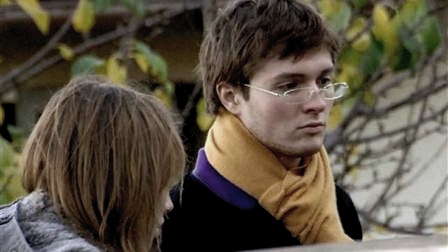
“Now I say… and then you say… and then I say… and then you say”
Reference the caption above: that’s the last time they talked before their first questionings.
Each day the cracks and fissures got worse. Would any cop not get suspicious?! Three days later, Sollecito separates with a bang and proclaims that Knox had made him lie.
That sure went well. Next murder Knox may do alone… A good primer for this post is this guide on how to read lies.
Here’s my take on the Recorded Statement taken from Amanda Knox 2 Nov 2007 in Part 4 of our previous post below. It is timed at 3:30pm. Mignini arrived about 3:00.
It could be the Squadra Mobila (the Flying Squad attached to the Carabinieri) took statements at the scene as Knox had to wait at the Questura quite a while before she was spoken to and got home late.
I have only processed three or four paragraphs so far (so this could turn into a whole series). What jumps out at me is the following statement:
Around 5 pm I left my house together with Raffaele to go to his house where we stayed the whole evening and the night.
In Sollecito’s own statement of 2 Nov 2007, in Part 5 of the previous post, he states:
At about 4:00 pm, Meredith left without saying where she was going, while we stayed at home until about 17.30. After that hour, Amanda and I took a little trip to the center to go to my house where we stayed until this morning.
So, from having been at Via della Pergola for lunch, during which time, Sollecito joined her and Meredith had got out of bed after arriving home in the early hours, and according to Knox and Sollecito, still had the remains of vampire makeup on her chin, was wearing her ex-boyfriend’s jeans, and had gone out at four, “˜without saying where she was going’, the pair claim to have gone straight to Raff’s apartment in Via Garibaldi, “˜at about five’. In Sollecito’s earliest account, it was to go to his house via the centre.
The next written record we have comes from Knox email home to 25 people in her address book on Sunday 4 Nov 2007, in the early hours circa 36 hours or so after Meredith’s body was found.
meredith came out of the shower and grabbed some laundry or put some laundry in, one or the other and returned into her room after saying hi to raffael. after lunch i began to play guitar with raffael and meredith came out of her room and went to the door. she said bye and left for the day. it was the last time i saw her alive. after a little while of playing guitar me and raffael went to his house to watch movies and after to eat dinner and generally spend the evening and night indoors. [sic]
Many believe this was Amanda writing out a “˜script’ to “˜get her story straight’. One thing about liars, is that they stick rigidly to a set chronology to make it easier to remember their lies.
The next written record is Sollecito’s first written statement to the police:
Raffale Sollecito: November 5th 2007 at 22:40 in the offices of the Flying Squad of the Perugia Police Headquarters
QA Around 16:00 Meredith left in a hurry without saying where she was going. Amanda and I stayed home until about 17:30-18:00.
QA We left the house, we went into town, but I don’t remember what we did.
QA We stayed there from 18:00 until 20:30/21:00. At 21:00 I went home alone because Amanda told me that she was going to go to the pub Le Chic because she wanted to meet some friends.
For the first time we are made aware that the pair went somewhere after leaving Via della Pergola at between “˜5:30 and 6:00’ according to Raffaele’s statement, this glides neatly into Popovic’s visit at 6:00pm at Raff’s abode. No visible gaps in the timeline here.
Next comes Knox’ handwritten statement to the police:
Amanda Knox Handwritten Statement to the police 6 Nov 2007
“˜Thursday, November 1st I saw Meredith the last time at my house when she left around 3 or 4 in the afternoon. Raffaele was with me at the time. We, Raffaele and I, stayed at my house for a little while longer and around 5 in the evening we left to watch the movie Amelie at his house.’
So Knox says they left at 5:00 ““ sticking to her scripted story as she set out in the email home, whilst Raff makes it an hour later. So, we are led to believe, they didn’t stay in town long at all, and in any case, ”˜I don’t remember what we did’.
This is a big flag. When people say, “˜I don’t remember’, they are telling you they recall an event, but are unable to retrieve it from their memory. In fact, they do not even try, not even when elite detectives are carrying out a crucial murder investigation of your girlfriend’s own roommate. A person who was not involved will say, “˜I don’t know’ when asked a straight question, not “˜I don’t recall’.
Sollecito sticks to his script: “˜We left via della Pergola, five-thirty to six’:
Raffaele Sollecito 7 Nov 2007 PRISON DIARY
“˜An amusing thing I remember is that Meredith was wearing a pair of men’s jeans which belonged to her ex”boyfriend in England. She left quickly around 4 pm, not saying where she was going. Meanwhile, Amanda and I stayed there until around 6 pm and we began to smoke cannabis.
My problems start from this moment because I have confused memories. Firstly, Amanda and I went to the centre going from Piazza Grimana to Corso Vannucci passing behind the University for Foreigners and ending up in Piazza Morlacchi (we always take that road). Then I do not remember but presumably we went shopping for groceries. We returned to my house at around 8 “ 8:30 pm and there I made another joint and, since it was a holiday, I took everything with extreme tranquillity, without the slightest intention of going out since it was cold outside.
Note the signifier, informing the reader, “˜it was cold outside’ embellishing the lie, “˜therefore we could not have gone out that night’.
So, whilst Raff on 7 Nov 2007 has jotted in his PRISON DIARY (which of course he is aware the authorities will be reading avidly), they were out between “˜six and eight’, Amanda writes to her lawyers a couple of days later adhering firmly to her script.
Amanda Knox Letter to her Lawyers 9 Nov 2007
Around 3 or 4 Meredith left the house wearing light-colored clothing, and all she said was “Ciao”. She didn’t say where she was going. I continued playing guitar and after a while Raffaele and I left my house, probably around 5pm.
We went to his house and the first thing we did was get comfortable. I took off my shoes etc. I used his computer for a little while to write down songs I wanted to learn for the guitar, I listened to some of Raffaele’s music at this time.
Note the inclusion of irrelevant and trivial detail, “˜I took off my shoes’. A liar loves to gild the lily.
click image for larger version
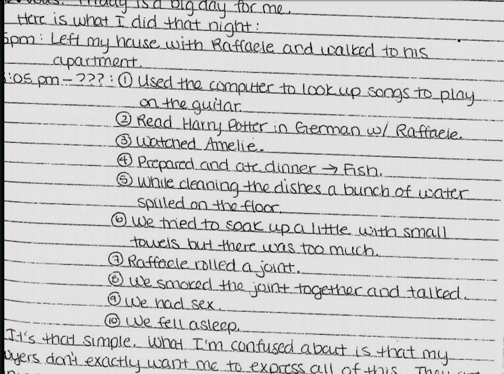
Then comes Knox’ next written affirmation of what she did the day of the murder:
Page 1223 PRISON DIARY ““ AMANDA KNOX 27 Nov 2007
Here is what I did that night:
5pm: Left my house with Raffaele and walked to his apartment.
5:05pm - ???:
(1) Used the computer to look up songs to play on the guitar.
(2) Read Harry Potter in German w/Raffaele.
(3) Watched Amelie.
(4) Prepared and ate dinner ““ Fish.
(5) While cleaning the dishes a bunch of water spilled on the floor.
(6) We tried to soak up a little with small towels but there was too much.
(7) Raffaele rolled a joint.
(8) We smoked the joint together and talked.
(9) We had sex.
(10) We fell asleep.It’s that simple.’
Did you spot, she remembers her lines, despite her problems with amnesia? Still no mention of going into the old town. When people use qualifies such as, “˜That’s about it’, or “˜It’s as simple as that’, there’s another flag they have just told you a lie. Note the triple question mark as if she is unsure it took half an hour to arrive at Raff’s, in case anyone pulls her up on it sometime in the future. Again bells and whistles, the liar’s toolkit.
Raffaele helpfully offers us an insight in his book several years later as to why he revealed ““ even if Amanda never does ““ they went into town in his police statement of 5 Nov 2007.
From Honor Bound 2012 Andrew Gumbel and Raffaele Sollecito write:
(P 17) It was the last time I ever saw [Meredith Kercher].
Amanda and I smoked a joint before leaving the house on Via della Pergola, wandered into town for shopping before remembering we had enough for dinner already, and headed back to my place.
P53 (in the Questura 5 Nov 2007)
I mentioned [to police] Amanda and I had gone out shopping, something I had apparently omitted in my previous statements. [note the plural].
So, we see, Raffaele has not voluntarily offered the information “˜we went into town’ either, on the afternoon of 1 Nov 2007. He concedes he only proffered it, because the police brought it up. When asked the purpose of the trip, he claims they went “˜shopping’, but on not being able to prove they bought anything nor state which shops the pair frequented, he had to retract this half-lie, by now adding to his 6 Nov 2007 official police statement, later, that once there, they suddenly realised ”˜we had enough for dinner already’.
So, we are led by this to conclude the purpose of the expedition into the old town was “˜shopping for dinner’, when before, it was to “˜to go to my house where we stayed until this morning.’
It is bizarre and a symptom of lying for someone to say they did something, but then didn’t do it, when asked to elaborate. Raff omits to even mention to police going into the old town, and Knox persistently does not mention it at all. He only mentions it when detectives ask him why he omitted to. He then “˜suddenly remembers’ this “˜unimportant detail’ and tells them they were there to shop. But wait. They suddenly do not do any shopping at all, whilst in the old town, because once there, they realise they ”˜already had’ provisions for the evening meal. Amanda Knox makes clear this evening meal was FISH. Yet she claims she couldn’t remember exactly what she did at Raff’s, for at least three weeks. Fishy indeed.
I don’t know about you, but if I head into town to buy food or clothes, once there, I don’t suddenly think, “˜Hang on a minute, what am I doing here, I already have bread/a dress at home!’
Surely, I would buy something anyway, or at least browse around, perhaps use my John Lewis voucher and go for a coffee and cake.
Astonishingly, years later, Knox still deceives us in this matter:
In Waiting to be Heard 2013 Amanda Knox resolutely omits the detail of “˜going into the old town’:
(P61) Sometime between 4:00pm and 5pm we left to go to his place.’
There then follows filler sentences about how “˜we wanted a quiet cozy night in’.
Then comes the type of deception liars love to use: they pad out their tall tales with irrelevant guff.
“˜As we walked along, I was telling Raffaele that Amélie was my all time favourite movie.
“˜Really?’ he asked. “˜I’ve never seen it’
[Forgetting completely, forensic police discovered he’d downloaded the movie way back on 28 Oct 2007 {by coincidence, no doubt}].
“˜Oh my God,’ I said, unbelieving. “˜You have to see it right this second. You’ll love it’
The narrative then completely jumps to:
Not long after we got back to Raffaele’s place, his doorbell rang. [Enter first alibi Jovanna Popovic, whom Raff states appeared at 6:00pm].
A whole hour is omitted. One whole hour to get back to Raff’s, just around the corner, four to ten minutes away at the outside.
From all the embellishments, fabrications and outright lies, we see that what happened between 4:00pm and 9:00pm and where the pair went, is significant. Some say, they obviously went to score drugs. However, they openly admit to smoking a joint. In fact, they go to pains to emphasise it. They have no inhibitions talking about having sex. Therefore, the trip into the old town which took up to two to five hours of their time is rather more sinister than some kind of coyness or embarrassment about buying some dope.
In his statement to police on 5 Nov 2007, Sollecito changes his story and claims he came home alone at ‘20:30/21:00’. As we now know, the pair both switched off their phones together, between 20:45 and 21:00, so we can be sure this time is supremely salient. Meredith was on her way back around then. From Knox not ever mentioning the trip into town, it could be she indeed never did go into town, and that Raff went alone.
Raffaele Sollecito complains in his book “˜the police were out to get me’ by catching out his anomalies. However, I was watching a tv programme a few days ago, about a murder case, and detectives had to puzzle out from scratch who was the culprit. The detectives explained to the viewer, when someone comes in for questioning, all they have is that person’s face value account. They then check out the details, and then, if they discover falsehood and deception in the interviewee’s story, that is what makes them suspicious. So Raff and Amanda have only themselves to blame police suspected them.
I believe the pair followed Meredith and stalked her movements that night, hence the concealment of their true motive for being out between 4:00 and 9:00.
Popovic has a story that she had to pick up a suitcase from the station, and then didn’t have to after all, so either she really did see Knox at home at six, as claimed, or it was “˜a friend helping out with the alibi’. See “˜the event that is a non-event’ -type of lie, as above. Who knows what that was about. Popovic claims to have spoken to the pair at between 5:30 and 5:45 and again at about 8:40. I personally remain sceptical of her testimony, as I do of his father’s, Francesco, whose claimed account of the 8:42 telephone conversation directly contradicts Knox’ and Sollecito’ with regard to dinner and the pipes flooding, supposedly happening before the murder.
We do know, as James Raper points out, as per Massei - “at 18:27:15 [6.27 pm] on the 1/11/07, there was human interaction via the “VLC” application, software used to play a multimedia file for a film “Il Favolso Mondo Di Amelie.avi”, already downloaded onto Sollecito’s computer laptop via P2P (peer to peer) some days earlier.”
We also know there was human interaction when the film “˜crashed’ (as it was finished?) at 9:10 because someone clicked on the error message to close it. I do not think this starting and finishing the film proves anything. I have always viewed Amélie as a contrived alibi.
Lies can work both ways. I don’t believe either Francesco or Popovic. The supposed testimony of these two “˜alibi witnesses’ were used directly against Sollecito when his compensation claim was thrown out.
Posted by KrissyG on 12/18/17 at 03:12 AM •
Permalink for this post •
Archived in Defendants in court, Amanda Knox, Raff Sollecito, Evidence & Witnesses, Questionings, Trials 2008 & 2009, Prelim hearings, Hoaxes against Italy, 1 Ital justice hoax, 2 Italian mileu hoax, 9 Mignini v Knox hoax, 11 No court bent hoax, Hoaxes Knox & team, 16 Interrogation hoax, Hoaxers from 2007, Knox-Marriott PR, Raff Sollecito PR, Heavey, Bremner, Bruce Fischer, Steve Moore, Saul Kassin, Amanda Knox #2, Raff Sollecito #2, John Douglas •
Comments here (23)
Tuesday, February 14, 2017
Sollecito Thinks He Can Win Again At The Supreme Court? Think Twice, Eyes Much Sharper Now
Posted by James Raper

1. Sollecito’s Tough Road Ahead
He who comes to court for compensation must come with clean hands.
Dr Maresca’s comment quoted below is relevant and fully justified. It is not to be overlooked that in addition to the lies and suspicious behaviour we have a “definitive” (joke) judgement that also says that Knox and probably Sollecito were present in the cottage at the time of the murder.
Even if Sollecito was not then he had good cause to believe that Knox was, yet before and after his police statement he did everything he could to obfuscate the fact and mislead investigators and prosecutors, all the while trying to dig himself out of a hole.
That adds up to a number of additional criminal offences he has committed but for which he has escaped sanction. In addition who can doubt that at the very least he had a part in, or knowledge of, the burglary staging (not criticized by the 5th Chambers), and the subsequent removal of blood traces (the evidence for which which the 5th Chamber basically ignored).
‘Doubts Remain about Sollecito’s Acquittal by Maresca’
(ANSA) - PERUGIA, Feb. 12 - The lawyer Francesco Maresca, who represents the family of Meredith Kercher, commented on the decision of the Tuscan capital judges to reject the claim for unjust detention by the young man from Puglia.
“The Court of Appeal of Florence confirms the uncertainty related to the acquittal of Raffaele Sollecito and Amanda Knox will remain in the history of Italian justice for all the unresolved doubts that it leaves”.
According to the lawyer “It confirms the statements and behavior of the young pair as a justification for custody and reminds us of the fact that the Supreme Court has placed them still in the house of the crime, so it really does seem that this absolution was to be refused at all costs.”
2. Knox & Sollecito Actions In The Week Prior To Arrest:
This is a repeat of my post of almost exactly three years ago which reveals an incriminating behavior pattern for sure.
A very strong case for guilt has been made at trial and endorsed at the first-level appeal…
The focus of this post… is upon the described behaviours of Knox and Sollecito, from the very beginning for a full week.
How The Behavior Speaks To Guilt
The early pointer of the staged break-in aside this behaviour gave investigators an insight into the pair’s possible involvement back on Day One: Behavioral pointers have continued on a par with corroborated developments in the case.
It has even continued, incredibly, since their release from prison. For me it is the thread that runs through this case having as much to do with the overall picture of culpability as the other elements .
This behaviour - to include what they have to say for themselves - is a catalogue of the inappropriate, of the implausible, of inconsistencies and contradictions, of evasions and obfuscations, to be gleaned from the accounts of Knox and Sollecito themselves and highlighted in the accounts of other witnesses. It is also to be gleaned from phone and computer records.
Taken together it is a formidable body of evidence which goes to character and culpability. It cannot be attributed to a railroading job, the machinations of a corrupt and evil prosecutor or character assassination by the media. It is also implausible if not impossible to explain it as being due to naivety, confusion or some quirkiness of character.
It amounts to the pair of them concocting stories, telling lies and misleading investigators and the general public.
Physical Evidence Array Is Already Substantial
There are numerous items of evidence which are building blocks in the prosecution case and with which we are all familiar.
- 1. The staged break-in via Filomena’s window with pointers to this outside, on the windows and shutters, and throughout the bedroom.
2. The evident partial clean up proved by footprint trails with footprints missing and what was behind the locked door.
3. Amanda Knox’s lamp on the floor behind Meredith’s locked door which she only conceded was her own at trial, under pressure.
4. Knox’s dried and congealed blood on the tap in the small bathroom that Amanda Knox and Meredith shared.
5. The bloody footprint on the mat in that bathroom definitively attributed to Sollecito rather than Guede
6. The mixed DNA of Knox and Meredith Kercher found in blood in the basin, the bidet and on the box of Q tips in that bathroom
7. Two luminol enhanced mixed traces containing DNA belonging to Knox and Meredith Kercher, one in the corridor and the other in Filomena’s room
8. Two luminol enhanced footprints of Knox in the corridor and one of Sollecito immediately outside Meredith’s room.
9. The knife taken from Sollecito’s apartment with Meredith Kercher’s DNA on the blade and Knox’s DNA on the handle and on the blade
10. Meredith Kercher’s bra clasp with Sollecito’s DNA on a hook and contamination possibilities definitively ruled out.
Behaviors In The First Week Of November 2007
I don’t want to make this an unduly long post. Accordingly I am going to concentrate on the period up to that famous police interrogation analysed just below. As to that critical period I will be selective but it should be enough.
The Lady With The Mop?
The story (in Knox’s e-mail) that she had visited the cottage to collect a mop, have a shower and get a change of clothing, earlier on the morning of the 2nd November, but did not notice that Filomena’s window had been broken and her room trashed is just that - a made up story. It is entirely implausible and the account unreliable for a number of reasons including-
- (a) it is hard to believe that she did not notice the hard to miss fact that the shutters to Filomena’s window were (as they were found) open - this would have alerted her to the likelihood that Filomena was back home which she would, of course, have checked out of curiosity if nothing else given that she found no one home.
(b) her claim that Filomena’s door was shut is contradicted by Sollecito who wrote (prison diary) that when he later entered the cottage with Knox Filomena’s door was wide open.
(c) it is hard to believe that she took a shower without noticing until after her shower (as she claimed) that there was blood on the bathroom mat, including a bloody footprint. In fact she didn’t even claim to notice that it was a footprint despite the fact that it was obviously so.
(d) it is hard to believe that having found the front door wide open and having found blood, and having opted for a shower and to blow dry her hair, she never got round to checking for any sign of Meredith’s presence. Any one else would have tried her door to check whether or not she was home.
(e) from her appearance at the cottage that morning it is hard to believe that she took a shower at all (let alone blow dried her hair) and the cops remarked that she reeked of body odour.
(f) less problematic but nevertheless still somewhat surprising is that as she is drying her hair she makes a fuss over shit (left by Guede) in the toilet, describes herself as being “uncomfortable” about it but does not flush it away before grabbing the mop and leaving.
The Two Stayed At Home?
The story that Knox and Sollecito had spent the previous night (the night of Meredith’s murder) indoors, critically from 9 pm onwards, that both had slept and that Knox had been the first to rise at about 10.30 am the next morning is implausible and uncorroborated, not only because this alibi is directly contradicted by the testimony of Curatolo and Quintavalle, and Sollecito’s statement to the police that Knox had gone out and not returned until about 1 am, but also in view of the following facts.
- (a) Curatolo claimed to have first seen the Knox and Sollecito in Piazza Grimana shortly after 9.30 pm but Knox claimed in her trial testimony that she and Raffaele had cooked and eaten a meal between 9.30 and 10 pm.
GCM: Can you say what time this was?
AK: umm, around, umm, we ate around 9.30 or 10, and then after we had eaten, and he was washing the dishes, well, as I said, I don’t look at the clock much, but it was around 10. And”¦he”¦umm”¦well, he was washing the dishes and, umm, the water was coming out and he was very bummed, displeased, he told me he had just had that thing repaired. He was annoyed that it had broken again. So”¦umm
LG: Yes, so you talked a bit. Then what did you do?
AK: Then we smoked a joint together”¦”¦we made love”¦..then we fell asleep.
Unfortunately Sollecito’s father himself torpedoed this dodge by telling the court that when he phoned his son at 8.42 pm Sollecito had told him that there had been a water leak while he was washing the dishes. Taking into account Knox’s testimony that they had eaten before the dish washing, this places the meal and dish washing before that call.
(b) Sollecito told the police that at about 11 pm he had received a call from his father on his land line. Not only is that not confirmed by his father but there is no log of such a call.
(c) There is no log of a call to his mobile at that time either though his father had sent a text message at that time but which Sollecito did not receive until 6. 03 am the following morning. We know that he had received it at that time because that is the time at which it is logged in the phone records. Sollecito had just turned his phone on and clearly the phone had been off when the text message was sent.
(d) There is no record of any phone activity for either of them from after the 8.42 pm call to, in Sollecito’s case, receipt of that text message at 6.03 am, and in Knox’s case her call to Meredith’s English phone at 12.07 pm the next day.
A further word about this Point (d) here as Knox has released her phone records on her web site. In her case it has to be said that this is not so unusual. Up until the 30th October there is no regular pattern of late or early morning phone activity.
It is interesting to note, however, that as of the 30th October there is a spate of texts and calls between her and a young Greek known to us as Spiros. Communication between them had in fact been going on since the beginning of October but there are 5 texts in the afternoon of the 30th, two telephone calls in the afternoon and a call at 11.38 pm on Halloween.
In the early hours of the following morning there are a couple of calls between the two. In fact we know that the two met up together for Halloween as Knox was at a loose end. Meredith had shrugged her off and Raffaele was attending a friend’s graduation dinner out of town.
Sollecito is different as his father was in the habit of calling at all hours just to find out what his son was doing and, as we know, he had called late only to find that his son’s phone was switched off.
In the case of Knox she admitted in any event that her phone had been switched off, “to save the battery”.
(e) There is no record of any activity on Sollecito’s computer after 9.15 pm and until 5.32 am the following morning when music was played for half an hour. This contradicts the claim that Sollecito had smoked pot and interacted with his computer until midnight and that they had both slept until late the following morning.
(f) The fact that the next morning, outside the cottage, both Knox and Sollecito looked utterly exhausted. This belies the alibi that they had spent a quiet night indoors and had only risen late that morning.
The Fake Call To Knox’s Mum in Seattle?
Knox falsely claims in her book that having had her shower she called her mother on her way back to Sollecito’s apartment as she was beginning to have concerns as to what she had seen at the cottage. Her mother tells her to raise her concerns with Raffaele and the other flatmates and Knox says that she then immediately called Filomena. Filomena tells her to get hold of Meredith by phone which she tries to do by calling Meredith’s English phone first, then her Italian one.
- (a) How does this correlate to the contents of her e-mail of the 11/04/07?
(b) How does this correlate to Knox’s phone records?
(c) There is no mention of a call to her mother at all in the e-mail. This from her e-mail -
“”¦.and I returned to Raffaele’s place. After we had used the mop to clean up the kitchen I told Raffaele about what I had seen in the house over breakfast. The strange blood in the bathroom, the door wide open, the shit in the toilet. He suggested I call one of my roommates, so I called Filomena”¦”¦”¦..
Filomena seemed really worried so I told her I’d call Meredith and then call her back. I called both of Meredith’s phones the English one first and last and the Italian one in between. The first time I called the English phone it rang and then sounded as if there was disturbance, but no one answered. I then called the Italian phone and it just kept ringing, no answer. I called the English phone again and this time an English voice told me the phone was out of service.”
(d) the phone records are as follows for 2 November 2007:
Ist call of the day @ 12.07.12 (to Meredith’s English phone) - 16 seconds
2nd call @ 12.08.44 (to Filomena) - 68 seconds
3rd call @ 12.11.02 (to Meredith’s Italian phone) - 3 seconds
4th call @ 12.11.54 (to Meredith’s English phone) - 4 seconds
8th call @ 12..47.23 (first call to her mother) - 88 seconds
(e) The discrepancies are numerous, see these examples:
1. The first call to her mother was not just after leaving the cottage but 40 minutes after the call to Filomena, and the call to Filomena had been placed after she had returned to Raffaele’s place and after they had used the mop and had breakfast. In fact, say about an hour after she left the cottage.
2. The first call to Meredith’s English phone was placed before the call to Filomena, and not after as Knox would have it in her e-mail. A minute before, but Knox did not mention this to Filomena, as confirmed by the e-mail and Filomena’s testimony.
3. The first call to Meredith’s English phone disappears entirely in Knox’s book.
4. The call to the Italian phone did not just keep ringing. The connection was for 3 seconds and this was followed by a connection to the English phone for 4 seconds.
5. The English phone was not switched off or out of service. Mrs Lana’s daughter had found it. She said that she would not have done so but for it ringing (the 12.07 call for 16 seconds?). She picked it up and took it into the house where it rang again (the 12.11 call - 4 seconds?). A name appeared on the screen as it rang : “Amanda”.
6. The 3 and 4 second calls are highly suspicious. The Italian phone was undoubtedly in the possession of the postal police. According to Massei it’s answering service was activated, accounting for the log. Clearly Knox did not even bother to leave a message for Meredith as it would take longer than 3 seconds just to listen to the answering service. This is not the behaviour of someone genuinely concerned about another.
My Observations:
1. In her e-mail, and repeated in her trial testimony, Knox says that she woke up around 10.30 am, grabbed a few things and walked the 5 minutes back to the cottage. If the first call to her mother was about an hour after she left the cottage (see before), then she left the cottage at about 11.47 am, which means that she spent over an hour there. Either that or she spent more (a lot more) than 20 minutes at Raffaele’s place before calling Filomena. The latter would be more likely as it is difficult to conceive that she spent over an hour at the cottage. She didn’t have the heating on when she was there. Either way there is a period of about an hour and a half between when she might have tried to contact Meredith or raise the alarm and actually doing so.
2. That we are right to be incredulous about this is borne out by the false claim in Knox”˜s book. That false claim is significant and can only be because Knox is aware of the problem and feels she needs to add some support to her implausible story of the mop/shower visit and to conceal the real reasons for the inactivity and delay connected with it.
3. That it is incredible is even belatedly acknowledged by Sollecito’s feeble but revealing attempt to distance himself from Knox in a CNN interview on the 28 Feb this year. “Certainly I asked her questions” he said. “Why did you take a shower? Why did you spend so much time there?”
4. That she makes that false claim and has constantly stonewalled and/or misplaced the 16 second call to Meredith’s English phone is indicative of her guilty knowledge. Her guilty knowledge with respect to the 16 second call was that it was made to ascertain whether or not the phones had been located before she called Filomena, and hence for her it was not (incredulous though this is without such explanation) a pertinent fact for her to bring up with Filomena.
The Real Call To Knox’s Mum In Seattle?
As to the 12.47 call to her mother itself (4.47 am Seattle time and prior to the discovery of Meredith”˜s body) Knox not only did not mention that in her e-mail but in her trial testimony she steadfastly declined to recall that it had occurred.
She clearly did not want, or could not be trusted, to discuss why the call had occurred and what had transpired in conversation with her mother before the discovery of Meredith’s body.
Not only was the timing of the 12.47 call inconvenient to her mother but I found it interesting to note from Knox’s phone records (covering 2nd Oct - 3rd November) that mother and daughter do not appear to have called or texted each other once up until that 12.47 call.
It would appear then that in so far as they remained in direct communication with each other for that period it must have been by e-mail. One can therefore imagine that her mother was very surprised to receive that call.
It is also very difficult to accept that Knox could not recall a phone call she was not in the habit of making. (On the other hand the same records show that it was not at all unusual for Knox and Meredith to communicate with other on Meredith’s English phone.)
Sollecito’s Call From His Dad?
At the cottage, and prior to the above call, Sollecito received a call from his father at 12.40 am. Do we know what they discussed? It would in any event have been after the discovery of Filomena’s broken window and (allegedly) Sollecito’s (rather feeble) attempt to beak down Meredith’s door.
Did the responsible adult advise his son to do the obvious and call the police? One would think so, but then why was there a 10 minute delay before he called his sister in the Carabinieri at 12.50 am? Indeed, why call his sister at all? Filomena had also urged Knox to call the police when she called at 12.35.The delay might be explained by the unexpected arrival of the postal police and if this was the case then it was before Sollecito called the 112 emergency services.
The Claims Of Finding Meredith’s Body?
Neither Knox nor Sollecito saw into Meredith’s room when the door was broken down and her body discovered on the floor under a quilt. Yet in the immediate aftermath it is as if they have wanted others to believe that it was they who discovered her body and in the bragging about this there have been disclosures, not only as to what they should not have been aware but also suggestive of disturbed personalities. This behaviour was remarkable for all the wrong reasons.
- (a) Luca Altieri”˜s testimony makes it clear that Knox and Sollecito had heard about Meredith”˜s cut throat directly from him during the car ride to the police station.
However her bizarre and grotesque allusion in the early moments of the investigation to the body being found stuffed into the closet (wardrobe) is not just factually incorrect (it was lying to the side of the closet) but bears correlation to the later forensic findings based on blood splatter in front of and on the closet door, that Meredith had been thrust up against the closet after having been stabbed in the throat.
(b) The behaviour of Knox and Sollecito at the police station is documented in the testimony of Meredith’s English girlfriends and of the police. Whilst it is true that people react to grief in different ways it is difficult to ascribe grief to Knox’s behaviour. Emotionally she was cold towards Meredith’s friends and occasionally went out of her way to upset them with barbed and callous remarks.
The fact that Knox was not observed to cry and wanted to talk about what had happened is not of itself indicative of anything but remarks like “What the fuck do you think, she bled to death” and her kissing and canoodling with Raffaele (including them making smacking noises with their lips when they blew kisses to each other) in front of the others was not normal.
Rather chilling in retrospect was a scene between the pair of them when Knox found the word “minaccia” ( in english - threat) amusing and made a play of it with Sollecito in front of witnesses.
(c) Grief is in any event reserved for friends and relations, or people one much admires. The evidence is that the initial short friendship between the two had cooled to the extent that Meredith was studiously, if politely, avoiding being around Knox. For the narcissistic and attention seeking american girl this would have been difficult to ignore and may well have offended her.
(d) The next day Sollecito was willingly collared by a reporter from the Sunday Mirror and told her about the horror of finding the body.
“Yes I knew her. I found her body.”
“It is something I never hope to see again,” he said. “There was blood everywhere and I couldn’t take it all in.”
“My girlfriend was her flatmate and she was crying and screaming, ‘How could anyone do this?’”
Sollecito went on to tell the reporter that “It was a normal night. Meredith had gone out with one of her English friends and Amanda and I went to party with one of my friends. The next day, around lunchtime, Amanda went back to their apartment to have a shower.”
About the only thing that is true here is that he knew Meredith.
Posted by James Raper on 02/14/17 at 05:08 AM •
Permalink for this post •
Archived in Defendants in court, Raff Sollecito, The legal followups, Sollecito followup, Hoaxers from 2007, Raff Sollecito PR, Raff Sollecito #2 •
Comments here (17)
Tuesday, April 12, 2016
Endemic Hints By RS That He WAS One Of The Real Killers Pretty Blatant In Italy #2
Posted by Guermantes

Popular TV and newsprint presence Selvaggia Lucarelli one of more prominent anti-RS
The humorless and un-self-aware RS and AK really play into skeptical Italian commentators’ hands.
Almost everything Sollecito says and does now is put under the microscope. He seems to sort of get that he becomes the butt of a lot of often-subtle jokes. His ticked-off reactions only make things worse.
This is my translation of a second column by Selvaggia Lucarelli the popular TV and newsprint presence. This was our first.
April 5, 2016
Raffaele Sollecito becomes crime commentator on TV with TgCom24. Next stop ““ knife sharpener?
By Selvaggia Lucarelli
A year ago, the Court of Cassation definitively acquitted Raffaele Sollecito (and Amanda Knox). Evidentiary framework that would confirm their guilt beyond reasonable doubt was lacking. Now Raffaele Sollecito is a free man and has an inviolable right to do what he wants. He could be a singer, an insurance agent, a tailor, a blacksmith, a web designer, or a pizza maker.
And yet, all of his amazing attempts to kick off a second life are clues and evidence (which is rather damning) not to be guilty of murder “beyond reasonable doubt”, but to be guilty of bad taste, inelegance, missed opportunities and unintelligence beyond reasonable doubt. Beyond any doubt or hesitation at all. Beyond any uncertainty.
On this matter, the evidence is rather overwhelming and reliable. And no, I’m not part of that forcaioli (pitchfork, gallows) lobby Sollecito often likes to quote. I am part of that large group of people who witness his awkward and incoherent attempts at liberation / redemption and wonder if there is no one sensible next to him to suggest that he chooses a career a few fields away from the dead people / murder victims.
Because there would be other things to do if he wished so, yet the dear Raffaele, for now, of all the brilliant ideas about his future career has given birth to two: the first was that of an app (funded by the Puglia region with 66,000 Euro) to arrange funerals, share photos of the dead with others and, as is written in the introduction to his website, “to eliminate, through the services of the app, the distance between you and the person you want to commemorate.”
I mean, if really, thanks to Sollecito, there exists a way to keep in touch with the dead, we hope that Meredith’s mother downloads the app as soon as possible and chats with her daughter to ask who had murdered her, together with Rudi Guedè, seeing as he was convicted of murder in complicity with someone, but that someone has never been identified.
However, the Sollecito app, for which he won a grant (the Puglia region realized that the idea of funerals 2.0 was likely to slide into second place in the ranking of the top apps in the world after Whatsapp), must not have had the desired effect because Raffaele has decided to take a second road.
The news is just a few days old: Sollecito is now a TV crime expert in the Mediaset’s program “This Week’s Mystery” where he discusses amiably the most famous murder victims.
Of course, it should be recognized that in a world of improvised TV experts, it could not be said that the young man did not chew on his arguments, so all in all we appreciate his choice of Mediaset to work towards competence. It is the issue of good taste that continues to leave us vaguely incredulous, so much so that TgCom24 announced Sollecito’s debut on April 1, and virtually no one paid attention to the news believing that it was yet another surreal April Fools’ joke.
After three days and the airing of the program everyone had to believe the unbelievable and the news yesterday was revived by all. The moral of the story: Sollecito, commentator on TV in a broadcast on murder victims, in the history of all the April Fools’ jokes from the Cretaceous to the present, is not, alas, a false story mistaken for true, but the first real news mistaken for false.
I wonder now what will be his next steps in the world of work: maybe it would be a nice idea to open a guest house for students. Or become a sharpener of knives. Or open a real estate agency in Perugia. What is certain is that in the wake of this macabre narcissism anything is possible.
And yes, of course, that is the basic premise. The certainty that Raffaele Sollecito can do whatever the hell he wants. It is also true, however, a healthy person judged innocent by a court while half of Italy is still convinced he’s guilty would instead seek media oblivion.
And if not oblivion, at least a career a few fields away from the smell of death, the suspicion that death carries with it, the face of a little girl named Meredith who was killed like a dog. Not Raffaele, he does not intend to sever that bond (with the dead) but, on the contrary, seems to want to ride on with uncanny persistence.
Too bad. It took eight years to prove his innocence, it would take five minutes to prove his intelligence. Maybe opening a kiosk outside the stadium or an architectural bureau in Barletta, instead of going on TV to argue with Bruzzone who knows most about killings, would be a better idea. Meredith’s parents would appreciate this, I’m sure.
Posted by Guermantes on 04/12/16 at 10:08 AM •
Permalink for this post •
Archived in Defendants in court, Raff Sollecito, Hoaxes Sollecito etc, 25 RS persona hoax, 27 Single alibi hoax, 28 Not at house hoax •
Comments here (17)
Friday, February 26, 2016
Surprising Similarities Between Sammy The Bull Gravano And The Ex-Perps In Meredith’s Case
Posted by Chimera
Overview
This piece is about Salvatore (Sammy the Bull) Gravano, an admitted serial killer.
He had a career in the mafia, and was the underboss and hitman for the notorious mob boss John Gotti. Although his is a case about organized crime, there are many similarities between Gotti v Gravano, and Knox v Sollecito v Guede.
Some Gotti/Gravano history
John Gotti was a captain in the Gambino crime family (named after Carlo Gambino), based in New York, NY. A serious problem emerged for him when several members of his ‘‘crew’’ were indicted for drug dealing.
These indictments included his younger brother, Gene Gotti, and Angelo Ruggiero, a childhood friend. The policy within the crime family for many years had been ‘‘deal-and-die’‘.
The upper leadership of the mob had figured that drug dealing was too high profile a crime, and that the extra police attention was not worth it. True, this was extremely hypocritical, as the bosses collected their cut of all income, knowing that a large portion of those proceeds came directly from drugs.
The drug indictments suddenly meant that John Gotti was in danger.
Though not personally implicated, he thought he might also be killed on the assumption that he approved of the alleged dealing. He decided to strike first, to save his own neck by having then boss Paul Castellano ‘‘rubbed out’‘. Gotti solicited the help of Salvatore (Sammy the Bull) Gravano, who was known as a prolific killer.
Paul Castellano had inducted Gravano into the mob in 1978. However, Gravano had no qualms about killing his ‘‘friend’’ since Gotti offered him even more: a promotion to ‘‘capo’’ or to ‘‘captain’‘.
Gravano helped Gotti set up the hit for December 16, 1985. With Castellano (and driver Tommy Billoti who was at the time underboss) dead, the family was temporarily leaderless. Gotti got himself voted in, and took over the Gambino family.
Castellano wasn’t the only ‘‘friend’’ that Gravano murdered, or would later murder. Gravano murdered Robert di Bernardo—a business partner, Louie Molito—a childhood friend, and others. He then took over any assets that they had. Some ‘‘friend’‘.
For the next several years, Gotti deliberately put himself into the spotlight. He managed to win 3 criminal trials, and seemed untouchable. However, in 1990, his mouth got him into trouble, and the FBI recorded Gotti implicating himself and other Gambino associates on murder and other crimes.
Gotti also made many nasty insults towards Gravano, now his underboss.
Gotti, Gravano, and Frank LeCasio (then the 3rd in command) were arrested December 11, 1990. All were held without bail. When Gravano finally heard the tapes of what Gotti had been saying about him, he turned and became a ‘‘mob rat’‘. Gotti and LeCasio were convicted of murder, racketeering and other crimes, and received life without parole.
Gravano, however got a deal that would put Karla Homolka to shame: 5 years for 19 murders. True, he could have served 20 for racketeering, but the judge cut it far below that.
For the complete interview, please see the YouTube video at the top here. This was shot in the 1990’s and converted to digital, so the quality is not that great. Here are a few more for background. The third one, the movie ‘‘Gotti’’ is fairly accurate, though off on some points.
- More on Sammy Gravano.
- More on the Gambino Family.
- More on John Gotti.
Gambino family highlights
(1) Albert Anastasia (underboss to Vincent Magino) made his ‘‘friend’’ disappear. Anastasia then took over.
(2) Carlo Gambino (underboss to Albert Anastasia) had his ‘‘friend’’ shot in a barbershop. Gambino then took over.
(3) Carlo Gambino made sure the ‘‘best qualified person’’ took over when he had a heart attack. He hand picked his brother-in-law Paul Castellano to succeed him.
(4) Paul Castellano’s underboss, Neil Delacroce, died of cancer. Castellano hand picked his buddy, Tommy Bilotti, to become new underboss.
(5) John Gotti and Salvatore (Sammy) Gravano, had their ‘‘friend’’ Paul Castellano shot dead in public. Gotti took over.
(6) While in prison, John Gotti made sure the best qualified person succeeded him as boss. He hand picked his son, John Jr.
So…. murder and nepotism seem to be how the top spots get filled in the mafia.
Excerpts From the Video
2:55 (Gravano) You can relate me to a soldier in Vietnam who killed hundreds of people. I was a soldier of Cosa Nostra. I am a hitman.
No. You are just a slimeball who kills for money.
3:25 (Gravano) Here I am
3:30 (Sawyer) They have said that you are the single most important witness ever to testify against the mob.
3:36 (Gravano) I think I am.
3:39 (Sawyer) So there’s a word you use, for people who turn ...
3:42 (Gravano) Who cooperate. You trying to goat me into the word? Rat? Is that the word?
3:51 (Sawyer) That’s the word. So are you a rat?
3:53 Gravano) I look at it as ‘‘I was betrayed. I betrayed him.’‘
3:59 (Sawyer) Double crosser?
4:01 (Gravano) Loud sigh ... master double-crosser. John’s a double-crosser. I’m a master double-crosser. We played chess, and he lost.
Gravano had in the past sneered at the idea of people testifying. However, when it is his turn, he dismisses it as a game.
4:30 (Gravano) Power has a way, where you can believe for a while that you can walk on water. And I think this is what happened to him.
And people who can walk away from 19 murders? What are they thinking?
5:25 (Sawyer) Were you Gotti’s friend?
5:30 (Gravano) His pit bull. And his friend.
5:42 (Sawyer) What was the reason, the real reason you cooperated? Or was it just to save your skin?
5:48 (Gravano) I was just tired of the mob, and tired of fighting. It was a door out of the mob. You know I watched the David Karresch incident, and I would say to myself: ‘‘how could these people get so brainwashed? Are they crazy? Are they nuts?’’ And then I look at myself in the mirror and I say ‘‘brainwashed?’’ Here I am on orders, killing people left and right. And I’m calling them brainwashed.
6:18 (Sawyer) There was a book written about you that you said you had a characteristic of committing murder with the non-chalence of someone pulling open the tab on a can of beer. That was about all that it phased you, or about all it took.
6:30 (Gravano) As far as being a hitman goes, I was actually good at it.
6:36 (Sawyer) Because you were fast, and lethal?
6:39 (Gravano) And loyal. If I was on your case, I dropped everything.
6:45 (Sawyer) Look at this list. There are ... how many?
6:49 (Gravano) 19
6:51 (Sawyer) Serial killers don’t have 19.
6:53 (Gravano) We’re worse than they are.
Okay, which is it? You turned on Gotti because it was a chess game? Or you did it because you were tired of the mob and the games? It can’t be both.
7:00 (Gravano) We only kill ourselves. What are you worried about? The public seems to like what we do. Look at John Gotti. If I have 19, forget about what he has. When he wanted a hit, he wanted it done yesterday. He would sent me to supervise it, or to control it, make sure the job got done. And I obviously did. When you’re the boss, and you’re giving orders, you’re credited with all of it, even if you’re not on the street.
Gravano is pulling the ‘‘John was even worse’’ card here. And he seems somewhat proud of what he has done. Sicko.
17:55 (Gravano) I remember something that surprised me is that I had no remorse at all. None. I didn’t feel sorry for him in the least. I felt power. I felt like my adrenaline in my body was completely out of control.
18:09 (Sawyer) You were excited?
18:13 (Gravano) I guess it’s like an animal going after its prey.
18:35 (Gravano) Everything changed. .... At a club, oh, no Sammy, you don’t have to wait in line. You can come right in.
18:40 (Sawyer) You were a player?
18:45 (Gravano) I was out of the minor leagues. I was in the major leagues.
No comment needed.
Other parallels with our pair
- Gravano is of Italian-American descent.
- Knox is American.
- Sollecito is Italian.
- Gravano was paid $1.5 million for ‘‘his’’ book called Underboss.
- Knox was paid $3.8 million for ‘‘her’’ book called Waiting to be Heard.
- Sollecito was paid $950,000 for ‘‘his’’ book, called Honor Bound
- Gravano tried to ‘‘cash in’’ on his murders by admitting what he had done.
- Knox/Sollecito tried to ‘‘cash in’’ on Meredith’s murder
- ’‘Gravano’s’’ book was really written by Peter Maas.
- ’‘Knox’s’’ book was really written by Linda Kuhlman.
- ’‘Sollecito’s’’ book was really written by Andrew Gumbel.
- The families of Gravano’s victims are outraged he is cashing in on the notoriety of his crimes.
- The Kercher family is outraged AK/RS are cashing in on the notoriety of their crimes.
- Gravano got an interview from Diane Sawyer.
- Knox’s first (of many) interviews was with Diane Sawyer.
- Sollecito’s first (of several) interviews was with Katie Couric.
- Gambino boss John Gotti was referred to as ‘‘John Gotti’‘.
- Sammy Gravano was referred to as ‘‘John Gotti’s Hitman’‘.
- Amanda Knox is referred to as ‘‘Amanda Knox’‘
- Raffaele Sollecito is referred to as ‘‘Amanda Knox’s Italian Ex-Boyfriend’‘
- Gravano has no problems airing personal details about his ‘‘friend’’ John.
- Knox has no problems airing personal details about her ‘‘friend’’ Meredith.
- Gravano criticizes Gotti’s public lifestyle, then after his deal becomes a media whore.
- Knox claims she wants to live in peace, but becomes a media whore to sway public opinion, and sell ‘‘her’’ book.
- Sollecito claims he was just dragged into Knox’s case, but becomes a media whore for the same reasons as Knox.
- Gravano blames Gotti for destroying the Gambino family, even though he was the one who testified at trial.
- Knox seems to blame Meredith for her own death, even though she stuck the knife in (well, she had it coming).
- Gravano (at least he claims) to have rigged Gotti’s racketeering trial to ensure an acquittal (or at worst a hung jury)
- Knox’s and Sollecito’s case was rigged by Hellmann/Zanetti and Marsca/Bruno to ensure an acquittal.
- Gravano was psychologically evaluated before leaving prison, and the results were disturbing.
- Knox and Sollecito were psychologically evaluated in prison, and the results were disturbing.
- Gravano smeared other mob associates for getting involved with drug trafficking.
- Knox smeared others (especially in her book) for drug use.
- Gravano’s drug smears were hypocritical as he was later brought to justice for drug trafficking.
- Knox’s drug smears were hypocritical, as she was into drugs, and slept with a dealer (Federico Martini) for drugs.
- Gravano’s most depraved act (outside of murder), was marrying a woman whose brother he had killed (Nick Scibetta).
- Knox’s most depraved act (outside of murder), was continuing her sex-for-drugs deal even after Meredith’s death.
- Sollecito’s most depraved act (outside of murder), was his various bride shopping efforts to avoid extradition.
- Warning signs? Gravano murdered his business ‘‘friends’‘, so betraying Gotti was no real surprise.
- Warning signs? Knox staged a break in, wrote rape stories, and threw rocks at cars, so violence in her home was no real surprise.
- Warning signs? Sollecito had supposedly attacked a classmate with scissors, so stabbing someone was no real surprise.
- Collateral damage? Gravano was prepared to kill innocent bystanders during the December 16, 1985 hit on boss Paul Castellano.
- Collateral damage? Knox framed an innocent person (Lumumba), and tried to pin it all on accomplice Rudy Guede.
- Collateral damage? Sollecito helped to pin it all on Guede, and cost his sister Vanessa her career with the Carabinieri.
A Final Thought:
Knox liked the Beatles. Here is ‘‘Working Class Hero’’ by John Lennon.
.... There’s room at the top
They’re telling you still
.... But first you must learn how to
Smile as you kill
.... If you want to be like all
The folks on the ‘Hill
Posted by Chimera on 02/26/16 at 07:17 PM •
Permalink for this post •
Archived in Various hypotheses, The psychology, Defendants in court, Amanda Knox, Raff Sollecito, The legal followups, US etc related •
Comments here (7)
Wednesday, February 17, 2016
Sollecito v Italy & Guede: Damning Incriminations Guede’s Team Says RS Will Be Stuck With
Posted by Our Main Posters
“Huh???” Sollecito in one of numerous interviews, usually falling short of convincing everyone
Post Overview
Guede’s team in Rome and Viterbo have a number of cards up their sleeves against Sollecito.
Sollecito and his father and legal team have apparently filed some damages lawsuit in Florence for compensation from the Republic of Italy.
His intention seems also to be to sue Rudy Guede, for defamation. In the RAI interview Guede did pretty solidly place him at the scene of the crime.
This post and later others will suggest what Sollecito could see thrown back at him. We’ve already pointed out that previous legal threats and court filings went nowhere. We may of course see that not happen here also.
This is a pre-emptive rebuttal published by the pro-bono team working for Rudy Guede at Viterbo Prison. (He also has a pro-bono legal team in Rome now.) They are responding to an attempt by Sollecito to put his case to bed in the weekly Oggi.
As with Guede’s interview this includes claims that are very self-serving. But it does also highlight the kinds of problems Sollecito faces.
It is kindly translated and submitted by Guermantes, one of our friends at PMF dot Net. Guermantes in part used Catnip’s new translation of the Micheli Report explaining Guede’s original verdict.
First Shot From Guede Team
February 5, 2016
The Centre for Criminological Studies of Viterbo responds - on behalf of Rudy Guede - to Sollecito’s assertions made in the Oggi article of January 26, 2016:
Raffaele Sollecito responds to Rudy Guede: “How many lies in the interview with Leosini”
Raffaele Sollecito “challenges” Rudy Guede on stories told by the Ivorian on TV
OGGI, analyzing word for word the interview with the Ivorian, imprisoned for the murder of Meredith Kercher, has identified at least eight omissions and blatant lies aired without being corrected. Among these, the appointment with the girl, the denial of having performed thefts, the use of hard drugs, the content of the judgment of the Supreme Court regarding the placement of Sollecito and Knox in the murder house.
The story of Rudy Guede still stands up though. Here is why “¦
Viterbo - Received and published ““ We learned of Raffaele Sollecito’s indignation, who, in an article published by a well-known weekly (Oggi, ed), complains about the inappropriateness of the broadcast of the ‘Cursed Stories’ program, in addition to the way it was recorded and run without contradiction[uncontested].
On this point, it is hardly necessary to recall that Raffaele Sollecito had been the guest on a large number of programs such as Porta a Porta, La vita in diretta, Domenica In, Piazza Italia (Rai programs, public television), Quarto Grado, Pomeriggio 5, Matrix (Mediaset), Otto e Mezzo (La7). All this - before, during and after the trials / verdicts that concerned him.
In the article just published, he notes, however, that comments and observations about current events should be offered before the verdicts and not after. Otherwise we would be “in the presence of a surreal fourth degree of judgment.”
We respect this opinion but we would also like to add that another school of thought argues that trials should be conducted in courtrooms and not on the pages of newspapers or in television studios. And Rudy Guede has waited eight years until the end of all sets of proceedings (including those relating to Raffaele Sollecito and Amanda Knox) before expressing his opinion.
Among other things, during a single television broadcast and not on the talk show circuit of national broadcasters. A choice, of Rudy, which should be respected. Because it is broadly related to the principles and values that characterize the Italian legal system.
Then, shifting the focus to the set-up of the program “without contradiction” [counter-arguments], it is necessary to point out at the outset that, in all those years of “Cursed Stories” programming, no one has ever complained about this mode. Moreover, Raffaele Sollecito himself was also the only guest “without contradiction.” Beginning with Porta a Porta of Bruno Vespa and ending with Otto e Mezzo of Lilly Gruber.
The [Oggi} article summarizes in eight points the alleged lies by Rudy quoting in some cases (not all) excerpts from transcripts or judgments about the case of Perugia. We try to respond to each of them, expressing the views of Rudy.
Point #1
Rudy had no appointment with Meredith? It may be! But speaking of appointments, the Court of first instance expressed itself by saying that “it is normal for twenty-somethings in a university town to meet up in the usual places without having to first set up a notary’s deed. “ [Par. 206.50] (page 93, Sentence of the First Degree Rudy Guede). This statement may also be taken into account even in the case of objection to Rudy’s words as having no value?
Still on point 1, credence is given to a few statements by Mr. Barrow, without saying, however, that the same had not only debunked at the hearing all his previous claims, but had also been in conflict with Rudy as regards girls. Moreover, the testimony of Mr. Barrow was interrupted by “the emergence of criminal behavior regarding monetary negotiations with a television news organization” (p.52). So much so that the witness was deemed unreliable.
Source: The Micheli Report
[194] Mr BARROW, already interviewed by the Public Prosecutor on the 11th of December 2007, which is to say a few days after Mr GEUDE’s return from Germany, had declared to knowing Mr GUEDE for some years, having often played basketball. On that occasion, though, he specified not moving in the same circles as him, due to RUDY being a habitual liar, drinking and using drugs, not to mention annoying the girls by molesting them in public and trying to kiss them.
[195] As for Ms KERCHER, who he described as shy and reserved, Mr BARROW had said he knew her from their shared visiting of the night clubs in the town centre, and in fact he had seen her on Halloween at the Domus, where ““ he says ““ RUDY definitely wasn’t; nor did it appear to him that the accused knew MEREDITH, and according to him it was not in fact true that he had spoken to her or had met her.
[196] In court, Mr BARROW restructured his grounds, saying for example that Mr GUEDE used to drink but a bit like how all the other young men were doing it, even if he had often seen him drunk; he instead denied being certain about any drug use on the part of RUDY, about whom he had mentioned it only for having heard gossip.
And also as regards the molestations, he corrected the gist of what he’d said in remembering only once when the detainee had struck up a conversation with a girl, without knowing that she was actually Mr BARROW’s girlfriend, and a squabble arose: on other occasions, he had seen him pull a girl towards himself while they were talking, although describing it as a gesture common to many others of the same age.
[197] On RUDY’s lies, the witness limited himself to saying that one time Mr GUEDE had been accused of having robbed something in a discotheque from a girl’s purse [translator’s note: handbag in BrE], the accused had immediately denied it, but then it had come out on the grapevine that it certainly had been him; on the presumed certainty that Mr GUEDE had not been at the “Domus” on the evening of the 31st of October, finally saying (and in effect he could not have said otherwise, ab initio) that he had not seen him, without being able to rule out that he really was there.
[198] The testimony, which in practice had not led to anything of significance being acquired, was then interrupted by the emergence of the outlines of an offence by Mr BARROW, concerning negotiations of a monetary nature with a leading television journalist, in whose regard he had presented a claim of trespass (when in reality he had invited those reporters in asking them for money for an interview), and it turned out he had then put forth a further request for money to settle things back to normal.
Point # 2
Rudy is a serial thief? The article in question contains two sentences that actually relate to the same incident five days before the tragedy, namely his entering an asylum in Milan. A reprehensible episode. So much so that Rudy has earned a related conviction for it (i.e. for possession of stolen goods.). However, beyond this, there is not a single record of another conviction, nor the presence of a complaint concerning other items mentioned in the article. Not only that, but the same Sentence of First Instance refers on page 101 to the absence of a “previous criminal record”, Rudy not having been tried yet for the Milan incident.
[Par. 44]””¦on 27 October 2007 (ergo, just five days before the murder) he had been identified in the Milan jurisdiction and had been charged without arrest [a piede libero] for theft, receipt of stolen goods, holding and carrying arms.
Point # 3
Rudy had left genetic traces in Meredith’s purse? In the trial papers we have not read even one time that Rudy’s genetic material was found inside her purse; if anything, only on the outside. And the difference is not trivial. In fact, finding his trace on the outside of the purse would allow to assume / hypothesize a simple movement of the object in question, while claim to have isolated Rudy’s DNA inside it would mean that the boy might have really went through it, the latter circumstance, which did not result in any conviction, was not confirmed because not supported by any element.
It is therefore in itself horrible and defamatory, the expression used in the [Oggi] article: “While Meredith was bleeding to death” Rudy “rummaged” [in her purse,] Also cell phones and anything else missing from Meredith’s bag were found elsewhere, without any fingerprints or traces of Rudy.
As far as first aid provided by Rudy to Meredith, his efforts were described even by judges who ““ still on p.101 of the Sentence of First Instance ““ conclude: “not being able to explain otherwise the presence near the body of three towels.”
Point # 4
flight into disco. As unspeakable as this behavior is, it is hardly necessary to mention that as regards Raffaele Sollecito and Amanda Knox, the Court of Appeal judges commented that there were “numerous and varied ways of how human beings react, faced with tragic situations” (taken from the Supreme Court with reference on page 17). Why should the same not apply to Rudy?
Point # 5
Rudy is a liar and he used cocaine? It is true that during the indictments are read expressions like the ones shown in quotation marks in the [Oggi] article, but in many circumstances the same assertions are revisited and subsequently confirmed by the judgments. Moreover, even as regards Raffaele Sollecito and Amanda Knox, it states that “the two have given versions not supported by objective evidence and not credible”.
Among other things, it is certainly not the case of measuring the credibility of all the defendants relying on the seriousness of the lies told; otherwise it would be appropriate to recall that Amanda Knox put at the scene of the crime an innocent, namely Lumumba, who only through an iron-clad alibi managed to get out of it.
[Par. 260.77] “It must finally be taken into account, still on the level of serious indicia of guilt and however arguing a contrario, that the two accused have given implausible versions [of alibis] or not substantiated by objective corroboration.
[Par. 260.78] “The circumstance of the missing memory or of the state of confusion, perhaps invoked with (convenient) reference to suggestive pressures on the one hand, or cloudiness of mind through use of stupefactants on the other hand, does not have concrete merit.
Point # 6
On this point Rudy says nothing special, so we do not understand just where the challenge is to what he said during the TV program.
Point # 7
The presence of Amanda and Raffaele at the crime scene. It turns out that during transmission Rudy have never claimed to have recognized the person he encountered that evening in via della Pergola. So we don’t understand the complaints about the alleged presence in that house.
It should be noted that in the Supreme Court ruling that absolves Sollecito and Knox is stated (p. 44) that “the hypothesized presence of the current appellants cannot in itself be considered as a demonstrative element of guilt.”
Why cannot the same reflection be taken into account for Rudy? Because the latter would leave traces “everywhere”? Rudy was there and admitted to having been there.
It should however be pointed out that this alleged abundance of traces must be scaled down seeing that on page 97 of the Sentence of First Instance it states that “the quantity of biological material referable to the accused could have been categorized, in effect, as minimal” [Par. 201], “ultimately nothing suggests that there was Rudy’s biological material in great abundance.”
[Par. 201] “”¦ with the conclusion that the biological material of Ms KERCHER was abundant, and Mr GUEDE’s, in proportion, was quite small.”
[Par. 9.3 on p.41 of the English translation (“pre-final”) of the Bruno/Marasca Report]: ”“¦the supposed presence in the house of the current appellants cannot, in itself be considered as a demonstrative element of guilt.”
Point # 8
In the last point it is reported that the substantial reasons for the denial of permission to obtain benefits requested by Rudy is to be attributed to the “lack of critical review of what has happened. He has not showed any remorse or repentance”.
First, if you intend to bring back quotation marks, it would be appropriate to bring it [the quote] back as it was actually written. And that is: ”“¦found that the applicant has committed serious crimes in respect of which he does not recognize his responsibilities.”
Why would he recognize [his responsibilities] if he claims to be innocent to the point of wanting to request a review of the process? Is it not his right? Or the rights that characterize the Italian legal system do not apply to Rudy?
If he really is a liar, he takes the consequences and responsibilities. But ultimately, in this dramatic story, it seems that it is widely assumed. Maybe - and we stress, maybe - far beyond his faults.
Posted by Our Main Posters on 02/17/16 at 02:37 AM •
Permalink for this post •
Archived in Defendants in court, Raff Sollecito, Rudy Guede, Hoaxes Sollecito etc, 25 RS persona hoax, 27 Single alibi hoax, 28 Not at house hoax, Hoaxes re Guede, 35 Good guy hoax, Raff Sollecito #2 •
Comments here (10)
Tuesday, February 09, 2016
Endemic Hints By RS That He WAS One Of The Real Killers Pretty Blatant In Italy #1
Posted by Peter Quennell

TV commentator Selvaggia Lucarelli voices what numerous Italians think
“Social Network For Dead People Launched In Italy By Amanda Knox’s Ex-Boyfriend”
We didnt make that headline up. Really. Sollecito’s gruesome venture is described here.
Called Memories, the business will provide a wide range of “graveyard” services, including lightning candles for the deceased, laying wreaths and flowers at graves, and even tombstone cleaning. Once a service is completed, the client’s profile will be updated with a high-resolution photo showing the work done. The prices start at €45 (50 dollars).
The project received a €66,000 grant (nearly $74,000) from Apulia’s regional authorities. Some extra expenses were covered by Sollecito and his family, The Local reported.
According to Sollecite, the idea came to him after his mother died in 2005. The grieving young man thought it would be a convenient way to look after her grave. “I wanted a way to make remembering her easier,” he explained.
Selvaggia Lucarelli is an influential blogger and a sharp and often very funny guest commentator on many TV shows in Italy. Like many in Italy, she doesnt just want to hold her nose and give the death-fixated fruitcake a free pass.
This time Sollecito ends up in the clutches of a journalist known for her controversy and sharp tone.
It seems that Lucarelli did not welcome the new start-up by the engineer from Puglia.
“See, Raffaele Sollecito, this thing to create a portal for funerals may seem clever but but is really macabre and in addition paints you for who you are (disrespectful and unintelligent) and casts an even more disturbing shadow over you - a healthy person judged innocent by a court while half of Italy is still convinced he’s guilty would instead seek media oblivion.
And if not oblivion, at least a career a few fields away from the smell of death, the suspicion that death carries with it, the face of a little girl named Meredith who was killed like a dog.
But there is obviously a sadistic pleasure in you wanting to see yourself still, with your hair slicked back and a funereal expression, on the front pages of newspapers associated with the word “death” and social networks associated with predictable jokes on the name Meredith.
Meredith needs to be remembered and respected in the silence of your home, not on a portal through which you try to make your wallet fat - you know that wont happen - and boost your macabre popularity.
Posted by Peter Quennell on 02/09/16 at 07:54 PM •
Permalink for this post •
Archived in Various hypotheses, The psychology, Defendants in court, Raff Sollecito, Hoaxes Sollecito etc, 25 RS persona hoax, 27 Single alibi hoax, 28 Not at house hoax, Raff Sollecito #2 •
Comments here (47)
Tuesday, January 26, 2016
Is Francesco Sollecito Forced Into Legal Aggression Anti-Guede Which Could Rebound?
Posted by Peter Quennell
Legal Development
Francesco Sollecito is being reported as denouncing Guede and initiating actions against him - and the Republic of Italy.
What must have looked to him nicely wound up by the Fifth Chambers at the end of March last year does seem to have a pesky tendency to become unwound.
It was unwound a bit by the continuance of Sollecito’s book trial in which RS lawyer Bongiorno refused to become involved. It was unwound a bit by the charges Dr Mignini requested against the RS lawyer Maori mid-year. It was unwound a bit by the Fifth Chambers with the poisoned sting at the end of its Report.
That Motavazione as phrased could open the way to a wrongful death suit against Sollecito (and Knox) or a petition to the President. A “guilty” verdict on the numerous false claims in Sollecito’s book could open the way to civil suits.
The petition was filed today at the Court of Appeal of Florence by their lawyers Giulia Bongiorno and Luca Maori. The lawyers decided to turn to the last trial court that dealt with the process. In particular, they demanded compensation of 516,000 Euros for the detention to which Sollecito was submitted from 6 November 2007 to 4 October 2011.
The computer engineer from Puglia has always proclaimed he was not involved in the murder and was finally acquitted along with Amanda Knox. “I can not spend my life defending myself from something I have not done ...”: Raffaele Sollecito commented on the interview…
He was followed by his father Francesco in transmitting a statement from their home in Puglia. “Raffaele is shocked and outraged,” said Francesco Sollecito. “I am also deeply outraged. I did not even sleep last night.” The father of Raffaele - finally acquitted for a murder he always proclaimed he was outside of - criticized in particular “Guede’s attitude towards the brutally murdered girl. Guede is refuted by the procedural documents, many of which are omitted in the interview. It was denied, among other things, by Raffaele’s friends that there was a random meeting with Meredith Kercher.”
“Guede still has to explain why he was in that house and why he went to the disco after finding the body. Let us remember, Francesco Sollecito empahsized again, that he is a person definitively convicted of murder. “
No mention at all of Knox? She was the one Guede really nailed, though Raffaele was pretty firmly placed at the crime scene too.
Last year, a bombastic Raffaele Sollecito had threatened to file a suit against Italy, but his father and lawyers had wound him back. Presumably because way, way, way too much could come out. “Take care about what you wish for.” “Let sleeping dogs lie.” “Discretion is the better part of valor.” Take your choice.
But such a suit is normal and expected. It would look suspicious if it was never filed. Now the Florence prosecution may get the chance to make the case in full the Fifth Chambers never heard.
Storms In The Past
Francesco Sollecito and Raffaele Sollecito and Vanessa Sollecito are all notorious for loosing their cool.
Francesco lost it here toward Raffaele, and especially here. Vanessa lost it here and again here. Everybody lost it toward Amanda Knox. Sollecito’s own book describes that rage.
And take a look. Despite supposed “honor bound” there are dozens of examples there.
Francesco Sollecito lost it after the Hellmann acquittal when Raffaele said he and Knox were still a thing, and again when RS took off to Seattle after Knox. He lost it again when a false felony claim in Sollecito’s book was unveiled on national TV.
Bongiorno also often seems in a rage. Hmmm. A group of people in a rage, and then things go too far. Where have we heard that before?
Posted by Peter Quennell on 01/26/16 at 02:43 AM •
Permalink for this post •
Archived in Defendants in court, Raff Sollecito, Rudy Guede, The officially involved, Victims family, Evidence & Witnesses, The pack attack, Hoaxes against Italy, 5 No pack attack hoax, Hoaxes Sollecito etc, 25 RS persona hoax, 28 Not at house hoax, Hoaxes re Guede, 33 Sole attacker hoax, Hoaxers from 2007, Raff Sollecito PR •
Comments here (21)
Thursday, November 05, 2015
A Critique In Five Parts Of The Fifth Chambers Motivation Report By Judges Marasca And Bruno #1
Posted by James Raper
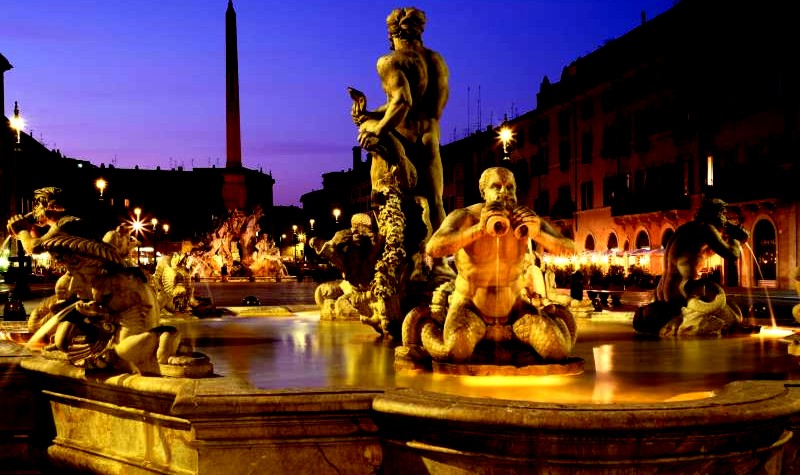
Image is of busy Rome at night
The Fifth Chambers Motivation Report
I will be critiquing the final 34 pages of the Motivation Report, the decisions and verdict parts.
This is the 54 page report released by the Fifth Chambers of the Italian Supreme Court late in September. For a full translation of the Report which can be referred to or downloaded please click here.
Key Decisions Of The Court
These are the eight main decisions I found In The Report -
- 1. The standard of “beyond any reasonable doubt” was not met due to insufficient and/or contradictory evidence - pursuant to Article 530, section 2 of the Italian Code of Criminal Procedure.
2. Multiple attackers upheld. Guede was guilty with others unknown.
3. The break-in in Romanelli’s room was staged.
4. Amanda Knox was present in the cottage at the time of the murder but there is insufficient evidence that she played a participatory role.
5. The DNA profile of Meredith Kercher on the knife and the DNA profile of Raffaele Sollecito on the bra clasp have “no probative or circumstantial relevance”
6. “Motive is not irrelevant” and motive was not established.
7. No selective cleaning.
8. No purpose would be served in remanding the case back to the 1st instance court of appeal (as had occurred on appeal against acquittal)
I am going to examine the 34 pages in which Marasca-Bruno present their rationale for the above. These pages also include reasons for the dismissal of various appeal submissions, which are of no interest to this critique.
Central to the acquittals is of course the claim that that the evidence was insufficient and/or contradictory and I shall look closely at how the Report sets out to demonstrate this.
We shall discover that a number of these co-called contradictions are not plausibly inherent in the trial evidence or in previous reports but are in fact the result of illogical reasoning, dogmatic assertion, indeed simply plucked from the air, by the 5th Chambers itself.
My Own Overall Reaction To The Report
My overall reaction to the Report is that it is quite unlike any other reasoning I have seen produced by a court of law.
It smacks of a desperate attempt to bring home an incomprehensible verdict.
The language and the dogmatic assertions, unsupported by any evidence, are quite startling.
The competence of the investigators, the forensic service and the judges who have adjudicated previously in the case, is called into question, frequently in a preposterous way.
I suspect that the Report was written with a view to the media being able to lift headlines from it, and many such potential headlines are to be found loaded towards the front of the Report. The busy tabloid editors dream.
Indeed the Report (when it actually has anything to say) is akin to opinion based journalism; inadequately researched and ill-considered.
There is a substantial amount of ponderous, self indulgent, and obfuscatory “scholastic” waffle in the Report. It forms a turgid barrier (like thick treacle) for the reader and, of course, the Courts’ affirmation that Knox was present when the murder was committed is only to be found deep into the Report.
Remove this waffle and padding however and the illogical and self -defeating nature of the reasoning stands out.
It is odd that some of the lengthy legal citations appear to conflict with the point that the Court is trying to make.
The Report challenges, if not overturns, some settled and well understood legal concepts in criminal law and natural justice and violates aspects of the Italian Code of Criminal Procedure. This must be of some concern to the Italian judiciary in general.
If ever there was a Supreme Court judgement that needed to be referred by the Italian President to the Council of Magistrates for review, this is it.
My Critique Of The Decisions Part #1
On The Nencini Appeal
So, let’s start. We begin with Marasca-Bruno setting the stage for their play (which as it progresses, bears a marked resemblance to Hamlet).
The Report claims that the Nencini appeal was -
“conditioned by the prospect of the factual profile unexpectedly included in the sentence of annulment ( i.e annulling Hellmann); such that the stringent and analytical evaluation of the Supreme Court might unavoidably force one towards affirming the guilt of the two accused. Misguided by this basic misunderstanding, the same judge is drawn into logical inconsistencies and obvious errors of judgement that are here reported.”
The Report refers to “the troubled and intrinsically contradictory path” of the history of the trial, by which, of course, they mean the acquittals at the Hellmann appeal.
“An objectively wavering process, whose oscillations, however, are also the result of clamorous failures, or investigative “amnesia” and culpable omissions of investigative activity. Had they been carried out these would, in all probability, have led to a picture, if not of certainty, to at least of tranquil reliability, pointing to either the guilt or innocence of today’s accused. Such a scenario, intrinsically contradictory, constitutes in itself, already, a first and eloquent signal of an investigation that was never capable of reaching a conclusion that was beyond any reasonable doubt.”
There are many carefully crafted layers of deception, supposition and “begging the question” in the above two quotes.
The first is that there was a factual profile (without stating what this was) emerging from the sentence of annulment.
That would not be true since all that the Supreme Court 1st Chambers did was annul Hellmann’s verdicts having accepted the prosecution’s grounds of appeal, one of which, incidentally, was that Hellmann was riddled with examples of “begging the question”, a trait which Marasca and Bruno are by no means averse to themselves.
That left the judicial process with the factual profile that emerged from the Massei trial, modified, if at all, by trial evidence from Hellmann.
Marasca-Bruno also quite arbitrarily assert that Nencini was “conditioned” and “misguided” by the terms of the annulment.
Whatever errors Nencini may have made in his Report (and there were a few) I can only find one (see later) that could have been potentially significant, an error in law, that is certainly censurable, but it is highly subjective and offensive to assert that these were conditioned by and a consequence of the annulment, or imply that they had an impact on the verdict. That assertion is simply begging the question and is clearly an affront to the appeal judge.
It is, of course, perfectly true that the Hellmann annulment came with a request from the 1st Chambers of the Supreme Court for the Florence appeal court to consider, (to paraphrase), “within it’s broadest discretion, the possibility of determining the subjective positions of Guede’s co-conspirators within a range of hypothetical situations, from premeditated intent to kill to an unwanted sex game that got out of control”.
To be clear, being asked to consider someone’s subjective position is not just an invitation to consider motive but more broadly an invitation to consider that person’s understanding of the nature and consequences of his interaction, or non-interaction, with a situation.
As it happened Nencini demonstrated latitude and independence in considering an entirely different and just as likely, if not more so, hypothesis. The hypothesis was not an affirmation of guilt, let alone proof, but was an element in the picture, and was certainly not forced upon the court by the terms of the annulment.
Marasca-Bruno may not have cared much for Nencini’s hypothesis (see later) but they can hardly, to be consistent, deplore the motivation given that they come up with (be it on little evidence) a subjective and puzzling scenario of their own for Knox (see the end of this critique) that leaves a lot of questions begging.
Equally begging the question is that the Hellmann acquittals were the consequence of an investigation that was never capable of reaching a conclusion that was beyond reasonable doubt. Marasca-Bruno also seem to accept, they certainly imply, that even an annulled verdict is evidence of reasonable doubt. Again there is no logical connection for that given that the verdict - they accept this - was correctly annulled..
All these assertions require to be demonstrated. Are they?
On The Claimed Media Impact
Next the Report claims that the media impacted on the conduct of the investigation and the judicial proceedings. There was “an unusual media clamour” of an international nature that -
“led to a sudden acceleration of the investigation, in the frantic search for one or more guilty people to placate international opinion, and certainly did not help lead to the truth”¦”¦”¦”¦”¦”¦”¦”¦media attention led to “prejudicial reflexes”, “procedural deviations”, generating “illicit noise” in the provision of information. This is not so much from the late discovery of witnesses, as of the raiding of the trial by the impromptu propulsion of detainees with proven criminal records, who are certainly not people averse to moments of pathological lying”¦”
The media, take note. But it is the investigators that are once again being called to account here.
Marasca-Bruno do not identify the point at which the aforesaid sudden acceleration is supposed to occur but I would hazard a guess that it was when the investigators discovered the body of a girl who had been brutally murdered. The only propulsion required would be the perfectly natural need to identify and detain the perpetrators, and not what the media was saying about the case.
Marasca-Bruno do not produce one convincing iota of evidence that the investigators were unduly influenced by the media attention rather than the evidence they were obtaining.
There is, of course, more than a nod to the defence PR myth of a Rush to Judgement about the above. However it is overlooked that there was a period of 7 months between the arrest of Knox and Sollecito and the prosecution notifying all concerned that they were ready to press charges.
Marasca-Bruno are, of course, perfectly right about Alessi and Aviello but omit to mention their names and that these were witnesses called by the defence. The media had nothing to do with that, but rather the evidence of multiple attackers.
Thus ends the setting of the stage for a play within a play.
We should now be aware that there is something rotten in the State of Denmark, with which a theatrical Marasca-Bruno, the personifications of Hamlet, are about to grapple. Nencini becomes Claudius who, as revealed by a supernatural apparition, had murdered Hamlet’s father (Hellmann).
On Multiple Attackers
We now come to a clear and unequivocal endorsement of multiple attackers. Well done.
And then, and here I somewhat reluctantly have to agree, Marasca-Bruno identify an error in law in the Nencini Report.
Nencini referred to Guede’s appearance at the Hellmann appeal when Guede was questioned as to the letter he wrote in response to the allegation concerning him made by Alessi. In this letter, read out to the court, Guede wrote “I hope that sooner or later the judges realize my complete lack of involvement in what was a horrible murder of Meredith a lovely wonderful young woman, by Raffaele Sollecito and Amanda Knox.”
Guede had not specifically said as much before and when cross-examined on the matter he declined to answer, referring the court to his previous statements. Nencini’s error was to treat the letter and those previous statements, in as much as they contained accusations placing Knox and Sollecito at the cottage at the time of the murder, as admissible circumstantial evidence.
That, however, is expressly excluded by the rule that states that incriminatory statements made by a witness of another are inadmissible unless the witness submits to cross-examination on them.
It should, however, be remembered that Guede did not give evidence at the Massei trial (nor were his previous statements admitted) and so it cannot be said that the error was that significant in the context of the evidence as a whole.
On The Trial Process
Having set the stage and dealt with points of law Marasca-Bruno now turn to the “merit of the trial process” which, of course they have already, and without merit, managed to sully.
Particularly this involves looking at the “Motivational structure of the ruling under appeal”.
“Discrepancies, inconsistencies and errors in judgement do not escape notice.”
They then proceed to set these out.
1. The Issue Of Motive
“Erroneous, in the first place, is the assertion regarding the substantive irrelevance of ascertaining the motive for the murderous act. This cannot be accepted in the light of the unquestioned doctrine of this regulating court, relating to the relevance of motive as the glue that links the various elements of which proof is made, especially in circumstantial cases such as the one at hand”
Well, Nencini did not maintain that motive was irrelevant, or even substantially irrelevant, per se. What he did say was this -
“Regarding motive, first it is necessary to quote the teaching of the Court of Legitimacy on whose opinion the precise indication of a motive for the crime of murder loses relevance when the attribution of responsibility to a defendant derives from a precise and concordant evidentiary framework (see Supreme Court, section 1 Criminal Sentence No. 11807, 12th February 2009).”
Marasca-Bruno ignore the above but quote another bit of law which, to paraphrase it, because it becomes complicated in translation, states that motive, whilst capable of constituting an element, has to be congruent with and capable of pointing all the elements of the evidence in a single direction, in a clear, precise and convergent manner, failing which any motive so postulated attains an air of ambiguity unable to fulfill it’s purpose.
Marasca-Bruno continue -
“”¦..which as we shall see shortly, (such purpose) cannot be maintained in the case at hand, in the face of a body of evidence which is ambiguous and intrinsically contradictory.”
If my paraphrasing is correct, then this does not contradict Nencini. Indeed the quotes, taken together, are complimentary and encapsulate what just about every criminal lawyer understands to be correct about the relevance of a motive in criminal proceedings. Nencini is not erroneous. Motive is not central. It is an element which may be useful. Futile and trivial motives are difficult to pin down to a specific cause. There are, indeed, glues other than motive, which fulfill the same purpose, such as the behaviour, lies, inconsistencies and contradictions referable to the words and actions of the accused themselves.
Finally, on motive, Marasca-Bruno make another point.
Guede had a sexual motive but this cannot be extended to others. To demonstrate the point they present the following argument, but here, again, I encounter a difficulty with the translation into English, and so I paraphrase:
“If it would be manifestly illogical (ed: as it would be) to hypothesize the involvement of Romanelli and Mezetti in the murder, and in complicity with a complete stranger, then it is equally illogical not to extend the same argument to Sollecito who had never met Guede.”
According to M-B, Nencini’s failure to advance this argument is a judicial error.
However I can quite understand why he did not advance it.
Firstly, the argument is based on Guede’s sexual motive and the implied premise that gender and sexual assault are related, which does render the involvement of Romanelli and Mezetti unlikely but does not help Sollecito.
Secondly, the lack of a link to Guede, in either case but particularly in Sollecito’s case, has nothing to do with whether or not the hypothesized perpetrator would in fact possess such a motive. Thirdly there is a link anyway, Knox,
The argument might conceivably operate on another plane, leaving aside sexual motive. Would anyone commit murder with a stranger? Well it happens in fact, particularly if there is a party who can link the strangers together.
The reason, of course, why one cannot hypothesize the involvement of Romanelli and Mezetti in the murder is that they both had proven alibis, whereas Sollecito did not, and that would seem to be the more pertinent fact.
It is a suggestive argument but one that is flawed. In any event it is not significant and Marasca-Bruno are not averse from making significant judicial errors themselves, as we shall see.
***
Please click here for the next post.
Posted by James Raper on 11/05/15 at 03:39 PM •
Permalink for this post •
Archived in Defendants in court, Amanda Knox, Raff Sollecito, The officially involved, Supreme Court, Appeals 2009-2015, Cassation critiques, J Raper critique •
Comments here (15)
Wednesday, November 04, 2015
A Critique In Five Parts Of The Fifth Chambers Motivation Report By Judges Marasca And Bruno #2
Posted by James Raper
Image is of busy Rome at night
The Fifth Chambers Motivation Report
I continue critiquing the final 34 pages of the Motivation Report, the decisions and verdict parts.
My first post can be read here. A full translation of the Report can be read here.
Time of Death
“Another judicial error is the finding that the establishment of Kercher’s exact time of death was irrelevant, in the belief that the approximate timing offered by the expert investigators was sufficient, for all that this may have been correct at the trial stage”¦”¦”¦”¦”¦.time of death is an unavoidable factual pre-requisite for the verification of the defendants”˜ alibis.”
Once again, this is to entirely misrepresent Nencini. He did not say that the TOD was irrelevant, and as for an exact TOD this would be impossible, even if the temperature of the body had been taken by the pathologist as soon as he arrived at the scene of the crime, which I am sure any intelligent and informed observer would understand. That would have narrowed the time frame very probably, but it was not a “judicial error”.
We could go on and delve into the evidence, particularly the expert and other evidence which became available over time and which conditioned Nencini’s observations, but Marasca-Bruno do not, instead resorting to a banal statement that does not take account of any of the foregoing.
“Deplorable carelessness in the preliminary investigative phase”¦”¦[ ed: not taking body temperature, yes, but other forensic considerations had to apply as well]”¦....a banal arithmetic mean between a possible earliest time and a possible latest time (from around 6.50 pm on the 1st Nov to 4.50 am of the following day), thus fixing the time at about 11 -11.30pm”
At the time of the Massei trial the pathologist, Dr Lalli had concluded that death may have occurred between 8 pm on the 1st Nov and 4.00 am the next day. This was based on calculating temperature decrease in the cadaver, taking the Henssge nomogram into account, rigor mortis, hypostatic marks etc. The Henssge nomogram also allows one to calculate back a specific number of hours from the time of first measurement and this permitted an intermediate valuation of about 11 pm. It was not simply an arithmetic mean.
But in any event, the decision not to take the body temperature but rather preserve the scene for forensics for about 11 hours had no detrimental impact upon the defendants’ alibis. It is accepted that Meredith was certainly alive at 9 pm on the 1st Nov and there is nothing to corroborate an alibi for the accused from 9.15 pm onwards on the 1st Nov until 5. 30 am the following day. Body temperature taken, and rigor mortis observed, earlier, would not have been able to narrow TOD down to a period of 15 minutes ( 9 to 9.15 pm), and hence prior to the last temporal reference point for a credible alibi, the interaction on Sollecito’s computer, or anything like that.
On The Scientific Evidence
Marasca-Bruno observe that there is a debate to be had here as to -
“The legal value attributable to scientific evidence, with particular reference to the genetic investigations, acquired in violation of the rules established by international protocols.”
The terms of the debate therefore define it”˜s conclusion.
There are, they say, two theories which have to be balanced -
(1) “that which puts an increasing amount of weight on the contribution of science, even if not validated by the scientific community,”
and
(2) “that which insists on the primacy of law and postulates that, in deference to the rules of criminal procedure, only those scientific experiments validated according to commonly accepted methodological canons may be allowed to enter.”
No cigars for guessing which self- formulated option they prefer. It is, of course, (2), but still they have already both begged and loaded the question with their insistence on “validation” (which in this context means repeating the scientific test to obtain the same result) according to “international protocols”
Then, to disguise that selection, we have this -
“The court concedes that this delicate problem”¦..must find a solution in the general rules that inform our legal system”¦.and not”¦.in an abstract insistence on the primacy of science over law or vice versa”¦”¦”¦”¦”¦”¦”¦. Scientific proof cannot, in fact, aspire to an unconditional credit of self-referential trustworthiness in the trial setting, by the very fact that a criminal trial renounces all notion of legal proof.”
Marasca-Bruno would not be so stupid as to insist that science has primacy over law in a trial setting. Would they? The law, having primacy, must find the means to accommodate the maxims of science, but within the general rules that inform the legal system.
They continue -
“The reference co-ordinates will have to be those attaching to the principle of cross examination and to the judge’s control over the process of formation of evidence, which must respect preordained guarantees, the observance of which must strictly govern the judgement of the relevant results’ reliability.”
Interesting. “Cross-examination”? Perhaps they are reminded of the decisive inadmissibility of the previously discussed section of Guede’s letter. Can the DNA traces on the knife and the bra clasp fall into the same category? Can “validity according to international protocols” be a preordained guarantee, in the same manner as the rights of an accused not to be incriminated by a witness who refuses cross-examination is guaranteed by Article 526 of the ICCP?
If so, then some compelling reason will have to be advanced - abiding by the rules of evidence that inform the legal system. They cannot refer to an Article on the point in the ICCP. There is none, and if there were, and if it stated that the repeatability of a scientific test was a guarantee for the test to be reliable and/or admissible, then sample 36b from the knife would not even have made it into the trial. And this is not the fault of the ICCP. There is no other body of law in the world that I am aware of that embodies any such guarantee, even for Low Copy DNA. And the reason for that, in part, is that there is no internationally recognized protocol, and precisely because there is no agreement in the scientific community as to this as yet.
Marasca-Bruno tend to treat “reliability” and “admissibility” as interchangeable concepts, and indeed, given the manner in which they consider these concepts, in the context of the topic under discussion, there is some logic to this, for surely if a piece of evidence is pre-ordained as unreliable then it must be inadmissible as well.
There then follows a lot more pompous waffle that need not detain us, other than to comment that none of this advances, and indeed does not even consider, any compelling reason for regarding repeatability as a pre-ordained guarantee from the point of view of admissible, or reliable, evidence.
Indeed, the ICCP does specifically take into account non-repeatable tests for we can find in Article 360 that provided the conditions therein are complied with then the results of non-repeatable technical tests are admissible.
Why the insistence on repeatability despite Article 360?
Does the testimony of an eye witness to a crime have to be corroborated by a video of the incident, or other eye witness testimony, before his testimony can be considered reliable and admissible?
Why is the result of a scientific test, conducted in accordance with a method which has already been repeatedly used in the scientific community to establish the validity of the method, be treated any differently?
The eye witness, of course, does not have a video of the incident by which to check his memory, whereas a biological trace may well be sufficient to allow for repeated tests. However in such cases, if there is no repeat, the result is not automatically ruled unreliable or invalid. It is for the defence to request a repeat and if they do not, then it does not happen.
There would, of course, be a capacity for repeat, which Low Copy Number might not have, but if repeats do not occur when the capacity exists, then this is because the result is unambiguous, as the results were, for the judge a quo, in the case of Meredith’s profile on the knife and Sollecito’s profile on the bra clasp.
However, Marasca-Bruno move on to declare that they do not share Nencini’s lack of hesitation in attributing evidentiary value to the knife and bra clasp results.
They quote the jurisprudence of the Supreme Court, in genetic investigations, about it’s degree of reliability -
“full value of proof, and not merely as an element of circumstantial evidence according to Article 192.”¦”
adding that
“in cases where the genetic investigation doesn’t provide absolutely certain findings, circumstantial value can be attributed to it’s results (section 2,n. 8434 of 05/02/2013, etc”¦”¦)”¦”¦which mean that where identity is established, the findings of the genetic investigation assume significant evidence, while in the case of mere compatibility with a specific genetic profile, they only have circumstantial importance.”
It is at this point that I had to pause and consider the very real possibility that Marasca-Bruno may have the combined denseness of two planks of wood nailed together.
The compatibility of trace B on the knife with the genetic profile of Meredith Kercher is such that it is full proof of the “identity” of the trace, certainly established, and that by any scientific protocol. That was acknowledged by all the trial experts and even, though with some reluctance, by Vecchiotti.
Even if not full proof of ID it certainly has significant circumstantial relevance, according to the above and pursuant to Article 190 (which is mentioned later).
With that uncomfortable thought perhaps lurking in the back of their minds, they seek to obfuscate matters -
“As a general rule it is possible to adhere to these conclusions, on the condition, though, that the activity of collecting samples, storage and analysis of the exhibits has respected the regulations approved by the protocols of the profession.”
They then, rather bizarrely, go on to aver that that the correct methods, to preserve authenticity, were stated by the Supreme Court”¦..“even if only on the subject of information technology evidence”
Eh ?!
They refer to Article 192, section 2 -
“The existence of a fact cannot be deduced from pieces of circumstantial evidence unless they are serious, precise and consistent.”
They opine -
“Taking into account such considerations [ed: “such considerations” need not concern us - they were just preceding waffle] one really cannot see how the results of the genetic analysis - that were performed in violation of recommendations for the protocols regarding the collection and storage - can be endowed with the characteristics of seriousness and preciseness.”
John McEnroe and “You cannot be serious!” springs to mind.
They are also confusing the information obtained from the electropherogram with sample collection methods.
It is, of course, important to maintain clarity of thought by keeping the issue of the value of the evidence [ed: it’s seriousness, precision and consistency] apart from the issue of contamination. As Nencini and others were able to do. Marasca-Bruno are running these issues together.
“It is absolutely certain that these methods were not complied with [cites the C-V Report] -
(a) The knife collected and then preserved in a cardboard box, of the sort used to package Xmas gadgets, agendas “¦”¦”¦.
(b) The bra clasp [collected 46 days after] “¦”¦”¦”¦..the photographic documentation demonstrating that at the time of collection, the clasp was passed from hand to hand”¦. In addition wearing dirty latex gloves.”
Shall I comment? Oh, alright. What is the relevance of the cardboard box unless it was a conduit for contamination? That was not even hypothetically plausible.
Yes, as we all know the bra clasp was recovered after 46 days. But where are these collection protocols that are internationally recognized and are a pre-ordained guarantee recognized by law?
As for dirty gloves the only evidence of this that I have seen is a photograph of the bra clasp being held in one gloved hand whilst the glove on another hand, patently belonging to the same operative, shows spots of some substance on it, which spots are most probably, in the circumstances, blood derived from the clasp the operative is holding.
Where is the common sense of the 5th Chambers?
What exactly was wrong with the in-depth common sense analysis of Massei and Nencini?
And so we swing back to the conclusion that was their premise.
“In essence, it is nothing less than a procedure of validation or falsification typical of the scientific method, of which we have talked before. And it is significant, in this regard, that the experts Berti-Berni, officials of the R.I.S Roma, carried out two amplifications of the trace (ed: 36I) retrieved from the knife blade.
In the absence of verification by repetition of the investigative data, it is questionable what could be the relevant value to the proceedings, even if detached from the scientific theoretical debate, of the relevance of outcomes carried out on such scarce or complex samples in situations not allowing repetition.”
Let us recall what actually happened with sample 36I. In 2013 this sample, which had not been analyzed by the Independent Experts, was analyzed by Berti-Berni. The sample was Low Copy Number and the quantum of DNA present was significantly less than was present with sample 36B. However they were able to carry out the test with a repeat because since 2007 there had been further technical advances in the equipment.
The repeat confirmed the evidential value of the first test (Knox) despite the low level of DNA. Low Copy Number, as an inherent problem per se, and as evidence of contamination per se, as argued in the case of 36B (Meredith), was shown not to be an issue. That was what was truly significant about the test, and it underscores that the result of the test on 36B had significant evidential value.
The knife and the bra clasp -
“”¦.cannot take on either probative or circumstantial relevance precisely because, according to the aforementioned laws of science, they necessitated validation and falsification.”
The primacy of the rules of evidence has just been jettisoned with this dogmatic assertion, which is not even derived from the logic of the argument they have presented in support. Indeed much of the argument (or rather, the waffle) is merely this dogmatic assertion in numerous different guises and tediously extended formulations of itself.
Not only that but Guede was also convicted on the basis of DNA tests that were not repeated!
One wonders what criminal judges in Italy will make of this, and of the fact that judges from the 5th Chambers, who deal primarily in matters other than criminal law, have presumed to lay down law to them in this field.
The reality is that despite this nothing will change as to the rules of evidence and how forensic evidence is evaluated in the criminal courts. The system, understandably, will not countenance that. That will leave this case, as it pertains to Knox and Sollecito, as an exception, a bizarre anomaly in the judicial record.
Perhaps, in the future it will not present a practical problem, given that developments in technology are able to detect even smaller amounts of DNA, thus allowing for repeats.
***
Please click here for the next post.
Posted by James Raper on 11/04/15 at 03:00 PM •
Permalink for this post •
Archived in Defendants in court, Amanda Knox, Raff Sollecito, The officially involved, Supreme Court, Appeals 2009-2015, Cassation critiques, J Raper critique •
Comments here (21)