

Category: Trials 2008 & 2009
Thursday, December 21, 2017
Knox & Sollecito: How From Their Very First Questionings The Cracks & Fissures Start To Appear #2
Posted by KrissyG
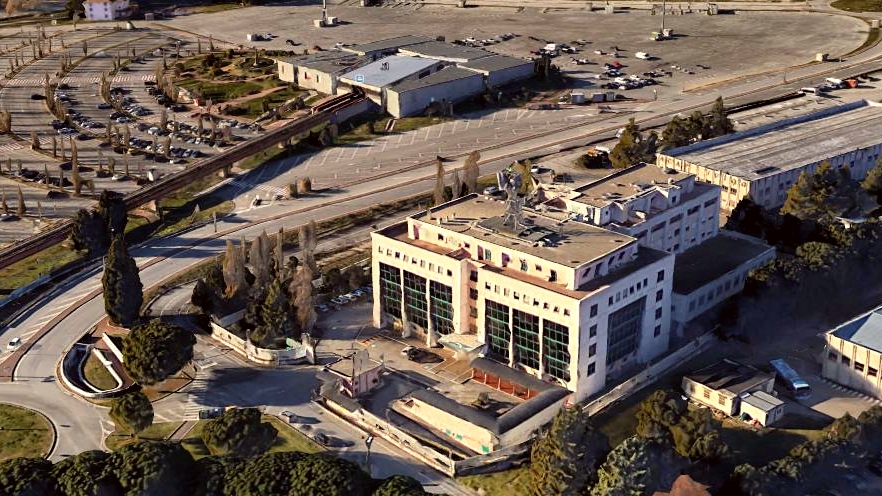
Minimetro at left foresightedly located provides quick 2 mile trip up to the center.
1. The Much Mischaracterized Interview Context
You’ve read the PR-driven meme that Perugia investigators zoomed in way too quickly on Amanda Knox?
And also on Raffaele Sollecito? No, probably not Raffaele. He is a really big nuisance in proving any malicious targeting. Hard to manufacture a reason to zoom in on an Italian male with a rich and connected father and mafia ties.
Say that investigators were doing little else but ferociously framing Amanda Knox, as John Douglas, Steve Moore and Michael Heavey have claimed again and again (and even so advised the Department of State).
Well-trained American investigators will say they are lucky to average upward of a dozen sessions a week with people of possible involvement. If Douglas, Moore and Heavey have it right, what is your best guess here? Five? Seven? Maximum ten?
Okay. Take a look. Amazing, right? And there were many more still in progress. Interviewing went on for weeks. They are all loaded on the Case Wiki. Never recorded, as the PR lie has it? No, literally everything was captured.
Unfair zooming-in? These depositions prove quite the opposite. Right through to the fourth and ultimate session on 5 November, the investigators were mainly in the mode of spreading the net wider and wider. Seeking still others maybe involved.
2. Analysis Of Knox’s First Statement Continues
Remember this is still the same day Meredith’s body was discovered. We are still on the 2 November deposition which sets narrow limits on what Knox could credibly claim later. (Path dependency, for scientists.)
Maybe Douglas, Heavey and Moore would have missed them?! But I’ll point out more Knox claims that for competent law enforcement would be big red flags. Points that dont match up with Knox down the road, and points that don’t match up with Sollecito.
This morning, around 10-11am, I returned to my house alone to have a shower and change my clothes, and in this circumstance I noticed that the entrance door of the apartment was wide open whereas the doors to the rooms inside the house were all closed, at least the ones to Filomena’s and Meredith’s rooms, although I didn’t check if they were locked, whereas the one to Laura’s room was ajar and my door was open as usual.
Why would she say the door of the apartment was wide open? Remember, we only have Knox’ word for this. We know it needed a key to lock it. In Honor Bound, Raff says this applied both coming in and going out. Imagine for a minute the real reason for returning was to continue tidying up. The aim had been to finally leave the cottage with the door left flapping open (as though by an unknown intruder). If it had been locked, then the conclusion would be it must be Knox, as she and Meredith were the only house mates around that weekend. So, of course, she has to claim it was open. Distancing herself.
She says she “˜didn’t check if they were locked’ (Filomena’s and Meredith’s rooms). But why would they be locked. This indicates an awareness that Meredith’s room was locked. To explain why she didn’t spot it then, we have the made-up-on-the-spot event, which turns out to be a non-event. Rather like Gubbio. They were going to “˜go to Gubbio’, but then they didn’t go.
We see from Knox’ statement, she wants to tell the story as though she really was innocent. She has to imagine and play role what an innocent person would do. The door was hanging open. She was only there because she wanted to shower and change to go to Gubbio Ah, but what about Meredith’s locked door? Didn’t try it to see if it was locked. Which of course it was. Perhaps Knox has psychic powers to foresee that it might be found to be locked in the future. Pre-empting and forestalling the tricky question of Meredith’s closed door.
These things seemed really strange to me because, like I already said, it is customary for all of us to always close the entrance door with a key since that is the only possible way to close it. So I started to call [the names of] the girls aloud, but without getting an answer. At that moment I thought that maybe one of the girls had gone out to throw the trash into the bins, or to go to see our neighbors, the boys, who occupy the apartment below ours and with whom we hang out.
Knox claimed she didn’t know Laura and Filomena were away for the weekend until Filomena told her on the phone after she rang her at midday on 2 Nov 2007, a couple of hours later. But seriously, if there are three possible housemates around, wouldn’t one just call, “˜Hello! Anybody home?’
Truth is, Knox doesn’t want to say she knew Meredith was the only one around, as the next question would be, “˜So what happened when you called Meredith’s name and knocked on her door, and tried the handle’.
Meredith home alone, would be a real reason to panic. The realisation “˜Meredith might be hurt inside’ mustn’t come ““ for script purposes ““ until after Knox has - in her story - had a shower, changed and gone back to Raff to tell him of her strange experience. She has to account for going back to his abode and ringing Filomena from there. Rather than ring him from the cottage, she has to walk there and then walk back with him. After a leisurely breakfast, of course.
Still imagining herself in the role of innocent, she has to dream up why, if she thought all housemates were around they didn’t seem to be after all, so here comes the precluding: “˜I thought that maybe one of the girls had gone out to throw the trash into the bins, or to go to see our neighbors’.
I remember having closed the front door of the apartment, but I didn’t lock it with the keys, and I went to the bathroom located near to my room, the one that only me and Meredith usually use, to have a shower, when I noticed drops of blood on the floor and a bigger blood stain on the bath math and other blood stains on the sink as if someone had smeared it with a bloody hand. This thing seemed a bit strange to me because we girls are all fairly clean and tidy, and we clean the bathroom [immediately] after we have used it. At first I thought that the blood on the sink could be mine because I did some ear piercings about a week ago, so I immediately checked in the mirror and touched my ear. Then I touched the blood on the sink but seeing that it was not removed immediately, that is, it was not recent, I thought it could be some girl’s menstrual blood and because it disgusted me, I did not attempt to clean it.
Reason for not raising the alarm or becoming concerned? I thought it could be some girl’s menstrual blood and because it disgusted me, I did not attempt to clean it.
Again, a clever lie (or so she thought) whilst expressing her disgust at Meredith’s life blood, it would “˜explain’ why she thought nothing was amiss, just a bit strange (she reasons). As Meredith was the only other person who used that bathroom, we note the careful avoidance of using her name and the use of “˜some girl’ instead. Remember, at this stage, she is not to know anything has become of Meredith. Could be anybody’s blood, is the message, with an innocuous cause (albeit “˜disgusting’.)
No mention of padding back to her room on the “˜disgusting’ bathmat to fetch a towel after the shower, which seems to be a story that evolved later, when her lawyers told her of the five isolated luminol prints in the hallway identified as “˜compatible’ with hers and Raff’s.
Immediately after this I went to the other bathroom, where I usually dry my hair, and after having dried it, I noticed that there were feces in the toilet, that is, someone had used it to relieve themselves, but they had not flushed afterwards. This thing also seemed strange to me for the reasons that I have already stated, and so I avoided flushing it myself.
Again we have the liar’s ready explanation as to why the toilet was left in a disgusting state, even though at this stage, she wasn’t spooked enough to think there was anything to be concerned about. No, the real reason it was “˜strange’, was that according to Knox, nobody who visited the cottage would ever have not flushed the loo. So that explains why it dawned on her when they realised there had been a burglary that this faece must be the burglar’s. She ”˜avoided flushing it’ herself, she explains to police, because she had some kind of uncanny intuition it didn’t belong to anybody in the house, nor their friends.
As for Knox shock at the poop, Sophie Purton testified to the court:
One thing in particular that I remember very well regards Amanda’s habits in the bathroom. Meredith said that Amanda often did not flush the toilet. [This] annoyed her and she wanted to do something about it but did not know what to do without creating problems, not wanting to create embarrassing situations.
Same complaint by those in prison with Knox. She does on:
Later I took the mop, which was located inside a closet, and I left my house to go to my boyfriend’s house to clean his room [kitchen] because we had soiled it the previous night. I remember that when I left, around 11.30 am, but I’m not sure about the precise time as I didn’t look very carefully at the clock, I closed the door of the apartment with a turn of the key.
In Knox’ court testimony and police interviews, her favourite refrains are “˜I wouldn’t know what time it was, as I don’t look at the clock’. One wonders how appropriate this type of sarcasm is in front of murder detectives and a panel of judges. As Francesco put the time of the pipes leaking at before 8:42 and Knox put it back considerably later, changing it from 9:30, to 10:00 and then to 11:00 pm, we see her dilemma. She has to say she only took the mop to Raff’s that morning or she’s admitting she returned to the cottage on the night of the murder.
After arriving at the house of my boyfriend, who lives alone in an apartment near my house and to be more precise in Corso Garibaldi number 110, we stayed there for about an hour, for the time it took to clean the kitchen and have some breakfast, after which we returned to my house together. I want to point out that I immediately told my boyfriend about the strange things that I had detected in my house, and he urged me to call one of the girls.
Immediately? That came and went. Here it’s all action, systems go. The ditzy Knox needed caring Raff to get her to start worrying. So first two calls to Meredith’s phones. Then Filomena. She again has to be told to “˜ring Meredith’, this time by Filomena. So she dutifully rings Meredith again, this time, just a quick couple of seconds each. Been there, done that.
And I did indeed first call [emphasis added] Filomena to ask her if she knew anything about the blood I had found in the bathroom, and she replied that she knew nothing about it as she had slept at her boyfriend’s, Marco’s, house the previous night, and the following morning, that is, this morning, she had gone directly to work without going home first. After Filomena, [emphasis added] I phoned Meredith three times and to be more precise, the first time I called her, I called her English cell phone number 00447841131571, which is the first phone number Meredith gave to me, and which I saved first to my phone card; the phone rang several times, and at one point I heard the line disturbances and interruption of rings. So I tried to contact her on the phone with the number 3484673711, and also this time the phone rang but no-one answered. I tried calling her for the third time with the first cell phone number again, but also this time without getting an answer.
I didn’t call Laura because Filomena had told me in the previous phone call that she had gone to Rome, but I don’t remember if Filomena told me when she had left. So I haven’t seen Laura since the afternoon of October 31st this year. At this point, I returned to my house with my boyfriend, worried about Meredith, because she was the only one whose whereabouts I didn’t know of.
As we know, this call was 12:11 yet Knox & Sollecito didn’t actually get to the cottage until circa 12:35, when by coincidence the postale police arrived and Filomena rang Knox again. This time, she was told of her smashed window. Knox and Sollecito were so “˜worried about Meredith’ it took over twenty minutes to carry out what should be a five-minute walk.
Knox doesn’t tell police that the first call she made, after having switched off her phone 20:45 the night before, was at 12:08 to Meredith’s two phones, before she ring Filomena. So a clear lie, that it wasn’t until Filomena mentioned it that it occurred to her to ring Meredith. She didn’t realise, either, that police could discover just how long she rang for. We see it is a nonsense “˜no-one answered’ if they only rang for three seconds or less. Another sleight of hand, changing the chronology, which takes on a different light when the true time line comes to light.
When I got to my house, around 1 pm, I opened the front door, which I found locked, and entered the apartment. I began to open the doors of the rooms occupied by the other girls. First, I opened Filomena’s bedroom door, that is the first room nearest to the entrance, and together with Raffaele we found that the window, with two shutters, was open and the window glass was broken. I don’t remember if both glasses were broken or only the other one. Broken glass was scattered on the floor, inside the room, near the window. Scared, I thought it could be that a thief had entered the house, and then I quickly glanced around to check that everything was in order, and that nothing had been removed. So I headed to Laura’s room and also there I opened the door and checked that everything was in order. I want to point out that I didn’t go inside the rooms, that I just had a quick look, from the door.
Immediately after that I went into my room, and even there I didn’t notice anything / nothing was different, after which I headed to Meredith’s room, but I couldn’t open the door because it was locked.
Given, having just rang Meredith’s phones three times, and now being told by Filomena that she and Laura were both away for the weekend, you’d think Meredith’s room would be FIRST priority. Instead, in her account, Knox checks the other two instead, even though Sollecito stated Filomena’s door was wide open when he arrived. Laura’s door was “˜ajar’ and had a drawer hanging out, and surprise, surprise, Knox’ hunch about Meredith’s door being locked, turns out to be correct, but she only finds out now, some two hours later.
Knox goes to her room, on a dark November day, and doesn’t notice her table lamp is missing (it is on the floor of Meredith’s room) and she would have had to dry herself after the shower (she claims) and change in the dark, as the room had very little natural light.
At that point I looked out from the bathroom terrace, leaning forward to try and see the window of Meredith’s room, but I couldn’t see anything, after which I returned to the door to look through the keyhole and I could only see Meredith’s handbag on the bed. I retraced my steps to take another look at all the rooms without, however, entering any of them and without noticing anything unusual. Immediately after that I entered the first bathroom near the entrance to the apartment where I very quickly looked around without paying close attention to whether the feces were still inside the toilet.
Knox keeps telling the police she didn’t enter any of the rooms, as though she was being carefully to not contaminate any evidence nor disturb the mise en scene the police see set out before them.
At that point while Raffaele remained in the apartment, I went down to the downstairs students’ apartment, and above all to talk with Giacomo hoping he would have news of Meredith’s whereabouts, but no-one answered the door. After I had returned to the apartment, Raffaele decided to call his sister for advice on what to do, and immediately after that call he called, I don’t know if it was the state police (Polizia) or Carabinieri, to come to the house, and in the meantime, I contacted Filomena at her cell phone number 3471073006 to inform her we had found the window panes in her room broken, and that Meredith’s room was locked. She replied that she would join me at once.
So now, the lead up to the discovery of the body is in full swing. Filomena is on her way, and so are the police. Once again liar Knox changes the chronology and the correct order of things. Note how here, Raff calls his sister (a very brief 39 seconds) before Knox claims she contacted Filomena to tell her of the broken window. Firstly, this would place Raff’s call at 12:35, and we know it was actually 12:47. Secondly, Knox only called Filomena once, and that was at 12:11. Filomena had to ring Knox ““ for the third time ““ at circa 12:35, when she was informed of the mayhem in her room. Police later found out the real time of Sollecito’s call.
Raffaele, who was worried about Meredith’s safety, tried to break the door to her room by kicking it without success, and immediately afterwards we saw the plainclothes police arrive. After they showed us their identification cards, they inquired about our particulars and our cell telephone numbers. Then they asked us what had happened. We told them about the window we had found with the shattered glasses, about the blood stains found in the bathroom, and about Meredith’s room that was strangely locked. The policemen asked us questions about the people who occupied the house and about the telephone calls made, and in the meantime a friend of Filomena whom I know as Marco, and two other friends of hers I didn’t know, arrived. At that point Filomena began to talk to the policemen, and while I stood aside in the kitchen, the others together with the policemen headed for Meredith’s room and broke down the door. I can’t specify who really proceeded to break down the door. At that point I heard Filomena screaming and saying “a foot, a foot” while the police officers ordered us all to go outside the apartment.
At that point while Raffaele remained in the apartment, I went down to the downstairs students’ apartment, and above all to talk with Giacomo hoping he would have news of Meredith’s whereabouts, but no-one answered the door. After I had returned to the apartment, Raffaele decided to call his sister for advice on what to do, and immediately after that call he called, I don’t know if it was the state police (Polizia) or Carabinieri, to come to the house, and in the meantime, I contacted Filomena at her cell phone number 3471073006 to inform her we had found the window panes in her room broken, and that Meredith’s room was locked. She replied that she would join me at once.
At that moment I learned from my boyfriend that inside Meredith’s room, in the wardrobe there was a girl’s body covered with a sheet, and the only thing you could see was a foot. None of those present mentioned the name of Meredith, and as I left the house immediately after that without having seen the body, I can’t state whether it’s her.
What’s interesting is what Knox omits. She fails to mention calling her mother at 3:57 am Seattle Time, soon before Luca kicked open the door at circa 13:05.
These “additionallys” are likely answers to further impressive and unexceptionable questions by the police.
Additionally: There are four Italian students living in the apartment on the lower floor of my house, and we often gather together to play the guitar; together with them we also went out a few times to go for a dinner, and once we went to a disco. Meredith and I went out more times together with all the four boys than the other two (Laura and Filomena). These guys are respectively called Giacomo, Marco, Stefano and the fourth, with whom I personally speak very little, I seem to remember is called Riccardo. I know that one of the four guys, to be precise, Giacomo, is Meredith’s boyfriend. In fact, Meredith sometimes slept at Giacomo’s house and sometimes Giacomo came to our house to sleep with Meredith. I want to point out that the two didn’t very often go out together as Meredith went out with her English friends while Giacomo, from what Meredith told me, preferred to spend more time at home.
Additionally: Regarding the house keys, I can say that they are available to each of us, but I don’t know that other outsiders would be in possession of any copies of them, including Raffaele, my boyfriend. I’m sure Filomena gave no key to Marco, her boyfriend, since every time he arrives at our house he always knocks at the door very loudly. Laura doesn’t have a boyfriend, whereas regarding Meredith, I can say that knowing her I don’t think she had given keys to Giacomo even if I can’t definitely rule it out.
Additionally: Meredith and Giacomo had only been seeing each other for a few weeks, and as for their relationship, Meredith herself told me that it was going well, she never talked about any quarrels with Giacomo, whom I moreover find a very quiet guy. As I’ve already said, she went out very often with her English friends, and they used to attend the disco pub “Merlins”. Once I went there too, and another time we went to another disco pub. Both times there were just us girls.
Additionally: Meredith and I did not celebrate Halloween together, in that I, that evening, was at the “Le Chic” pub, but not for work, but I know she went to “Merlins” with her English friends and without Giacomo, as she told me herself just yesterday. She told me that she had a lot of fun. She did not tell me about any new acquaintances made that evening. From what I know she always went out with the same friends, including me, or with Giacomo and his friends. She usually did not go out alone in the evening.
Additionally: I can describe Meredith as a girl of 21 years or age, of English nationality, about 1.70cm (5’7’‘) tall, thin build, olive complexion, black hair smooth and long, brown eyes. I don’t think she had any particular marks such as tattoos or other marks on her body. The last time I saw her, she was wearing white jeans and a short, light, pale-colored jacket.
Her email to her address book contacts came some 36 hours later, and we can see how she attempts to consolidate what she told the police. This becomes a script which she commits to memory in strict chronological order as is in the manner of a liar, in order to keep track of their falsehoods.
Posted by KrissyG on 12/21/17 at 11:33 PM •
Permalink for this post •
Archived in Defendants in court, Amanda Knox, Raff Sollecito, Evidence & Witnesses, Questionings, Trials 2008 & 2009, Prelim hearings, Hoaxes against Italy, 1 Ital justice hoax, 2 Italian mileu hoax, 9 Mignini v Knox hoax, 11 No court bent hoax, Hoaxes Knox & team, 16 Interrogation hoax, Hoaxers from 2007, Knox-Marriott PR, Raff Sollecito PR, Heavey, Bremner, Bruce Fischer, Steve Moore, Saul Kassin, Amanda Knox #2, Raff Sollecito #2, John Douglas •
Comments here (10)
Monday, December 18, 2017
Knox & Sollecito: How From Their Very First Questionings The Cracks & Fissures Start To Appear
Posted by KrissyG
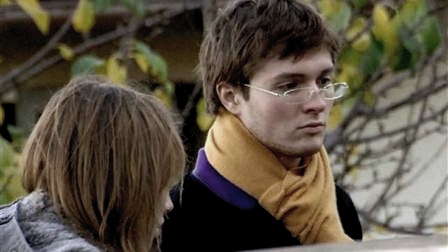
“Now I say… and then you say… and then I say… and then you say”
Reference the caption above: that’s the last time they talked before their first questionings.
Each day the cracks and fissures got worse. Would any cop not get suspicious?! Three days later, Sollecito separates with a bang and proclaims that Knox had made him lie.
That sure went well. Next murder Knox may do alone… A good primer for this post is this guide on how to read lies.
Here’s my take on the Recorded Statement taken from Amanda Knox 2 Nov 2007 in Part 4 of our previous post below. It is timed at 3:30pm. Mignini arrived about 3:00.
It could be the Squadra Mobila (the Flying Squad attached to the Carabinieri) took statements at the scene as Knox had to wait at the Questura quite a while before she was spoken to and got home late.
I have only processed three or four paragraphs so far (so this could turn into a whole series). What jumps out at me is the following statement:
Around 5 pm I left my house together with Raffaele to go to his house where we stayed the whole evening and the night.
In Sollecito’s own statement of 2 Nov 2007, in Part 5 of the previous post, he states:
At about 4:00 pm, Meredith left without saying where she was going, while we stayed at home until about 17.30. After that hour, Amanda and I took a little trip to the center to go to my house where we stayed until this morning.
So, from having been at Via della Pergola for lunch, during which time, Sollecito joined her and Meredith had got out of bed after arriving home in the early hours, and according to Knox and Sollecito, still had the remains of vampire makeup on her chin, was wearing her ex-boyfriend’s jeans, and had gone out at four, “˜without saying where she was going’, the pair claim to have gone straight to Raff’s apartment in Via Garibaldi, “˜at about five’. In Sollecito’s earliest account, it was to go to his house via the centre.
The next written record we have comes from Knox email home to 25 people in her address book on Sunday 4 Nov 2007, in the early hours circa 36 hours or so after Meredith’s body was found.
meredith came out of the shower and grabbed some laundry or put some laundry in, one or the other and returned into her room after saying hi to raffael. after lunch i began to play guitar with raffael and meredith came out of her room and went to the door. she said bye and left for the day. it was the last time i saw her alive. after a little while of playing guitar me and raffael went to his house to watch movies and after to eat dinner and generally spend the evening and night indoors. [sic]
Many believe this was Amanda writing out a “˜script’ to “˜get her story straight’. One thing about liars, is that they stick rigidly to a set chronology to make it easier to remember their lies.
The next written record is Sollecito’s first written statement to the police:
Raffale Sollecito: November 5th 2007 at 22:40 in the offices of the Flying Squad of the Perugia Police Headquarters
QA Around 16:00 Meredith left in a hurry without saying where she was going. Amanda and I stayed home until about 17:30-18:00.
QA We left the house, we went into town, but I don’t remember what we did.
QA We stayed there from 18:00 until 20:30/21:00. At 21:00 I went home alone because Amanda told me that she was going to go to the pub Le Chic because she wanted to meet some friends.
For the first time we are made aware that the pair went somewhere after leaving Via della Pergola at between “˜5:30 and 6:00’ according to Raffaele’s statement, this glides neatly into Popovic’s visit at 6:00pm at Raff’s abode. No visible gaps in the timeline here.
Next comes Knox’ handwritten statement to the police:
Amanda Knox Handwritten Statement to the police 6 Nov 2007
“˜Thursday, November 1st I saw Meredith the last time at my house when she left around 3 or 4 in the afternoon. Raffaele was with me at the time. We, Raffaele and I, stayed at my house for a little while longer and around 5 in the evening we left to watch the movie Amelie at his house.’
So Knox says they left at 5:00 ““ sticking to her scripted story as she set out in the email home, whilst Raff makes it an hour later. So, we are led to believe, they didn’t stay in town long at all, and in any case, ”˜I don’t remember what we did’.
This is a big flag. When people say, “˜I don’t remember’, they are telling you they recall an event, but are unable to retrieve it from their memory. In fact, they do not even try, not even when elite detectives are carrying out a crucial murder investigation of your girlfriend’s own roommate. A person who was not involved will say, “˜I don’t know’ when asked a straight question, not “˜I don’t recall’.
Sollecito sticks to his script: “˜We left via della Pergola, five-thirty to six’:
Raffaele Sollecito 7 Nov 2007 PRISON DIARY
“˜An amusing thing I remember is that Meredith was wearing a pair of men’s jeans which belonged to her ex”boyfriend in England. She left quickly around 4 pm, not saying where she was going. Meanwhile, Amanda and I stayed there until around 6 pm and we began to smoke cannabis.
My problems start from this moment because I have confused memories. Firstly, Amanda and I went to the centre going from Piazza Grimana to Corso Vannucci passing behind the University for Foreigners and ending up in Piazza Morlacchi (we always take that road). Then I do not remember but presumably we went shopping for groceries. We returned to my house at around 8 “ 8:30 pm and there I made another joint and, since it was a holiday, I took everything with extreme tranquillity, without the slightest intention of going out since it was cold outside.
Note the signifier, informing the reader, “˜it was cold outside’ embellishing the lie, “˜therefore we could not have gone out that night’.
So, whilst Raff on 7 Nov 2007 has jotted in his PRISON DIARY (which of course he is aware the authorities will be reading avidly), they were out between “˜six and eight’, Amanda writes to her lawyers a couple of days later adhering firmly to her script.
Amanda Knox Letter to her Lawyers 9 Nov 2007
Around 3 or 4 Meredith left the house wearing light-colored clothing, and all she said was “Ciao”. She didn’t say where she was going. I continued playing guitar and after a while Raffaele and I left my house, probably around 5pm.
We went to his house and the first thing we did was get comfortable. I took off my shoes etc. I used his computer for a little while to write down songs I wanted to learn for the guitar, I listened to some of Raffaele’s music at this time.
Note the inclusion of irrelevant and trivial detail, “˜I took off my shoes’. A liar loves to gild the lily.
click image for larger version
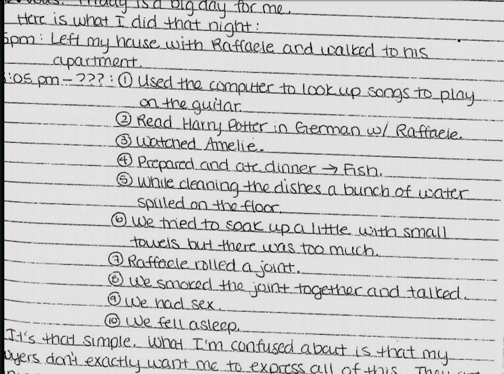
Then comes Knox’ next written affirmation of what she did the day of the murder:
Page 1223 PRISON DIARY ““ AMANDA KNOX 27 Nov 2007
Here is what I did that night:
5pm: Left my house with Raffaele and walked to his apartment.
5:05pm - ???:
(1) Used the computer to look up songs to play on the guitar.
(2) Read Harry Potter in German w/Raffaele.
(3) Watched Amelie.
(4) Prepared and ate dinner ““ Fish.
(5) While cleaning the dishes a bunch of water spilled on the floor.
(6) We tried to soak up a little with small towels but there was too much.
(7) Raffaele rolled a joint.
(8) We smoked the joint together and talked.
(9) We had sex.
(10) We fell asleep.It’s that simple.’
Did you spot, she remembers her lines, despite her problems with amnesia? Still no mention of going into the old town. When people use qualifies such as, “˜That’s about it’, or “˜It’s as simple as that’, there’s another flag they have just told you a lie. Note the triple question mark as if she is unsure it took half an hour to arrive at Raff’s, in case anyone pulls her up on it sometime in the future. Again bells and whistles, the liar’s toolkit.
Raffaele helpfully offers us an insight in his book several years later as to why he revealed ““ even if Amanda never does ““ they went into town in his police statement of 5 Nov 2007.
From Honor Bound 2012 Andrew Gumbel and Raffaele Sollecito write:
(P 17) It was the last time I ever saw [Meredith Kercher].
Amanda and I smoked a joint before leaving the house on Via della Pergola, wandered into town for shopping before remembering we had enough for dinner already, and headed back to my place.
P53 (in the Questura 5 Nov 2007)
I mentioned [to police] Amanda and I had gone out shopping, something I had apparently omitted in my previous statements. [note the plural].
So, we see, Raffaele has not voluntarily offered the information “˜we went into town’ either, on the afternoon of 1 Nov 2007. He concedes he only proffered it, because the police brought it up. When asked the purpose of the trip, he claims they went “˜shopping’, but on not being able to prove they bought anything nor state which shops the pair frequented, he had to retract this half-lie, by now adding to his 6 Nov 2007 official police statement, later, that once there, they suddenly realised ”˜we had enough for dinner already’.
So, we are led by this to conclude the purpose of the expedition into the old town was “˜shopping for dinner’, when before, it was to “˜to go to my house where we stayed until this morning.’
It is bizarre and a symptom of lying for someone to say they did something, but then didn’t do it, when asked to elaborate. Raff omits to even mention to police going into the old town, and Knox persistently does not mention it at all. He only mentions it when detectives ask him why he omitted to. He then “˜suddenly remembers’ this “˜unimportant detail’ and tells them they were there to shop. But wait. They suddenly do not do any shopping at all, whilst in the old town, because once there, they realise they ”˜already had’ provisions for the evening meal. Amanda Knox makes clear this evening meal was FISH. Yet she claims she couldn’t remember exactly what she did at Raff’s, for at least three weeks. Fishy indeed.
I don’t know about you, but if I head into town to buy food or clothes, once there, I don’t suddenly think, “˜Hang on a minute, what am I doing here, I already have bread/a dress at home!’
Surely, I would buy something anyway, or at least browse around, perhaps use my John Lewis voucher and go for a coffee and cake.
Astonishingly, years later, Knox still deceives us in this matter:
In Waiting to be Heard 2013 Amanda Knox resolutely omits the detail of “˜going into the old town’:
(P61) Sometime between 4:00pm and 5pm we left to go to his place.’
There then follows filler sentences about how “˜we wanted a quiet cozy night in’.
Then comes the type of deception liars love to use: they pad out their tall tales with irrelevant guff.
“˜As we walked along, I was telling Raffaele that Amélie was my all time favourite movie.
“˜Really?’ he asked. “˜I’ve never seen it’
[Forgetting completely, forensic police discovered he’d downloaded the movie way back on 28 Oct 2007 {by coincidence, no doubt}].
“˜Oh my God,’ I said, unbelieving. “˜You have to see it right this second. You’ll love it’
The narrative then completely jumps to:
Not long after we got back to Raffaele’s place, his doorbell rang. [Enter first alibi Jovanna Popovic, whom Raff states appeared at 6:00pm].
A whole hour is omitted. One whole hour to get back to Raff’s, just around the corner, four to ten minutes away at the outside.
From all the embellishments, fabrications and outright lies, we see that what happened between 4:00pm and 9:00pm and where the pair went, is significant. Some say, they obviously went to score drugs. However, they openly admit to smoking a joint. In fact, they go to pains to emphasise it. They have no inhibitions talking about having sex. Therefore, the trip into the old town which took up to two to five hours of their time is rather more sinister than some kind of coyness or embarrassment about buying some dope.
In his statement to police on 5 Nov 2007, Sollecito changes his story and claims he came home alone at ‘20:30/21:00’. As we now know, the pair both switched off their phones together, between 20:45 and 21:00, so we can be sure this time is supremely salient. Meredith was on her way back around then. From Knox not ever mentioning the trip into town, it could be she indeed never did go into town, and that Raff went alone.
Raffaele Sollecito complains in his book “˜the police were out to get me’ by catching out his anomalies. However, I was watching a tv programme a few days ago, about a murder case, and detectives had to puzzle out from scratch who was the culprit. The detectives explained to the viewer, when someone comes in for questioning, all they have is that person’s face value account. They then check out the details, and then, if they discover falsehood and deception in the interviewee’s story, that is what makes them suspicious. So Raff and Amanda have only themselves to blame police suspected them.
I believe the pair followed Meredith and stalked her movements that night, hence the concealment of their true motive for being out between 4:00 and 9:00.
Popovic has a story that she had to pick up a suitcase from the station, and then didn’t have to after all, so either she really did see Knox at home at six, as claimed, or it was “˜a friend helping out with the alibi’. See “˜the event that is a non-event’ -type of lie, as above. Who knows what that was about. Popovic claims to have spoken to the pair at between 5:30 and 5:45 and again at about 8:40. I personally remain sceptical of her testimony, as I do of his father’s, Francesco, whose claimed account of the 8:42 telephone conversation directly contradicts Knox’ and Sollecito’ with regard to dinner and the pipes flooding, supposedly happening before the murder.
We do know, as James Raper points out, as per Massei - “at 18:27:15 [6.27 pm] on the 1/11/07, there was human interaction via the “VLC” application, software used to play a multimedia file for a film “Il Favolso Mondo Di Amelie.avi”, already downloaded onto Sollecito’s computer laptop via P2P (peer to peer) some days earlier.”
We also know there was human interaction when the film “˜crashed’ (as it was finished?) at 9:10 because someone clicked on the error message to close it. I do not think this starting and finishing the film proves anything. I have always viewed Amélie as a contrived alibi.
Lies can work both ways. I don’t believe either Francesco or Popovic. The supposed testimony of these two “˜alibi witnesses’ were used directly against Sollecito when his compensation claim was thrown out.
Posted by KrissyG on 12/18/17 at 03:12 AM •
Permalink for this post •
Archived in Defendants in court, Amanda Knox, Raff Sollecito, Evidence & Witnesses, Questionings, Trials 2008 & 2009, Prelim hearings, Hoaxes against Italy, 1 Ital justice hoax, 2 Italian mileu hoax, 9 Mignini v Knox hoax, 11 No court bent hoax, Hoaxes Knox & team, 16 Interrogation hoax, Hoaxers from 2007, Knox-Marriott PR, Raff Sollecito PR, Heavey, Bremner, Bruce Fischer, Steve Moore, Saul Kassin, Amanda Knox #2, Raff Sollecito #2, John Douglas •
Comments here (23)
Thursday, December 14, 2017
Interrogation Hoax #19: ALL Knox Q&A Sessions 2-6 November 2007 WERE Recorded #1
Posted by Our Main Posters
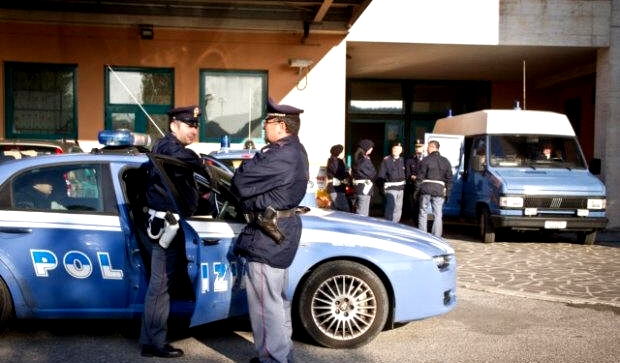
Working entrance of Perugia’s main police station
1. What Does The Hoax Allege?
In its ever-differing core version (see Part 3) this widely-promulgated hoax alleges among other things:
(1) that the total hours Knox was questioned from 2 to 6 November was upward of 50;
(2) that Knox was the main suspect for the murder of Meredith from the get-go;
(3) that the “interrogation” was conducted by tag-teams of investigators working in shifts;
(4) that Knox was under duress and forbidden bathroom breaks, sleep and refreshments.
(5) that Knox was refused a lawyer and all questioning sessions were illegally not recorded.
(6) That the outcome was “a confession”.
2. Who Are The Main Propagators?
Often seeming intent on outdoing one another in their manufactured outrage and lurid descriptions, the frontrunners are Doug Preston, Steve Moore, Michael Heavey, Paul Ciolino, Saul Kassin, John Douglas, and Bruce Fischer.
Also Steve Moore, Steve Moore, and Steve Moore. Seemingly for him an obsession.
Thousands of other accounts take their word as gospel. Curt Knox and Edda Mellas have repeated it, blaming Amanda when challenged (really).
Amanda Knox attempts to fire up this hoax again repeatedly.
But testimonies of numerous investigators at trial that she sat through without objection confirmed one another, strong proof that nothing on the list above is true.
Knox tried to make some of this fly at the 17 December 2007 questioning that she herself requested by Dr Mignini.
She tried again on the stand at trial in July 2009. But she had to concede that none of it was like that list above and that she was treated fairly on 5-6 Nov.
No judge in 2007, 2008, 2009, 2011, 2013, and 2015 ever accepted that a “confession” was forced out of her. Knox’s own lawyers did not believe it.
Totally isolated on this in court, and often her own worst enemy, Knox was sentenced to three years for voluntarily and maliciously fingering Patrick.
Knox will remain a felon for life (there can be no reversal) for this demonizing of Patrick.
She is trying very hard to hide that fact.
For example she hid it last year from Netflix. Now she is hiding it from Vice Media who dont realize that Knox is the mother of all demonizers. Not yet.
3. Complete Absence Of Verification
So far, the hoax is a huge fail. See Part 2.
But the malicious or confused usual suspects continue to parrot the hoax like a mantra. For Fischer’s hapless bunch of apologists on Ground Report it’s a mainstay.
In this series we have already posted proof of records of all Q&A made and signed by Knox herself for 5 and 6 November. They dont go toward proving anything on the list.
Here below is the record made and signed by Knox three days earlier for 2 November. A sort of prequel but an important one. It began at the house and then took maybe two hours at the questura. We will be posting the records for 3 and 4 November soon. None of them go toward proving anything at all on the list.
Here Knox was in discussion (in fact said to be eagerly in discussion) with just three officers on their regular shifts. This record is timed at 3:30 pm. There was a hour or so for discussion and an hour or so for typing and signing. Then Knox sat outside with others until they were all fingerprinted and sent home.
This below was the longest of all her questionings. Her sessions on 3 and 4 November merely consisted of two visits with Dr Mignini to the house, nothing more. Her nighttime sessions on 5 and 6 November we have posted on; they were quite short too. We know of no hard proof that puts their aggregate time beyond ten hours at maximum. We think less actually.
We will post the reports for 3 and 4 November soon, and you may be surprised at their briefness and thrusts - especially as Knox’s book suggests rank paranoia and chronic fatigue at the burdensomness of it all setting in.
Remember Knox was free to walk out of the police station at any time. Remember twice she turned up unrequested and she just hung around, watching and listening. (Her team actually counts in all those hours to get to their 50-plus.)
Before the wee hours of 6 November she did not even have the status of a witness. Just a person with information of possible value.
Told that she needed a lawyer on 5 and 6 November by both Rita Ficarra and Dr Mignini, she brushed them off, and kept talking and talking.
She was very keen to see things put in writing, and she demanded statements like this one to sign. The Sollecito statement follows.
4. Signed Record Of Knox Statement 2 November
[Preliminary Translation Not Yet Checked Out For Wiki]
Questura di Perugia /Perugia Police Station
Squadra Mobile /Flying SquadRe: Transcript of summary information from persons informed of the facts (of the case) conveyed by:
KNOX, Amanda Marie, born in Washington (USA) on July 9th, 1987, domiciled in Perugia, Via della Pergola n. 7; identified by means of Passport n. 422687114 issued by the US Government on June 13th, 2007, tel. 3484673590.On the day of November 2nd, 2007 at 3.30 pm, in Perugia at the offices of the Squadra Mobile of the Questura of Perugia. Before the undersigned Officers of the Judicial Authority Inspectors Luca C. Scatigno and Rita Ficarra, Assistant Fabio D’Astolto, respectively on duty at the aforementioned office and the local U.P.G.S.P., there is present the person indicated above who sufficiently understands and speaks Italian, who regarding to the death of Meredith Susanna Cara KERCHER, and who declares the following:
“I have been in Italy since the end of September for reasons of study, even if occasionally, on Tuesdays and Thursdays, I work in a pub called “Le Chic”, and since then I have lived at Via della Pergola number 7 together with other girls, specifically: Laura, 27 years of age, who is the one through whom I found the apartment in question, Filomena, 28 years of age, whose surnames I don’t know, but I know that they work in a law firm, though not together.
Then also living there is Meredith, an English student attending on the Erasmus exchange programme. Each one of us, peripatetically, occupies a room in the aforementioned apartment, on the 2nd floor. The common parts shared by all the girls are the two bathrooms and kitchen. Access to the apartment is through a door reached by an exterior stair. This entrance door, to be well closed, needs to be locked by means of keys, because otherwise as it is broken the door can be opened with a simple push.
Yesterday afternoon I definitely saw Meredith at lunch time, around 1 pm roughly. On that occasion I ate at my house together with my Italian boyfriend, Raffaele, whereas Meredith did not eat with us. Around 3 pm or perhaps 4 pm, after chatting a bit together with us, Meredith said goodbye and left, without however saying either the place she was going to or with whom, while we remained to play the guitar. I am not sure if yesterday Laura was at the house, because I didn’t see her, but I cannot exclude that she may have been in her room. Filomena, on the other hand, I saw yesterday morning before lunch time. She was preparing herself to go to a graduation party that afternoon.
Around 5 pm I left my house together with Raffaele to go to his house where we stayed the whole evening and the night.
This morning, around 10-11am, I returned to my house alone to have a shower and change my clothes, and in this circumstance I noticed that the entrance door of the apartment was wide open whereas the doors to the rooms inside the house were all closed, at least the ones to Filomena’s and Meredith’s rooms, although I didn’t check if they were locked, whereas the one to Laura’s room was ajar and my door was open as usual. These things seemed really strange to me because, like I already said, it is customary for all of us to always close the entrance door with a key since that is the only possible way to close it. So I started to call [the names of] the girls aloud, but without getting an answer. At that moment I thought that maybe one of the girls had gone out to throw the trash into the bins, or to go to see our neighbors, the boys, who occupy the apartment below ours and with whom we hang out.
I remember having closed the front door of the apartment, but I didn’t lock it with the keys, and I went to the bathroom located near to my room, the one that only me and Meredith usually use, to have a shower, when I noticed drops of blood on the floor and a bigger blood stain on the bath math and other blood stains on the sink as if someone had smeared it with a bloody hand. This thing seemed a bit strange to me because we girls are all fairly clean and tidy, and we clean the bathroom [immediately] after we have used it. At first I thought that the blood on the sink could be mine because I did some ear piercings about a week ago, so I immediately checked in the mirror and touched my ear. Then I touched the blood on the sink but seeing that it was not removed immediately, that is, it was not recent, I thought it could be some girl’s menstrual blood and because it disgusted me, I did not attempt to clean it.
Immediately after this I went to the other bathroom, where I usually dry my hair, and after having dried it, I noticed that there were feces in the toilet, that is, someone had used it to relieve themselves, but they had not flushed afterwards. This thing also seemed strange to me for the reasons that I have already stated, and so I avoided flushing it myself
Later I took the mop, which was located inside a closet, and I left my house to go to my boyfriend’s house to clean his room [kitchen] because we had soiled it the previous night. I remember that when I left, around 11.30 am, but I’m not sure about the precise time as I didn’t look very carefully at the clock, I closed the door of the apartment with a turn of the key.
After arriving at the house of my boyfriend, who lives alone in an apartment near my house and to be more precise in Corso Garibaldi number 110, we stayed there for about an hour, for the time it took to clean the kitchen and have some breakfast, after which we returned to my house together. I want to point out that I immediately told my boyfriend about the strange things that I had detected in my house, and he urged me to call one of the girls.
And I did indeed first call Filomena to ask her if she knew anything about the blood I had found in the bathroom, and she replied that she knew nothing about it as she had slept at her boyfriend’s, Marco’s, house the previous night, and the following morning, that is, this morning, she had gone directly to work without going home first. After Filomena, I phoned Meredith three times and to be more precise, the first time I called her, I called her English cell phone number 00447841131571, which is the first phone number Meredith gave to me, and which I saved first to my phone card; the phone rang several times, and at one point I heard the line disturbances and interruption of rings. So I tried to contact her on the phone with the number 3484673711, and also this time the phone rang but no-one answered. I tried calling her for the third time with the first cell phone number again, but also this time without getting an answer.
I didn’t call Laura because Filomena had told me in the previous phone call that she had gone to Rome, but I don’t remember if Filomena told me when she had left.
So I haven’t seen Laura since the afternoon of October 31st this year.
At this point, I returned to my house with my boyfriend, worried about Meredith, because she was the only one whose whereabouts I didn’t know of.
When I got to my house, around 1 pm, I opened the front door, which I found locked, and entered the apartment. I began to open the doors of the rooms occupied by the other girls. First, I opened Filomena’s bedroom door, that is the first room nearest to the entrance, and together with Raffaele we found that the window, with two shutters, was open and the window glass was broken. I don’t remember if both glasses were broken or only the other one. Broken glass was scattered on the floor, inside the room, near the window. Scared, I thought it could be that a thief had entered the house, and then I quickly glanced around to check that everything was in order, and that nothing had been removed. So I headed to Laura’s room and also there I opened the door and checked that everything was in order. I want to point out that I didn’t go inside the rooms, that I just had a quick look, from the door.
Immediately after that I went into my room, and even there I didn’t notice anything / nothing was different, after which I headed to Meredith’s room, but I couldn’t open the door because it was locked.
At that point I looked out from the bathroom terrace, leaning forward to try and see the window of Meredith’s room, but I couldn’t see anything, after which I returned to the door to look through the keyhole and I could only see Meredith’s handbag on the bed. I retraced my steps to take another look at all the rooms without, however, entering any of them and without noticing anything unusual. Immediately after that I entered the first bathroom near the entrance to the apartment where I very quickly looked around without paying close attention to whether the feces were still inside the toilet.
At that point while Raffaele remained in the apartment, I went down to the downstairs students’ apartment, and above all to talk with Giacomo hoping he would have news of Meredith’s whereabouts, but no-one answered the door. After I had returned to the apartment, Raffaele decided to call his sister for advice on what to do, and immediately after that call he called, I don’t know if it was the state police (Polizia) or Carabinieri, to come to the house, and in the meantime, I contacted Filomena at her cell phone number 3471073006 to inform her we had found the window panes in her room broken, and that Meredith’s room was locked. She replied that she would join me at once.
Raffaele, who was worried about Meredith’s safety, tried to break the door to her room by kicking it without success, and immediately afterwards we saw the plainclothes police arrive. After they showed us their identification cards, they inquired about our particulars and our cell telephone numbers. Then they asked us what had happened. We told them about the window we had found with the shattered glasses, about the blood stains found in the bathroom, and about Meredith’s room that was strangely locked. The policemen asked us questions about the people who occupied the house and about the telephone calls made, and in the meantime a friend of Filomena whom I know as Marco, and two other friends of hers I didn’t know, arrived. At that point Filomena began to talk to the policemen, and while I stood aside in the kitchen, the others together with the policemen headed for Meredith’s room and broke down the door. I can’t specify who really proceeded to break down the door. At that point I heard Filomena screaming and saying “a foot, a foot” while the police officers ordered us all to go outside the apartment.
At that moment I learned from my boyfriend that inside Meredith’s room, in the wardrobe there was a girl’s body covered with a sheet, and the only thing you could see was a foot. None of those present mentioned the name of Meredith, and as I left the house immediately after that without having seen the body, I can’t state whether it’s her.
Additionally: There are four Italian students living in the apartment on the lower floor of my house, and we often gather together to play the guitar; together with them we also went out a few times to go for a dinner, and once we went to a disco. Meredith and I went out more times together with all the four boys than the other two (Laura and Filomena). These guys are respectively called Giacomo, Marco, Stefano and the fourth, with whom I personally speak very little, I seem to remember is called Riccardo. I know that one of the four guys, to be precise, Giacomo, is Meredith’s boyfriend. In fact, Meredith sometimes slept at Giacomo’s house and sometimes Giacomo came to our house to sleep with Meredith. I want to point out that the two didn’t very often go out together as Meredith went out with her English friends while Giacomo, from what Meredith told me, preferred to spend more time at home.
Additionally: Regarding the house keys, I can say that they are available to each of us, but I don’t know that other outsiders would be in possession of any copies of them, including Raffaele, my boyfriend. I’m sure Filomena gave no key to Marco, her boyfriend, since every time he arrives at our house he always knocks at the door very loudly. Laura doesn’t have a boyfriend, whereas regarding Meredith, I can say that knowing her I don’t think she had given keys to Giacomo even if I can’t definitely rule it out.
Additionally: Meredith and Giacomo had only been seeing each other for a few weeks, and as for their relationship, Meredith herself told me that it was going well, she never talked about any quarrels with Giacomo, whom I moreover find a very quiet guy. As I’ve already said, she went out very often with her English friends, and they used to attend the disco pub “Merlins”. Once I went there too, and another time we went to another disco pub. Both times there were just us girls.
Additionally: Meredith and I did not celebrate Halloween together, in that I, that evening, was at the “Le Chic” pub, but not for work, but I know she went to “Merlins” with her English friends and without Giacomo, as she told me herself just yesterday. She told me that she had a lot of fun. She did not tell me about any new acquaintances made that evening. From what I know she always went out with the same friends, including me, or with Giacomo and his friends. She usually did not go out alone in the evening.
Additionally: I can describe Meredith as a girl of 21 years or age, of English nationality, about 1.70cm (5’7’‘) tall, thin build, olive complexion, black hair smooth and long, brown eyes. I don’t think she had any particular marks such as tattoos or other marks on her body. The last time I saw her, she was wearing white jeans and a short, light, pale-colored jacket.
Written, read, confirmed, signed
The declarer The verbalizers
Amanda Knox (signed) (Signed, three signatures)
5. Signed Record Of Sollecito Statement 2 November
QUESTURA DI PERUGIA
Anti-crime Police Division
Flying Squad
Section 5 Anti-drug treatment
SUBJECT: Minute of summary testimonial information provided by:
SOLLECITO Raffaele, born in Bari on 26.03.1984 residing in Giovinazzo (BA) in via Solferino nr. 4, domiciled in Perugia in C.so Garibaldi nr. 110, identified by means of C.I. nr. AJ1946390 Issued by the Municipality of Giovinazzo (BA) on 22.07.2004 Tel.340 / 3574303.The year 2007, of the month of November, the day 02 at 15.45, in the offices of the
Flying Squad of the Perugia Police Headquarters.Before us, undersigned Officers and Agents of P.G. Sost. Commissioner ROSCIOLI Roberto and Ass. ROSSI Romano, belonging to the Office. In the indicated inscription, the person indicated is the subject who heard about the finding of a dead English girl inside a flat located in Perugia in via della Pergola no. 7 who declares the following:
I state that I am a university student, enrolled in the first year of the Mathematics-Physics-Natural Sciences Department, at the Computer Science course at the University of Perugia. I am enrolled at the aforementioned university since 2003, also for about a year between 2005 and 2006 I attended the same course in Germany, through the Erasmus project. From October 2006 I returned to Perugia and for the study periods I live alone in a studio located in Perugia in Corso Garibaldi No. 10.
About a week and a half ago, I met my current girl of American nationality, KNOX Amanda, who is also a student, enrolled at the local University of Foreigners. My girlfriend lives together with three other students in an apartment located in Perugia in via della Pergola No. 7. Visting there, I have met the other three roommates, Filomena of Italian nationality, Laura also Italian with residence in Viterbo, and Meredith of English nationality with residence in London.
Since Amanda and I met, she usually spends the night at my house, same as it happened yesterday night and the previous one.
Yesterday morning, my girlfriend and I woke up around 10.30; I stayed to sleep while Amanda went to her home with the agreement that we would be seing each other in the early afternoon of the same day. Around 2:00 pm I went to Amanda’s house to have lunch with her and once I got there, I also found Meredith in the house who had already eaten. After eating lunch, I stayed at home talking to both my girlfriend and Meredith, who in the meantime was preparing to leave.
At about 4:00 pm, Meredith left without saying where she was going, while we stayed home until about 5.30 pm. After that hour, Amanda and I took a little trip to the town center and then went to my house where we stayed until this morning.
This morning around 10.00, we woke up and as on other occasions, Amanda returned home to take a shower and change, with the intention of returning later to my house.
At about 11:30 am, Amanda returned to my house and while we were having breakfast, she told me worriedly that in the house where she lives she had found the door open, and in the bathroom used by her and Meredith Amanda had noticed traces of blood both on the sink and in the mat below. Furthermore, Meredith’s room was locked.
Concerned about the situation, because it was not clear why the front door had remained open, Amanda went downstairs and knocked on the door of some Italian students who live under her to ask for help, but with negative outcome because nobody answered. I want to clarify that among the guys of the apartment above, there is a Giacomo, a person unknown to me, who Amanda says would hang out with Meredith. Not receiving resposess, Amanda, before returning to my house, locked the door and after arriving at my home told me the story
She asked me to take her home to find out what had happened. Once on the spot, Amanda opened the door, which has a defect in the lock, both from the outside and from the inside, which opens only with the keys because the handle does not work. Without the keys, it can not close even you pull it outward.
Once inside, we walked around the house and immediately Amanda noticed that in the other bathroom, the one used by the two Italian girls, when she left the house, there were faeces in the toilet while when we entered the toilet it was clean. In addition, the room in use by Filomena had the door wide open, was untidy and had the window completely open with the glass of the left pane broken in the lower part. Seeing this, Amanda told me that she had not previously seen this as the door to the aforementioned room was blocking the view of what was inside.
At this point, I went into the bathroom in use both by Amanda and Meredith. Here I too noticed the traces of blood on both the sink and the mat. Assuming something had happened, I was asking Amanda to call her roommate friends, but after several attempts she could only get in touch with Filomena, who told her that she was at her boyfriend’s house and that she would be returning immediately.
At this point Amanda called Meredith several times, and knocked on the door, but without any reply. Given the situation, I looked out of the various windows of the house in order to see where the window of Meredith’s room was, but being situated at the end of the apartment it was difficult to access from the outside, I decided to try to open the door by kicking it and pushing it at the height of the lock, but without succeeding because I only caused cracks in the wall and in the door.
Not succeeding in the intent, I tried to look through the keyhole which was missing the key and from there I could only see a brown woman’s bag that was on the bed, and on the left side probably an open cupboard door.
At this point I asked for advice from my sister, who serves as a Lieutenant of the Carabinieri in Rome, who advised me to call 112 directly. The local 112 when asked by me said that he would send a radio car. While waiting for the Carabinieri, I saw plainclothes police arrive who identified themselves officers of the Polizia Postale, who were looking for Filomena and Meredith because they had found the two cell phones of the latter.
To them, both Amanda and I told the story described above, and because of this the agents, given the situation, broke through the door of the room of Meredith thus ascertaining the tragic event. Seeing their faces I stayed on the sidelines and I did not look at what was inside. Present at the time of the breakthrough of the door, in addition to us and the police, there was also Filomena and her boyfriend who had arrived in the meantime and had reported not knowing where Meredith was.
Later a patrol squad of the Carabinieri also arrived. Being more precise, Amanda, when she told me that she went to ask for help from the boys who live below her apartment, found the doors closed but the gate in front of those doors was open.
I have nothing else to add.
Done, read, confirmed and signed.
Raffaele Sollecito
Posted by Our Main Posters on 12/14/17 at 03:28 PM •
Permalink for this post •
Archived in The officially involved, Police and CSI, Evidence & Witnesses, Questionings, Trials 2008 & 2009, Prelim hearings, Hoaxes against Italy, 1 Ital justice hoax, 2 Italian mileu hoax, 9 Mignini v Knox hoax, Hoaxes Knox & team, 13 AK persona hoax, 15 Single alibi hoax, 16 Interrogation hoax, 17 Fake memory hoax, Hoaxes Sollecito etc, 25 RS persona hoax, 27 Single alibi hoax, Hoaxes re Guede, 33 Sole attacker hoax, Hoaxers from 2007, Knox-Marriott PR, Raff Sollecito PR, Heavey, Bremner, Bruce Fischer, Steve Moore, Saul Kassin, Amanda Knox #2, Raff Sollecito #2, John Douglas •
Comments here (5)
Thursday, April 27, 2017
Multiple Attackers and the Compatibility of the Double DNA Knife (Exhibit 36)
Posted by James Raper
Our YouTube whiz DelPergola’s video of November 2010
Ed note: This evidence area is enormously compelling - but also emotionally difficult. It is why initially we did not publish our translation of the Micheli Report. And why a quarter of the trial was behind closed doors with the media excluded. That well-meaning decision has bedeviled the case ever since, because only the jury and others in court then - including the white-faced and tongue-tied accused pair - were exposed to the full power of the prosecution testimony.
Material from some of my previous posts on TJMK (link at bottom here) was incorporated into my Justice on Trial book. From Chapter 15, this is the second of several posts setting out further material.
Before looking at the forensic evidence, which is the final theme I identified earlier, it will be helpful to take into account the wounds suffered by Meredith, and whether these suggest anything as to the dynamics of the murder, and whether any of them were compatible with the knife recovered from Sollecito’s kitchen, Exhibit 36, called the Double DNA knife because the DNA of Meredith was found on the blade and the DNA of Knox on the handle.
As mentioned earlier the autopsy was carried out by Dr Lalli.
It was observed that there were no significant injuries to the chest, abdomen or lower limbs.
The significant elements in the examination were described as follows :
A fine pattern of petechiae on the internal eyelid conjunctive.
The presence of tiny areas of contusion at the level of the nose, localised around the nostrils and at the limen nasi [threshold of the nose].
Inside the mucous membranes of the lips, there were injuries compatible with a traumatic action localised in the inner surface of the lower lip and the inner surface of the upper lip, reaching up to the gum ridge.
Also found on the lower side of the jaw were some bruising injuries, and in the posterior region of the cheek as well, in proximity to the ear.
Three bruising injuries were present on the level of the lower edge of the right jaw with a roughly round shape. In the region under the jaw an area with a deep abrasion was observed, localised in the lower region of the middle part at the left of the jaw.
Once the neck had been cleaned it was possible to observe wounds that Dr Lalli attributed to the action of the point of a cutting instrument.
The main wound was located in the left lateral region of the neck. A knife would be compatible provided it had one cutting edge only which was not serrated. The wound was 8 cms in length and 8 cms deep. The width could not be measured because the edges had separated due to the elasticity of the tissues both in relation to the region and to the position of the head, which could have modified the width. The wound had a small “tail” at the posterior end. The wound penetrated into the interior structure of the neck in a slightly oblique direction, upwards and also to the right.
Underneath this large wound, another wound was visible, rather small and superficial, with not particularly clear edges, “becoming increasingly superficial until they disappeared”, in a reddish area of abrasions. The knife had penetrated both Meredith’s larynx and the cartilage of the epiglottis, and had broken her hyoid bone. A consequence of that damage is that Meredith would be unable to vocalise, let alone scream.
There was also a wound in the right lateral region of the neck, also attributed to a pointed cutting instrument. This was 4 cms deep and 1.5 cms wide (or long). It had not caused significant structural damage.
The presence of two relatively slight areas of bruising, with scarce colouring and barely noticeable, were detected in the region of the elbows.
On Meredith’s hands were small wounds showing a very slight defensive response. A small, very slight patch of colour was noticed on the “anterior inner surface of the left thigh”. Another bruise was noticed on the anterior surface, in the middle third of the right leg.
The results of the toxicological analyses revealed the absence of psychotropic drugs and a blood alcohol level of 0.43 grams per litre.
Tests of histological preparations of fragments of the organs taken during the autopsy were also performed. They revealed the presence of “pools of blood” in the lungs.
The cause of death was attributed to asphixiation and loss of blood, the former being caused by the latter.
There was nothing in the pathology which confirmed that Meredith had been raped, though we should recall that Guede’s DNA was found on the vaginal swab, though not of a spermatic nature. For Massei this was confirmation that she had been subjected to a sexual assault.
—————————————
There was argument in court as to whether Exhibit 36 was compatible with the main wound. There was no dispute amongst the experts that it could not have been responsible for the wound on the right. The knife had an overall length of 31 cms and the length of the blade from the point to the handle was 17.5 cms. The width of the blade, 4cms from the point, exceeded the width of the right hand wound. The wound on the right was more akin to a pocket knife, or perhaps a flick-knife.
I shall look at the arguments advanced by the defence as to why the knife would not be compatible in a moment, but before that there is a simple logical point as to incompatibility based on measurements.
A knife would only be incompatible if the length of the wound was greater than the length of the blade of the knife, or if the width of the wound was less than the width of the blade. Exhibit 36 was therefore a priori compatible.
On this basis I would also have to concede that a pocket or flick-knife is not a priori incompatible with the main wound, unless (though we would not know) the length of it”˜s blade did not exceed 8 cms.
It should however be recalled that the width of the left side wound was also 8 cms. That is over 5 times the width of the wound on the other side of the neck. The width of the blade on Exhibit 36, 8 cms from it’s tip - and being approximately 3.5 cms wide- was over twice the width of the blade on the “pocket knife”. This fact, and the robustness of the larger weapon, particularly with regard to the observed butchering at the base of the left-sided cut, makes Exhibit 36 a far more likely candidate, in my submission, than a “pocket knife”, and that’s without taking into account Meredith’s DNA on the blade.
We can also enter into a numbers game as regards the experts (8 of them) who opined on compatibility. Massei tells us that Dr Liviero concluded “definite compatibility”, Dr Lalli and Professors Bacci and Norelli “compatibility” whilst “non- incompatibility” came from the 3 GIP experts nominated at a preliminary hearing. The latter were Professors Aprile, Cingolani and Ronchi.
As far as I am concerned “non-incompatability” is not hard to understand. It simply means compatible.
Professors Introna, Torre, and Dr Patumi, for the defence, opined that Exhibit 36 could be ruled out. Their argument was twofold. First, the length of the blade was incompatible with the depth of the wound had the knife truly been used with homicidal intent. Indeed, if it had been thrust in up to the hilt then the point would have exited on the other side of the neck. Secondly, they said that the smaller wound or the abrasions beneath the main wound, mentioned earlier, were in fact caused by the hilt of a knife striking the surface of the neck. Obviously if that were so then the main wound was not caused by Exhibit 36.
Their argument does not consider, because we do not know, what may have been the actual dynamics of the knife strike. We cannot know what was the cause of the underlying wound or the reddish area of abrasions. As to that wound it may have been the result of the knife edge being run across the surface of the skin and the abrasions may have had a different cause in the prior struggle for which there is ample evidence. Hence their argument seems very weak.
We cannot leave the topic without considering that there may have been more than two knives involved. This possibility arises from the evidence of Professor Vinci, for the defence. He considered blood stains that were on the bed sheet in Meredith’s room. These stains very much resembled the outline of a knife, or knives, laid to rest on the bed sheet.
It was Professor Vinci’s contention that the bloody outlines (a dual outline from the same knife he said) was left by a knife with a blade 11.3 cms long, or a knife with a blade 9.6 cms long with a congruent blooded section of handle 1.7 cms long (9.6 + 1.7 = 11.3), and having a blade width of 1.3 to 1.4 cms.
Taking these measurements as read they may seem incompatible with a pocket knife (such as Sollecito had a proclivity to carry) and they certainly are as regards Exhibit 36. It follows, he argued, that one has to infer the presence of a third knife in any hypothesis and if a pocket knife and Exhibit 36 are already accounted for by Knox and Sollecito then a reasonable inference is that the third knife would have to be Guede’s. Professor Vinci’s blade is not incompatible a priori with either of the two wounds.
The problem, and without going into detail on the matter, is that Professor Vinci’s contention and measurements are somewhat speculative depending on what one thinks one sees in the stains. It is rather like reading tea leaves. One could just as well superimpose Exhibit 36 over the stains and conclude that it was responsible for them.
Massei only briefly commented about the bloody outlines on the bed sheet. He opined that the blood stains were certainly “suggestive” but insufficient to establish any clear outlines from which reliable measurements could be established. Clearly then he did not accord any reliability to Professor Vinci’s measurements.
—————————————————-
We can now turn to the issue of whether Meredith’s injuries tell us anything about whether her attacker was a “lone wolf” or not.
Massei believed that Meredith’s injuries lay at the heart of the matter. It seemed inconceivable to him that she would first be stabbed twice and that she would then be strangled. The amount of blood, being very slippery, would make maintaining pressure on her throat difficult. So Meredith was forcibly restrained and throttled first. The hypothesis of a single attacker requires that he continually modify his actions, first by exercising a strong restraining pressure on her, producing significant bruising, and then for some reason switching to life threatening actions with a knife, thereby changing the very nature of the attack from that of subjugation to that of intimidation with a deadly weapon, and finally to extreme violence, striking with the knife to one side of the neck and then to the other side of the neck.
Massei described the first knife blow, landing on the right side of her neck, as being halted by the jawbone, preventing it from going any deeper than the 4 cms penetration. The court considered that this was an action to force Meredith to submit to actions against her will. The same hypothesis could also, of course, in view of the injuries to the jaw, apply as to the lack of penetration with Exhibit 36 on the other side
What surprised Massei about Meredith’s wounds was that in spite of all the changes in approach during the attack she somehow remained in the same vulnerable position, leaving her neck exposed to attack.
Massei paid particular attention to the paucity and lack of what can be regarded as defensive wounds on her hands by comparison with the number, distribution and diversity of the impressive wounds to her face and neck. He found this disproportion to be significant, particularly with regard to what was known about Meredith’s physicality and personality.
Meredith was slim and strong, possessing a physicality that would have allowed her to move around with agility. She liked sports, and practiced boxing and karate. In fact she had a medium belt in karate. She would, had she been able to, have fought with all her strength. How then would a single attacker have been able to change hands with a knife to strike to both sides of her neck, let alone switch from one knife to another? He would have had to release his grip on the victim to do that, unless she had wriggled free and changed position, in which case he would have to subdue her all over again, but this time, if not before, she would be ready.
Since the attack was also sexual in nature, at least initially, how could a single attacker have removed the clothes she was wearing (a sweater, jeans, knickers and shoes) and inflicted the sexual violence revealed by the vaginal swab, without, again releasing his grip? It might be suggested, as the defence did, that Meredith was already undressed when the attack began, but for this to be the case one of three possible alternative hypotheses has to be accepted.
The first is that Guede was already in the flat, uninvited, and un-noticed by Meredith, which can only mean that the break -in was genuine but un-noticed by her. The second is that Guede was there by invitation and that their relationship had proceeded by agreement to the contemplation of sexual intercourse when Meredith suddenly changed her mind, unleashing a violent reaction from Guede. The third is that, having been invited in Meredith then thought that he had left, although he had not.
Having looked at the staging we can surely rule out the first hypothesis. As to the second, it does not fit with what is known about Meredith’s personality and the relationship she had been developing with Giacomo. As to the third it is difficult to imagine that in a small flat Meredith would not have checked before securing the front door and preparing for bed.
Massei found it was highly unlikely that one person could have caused all the resulting bruises and wounds by doing the above, including cutting off and bending the hooks on the bra clasp. The actions on the bra clasp alone would necessitate someone standing behind her and using a knife to cut the straps, requiring the attention of both hands from her attacker, during which time Meredith would have had the opportunity to apply some self-defence. It has to be conceded though that this could have happened when she was concussed, though there is no persuasive physical evidence of a concussive blow, or during or after she had been mortally wounded.
Massei concluded that there was little evidence of defensive manoeuvers on Meredith’s part, which to him meant that several attackers were present, each with a distribution of tasks and roles: either holding her and preventing her from making any significant defensive reaction, or actually performing the violent actions. He concluded that the rest of the body of evidence, both circumstantial and forensic, came in full support of such a scenario. He concluded that two separate knives had been used and that one was from Sollecito”˜s bedsit.
Although, at the trial, the defence had attempted to explain a scenario whereby a single attacker might have been responsible for the injuries, that there had been multiple attackers was not a scenario with which any court, other than the first appeal court presided over by Hellmann, demurred.
Posted by James Raper on 04/27/17 at 06:58 PM •
Permalink for this post •
Archived in Evidence & Witnesses, Real crimescene, Faked breakin, The pack attack, The two knives, DNA and luminol, Trials 2008 & 2009, Massei prosecution, Hoaxes against Italy, 4 No firm DNA hoax, 5 No pack attack hoax, Hoaxes re Guede, 33 Sole attacker hoax •
Comments here (17)
Friday, December 18, 2015
Knox Calunnia Trial #2: Judge Receives Arguments Of Prosecution And Knox; Verdict In New Year
Posted by Our Main Posters
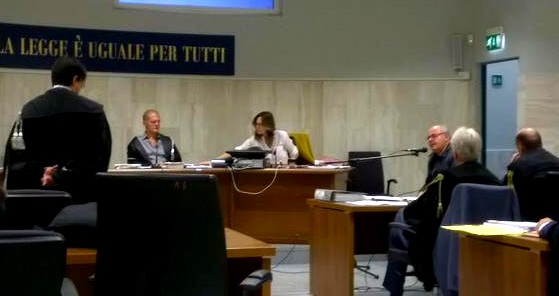
Court in session 7 September in Florence with Knox a no-show
1. Latest Development
We are informed that the final arguments to the judge by both sides have been submitted in writing.
We will summarise and/or fully translate them, hopefully next week. Next step is the verdict from Judge Boninsegna, which may come early in the New Year.
Below is a reposting of the background to this unusual case, and Machiavelli’s reports from the court on 7 September.
Such trials are very rare. Usually it is only organized crime figures that in the course of a trial impugn police and prosecutors who in Italy are much respected. Defendants rarely even get on the stand, and if they do so, they invariably follow the advice of defence counsel to not dig themselves in any deeper.
In contrast, Knox pretty well went haywire. NOBODY in Italy has ever believed her. Not her own lawyers, nor multiple hearings & trial judges, or the skeptical media, or the watching population, or Hellmann & Zanetti, or even Marasca & Bruno… Not even Curt Knox! He failed to turn up to give scheduled defense testimony that could have helped Amanda Knox last September.
Gee, thanks, Curt….
And she has left her own lawyers handicapped, as they had publicly counseled Knox to stop escalating her claims about illegal coercion at her “interrogation” on 5-6 November 2007.
Their filing probably needs to be especially careful to avoid their own liability.
2. Background To Calunnia Trial
This trial focuses on the claims of Amanda Knox at trial in 2009. Charges for malicious claims in her book will fall to another court, probably also in Florence. Oggi is already on trial for republishing some of them.
There seems no parallel in US or UK legal history to this - to a defendant testifying prolifically for two days to crimes by investigators, in spite of even more days of prior testimony which all pointed the other way.
Seemingly under strong pressure from her own family Knox willingly took a huge legal risk which her own lawyers had warned her about again and again, sometimes publicly, over nearly two years.
They never ever lodged even one complaint. Nor did the US Embassy in Rome, which monitored all sessions in court, and often checked her out (as did Italian MP Rocco Girlanda) in prison at Capanne.
The Massei court and the watching audience in Italy (read here and here) bought none of it. Knox still served three years for framing Patrick. Not even Judge Hellmann bought into her claims. Certainly not the Supreme Court.
The current trial in Florence was preceded by an investigation by Florence prosecutors, who bring the charges and argue them because Knox impugned officers of the justice system in their official roles.
Prior to today the prosecutors’ investigation report had only been released to Knox’s defense. So we don’t yet know if the charges extend beyond Knox’s claims of having been abused into a false “confession” on 5-6 November 2007.
Post #1 of our ongoing Interrogation Hoax series points toward what investigators testified to at trial.
Four months later Knox contradicted them at length as summarised in our two posts here and here: “The Amanda Knox Calunnia Trial In Florence: What It Is All About”
3. Machiavelli Reports From Trial 7 September
1. Tweets from the Florence court:
16. Zugarini was present throughout the interrogation and described when #amandaknox started to cry, remembered her peculiar hand-ear gestures.
15. Napoleoni testified #amandaknox was brought a chamomille when she started crying at 01:45, the interrogation was immediately stopped.
14. Napoleoni and Zugarini said they “cuddled” Knox because she was a 20-year old girl.
13. Both Mignini and Zugarini described having had impression that #amandaknox was feeling “relieved of a burden” after accusing Lumumba.
12. Mignini said Knox was not clearly a suspect to him by the 05:45 interrogation.
11. Witnesses had inaccurate memory on some details, but were convergent on some peculiar details.
10. Napoleoni said she did not enter interrogation room, she called Rita Ficarra out to talk to her.
9. Zugarini said, as for her knowledge, Knox was not told that Sollecito withdrew her alibi.
8. Zugarini said called interpreter only to ask #amandaknox more precise questions about people in her phone contact list.
7. Zugarini said #amandaknox was able to explain herself in Italian. They called an interpreter to translate what police had to say.
6. Testimony of Mignini was descriptive and framed thing in law. Mostly talked at length explaining alone, prosecutor listened.
5. In today’s hearing, Mignini talked 2 hours, confirmed arrived at 3am, police interview was over, he asked no questions of AK.
4. Napoleoni was precise and synthetic. Zugarini longer and IMO more interesting on many details.
3. Mignini and Judge Boninsegna appeared irritated by Dalla Vedova’s remarks.
2. Long hearing of Mignini at trial against Amanda Knox for calunnia. Napoleoni & Gubbiotti followed, then Zugarini
1. Testimony of some of the investigators accused by Knox and the lead prosecutor Dr Mignini [image above] is being taken in court.
[Reporting from the Florence court sometimes requires a wait to get to a place where mobile phones can connect to the outside.]
2. Emailed report following day (8 September):
No Knox calunnia session required today as last Friday and yesterday both sides completed their witness list.
Amanda Knox and Curt Knox chose not to testify.
Now Judge Boninsegna has ordered each side to prepare their arguments within three months (7 December).
The verdict is likely to arrive in the New Year.
Posted by Our Main Posters on 12/18/15 at 02:25 PM •
Permalink for this post •
Archived in Defendants in court, Amanda Knox, Trials 2008 & 2009, Knox on stand, The legal followups, Italian related, Hoaxes against Italy, 2 Italian mileu hoax, 3 No evidence hoax, 9 Mignini v Knox hoax, Hoaxes Knox & team, 16 Interrogation hoax, Hoaxers from 2007, Knox-Marriott PR •
Comments here (2)
Monday, September 07, 2015
Knox Calunnia Trial #2: Testimony In Florence Court Today By Some Accused By Amanda Knox Of Crimes
Posted by Our Main Posters
1. Overview Of This Post
The post is in 3 parts and was added to on the fly as new information flowed in.
Part 2 below summarizes what this trial is all about. It is not about Knox’s book, it is about her claims on the stand in mid 2009 of crimes committed by numerous investigators and the lead prosecutor.
Part 3 below is live reports from the court. Part 4 is about the Supreme Court sentencing report released today in Rome.
2. Background To Calunnia Trial
This trial focuses on the claims of Amanda Knox at trial in 2009. Charges for malicious claims in her book will fall to another court, probably also in Florence. Oggi is already on trial for republishing some of them.
There seems no parallel in US or UK legal history to this - to a defendant testifying prolifically for two days to crimes by investigators, in spite of even more days of prior testimony which all pointed the other way.
Seemingly under strong pressure from her own family Knox willingly took a huge legal risk which her own lawyers had warned her about again and again, sometimes publicly, over nearly two years.
They never ever lodged even one complaint. Nor did the US Embassy in Rome, which monitored all sessions in court, and often checked her out (as did Italian MP Rocco Girlanda) in prison at Capanne.
The Massei court and the watching audience in Italy (read here and here) bought none of it. Knox still served three years for framing Patrick. Not even Judge Hellmann bought into her claims. Certainly not the Supreme Court.
The current trial in Florence was preceded by an investigation by Florence prosecutors, who bring the charges and argue them because Knox impugned officers of the justice system in their official roles.
Prior to today the prosecutors’ investigation report had only been released to Knox’s defense. So we don’t yet know if the charges extend beyond Knox’s claims of having been abused into a false “confession” on 5-6 November 2007.
Post #1 of our ongoing Interrogation Hoax series points toward what investigators testified to at trial.
Four months later Knox contradicted them at length as summarised in our two posts here and here: “The Amanda Knox Calunnia Trial In Florence: What It Is All About”
2. Machiavelli Reports From Calunnia Trial
1. Tweets from the Florence court:
16. Zugarini was present throughout the interrogation and described when #amandaknox started to cry, remembered her peculiar hand-ear gestures.
15. Napoleoni testified #amandaknox was brought a chamomille when she started crying at 01:45, the interrogation was immediately stopped.
14. Napoleoni and Zugarini said they “cuddled” Knox because she was a 20-year old girl.
13. Both Mignini and Zugarini described having had impression that #amandaknox was feeling “relieved of a burden” after accusing Lumumba.
12. Mignini said Knox was not clearly a suspect to him by the 05:45 interrogation.
11. Witnesses had inaccurate memory on some details, but were convergent on some peculiar details.
10. Napoleoni said she did not enter interrogation room, she called Rita Ficarra out to talk to her.
9. Zugarini said, as for her knowledge, Knox was not told that Sollecito withdrew her alibi.
8. Zugarini said called interpreter only to ask #amandaknox more precise questions about people in her phone contact list.
7. Zugarini said #amandaknox was able to explain herself in Italian. They called an interpreter to translate what police had to say.
6. Testimony of Mignini was descriptive and framed thing in law. Mostly talked at length explaining alone, prosecutor listened.
5. In today’s hearing, Mignini talked 2 hours, confirmed arrived at 3am, police interview was over, he asked no questions of AK.
4. Napoleoni was precise and synthetic. Zugarini longer and IMO more interesting on many details.
3. Mignini and Judge Boninsegna appeared irritated by Dalla Vedova’s remarks.
2. Long hearing of Mignini at trial against Amanda Knox for calunnia. Napoleoni & Gubbiotti followed, then Zugarini
1. Testimony of some of the investigators accused by Knox and the lead prosecutor Dr Mignini [image above] is being taken in court.
[Reporting from the Florence court sometimes requires a wait to get to a place where mobile phones can connect to the outside.]
2. Emailed report following day (8 September):
No Knox calunnia session required today as last Friday and yesterday both sides completed their witness list.
Amanda Knox and Curt Knox chose not to testify.
Now Judge Boninsegna has ordered each side to prepare their arguments within three months (7 December).
The verdict is likely to arrive in the New Year.
4. Machiavelli On Cassazione Sentencing Report
4. The Cassazione sentence on the #meredithkercher case about #amandaknox and #raffaelesollecito is an offence to intelligence.
3. Cassazione repeats several times “strong suspicion” remains about #amandaknox and #raffaelesollecito
2. Cassazione says #amandaknox was in the apartment when murder was convicted, and it is “incontrovertible” that she committed calunnia.
1. INCREDIBLE: SC says *proven* fact that #amandaknox was in house when murder was committed. Agrees with court on this
Posted by Our Main Posters on 09/07/15 at 01:23 PM •
Permalink for this post •
Archived in Defendants in court, Amanda Knox, Trials 2008 & 2009, Knox on stand, The legal followups, Knox followup, Hoaxes against Italy, 1 Ital justice hoax, 2 Italian mileu hoax, 3 No evidence hoax, 9 Mignini v Knox hoax, Hoaxes Knox & team, 16 Interrogation hoax, 17 Fake memory hoax, Hoaxers from 2007, Knox-Marriott PR •
Comments here (25)
Tuesday, September 01, 2015
The Amanda Knox Calunnia Trial In Florence: What It Is All About #2
Posted by Peter Quennell
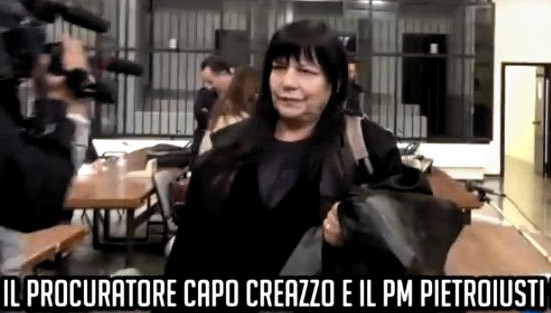
Above: Florence Prosecutor Dr Angela Pietroiusti. Quick route to Comments here.
1. Most Bungling Team In Legal History?
There is NO WAY Knox and Sollecito would be out on the streets if the playing field had been level.
Knox’s lawyers and family and PR effort and publishers all bungled enormously and suffered an overwhelming loss at both Knox’s trials (murder and calunnia) when pre-trial concessions could have served them well.
To make up for this, they tilted the playing field.
Manipulation of the media and thus American (but not Italian) opinion and manipulation of the evidence and manipulation of judges and manipulation of court-appointed DNA experts and manipulation to prevent Italy from finding out what was in Knox’s and Sollecito’s horrific books.
You want to see manipulation in spades?
See here and here and the whole huge area of the DNA and of course the RS and AK books.
You want to see bungling in spades?
No better example than this one which could possibly cost Sollecito lawyer Luca Maori his career and has stopped the Fifth Chambers of Cassation dead in their tracks.
Also Knox’s and Sollecito’s foolish books involving dozens of others are coming back to haunt them in court. Also look here at how Chris Mellas dropped Knox in it.
Helping Sollecito cost his sister Vanessa her Carbinieri job. Sollecito’s father admitted to Panorama he tried political manipulation and was charged. Knox’s parents parroted Amanda Knox and were charged. “Helpful” investigator Paul Ciolino framed an innocent man in another case and was charged. Doug Preston ally Mario Spezi smeared investigators after the two tried framing an innocent man and blocking an investigation getting too near the truth and Spezi was charged.
Judge Heavey lied to national presidents everywhere and was reprimanded and soon retired. The defense arranged for Judge Hellmann to preside over the 2011 appeal; he was overturned and pushed out. Pepperdine University pushed out the besotted security guard Steve Moore. Frank Sforza, facing felony charges, took off like a rabbit out of America. Defense witness Aviello was charged.
The defenses’ attempt to climb in Filomena’s window came up short. This bungled frame-up went nowhere. The pathetic Bruce Fischer team has gone nowhere.
2. Bungling In Knox’s Calunnia Case
Keeping Knox quiet for her own good was always a mighty struggle and the defense lawyers openly complained. It was an open secret in Perugia from 2007 to 2009 that Knox’s defense lawyers were struggling with Knox herself and with her family and her PR.
At least one defense lawyer was fired or walked off the job (as with the Sollecito team). This struggle broke out into the open at various times, for example see here.
Still. Knox’s defense team also did at least five things to help make matters worse for her in her calunnia trial now.
- 1) They allowed Knox to interrupt prosecution witness Anna Donnino, the interpreter, during her testimony in March 2009 to claim she was hit, having repeatedly said previously that that was untrue. That set the legal reaction in motion.
2) They put Knox on the stand seemingly unbriefed and allowed her to contradict both days and days of prosecution testimony and also prior declarations by herself.
3) They put a presumably privileged letter from Knox to themselves in evidence (see previous post) knowing that it contained false claims.
4) They applied to a Perugia judge for the transfer of the calunnia case from Perugia to Florence, thinking the Florence court was gunning for Dr Mignini when the truth is opposite.
5) They applied to the same Perugia judge for the attachment of Dr Mignini’s name to the complaint though they knew he was not at the “interrogation” as even Knox said on the stand.
Due to failed defense efforts Knox has already served three years and is a felon for life, and she now could face another six plus more penalties for her book. She is still not off the hook for murder as Fifth Chambers judges broke two laws and had fishy friends in their pasts.
So, good luck, Amanda Knox. GREAT TEAM!
3. Day Two Of Knox’s Testimony
These are excerpts related to the “interrogation” of 5-6 Nov. Important: we dont yet know what else the prosecutors will include in their charges as much of Knox’s testimony was on other things about which she also lied.
Excerpts in both posts are from the full transcript on the Case Wiki, and all transcription and translation into English (a massive task) was by the PMF Team.
Cross Examination By Prosecutor Mignini
GM: In your preceding declarations, on Nov 2 at 15:30, on Nov 3 at 14:45, then, there was another one, Nov 4, 14:45, and then there’s Nov 6, 1:45. Only in these declarations, and then in the following spontaneous declarations, did you mention the name of Patrick. Why hadn’t you ever mentioned him before?
AK: Because that was the one where they suggested Patrick’s name to me.
GM: All right, now is the time for you to make this precise and specific. At this point I will take…no, I’ll come back to it later. You need to explain this. You have stated: “The name of Patrick was suggested to me. I was hit, pressured.”
AK: Yes.
GM: Now you have to tell me in a completely detailed way, you have to remember for real, you have to explain step by step, who, how, when, was the name of Patrick suggested to you, and what had been done before that point. The name of Patrick didn’t just come up like a mushroom; there was a preceding situation. Who put pressure on you, what do you mean by the word “pressure”, who hit you? You said: “They hit me”, and at the request of the lawyer Ghirga, yesterday, you described two little blows, two cuffs.
AK: Yes.
GM: So that would be what you meant by being hit?
AK: Yes.
GM: Or something else? Tell me if there was something else. You can tell us.
AK: Okay.
GCM: So, you are—[Interruptions] The question is—[Interruptions] Escuse me. Excuse me. The question is quite clear. He is repeating this in order to give the accused a chance to add something to these events that were explained by the accused yesterday. The pubblico ministero is asking to return to these events mentioned yesterday in order to obtain more detail about exactly what happened and who did it. Please be as precise as possible.
GM: So you were in front of—
GCM: The question is clear.
GM: All right, so tell us.
GCM: Yes, it’s clear.
AK: All right. Okay.
GCM: If you could give more detail, be more precise, exactly what was suggested to you, about the cuffs, all that.
AK: Okay.
GCM: And who did all this, if you can.
AK: Okay. Fine. So, when I got to the Questura, they placed me to the side, near the elevator, where I was waiting for Raffaele. I had taken my homework, and was starting to do my homework, but a policeman came in, in fact there were I don’t know, three of them or something, and they wanted to go on talking to me. They asked me again—
GM: Excuse me, excuse me—
AK: [coldly] Can I tell the story?
GM: Excuse me for interrupting you otherwise we’ll forget—
CDV: Presidente, I object to this way of doing things. The question was asked—[Yelling, interruptions]—we should wait for the answer.
GM: It’s impossible to go on like this, no, no.
CDV: If a question is asked, she has to be able to answer.
GCM: Please, please. That’s correct. There is a rule that was introduced, which says that we should absolutely avoid interruptions from anyone.
CDV: I want to ask that she be allowed to finish her answer. She has the right, no?
GCM: Please, please, pubblico ministero. It’s impossible to go on this way.
GM: I would like to, I can—
GCM: No no no, no one can. We have to make sure that while someone is speaking, there are never any superimposed voices. And since the accused is undergoing examination, she has the right to be allowed to answer in the calmest possible way. Interruptions and talking at the same time don’t help her, and they can’t be written down in the minutes, which obliges the courts to suspend the audience and start it again at a calmer and more tranquil moment.
GM: Presidente—
GCM: No, no, no! Interruptions are absolutely not allowed! Not between the parties, nor when the Court, the President is speaking. So, interruptions are not allowed. Now, the accused is speaking, and when she is finished, we can return to her answers—
GM: Presidente.
GCM: Excuse me, please! But at the moment she is speaking, we have to avoid interrupting her. But—I don’t know if this is what was wanted—but while you are speaking, if you could tell us when. For instance, you say you were doing homework, but you didn’t tell us when. We need to know when, on what day, the 2nd of November, the 3rd, what time it was. While you are talking, you need to be more detailed, as detailed as you can with respect to the date and the time.
AK: Okay.
GCM: And we must avoid interruptions, but when you have finished, we can discuss your answer.
AK: Thank you. So, here is…how I understood the question, I’m answering about what happened to me on the night of the 5th and the morning of the 6th of November 2007, and when we got to the Questura, I think it was around 10:30 or nearer 11, but I’m sorry, I don’t know the times very precisely, above all during that interrogation. The more the confusion grew, the more I lost the sense of time. But I didn’t do my homework for a very long time. I was probably just reading the first paragraph of what I had to read, when these policemen came to sit near me, to ask me to help them by telling them who had ever entered in our house. So I told them, okay, well there was this girlfriend of mine and they said no no no, they only wanted to know about men. So I said okay, here are the names of the people I know, but really I don’t know, and they said, names of anyone you saw nearby, so I said, there are some people that are friends of the boys, or of the girls, whom I don’t know very well, and it went on like this, I kept on answering these questions, and finally at one point, while I was talking to them, they said “Okay, we’ll take you into this other room.” So I said okay and went with them, and they started asking me to talk about what I had been doing that evening. At least, they kept asking about the last time I saw Meredith, and then about everything that happened the next morning, and we had to repeat again and again everything about what I did. Okay, so I told them, but they always kept wanting times and schedules, and time segments: “What did you do between 7 and 8?” “And from 8 to 9? And from 9 to 10?” I said look, I can’t be this precise, I can tell you the flow of events, I played the guitar, I went to the house, I looked at my e-mails, I read a book, and I was going on like this. There were a lot people coming in and going out all the time, and there was one policeman always in front of me, who kept going on about this. Then at one point an interpreter arrived, and the interpreter kept on telling me, try to remember the times, try to remember the times, times, times, times, and I kept saying “I don’t know. I remember the movie, I remember the dinner, I remember what I ate,” and she kept saying “How can you you remember this thing but not that thing?” or “How can you not remember how you were dressed?” because I was thinking, I had jeans, but were they dark or light, I just can’t remember. And then she said “Well, someone is telling us that you were not at Raffaele’s house. Raffaele is saying that at these times you were not home.” And I said, but what is he saying, that I wasn’t there? I was there! Maybe I can’t say exactly what I was doing every second, every minute, because I didn’t look at the time. I know that I saw the movie, I ate dinner. And she would say “No no no, you saw the film at this time, and then after that time you went out of the house. You ate dinner with Raffaele, and then there is this time where you did nothing, and this time where you were out of the house.” And I said, no, that’s not how it was. I was always in Raffaele’s apartment.
GCM: [taking advantage of a tiny pause to slip in without exactly interrupting] Excuse me, excuse me, the pubblico ministero wants to hear precise details about the suggestions about what to say, and also about the cuffs, who gave them to you.
AK: All right. What it was, was a continuous crescendo of these discussions and arguments, because while I was discussing with them, in the end they started to little by little and then more and more these remarks about “We’re not convinced by you, because you seem to be able to remember one thing but not remember another thing. We don’t understand how you could take a shower without seeing…” And then, they kept on asking me “Are you sure of what you’re saying? Are you sure? Are you sure? If you’re not sure, we’ll take you in front of a judge, and you’ll go to prison, if you’re not telling the truth.” Then they told me this thing about how Raffaele was saying that I had gone out of the house. I said look, it’s impossible. I don’t know if he’s really saying that or not, but look, I didn’t go out of the house. And they said “No, you’re telling a lie. You’d better remember what you did for real, because otherwise you’re going to prison for 30 years because you’re a liar.” I said no, I’m not a liar. And they said “Are you sure you’re not protecting someone?” I said no, I’m not protecting anyone. And they said “We’re sure you’re protecting someone.” Who, who, who, who did you meet when you went out of Raffaele’s house?” I didn’t go out. “Yes, you did go out. Who were you with?” I don’t know. I didn’t do anything. “Why didn’t you go to work?” Because my boss told me I didn’t have to go to work. “Let’s see your telephone to see if you have that message.” Sure, take it. “All right.” So one policeman took it, and started looking in it, while the others kept on yelling “We know you met someone, somehow, but why did you meet someone?” But I kept saying no, no, I didn’t go out, I’m not pro-pro-pro—-
GCM: [taking advantage of her stammer] Excuse me, okay, we understand that there was a continuous crescendo.
AK: Yes.
GCM: As you said earlier. But if we could now get to the questions of the pubblico ministero, otherwise it will really be impossible to avoid some interruptions. If you want to be able to continue as tranquilly, as continuously as possible…
AK: Okay, I’m sorry.
GCM: So, if you could get to the questions about exactly when, exactly who… these suggestions, exactly what did they consist in? It seems to me…
AK: Okay. Fine. So, they had my telephone, and at one point they said “Okay, we have this message that you sent to Patrick”, and I said I don’t think I did, and they yelled “Liar! Look! This is your telephone, and here’s your message saying you wanted to meet him!” And I didn’t even remember that I had written him a message. But okay, I must have done it. And they were saying that the message said I wanted to meet him. That was one thing. Then there was the fact that there was this interpreter next to me, and she was telling me “Okay, either you are an incredibly stupid liar, or you’re not able to remember anything you’ve done.” So I said, how could that be? And she said, “Maybe you saw something so tragic, so terrible that you can’t remember it. Because I had a terrible accident once where I broke my leg…”
GCM: The interpreter said this to you?
AK: The interpreter, yes.
GCM: I also wanted to ask you because it isn’t clear to me: only the interpreter spoke to you, or the others also?
AK: All the others also.
GCM: Everyone was talking to you, all the others, but were they speaking in English?
AK: No, in Italian.
GCM: In Italian. And you answered in Italian?
AK: In Italian, in English…
GCM: And what was said to you in Italian, did it get translated to you in English?
AK: A bit yes, a bit no, there was so much confusion, there were so many people all talking at the same time, one saying “Maybe it was like this, maybe you don’t remember,” another saying “No, she’s a stupid liar,” like that…
GCM: But everything was eventually translated, or you understood some of it and answered right away?
AK: It wasn’t like an interrogation, like what we’re doing now, where one person asks me a question and I answer. No. There were so many people talking, asking, waiting, and I answered a bit here and there.
GCM: All right. You were telling us that the interpreter was telling you about something that had happened to her. [Interruption by Mignini.] But you need to get back to the questions asked by the pubblico ministero. This isn’t a spontaneous declaration now. This is an examination. That means the pubblico ministero has asked you a question, always the same question, and we still haven’t really heard the answer to it.
AK: Yes, sorry.
GCM: Right, so you were saying that there was this continuous crescendo.
AK: It’s difficult for me to say that one specific person said one specific thing. It was the fact that there were all these little suggestions, and someone was saying that there was the telephone, then there was the fact that… then more than anything what made me try to imagine something was someone saying to me “Maybe you’re confused, maybe you’re confused and you should try to remember something different. Try to find these memories that obviously you have somehow lost. You have to try to remember them. So I was there thinking, but what could I have forgotten? And I was thinking, what have I forgotten? what have I forgotten? and they were shouting “Come on, come on, come on, remember, remember, remember,” and boom! on my head. [Amanda slaps herself on the back of the head: End of video segment] “Remember!” And I was like—Mamma Mia! and then boom! [slaps head again] “Remember!”
GCM: Excuse me, excuse me, please, excuse me…
AK: Those were the cuffs.
GCM: So, the pubblico ministero asked you, and is still asking you, who is the person that gave you these two blows that you just showed us on yourself?
AK: It was a policewoman, but I didn’t know their names.
GM: Go ahead, pubblico ministero.
GM: So, now, I asked you a question, and I did not get an answer. You ... [interruptions]!
LG or CDV: I object to that remark! That is a personal evaluation! Presidente! That is very suggestive. He is making an unacceptable conclusion. He can ask a question, but this is a personal opinion. It seems to me that she did answer. She answered for a good five minutes.
GCM: Sorry, but I said that we were supposed to avoid interruptions, that we weren’t supposed to interrupt when someone was speaking—
LG or CDV: But—
GCM: Wait—avvocato, excuse me, please, let’s try to avoid these moments which don’t help anybody and probably harm the person undergoing the examination because they create tension in the court—
GM: When I am doing the cross-examination I would like—
GCM: Please, pubblico ministero. This is another recommendation: let’s avoid analyses. Let’s take the answers as they come, later the right moment will come to say that from this examination, you did not obtain the answer that you expected, that the accused did not answer the questions. That is a later phase. At this moment, let’s stay with the answers that we have, even if they are not exhaustive, and return to the question, but avoiding personal evaluations of their value. Go ahead, publicco ministero, go ahead.
GM: I would like to—
GCM: Yes, yes, go ahead, return to your question. And then you can come back to it with more details.
GM: The central point of that interrogation was the moment when the name of Patrick emerged. You spoke of suggestions, you spoke of pressure, you spoke of being hit, I asked you to give me a precise description of who gave you the blows, you need to describe this person. Was it a woman or a man? Who asked you the questions? Who was asking you the questions? There was the interpreter, who was the person who was translating. But the exam, the interrogation, who was doing it? Apart from the people who were going in and out. You must have understood that there was a murder, and this was a police station, and the investigation was hot, and what I am asking you is, who was actually conducting the interrogation?
GCM: The pubblico ministero is asking you, you said that the two blows were given to me by someone whose name I don’t know. The pubblico ministero is asking you firstly if you can give a description of the person who hit you, if you saw her, and if you can give us a description. The second question—
AK: So, when I—the person who was conducting the interrogation—
GCM: That was the second question! You’re starting with the second question, that’s fine, go ahead, go ahead.
AK: Oh, sorry…
GCM: Go on, go on. The person who was conducting the interrogation…
AK: Well, there were lots and lots of people who were asking me questions, but the person who had started talking with me was a policewoman with long hair, chestnut brown hair, but I don’t know her. Then in the circle of people who were around me, certain people asked me questions, for example there was a man who was holding my telephone, and who was literally shoving the telephone into my face, shouting “Look at this telephone! Who is this? Who did you want to meet?” Then there were others, for instance this woman who was leading, was the same person who at one point was standing behind me, because they kept moving, they were really surrounding me and on top of me. I was on a chair, then the interpreter was also sitting on a chair, and everyone else was standing around me, so I didn’t see who gave me the first blow because it was someone behind me, but then I turned around and saw that woman, and she gave me another blow to the head.
GCM: This was the same woman with the long hair?
AK: Yes, the same one.
GCM: All right. Are you finished? Tell me if you have something to add.
AK: Well, I already answered.
GCM: Fine, fine, all right. Go ahead, pubblico ministero.
GM: I’ll go on with the questions. In the minutes it mentions three people, plus the interpreter. Now, you first said that they suggested things to you. What exactly do you mean by the word “suggestion”, because from your description, I don’t see any suggestion. I mean, what is meant by the Italian word “suggerimento”, I don’t find it.
GCM: [quelling them] Excuse me, excuse me, please, please, excuse me, excuse me! Listen, the pubblico ministero is asking you: “suggestions”, you also mentioned words that were “put in your mouth”, versions, things to say, circumstances to describe.
The pubblico ministero is asking two things: who made the suggestions, and what exactly were you told to say? }}
AK: All right. It seems to me that the thoughts of the people standing around me, there were so many people, and they suggested things to me in the sense that they would ask questions like: “Okay, you met someone!” No, I didn’t. They would say “Yes you did, because we have this telephone here, that says that you wanted to meet someone. You wanted to meet him.” No, I don’t remember that. “Well, you’d better remember, because if not we’ll put you in prison for 30 years.” But I don’t remember! “Maybe it was him that you met? Or him? You can’t remember?” It was this kind of suggestion.
GCM: When you say they said “Maybe you met him?”, did they specify names?
AK: Well, the important fact was this message to Patrick, they were very excited about it. So they wanted to know if I had received a message from him—
[Interruptions]
GCM: Please, please!
[Interruptions, multiple voices]
CDV: It’s not possible to go on this way! [Mignini yells something at dalla Vedova]
GCM: Please, please, excuse me, excuse me!
??: I’m going to ask to suspend the audience! I demand a suspension of five minutes!
GCM: Excuse me, excuse me! Please!
CDV: Viva Dio, Presidente!
GM: Presidente, I’m trying to do a cross-examination, and I must have the conditions that allow me to do it! The defense keeps interrupting.
??: That’s true!
GCM: Excuse me, excuse me, please—
GM: We’re asking for a suspension!
GCM: Just a moment, excuse me. I’ve heard all the demands and suggestions, now the Court will decide. So.
[Several moments of silence, during which Amanda murmurs in a very tiny voice: “Scusa.”]
GCM: I want to point out that the accused offers answers to every question. She could always refuse to respond. She is answering, and that doesn’t mean she has to be asked about the same circumstances again and again. She is not a witness. The accused goes under different rules. We have to accept the answers—
??: But—
GCM: Please, please! We have to accept the answers given by the accused. She can stop answering at any time. At some point we simply have to move on to different questions. One circumstance is being asked again, the accused answered. The regularly, the tranquillity, the rituality of the court, of the process, has to be respected. The pubblico ministero was asking about suggestions. [To Amanda] If you want a suspension we can do it right away.
AK: No, I’m fine.
GCM: So the pubblico ministero was asking about the suggestions. All right?
AK: Sure.
GCM: So, you were the one who gave the first indication, introducing this generic pronoun “him”? This “him”, did they say who it could be?
AK: It was because of the fact that they were saying that I apparently had met someone and they said this because of the message, and they were saying “Are you sure you don’t remember meeting THIS person, because you wrote this message.”
GCM: In this message, was there the name of the person it was meant for?
AK: No, it was the message I wrote to my boss. The one that said “Va bene. Ci vediamo piu tardi. Buona serata.”
GCM: But it could have been a message to anyone. Could you see from the message to whom it was written?
AK: Actually, I don’t know if that information is in the telephone. But I told them that I had received a message from Patrick, and they looked for it in the telephone, but they couldn’t find it, but they found the one I sent to him.
GCM: I also wanted to ask you for the pubblico ministero, you wrote this message in Italian. I wanted to ask you, since you are an English speaker, what do you do when you wrote in Italian? Do you first think in English, and then translate into Italian, or do you manage to think directly in Italian?
AK: No, at that time, I first thought in English, then I would translate, and then write.
GCM: So that clarifies that phrase. Go ahead, pubblico ministero, but I think we’ve exhausted the question.
GM: Yes, yes. I just wanted one concept to be clear: that in the Italian language, “suggerire” means “indicate”, someone who “suggests” a name actually says the name and the other person adopts it. That is what “suggerimento” is, and I…so my question is, did the police first pronounce the name of Patrick, or was it you? And was it pronounced after having seen the message in the phone, or just like that, before that message was seen?
??: Objection! Objection!
GM: On page 95, I read—
CDV: Before the objection, what was the question?
GM: The question was: the question that was objected was about the term “suggerimento”. Because I interpret that word this way: the police say “Was it Patrick?” and she confirms that it was Patrick. This is suggestion in the Italian language.
GCM: Excuse me, please, excuse me. Let’s return to the accused. What was the suggestion, because I thought I had understood that the suggestion consisted in the fact that Patrick Lumumba, to whom the message was addressed, had been identified, they talked about “him, him, him”. In what terms exactly did they talk about this “him”? What did they say to you?
AK: So, there was this thing that they wanted a name. And the message—
GCM: You mean, they wanted a name relative to what?
AK: To the person I had written to, precisely. And they told me that I knew, and that I didn’t want to tell. And that I didn’t want to tell because I didn’t remember or because I was a stupid liar. Then they kept on about this message, that they were literally shoving in my face saying “Look what a stupid liar you are, you don’t even remember this!” At first, I didn’t even remember writing that message. But there was this interpreter next to me who kept saying “Maybe you don’t remember, maybe you don’t remember, but try,” and other people were saying “Try, try, try to remember that you met someone, and I was there hearing “Remember, remember, remember,” and then there was this person behind me who—it’s not that she actually really physically hurt me, but she frightened me…
GCM: “Remember!” is not a suggestion. It is a strong solicitation of your memory. Suggestion is rather…
AK: But it was always “Remember” following this same idea, that…
GCM: But they didn’t literally say that it was him!
AK: No. They didn’t say it was him, but they said “We know who it is, we know who it is. You were with him, you met him.”
GCM: So, these were the suggestions.
AK: Yes.
GCM: Go ahead, pubblico ministero.
GM: I object here on the dynamics, because here there’s a contrast…well… per carita—[Brief interruption from GCM]—From Amanda’s answer, it emerges that there was this cell phone and this message and this “Answer, answer,” whereas in the minutes of the Dec 17 interrogation, page 95, we find: The police could not have suggested—[Arguing, everyone speaking, Maresca, Pacelli etc., some saying that they need to know the exact page, it’s different in their version. ]
GCM: While the pubblico ministero is talking, let’s avoid interrupting him. It’s true that the pages are different, but still, if you can’t find the page, ask for a moment’s pause, don’t interrupt the reading.
GM: So, on line number one, two, three, four…
GCM: Pubblico ministero, don’t worry about the lines, please read.
GM: [reading] She said: “I accused Patrick and no one else because they were continually talking about Patrick.” Suggesting, to use Amanda’s words. I asked: “The police, the police could not suggest? And the interpreter, was she shouting the name of Patrick? Sorry, but what was the police saying?” Knox: “The police were saying, ‘We know that you were in the house. We know you were in the house.’ And one moment before I said Patrick’s name, someone was showing me the message I had sent him.” This is the objection. There is a precise moment. The police were showing her the message, they didn’t know who it was—
GCM: Excuse me, excuse me pubblico ministero [talking at the same time] excuse me, excuse me, the objection consists in the following: [to Amanda], when there are contrasts or a lack of coincidence with previous statements, be careful to explain them.
AK: Okay.
GCM: Do you confirm the declarations that the pubblico ministero read out?
AK: I explained it better now.
GCM: You explained it better now. All right pubblico ministero. Go ahead.
GM: So, let’s move forward.
AK: Okay.
GM: Now, what happened next? You, confronted with the message, gave the name of Patrick. What did you say?
AK: Well, first I started to cry. And all the policemen, together, started saying to me, you have to tell us why, what happened? They wanted all these details that I couldn’t tell them, because in the end, what happened was this: when I said the name of “Patrick”, I suddenly started imagining a kind of scene, but always using this idea: images that didn’t agree, that maybe could give some kind of explanation of the situation. I saw Patrick’s face, then Piazza Grimana, then my house, then something green that they told me might be the sofa. Then, following this, they wanted details, they wanted to know everything I had done. But I didn’t know how to say. So they started talking to me, saying, “Okay, so you went out of the house, okay, fine, so you met Patrick, where did you meet Patrick?” I don’t know, maybe in Piazza Grimana, maybe near it. Because I had this image of Piazza Grimana. “Okay, fine, so you went with him to your house. Okay, fine. How did you open the door?” Well, with my key. “So you opened the house”. Okay, yes. “And what did you do then?” I don’t know. “But was she already there?” I don’t know. “Did she arrive or was she already there?” Okay. “Who was there with you?” I don’t know. “Was it just Patrick, or was Raffaele there too?” I don’t know. It was the same when the pubblico ministero came, because he asked me: “Excuse me, I don’t understand. Did you hear the sound of a scream?” No. “But how could you not have heard the scream?”. I don’t know, maybe my ears were covered. I kept on and on saying I don’t know, maybe, imagining…
GCM: [Stopping her gently] Okay, okay. Go ahead, pubblico ministero.
CDV?: I’d like to ask a question, I’d like to make an objection about—
GCM?: All right, so—
GM: Is it a question or an objection? [crossing, arguing voices]
GCM: Please, no interruptions.
CDV?: [stronger] I said, I am asking a question and making an objection—
GCM: But, excuse me, let’s stay with essentials. Let’s hear what the pubblico ministero has to say, and then we’ll see. That’s a premise.
GM: I appeal to the court that this is making the examination impossible.
GCM: Please, please, sorry. Go ahead.
GM: I am trying to understand. In the interro—[he breaks off in mid-word, I think dalla Vedova must have stood up again.]
GCM: But it’s not possible to hinder things this way, avvocato. Excuse me. Why?
CDV?: [hard to hear because he’s speaking at the same time as GCM] The defense would like to formally ask for a break [?]
GCM: We haven’t even heard what he is trying to say yet. You can’t make preventive objections! I’m sorry, avvocato.
CDV?: I’m not making an objection—
GCM: [really trying to stop him but not succeeding, CDV goes on talking at the same time] Please, please avvocato, no no no no, the pubblico ministero is speaking. [GM also says some words] Excuse me, excuse me.
CDV?: The suggestions of the PM before asking the question are inopportune, because he is suggesting and making suggestive…
GCM: Please, please, excuse me, excuse me! [He really, really needs a gavel to bang!]
GM: [some words]
GCM: Please, pubblico ministero! We are creating useless moments—
GM: [some words]
GCM: [much louder] Please, pubblico ministero! Please! Now, excuse me.
GM or CDV: Please explain this concept to me.
GCM: Please, please! [He finally obtains silence] I understand that when these interruption happens, the tone gets a bit louder, but that is not helpful. [Interruption] Please, please—but we are getting the impression that the objections are preventive. So while the pubblico ministero is speaking, which he has every right to do in this phase, and the defense already had their chance to do it, and they weren’t interrupted yesterday, so we ask for equal treatment today, at the present moment of the examination of the accused. And the tone should always remain cordial without giving the impression of a—
CDV: Yes, yes, no, no. But it’s just that, I am asking that—
GCM: Please, avvocato. There’s no reason. We are trying to reconcile the interests of all parties, we are gathering circumstances on which the different parties are called to make analyses and the Court to decide. This will be helpful for everyone. Go ahead.
GM: The question is this: You say, you just told me a little while ago, that… the police—I’m trying to—well, I have to give a little introduction so she understands my question. You said “they found this message and they asked me whom it was to, if it was true or not true.” And you answered. Then the police obviously goes forward with their questions. “So, tell us”. And you…you just told me, I can’t read it, obviously I don’t have the transcription right here, but, I might be making a mistake, I don’t know, but you were saying that you remembered Piazza Grimana. Did you really say that?
AK: Yes.
GCM: Please, please, excuse me, there, now what the accused is saying is: “On the basis of these elements, I tried to reconstruct a scene that could be verified.” In these terms, not because she… She mentally elaborated, with her imagination: this is what I understood, how the scene could be realized, containing those elements that had come up.
AK: Certainly.
GCM: But she wasn’t speaking of an effective memory of circumstances that had effectively occurred in her perception. That is the meaning of the response of the accused.
AK: Certo.
GM: But you said that you remembered Piazza Grimana.
AK: I had an image of Piazza Grimana.
GM: An image of Piazza Grimana, that’s right. Now listen, in the interrogation, page 95, the same interrogation, but the same expression turns up in other places, I can give references if necessary…[Start of 6:54 minute video segment] ...I asked this question: Why did you throw out an accusation of this type? In the confrontations with Mr. Lumumba (I was continuing and you answered right away): “I was trying, I had the possibility of explaining the message in my phone. He had told me not to come to work.” Perfectly normal things. So, faced with a perfectly normal circumstance, “My boss texted me to tell me not to come to work and I answered him,” you could have just stated that. End of response. Instead, faced with the message, and the questions of the police, you threw out this accusation. So I am asking you, why start accusing him when you could calmly explain the exchange of messages? Why did you think those things could be true? }}
AK: I was confused.
GM: You have repeated that many times. But what does it mean? Either something is true, or it isn’t true. Right now, for instance, you’re here at the audience, you couldn’t be somewhere else. You couldn’t say “I am at the station.” You are right here, right now.
AK: Certainly. [Some noise]
GCM: The question is clear.
AK: Can I answer?
GCM: [quelling noise] Excuse me, excuse me! Please, go ahead.
AK: My confusion was because firstly, I couldn’t understand why the police was treating me this way, and then because when I explained that I had spent the whole time with Raffaele, they said “No, you’re a liar”. It was always this thing that either I didn’t remember or I was lying. The fact that I kept on and on repeating my story and they kept saying “No, you’re going to prison right now if you don’t tell the truth,” and I said “But I’ve told the truth,” “No, you’re a liar, now you’re going to prison for 30 years because either you’re a stupid liar or you forgot. And if it’s because you forgot, then you’d better remember what happened for real, right now.” This is why I was confused. Because I didn’t understand. I didn’t understand why. I didn’t understand anything any more. I was so scared and impressed by all this that at some point I thought What the heck, maybe they’re right, maybe I forgot.
GM: So, and then, you accused Lumumba of murder. This is the conclusion.
GM: I wanted to spend a moment on one last question, maybe the last but I don’t know, about the morning of the 6th.
AK: Okay.
GM: There’s another thing I didn’t understand. You said pressure was put on you, and there were suggestions, you explained today exactly what those consisted in, to say the name of Patrick and to accuse Patrick. Then you wrote a memorandum in which you confirm everything. And you weren’t under pressure right then. Why didn’t you just say: “I falsely accused someone.” Someone who was in prison, who was put in prison, maybe for a long time. Can you explain this to me?
AK: Certo.
CDV?: Can I make an objection? Very, very calmly and without animosity?
GCM: Thank you, thank you, thank you, thank you [for the calm, no doubt]. Thank you.
CDV?: It seems to me that the pubblico ministero, in presenting his questions, always makes references which go as far as actually suggesting the answers, and also—
GM: Well it is a cross-examination.
GCM: Please, please let’s avoid interruptions and let each person express what he has to say. Go ahead, avvocato.
CDV?: In the question he just asked, he mentions the memorandum and says it confirms. Now, this might be a specific question, but it should not be an assertion on the part of the pubblico ministero, followed by another question. If we look in the minutes, we find a series of unilateral declarations which all go to show what interests the pubblico ministero. To my mind, this mentality goes against our way of examining the accused. I just want to make this clear.
GCM: All right, taking into account these remarks, the pubblico ministero’s question remains. It could be rephrased like this: during the 5th and the 6th, you said there were pressures, and the name of Patrick Lumumba emerged as also being involved in these events. But as the pubblico ministero notes, you then you wrote the memorandum spontaneously. We heard that you yourself asked for paper to be able to write it.
AK: Certainly.
GCM: And writing with this liberty, you even referred to it as a gift, these elements which had already emerged, you reasserted them, and this involvement of Patrick Lumumba. What the pubblico ministero is asking is: how did you—this question was already asked yesterday—in these different circumstances, you weren’t in the room any more, there wasn’t any pressure, why didn’t the truth somehow get stabilized?
AK: Yes, yes. In fact, what happened is that I had literally been led to believe that somehow, I had forgotten something real, and so with this idea that I must have forgotten, I was practically convinced myself that I really had forgotten. And these images, that I was actually forcing myself to imagine, were really lost memories. So, I wasn’t sure if those images were reality or not, but explaining this to the police, they didn’t want to listen to the fact that I wasn’t sure. They treated me as though I had now remembered everything and everything was fine and I could now make a declaration in the tribunal against someone, to accuse someone. I didn’t feel sure about that. I didn’t feel—
GCM: Excuse me, but in the memorandum, do you remember what you wrote about Patrick? Because maybe it wasn’t precise…
GM: [Interrupting] I want—I want—I want to contest this point. Two points in the memorandum. If I’m not mistaken, you weren’t a witness right then. You had been the object of an arrest warrant. You had been arrested. You know the difference between a suspect and a witness. You weren’t a witness. Not any longer. So in the memorandum—
CDV?: One moment—[hard to hear] Does she know the difference?
GM: Can I continue? Sorry, avvocato, but I’m asking questions! Can I continue? He’s continually—
GCM: Sorry, sorry, go ahead.
GM: This is impossible!
GCM: Please, pubblico ministero, go ahead, go ahead.
GM: I am interrogating. I am interrogating. Now I’m distracted. Now, the difference between a suspect and a witness—a person informed of the facts. You said: “I made these declarations so that I could leave, so I could be—” but instead, you were arrested. And you wrote the memorandum after you had been arrested. And you wrote two sentences: I’ll read them. “I stand by my statements that I made last night about events that events that could have taken place in my home with Patrick.” [In Italian: “I confirm…”] Do you know what the word “confirm” means in Italian? “In the flashbacks that I’m having, I see Patrick as the murderer.” There wasn’t any policeman with you when you wrote that. No one. You wrote that in complete liberty. Do you know how to explain to me why? And this is even more decisive than what you said some hours earlier. Can you explain this?
AK: I couldn’t even explain to myself why I had these images in my head, because I didn’t know if they were memories or not. And I want to say that if I made these declarations, that they asked me to sign and everything, I did it, but I wanted in the memorandum to explain my doubt, this fact that I wasn’t sure about it, because no one ever wanted to listen when I said listen, I don’t know.
GCM?: Effectively the memorandum was correcting what had been said, and these doubts arose.
GM: Do you have lapses of memory? At that time did you ever have lapses of memory?
AK: Did I have what?
GM: Lapses of memory.
AK: Oh, lapses of memory.
GM: Lapses of memory. Moments where you couldn’t remember things that you had done. “What did I do yesterday? I don’t know.”
AK: [Laughing] I’ve had that problem all my life.
GM: What?
AK: I’ve had that problem all my life. I can’t remember where I put my keys.
GM: So it happened to you at other times? Explain it to me. You previously mixed up things, didn’t know whether you had dreamed things or they were real?
AK: No, not that part about the imagination! I would forget for example what I ate yesterday for dinner, yes, that happened to me, but not to actually imagine things.
GM: To imagine something that hadn’t really happened, that never happened to you.
AK: No. I never had that problem, but then, I had never been interrogated like that before.
GM: Okay, so when you had this flashback, you saw Patrick as the murderer. What was this flashback?
AK: The flashback consisted in this image of Patrick’s actual face, not that I imagined an actual act, I imagined his face. Then I had this image of Piazza Grimana, then an image of Patrick’s face, then I always had this idea that they wanted to say: these images explain the fact that you met him, and you brought him home, and maybe you heard something and covered your ears, and it was always like this, not that I actually imagined having seen Meredith’s death. It was these images that came by themselves, to explain…
GM: I see. All right. I take note of what you’re saying. Now, let’s talk about your memorandum from the 7th, still written in total autonomy, without anyone around you. You wrote: “I didn’t lie when I said that I thought the murderer was Patrick. At that moment I was very stressed and I really did think that it was Patrick.” Then you add “But now I know that I can’t know who the murderer is, because I remember that I didn’t go home.” Can you explain these concept to me?
AK: Yes, because I was convinced that I somehow could have forgotten. So in that moment, I—
GM: So what you had said might have actually been true?
AK: Yes.
AK: Yes, it could have been true, but at that moment. But then, when I was able to rethink the facts, it became clearer and clearer that it didn’t make sense, that it was absolutely ridiculous that I could have thought that or imagined it.
GM: But didn’t you feel the need to intervene to get an innocent person out of prison? You didn’t feel the need?
AK: But the police had already called me a liar, and I didn’t feel they were listening to me. Also because in the Questura—
GM: But you were in prison!
AK: But in the Questura, I had already told them: Look, I’m not sure about this, and they didn’t want to hear that. They didn’t want to listen, because they said to me “No, you’ll remember it later. You just need a little time to really remember these facts.” I told them no, I don’t think it’s like that, but they didn’t want to listen.
GM: They didn’t believe you. But you, once you said that you remembered, [snaps fingers?] you could have just made a declaration or sent me another memorandum saying “No, I didn’t say the truth. Patrick is innocent.”
GCM: Excuse me, we already had explanations about this.
Posted by Peter Quennell on 09/01/15 at 04:57 AM •
Permalink for this post •
Archived in Defendants in court, Amanda Knox, Trials 2008 & 2009, Knox on stand, The legal followups, Knox followup, Hoaxes against Italy, 1 Ital justice hoax, 2 Italian mileu hoax, 9 Mignini v Knox hoax, Hoaxes Knox & team, 13 AK persona hoax, 16 Interrogation hoax, Hoaxers from 2007, Knox-Marriott PR •
Comments here (26)
The Amanda Knox Calunnia Trial In Florence: What It Is All About #1
Posted by Peter Quennell

Above: Florence Prosecutor Dr Leopoldo Di Girolamo. Quick route to Comments here.
1. Arrangements For Knox Trial In Florence
Knox’s second trial for aggravated calunnia will take place later this week and early next week in Florence.
For the record the sentence for a repeat calunnia offense can be six years and the statute of limitations cuts in at 11 year and three months which in this case will be late in AD 2020.
The real drama if any will be next week, when witnesses are to be called starting on Monday. We should have some court reporting from Main Poster Machiavelli. There is the possibility of a closed court and a verdict on Tuesday.
We believe the judge will be Dr Giampaolo Boninsegna. We presume that Knox will not attend (perhaps a weak move, perhaps not).
Two prosecutors have developed the case which was sparked by complaints from investigators in the Perugia central police station. They are Dr Leopoldo Di Girolamo (image above) and Dr Angela Pietroiusti. We could see either or both of them in action.
It appears now that knox’s lawyers will again be Ghirga and Dalla Vedova, who some lawyers criticise for dropping her in it at trial with an ill-judged stint on the stand after 20 months of trying to stop Knox dropping herself in it.
2. Why Knox Was On The Stand in 2009
Knox’s team primarily primarily intended that Knox’s two days on the stand should serve to explain why she framed Patrick and then allowed him to languish in prison.
Both publicly to the media and at the Micheli hearings in late 2008 Knox’s lawyers had denied she was ill-treated or forced into a “confession”. So why was Knox put on the stand?
Probably in part because Knox absolutely insisted on it, given her considerable track record of written and spoken explanations and her interrogation in December 2007 by Dr Mignini. Each time a fail, but perhaps she had in mind the movie Groundhog Day.
And probably in part because the prosecution portion of the trial had been pretty damning. There had been stacks of evidence and numerous witnesses whose testimony fitted together pretty seamlessly.
Contrast this with the defense portion of the trial, from late summer onward, which was often awkward and hesitant, often did not fill complete court days, and really gained no ground back.
3. The Knox Defense Team’s Uphill Task Here
Bizarrely, Knox AND her lawyers AND her family had already sat through days and days of testimony earlier in the trial from various investigators who were present on 5-6 November when Knox explosively fingered Patrick.
Knox’s testimony was like night and day compared to that, as if none of that previous testimony had even happened. This was probably unique in Italian legal history and quite possibly in US legal history also.
Our ongoing Interrogation Hoax series, still far from complete, which has included a lot of new translation, showed what a very consistent picture of events on 5-6 Nov all these witnesses testified to.
Testimony led by Knox’s team (see below) was quite extensive but it tellingly wandered far from the main point and was very pussyfooting about 5-6 Nov even though Knox was not under oath and prosecutor cross-examination was circumscribed. It really won no points for Knox at all and didnt avoid her serving three years.
To consider the target testimony below against the picture the court had already developed, please read at least Part One of the series.
Look below as you read for all the numerous claims by Knox of illegal pressure and illegal abuse and illegal insistence of scenarios and names given to her by the cops.
According to the prior testimony of all those officers Knox is impugning, none of these claims of illegality seemingly designed to hurt careers had any truth at all to them.
4. Day One of Knox’s Testimony
Day two’s testimony will follow in our next post. Excerpts in both posts are from the full transcript on the Case Wiki, and all transcription and translation into English (a massive task) was by the PMF Team.
Relevant Questions By Lumumba Lawyer Pacelli
Here AK is Knox, CP is Pacelli, and GCM is Judge Massei.
CP: Listen, let’s get to the evening of November 1. On the evening of November 1, 2007, did you have an appointment with Patrick near the basketball court?
GCM: (Interrupting the interpreter who is putting this question into English for Amanda) Excuse me, excuse me. Also for the interpreter, also the English translation, everything is for everyone, this is not a dialogue between two people.
CP: I’ll ask a simpler question, Presidente.
GCM: No no, we heard it. Please, go ahead. (The interpreter translates the question)
AK: No, I didn’t.
CP: So, on the evening of November 1, you didn’t meet Patrick?
AK: No.
CP: You didn’t meet him at the basketball court?
AK: No.
CP: Then why did you say you met him at the basketball court during your interrogation of November 6, 2007, at 1:45 in the morning in front of the judicial police?
AK: It was a complicated situation. I can explain it if you want me to go into it.
CP: Yes, yes, later.
AK: Okay.
CP: You had the keys of the apartment in via della Pergola?
GCM: Excuse me, avvocato, she was saying something.
CP: Sorry. Please, go ahead.
GCM: She was adding something. Please go ahead. You can answer…
AK: Okay.
GCM: ...with all the time and the precision that you need.
AK: Okay.
GCM: (addressing the interpreter) Tell her that if she wants to add something, as it seemed she did, she can do it, and we will listen. (Interpreter puts this into English)
AK: Yes. Um, the interrogation process was very long and difficult. Arriving in the police office, I didn’t expect to be interrogated at all. When I got there, I was sitting on my own doing my homework, when a couple of police officers came to sit with me. They began to ask me the same questions that they had been asking me days…all these days ever since it happened. For instance, who could I imagine could be the person who killed Meredith, and I said I still didn’t know, and so what they did is, they brought me into another interrogation room. Once I was in there, they asked me to repeat everything that I had said before, for instance what I did that night. They asked me to see my phone, which I gave to them, and they were looking through my phone, which is when they found the message. When they found the message, they asked me if I had sent a message back, which I didn’t remember doing. That’s when they started being very hard with me. They called me a stupid liar, and they said that I was trying to protect someone. (Sigh) So I was there, and they told me that I was trying to protect someone, but I wasn’t trying to protect anyone, and so I didn’t know how to respond to them. They said that I had left Raffaele’s house, which wasn’t true, which I denied, but they continued to call me a stupid liar. They were putting this telephone in front of my face going “Look, look, your message, you were going to meet someone”. And when I denied that, they continued to call me a stupid liar. And then, from that point on, I was very very scared, because they were treating me so badly and I didn’t understand why. (Sigh) While I was there, there was an interpreter who explained to me an experience of hers, where she had gone through a traumatic experience that she could not remember at all, and she suggested that I was traumatized, and that I couldn’t remember the truth. This at first seemed ridiculous to me, because I remembered being at Raffaele’s house. For sure. I remembered doing things at Raffaele’s house. I checked my e-mails before, then we watched a movie. We had eaten dinner together, we had talked together, and during that time I hadn’t left his apartment. But they were insisting upon putting everything into hourly segments, and since I never look at the clock, I wasn’t able to tell them what time exactly I did everything. They insisted that I had left the apartment for a certain period of time to meet somebody, which for me I didn’t remember, but the interpreter said I probably had forgotten. (Sigh)...
AK: So what ended up happening was, that they told me to try to remember what I apparently, according to them, had forgotten. Under the amount of pressure of everyone yelling at me, and having them tell me that they were going to put me in prison for protecting somebody, that I wasn’t protecting, that I couldn’t remember, I tried to imagine that in some way they must have had…it was very difficult, because when I was there, at a certain point, I just…I couldn’t understand (Start of 15:19 minute video segment) why they were so sure that I was the one who knew everything. And so, in my confusion, I started to imagine that maybe I was traumatized, like what they said. They continued to say that I had met somebody, and they continued to put so much emphasis on this message that I had received from Patrick, and so I almost was convinced that I had met him. But I was confused.
CP: But—did you really meet him at the basketball court?
AK: No.
CP: Then how could you be convinced that you had met him?
AK: I was confused.
CP: When you said this, how many police inspectors were present?
AK: I don’t know how many were police officers or inspectors, but there were lots.
CP: Listen, but you were accompanied to the bar, they offered you a cappuccino over the night? They assisted you through the night?
AK: I was offered tea after I had made declarations.
CP: So they treated you well.
AK: No!
On November 6, 2007, at 1:45, you said that you went to the house in via della Pergola with Patrick. Did you go?
AK: The declarations were taken against my will. And so, everything that I said, was said in confusion and under pressure, and, because they were suggested by the public minister.
CP: Excuse me, but at 1:45, the pubblico ministero was not there, there was only the judicial police.
AK: Ha. They also were pressuring me.
CP: I understand, but were they telling you to say that, too, or did you say it of your own free will.
AK: They were suggesting paths of thought. They were suggesting the path of thought. They suggested the journey. So the first thing I said, “Okay, Patrick”. And then they said “Okay, where did you meet him? Did you meet him at your house? Did you meet him near your house?” “Euh, near my house, I don’t know.” Then my memories got mixed up. From other days, I remembered having met Patrick, at Piazza Grimana, so I said “Okay, Piazza Grimana.” It wasn’t as if I said “Oh, this is how it went.”
GCM: Please go ahead, avvocato.
CP: —which is the object of both declarations, the one at 1:45 and the one at 5:45. (Crossing voices.)
GCM: It was about facts, though?
CP: All right, I’ll reformulate the question. Meredith, before she was killed, did she have sex?
AK: I don’t know.
CP: Then why, in the interrogation of Nov 6 at 1:45, did you say that Meredith had sex before she died?
AK: Under pressure, I imagined lots of different things, also because during the days that I was being questioned by the police, they suggested to me that she had been raped.
CP: And the police suggested to you to say this?
AK: Yes.
CP: And to make you say this, did they hit you?
AK: Yes.
CP: When you wrote the memorandum, were you hit by police?
AK: When?
CP: When you wrote the memorandum. Were you hit by police?
AK: No.
CP: Mistreated?
AK: No.
CP: Did the police suggest the contents?
AK: No.
CP: You gave it to them freely?
AK: Yes.
CP: Voluntarily?
AK: Yes.
CP: Listen, in this memorandum, you say that you confirm the declarations you made the night before about what might have happened at your house with Patrick. Why did you freely and spontaneously confirm these declarations?
AK: Because I was no longer sure what was my imagination and what was real. So I wanted to say that I was confused, and that I couldn’t know. But at the same time, I knew I had signed those declarations. So I wanted to say that I knew I had made those declarations, but I was confused and not sure.
CP: But in fact, you were sure that Patrick was innocent?
AK: No, I wasn’t sure.
CP: Why?
AK: Because I was confused! I imagined that it might have happened. I was confused.
CP: Did you see Patrick on November 1, yes or no?
AK: No.
CP: Did you meet him?
AK: No.
CP: Then why did you say that you saw him, met him, and walked home with him?
AK: Because the police and the interpreter told me that maybe I just wasn’t remembering these things, but I had to try to remember. It didn’t matter if I thought I was imagining it. I would remember it with time. So, the fact that I actually remembered something else was confusing to me. Because I remembered one thing, but under the pressure of the police, I forced myself to imagine another. I was confused. I was trying to explain this confusion, because they were making me accuse someone I didn’t want to accuse.
Relevant Questions By Knox Lawyer Ghirga
CP: I’ll repeat my question. On the 10th, you said to your mother: “It’s my fault that he’s here. I feel terrible.” Why didn’t you say this to the pubblico ministero?
LG?: I object! He’s already asked this question. And it was answered.
GCM: Yes. It was already asked.
CP: Yes, but she hasn’t answered!
LG?: Yes, she HAS answered!
CP: Can she answer? I didn’t understand.
GCM: Excuse me, excuse me. Please.
CP: I didn’t understand her answer, President. Can you explain?
GCM: So, the question was asked and has been asked again because—
CP: (speaking over him) Because I didn’t understand the answer!
GCM: —the defense lawyer has not understood why—in what regards the police, the accused has said that when they came to bring her paper, they said “Oh, another truth,” so her relations with them were such that she did not feel that she could tell them this circumstance. It remains to ask why she did not tell the pubblico ministero. This is what the lawyer is asking. For what concerns the police, we have heard her position and her answer. We’re talking about the period after the 10th of November, when this conversation with the mother was recorded. In what concerns the pubblico ministero, the lawyer is asking you why you didn’t feel the necessity, like with your mother, of telling him that Patrick Lumumba, as far as you were concerned, had nothing to do with all this.
AK: We are talking about when I was in front of the judge?
GCM: After the 10th of November.
AK: Frankly, I didn’t have good relations with the police after that period, nor with the pubblico ministero, because he also had suggested declarations that got written down in the declarations. I didn’t know where to turn. I felt better talking to my defense than to the police.
LG: All right, I’ve exhausted this topic. Now, I said we were just coming to the evening when you were called in, or rather when Raffaele was called in to the Questura on Nov 5. Where did you come from? Were you having dinner somewhere? Do you remember?
AK: We were at the apartment of a friend of his, who lived near his house, and we were having dinner with them, trying, I don’t know, to feel a bit of normality, when Raffaele was called by the police.
LG: Okay. So you went with him in the car, and you came in and they settled you somewhere, and later you were heard.
AK: Yes. What happened is that they weren’t expecting me to come. I went somewhere a bit outside near the elevator, and I had taken my homework with me, so I started to do my homework, and then I needed to do some “stretching”, so I did some “stretching”, and that’s when one policeman said something about my flexibility. A comment.
LG: Okay. Then you were interrogated, let’s say interrogated, it was just for information. So you were interrogated.
AK: Mm.
LG: During the interrogation, there were several people in the room, did someone come who was involved in Raffaele Sollecito’s interrogation? He was being interrogated in one place, you in another.
AK: So, there were lots and lots of people who came in and went out, and after one had come in and gone out, another policewoman told me that Raffaele said that I went out of the apartment—at least, Raffaele apparently said that I (stammering) had gone out of his house.
LG: Okay. And the episode of the text message came later? After this person came in and said that? You don’t remember?
AK: Yes, yes. I think it happened after they told me that.
LG: Now what interests me is that you should be precise about the term “hit”, because being hit is something…was it a cuff on the head, two cuffs on the head? How precise can you be about this “hitting”?
AK: So, during the interrogation, people were standing all around me, in front of me, behind me, one person was screaming at me from here, another person was shouting “No no no, maybe you just don’t remember” from over there, other people were yelling other things, and a policewoman behind me did this to me (you hear the sound of her giving two very little whacks).
LG: Once, twice?
AK: Twice. The first time I did this, I turned around to her, and she did it again.
LG: I wanted to know this precise detail.
AK: Yes.
LG: After all that, that whole conversation, that you told us about, and you had a crying crisis, did they bring you some tea, coffee, some cakes, something? When was that exactly?
AK: They brought me things only after I had made some declarations. So, I was there, they were all screaming at me, I only wanted to leave because I was thinking that my mother was arriving, and I said look, can I have my telephone, because I want to call my mom. They said no, and there was this big mess with them shouting at me, threatening me, and it was only after I made declarations that they started saying “No, no, don’t worry, we’ll protect you,” and that’s how it happened.
LG: Then you stayed in the Questura?
AK: Yes.
LG: Then, at midday, or one o’clock, we don’t know exactly, they brought you a paper called an arrest warrant. When they served you this warrant, it must have been around twelve, one o’clock. Do you remember?
AK: So, all papers they brought me to sign, at that point, they were all the same to me, so I can’t even say what I had to sign, arrest warrant, declarations, whatever, because at a certain point, I just wanted to sign and go home.
LG: Right. But instead?
AK: Instead, no. After a while they told me I had to stay in the Questura, so I had to stay, and I rolled up in a fetal position to try to sleep, on a chair, and I fell asleep, then I woke up, and I was there thinking and some people were going in and out, and during this period of time, I was telling them: “Look, I am really confused, these things don’t seem like what I remember, I remember something else.” And they said “No no no no no, you just stay quiet, you will remember it all later. So just stay quiet and wait, wait, wait, because we have to check some things.” And at that point I just didn’t understand anything. I even lost my sense of time.
LG: And I wanted to ask you after how long they took you to prison. At some point there was a car, a police wagon that took you to prison. After how much time was that? You don’t know?
AK: Well, I can’t say, but what I can say is that I stayed a while in the Questura, and during that time I kept trying to explain to the police that what I had said was not certain, and they took my shoes during that time and they took some pictures, they undressed me to take the pictures, and so it seemed like a long time.
LG: So it was between this time and the time you went to prison that you wrote the memorial?
AK: Yes. I wrote it there because, I asked to do it because I was telling them “Listen, you’re not hearing me, give me a piece of paper, and I’ll write this down in English to be sure you understand what I’m saying.” But I couldn’t really say that. I just said “Look, I’ll give you a present.” (Laughs.) It was because I wasn’t really able to speak or understand then. So I wrote that, but after I wrote the first pages, I was in the middle of writing this memorandum, they suddenly said “Hurry up, hurry up, finish because we have to take you to prison.” I stayed there like…I didn’t expect to go to prison, I thought maybe I hadn’t understood. I asked the policemen, the people who were around me, there, “But Why? I haven’t done anything.” And they said “No, it’s just bureaucracy. At least that’s what I understood.
LG: All right Amanda, okay. Thank you. So you went to prison and spent the night. When did you write the second memorial?
AK: So in prison I again asked for paper, because that’s how I’m used to expressing myself, the way I succeed best, also to organize my thoughts, I needed to write them down. I needed to reorganize all my thoughts, because at that point I was still confused, I still had these images in my memory that finally I understood were a mixture of real images in my memory from other days mixed with imagination. So I needed those pieces of paper, so I could take everything and put it in order.
LG: All right, I’ve finished the subject of the night in the Questura. When you made your first declaration, it was without the pubblico ministero. Then he came. Can you tell us if there was some discussion about a lawyer? If you remember, and whatever you remember.
AK: So, before they asked me to make further declarations—I really can’t tell you what time it was, I was lost after hours and hours of the same thing—but at one point I asked if I shouldn’t have a lawyer? I thought that, well, I didn’t know, but I’ve seen things like this on television. When people do things like this they have lawyer. They told me, at least one of them told me that it would be worse for me because it would prove that I didn’t want to collaborate with the police. So they told me no.
Amanda Knox’s first letter of Nov 9, 2007
This letter was entered in testimony by Knox’s lawyers on the first day. It was written by Knox to her lawyers around noon on Friday, Nov., 9, three days after her arrest and one day after the Matteini Hearing. Words that are missing from the scan are shown in square brackets.
Presumably intended to help Knox, it has now become part of her problem.
Per I Miei Avvocati
- Amanda Knox (Friday, Nov. 9, 2007)
Buon giorno Signore Ghirga e Signore Vedova. I’m sorry, but I must write in english to make sure I express myself (cl)early. Please excuse my handicap. I trust you are well, though probably very busy with my case and for this I thank you. What I want to provide for you now is help, because I know my position (is) a little confusing. I want to write for you everything I know as best I can and I especially want to tell you about this so-called “confession” that the police received from me. I want to begin with this “confession” because I know it is the most confusing, and so I will begin with that night.
The night of Monday, November 5th, 2007, and the following early morning of Tuesday, November 6th, 2007, was one of the worst experiences of my life, perhaps the worst. Around 10:30pm or 11pm Raffaele and I arrived at the police station after eating dinner at the apartment of one of Raffaele’s friends. It was Raffaele who the police called, not me, but I came with him to the Questura anyway while he was to be questioned for support, as he had done for me many times. When we arrived he was taken inside and I waited by the elevator and looked through my books while I waited. Not long aftwerward one of the police came and sat by me, wanting to talk with me, supposedly to pass the time. He didn’t tell me he was a police officer. In fact, he said I could tell him whatever I wanted because it wouldn’t matter. At the time I was frustrated and told him so. I thought it was ridiculaous that the police called us in at ridiculous hours of the night and kept us at the police station for hours on end with only vending maschine (sic) food to sustain us, especially since we (wer)e all doing our best to help the police. I had been asked twice to reenter the home of my neighbors and mine, first to witness the blood in the neighbors’ apartment and then to look through (k)nives in mine. I really feared the place. Inside my own home I broke down crying because I couldn’t stand to be inside. These were the reasons for my frustration and I told him so.
He then wanted to discuss who I thought the murderer could be, but as I had already told them before, since I wasn’t there at my home, I couldn’t have any idea, but (deleted words) he wasn’t satisfied with my answer. Who did I think it was? How would I know? I didn’t know anyone dangerous. Soon I was joined by other police people who only wanted to “talk” but who interrogated me again with the same questions. What males had ever been in my house? Who knew Meredith? Did I have any phone numbers? I gave them all the information I could. Names, phone numbers, descriptions. But it was all giving me a headache. I had already answered these questions before and I was confused as to why the police wanted so much to talk to me. Why me? Why did they keep asking me who I thought the murderer was when I already told them I had no idea?
And then they brought me inside, because it was “warmer”. I (asked) where Raffaele was and they told me he would be done soon (but) in the meantime they wanted to talk to me. The interrogation process started rather quickley (sic). One minute I was just (tal?)king and the next they were asking me where I was between (?):30pm and 1:30am between November (1st) and 2nd. I told them I was with my boyfriend, like I had already said. They asked me what I had done during this time period and I found that I couldn’t remember a lot. I told them (we) watched the movie Amelie together, that we ate dinner (tog)ether, that after dinner Raffaele washed the dishes and spilled water on the floor when the pipes came loose. I told them that (we) smoked hash somewhere in that time but I couldn’t remember (mo)re. They told me I was lying. They told me they knew I had (not) been with Raffaele. They told me they knew I met someone that night. They told me they had proof I was at my house that night. This really confused me. I told them I wasn’t lying and (the)y began to get angry. Stop telling lies, they told me. We know (you) were there! But this didn’t make sense. I was frightened, because I couldn’t for the life of me remember what I did during the time (the)y were asking me. What were you doing?! Where did you go?! We (kno)w you were at your house!! Who did you meet?! But this all (did)n’t make any sense. How could they have proof that I was at my (hou)se when I wasn’t? Why did they think these things? Why me? They told me Raffaele had finally told the truth and that he had no (rea)son to lie. They told me that they knew I had told Raffaele to (lie?) and I told them this wasn’t true. I had never told him any (suc)h thing. We talked about the message I received from Patrik (and) I told them yes, I received a message from Patrik, he told me (not) to go into work that night because there was no one there. I (did)n’t remember if I had sent a message back, so I said no, but they (had) taken my phone and showed me the message I forgot I sent: (ending?) with the words, “Ci vediamo. Buona serata.” They called me a (stu)pid lier. They said I was protecting someone, who was it?! (The)y stuck pieces of paper in front of me, to write down the name (of) the murder, but I didn’t know. And I still couldn’t remember (wha)t me and Raffaele had been doing at his house. I had nothing to (say?) to answer their questions and it was terrifying me. Why couldn’t (I r)emember. The interpretor told me that one time she experienced (a ho)rrible car accident and couldn’t remember what had happened (unt)il a year later. She told me perhaps I had seen something (horr)ible and I couldn’t remember. Since I couldn’t remember (wha)t I had been doing at Raffaele’s house I started to think what (...?) was true? What if I had seen something and I didn’t (rem)ember? But it didn’t make sense. I remembered being (at) Raffaele’s the whole night. But in the meantime the police were (...?) or they were going to put me in jail for (...?) (p)rotecting the killer. They told me they had already caught the killer (a)nd they just wanted me to say his name, but I knew nothing. My (m)ind was a blank slate. Now, now, now!!! They were yelling at me. One (p)olice officer hit me on the back of my head twice. My head was (s)earching for any answer. I was really confused. I thought I was at my boyfriend’s house, but what if it wasn’t true? What if I couldn’t remember? I tried and tried and tried, but I couldn’t remember anything until all of the police officers left the room except one. He (to)ld me he was the only one who could save me from spending the (n)ext 30 years in jail and I told him I couldn’t remember. I asked to see the message on my phone to see if I remembered sending that (an)d when I saw the message my mind thought of Patrik. It was all I could think of, Patrik. I imagined meeting him by the basketball (cou)rts, I imagined him in front of my house, I imagined covering my ears to stop the sound of Meredith’s screaming, and so I said (Pa)trik. I said Patrik and I regret every second of it because now I (k)now that what I have said has done someone harm that I have no idea whether he was involved or not.
After I said his name I was hysterical. I was weeping, (s)cared of what could have happened to me. I honestly thought (t)his could have been the answer. I was so confused. They told me that they had to write all of this down but I told them I wasn’t (s)ure. So they told me just to say what I had said, that I had seen (Pat)rik. That I had heard Meredith screaming. I told them I was (c)onfused, unsure, but they weren’t interested. While they were writing my so-called “confession”, which the didn’t call it (t)o me, they asked me to say if it was okay to write certain things. I (d)dn’t explain, but just said yes or no according to what these (im)ages of Patrik were showing me, but I always told them I wasn’t (su)re, these things didn’t seem real. They asked me why he had done (thi)s and I didn’t know why. Why would anyone kill another person? I told them he must be crazy. They asked me if I feared him and I (sa)id yes. I was so confused and the idea that he would kill someone (fr)ightened me. But I had never been frightened of him before, he has (al)ways been kind to me. After all of this I was allowed to sleep, (fi)nally. The whole thing was going through my head and I felt (aw)ful, to even think I could have been involved. But the more (confu)sed I became, the more sure I was that these ideas about Patrik (w)eren’t true, but I still couldn’t remember what I had been (do)ing at my boyfriend’s house after dinner.
I seriously started to doubt when the police told me what my boyfriend had said. (1) First, that when I received the message from (Pat)rik, that I had told him I had to leave to go to work. This I (k)new, even then, wasn’t true. I remembered and still do specifically (th)at I had told him I _didn’t_ have to work and I kissed him and (...)
(...) said, “Yay!” (2) I also never told him to lie for me. Why would he lie? Could he have lied about me not being there too? I was especially troubled by this because even though I had thought of Patrik, I still remembered being at Raffaele’s house. I told the police of my doubts but they said not to worry, little by little, I would remember. So I waited.
I tried writing what I could remember for the police, because I’ve always been better at thinking when I was writing. They gave me time to do this. In this message I wrote about my doubts, my questions, and what I knew to be true.
(Deleted words) During this time I was checked out by medics (and?) had my picture taken as well as more copies of my fingerprints. They took my shoes and my phone. I wanted to go home but they told me to wait and then eventually that I was to be arrested. Then I was taken here, to the prison, in the last car of three who carried Patrik, then Raffaele, and then me to prison.
I hope this clears up some confusion for you and I’m sorry again that it is in English. I hope you are in contact with my mother and if you are, could you please tell her I love her, that I miss her, that I’m okay, and that I hope to see her soon.
I also just received the order of arrest and it says I must remain here in prison for one year. I’m assuming this means only if they can prove I did it or not. So I’m not sad, I just have to wait until they prove I’m not guilty, and that I wasn’t there.
I want to write another message for you which describes my version of events that at this time I remember very well. This I will do on a different piece of paper and a little later because I’m very tired.
Good luck and thanks,
Amanda Knox
quasi mezzogiorno
Venerdi, Novembre 9, 2007
Part 2 (Day Two) in our next post.
Posted by Peter Quennell on 09/01/15 at 02:07 AM •
Permalink for this post •
Archived in Defendants in court, Amanda Knox, Trials 2008 & 2009, Knox on stand, The legal followups, Knox followup, Hoaxes against Italy, 2 Italian mileu hoax, 3 No evidence hoax, 9 Mignini v Knox hoax, Hoaxes Knox & team, 16 Interrogation hoax, 17 Fake memory hoax, Hoaxers from 2007, Knox-Marriott PR •
Comments here (15)
Sunday, July 26, 2015
Why The Count Of Discredited Prosecution Witnesses Even Now Remains Down Around Zero
Posted by James Raper
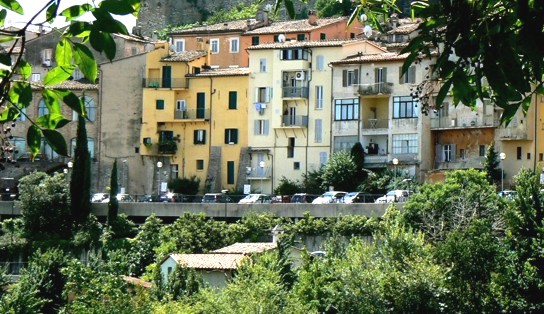
As with all images on TJMK this image above will expand if clicked on
Just sifting through the latest drivel on Injustice in Perugia today and I came across this statement from one of their main posters.
“It was physically impossible for Capezalli to have heard any sounds from Meredith’s residence”.
Note : not that she was mistaken or that her evidence was unreliable but the bald statement that it was physically impossible for her to have heard anything.
Was she profoundly deaf then? If not, then why this assertion? Without some basis for this assertion then it is simply a dismissive slur on the credibility of the witness.
This happens to be the same poster who wowed that board with his claim that the Prosecution suppressed exculpatory evidence that would have cleared Knox and Sollecito.
Not that he supplied any proof. How could he?
It is axiomatic, of course, that if there was suppressed evidence then what it was would not be known. Nevertheless it was a ready springboard for calls from mindless idiots to have the Prosecution fully investigated and charged with perverting the course of justice!
Anyway, to move on, the purpose of this post is just to revisit (with pictorial assistance) Capezalli’s testimony (I shall call her Nara from now on) and see if there is even a scintilla of justification for the claim.
Now to be fair, Nara did say in her evidence that she had double glazing and maybe that is what he is referring to although for the life of me I don’t see why that would make it impossible for her to hear a scream outside.
But it’s worth investigating because it’s the sort of thing that does get repeated without further analysis and I have read others taking that remark at face value and doubting whether she did hear a scream and, perhaps more credibly, whether she would have heard the sound of someone running on the gravel of the cottage forecourt and up the metal steps from the car park.
Here is what she said -
“What happens is that getting up I’m going past the window of the dining room, because the bathroom is on that side, and as I am there I heard a scream, but a scream that wasn’t a normal scream. [A terrifying and agonising long scream as she describes it elsewhere] I got goose bumps to be truthful. At that moment I no longer knew what was happening, and then I went on to the bathroom. There is a little window with no shutters, none at all.”
Mignini then asks -
Q—Well, you go by the window and you hear this cry?
Ans ““ Yes.
Q ““ Then you continue to go towards the bathroom, you told me?
Ans ““ Yes.
Q ““ Do you open the bathroom window?
Ans ““ No.
Q ““ Explain what happened for us.
Ans ““ I haven’t any shutters on that window, I only have double-glazing so I can look straight out
Q ““ So you looked out of the bathroom window?
Ans”“ I didn’t open up because I had all the little succulent plants there for the light.
A little late in her testimony Mignini seeks to clarify her evidence -
Q”“ So you hear the scream, go to the bathroom, look out the window and you don’t see anything?
Ans ““ No.
Q ““ Then you go back to the bedroom?
Ans ““ Yes.
Q ““ When is it that you hear the noises you described, and then we will see what they are?
Ans ““ I hear the noises I described when I was closing the bathroom door, then I heard running, because that steel there [the metal stairs] makes a tremendous noise at night, then when you don’t hear cars going by or such like, I looked out but there was nobody there.
Q ““ From which way?
Ans ““ To the left and the right, and there was nobody there.
Q ““ Then you heard the scuffling?
Ans ““ The same, in the meantime I heard running on the stairs, from the other direction they were running in the driveway.
Much later Nara is helpfully (perhaps) cross examined by Dalla Vedova on her remark that she has double glazing, as follows -
CDV - How are your windows made?
Ans - My windows are made of wood. They have double glazing and they have a shutter.
CDV - When you say “they have double glazing” do you mean that every single window has two panes, or are there two windows, one in front of the other?
Ans - No, two panes in each side and opening in the middle.
Confused? What is she really describing?
Many moons ago Kermit put together a very helpful Powerpoint lambasting the behaviour and claims of Paul Ciolino, the American PI who appeared on CBS rubbishing the suggestion that Nara would have been able to hear anything. It is obviously Ciolino’s disreputable work that is the basis for the claim.
I am going to lift some stills from Kermit’s excellent Powerpoint and add to them some more from a (somewhat infamous) Channel 5 documentary, from which it will be clear that
(a) Nara doesn’t have double glazing, nor shutters, at least not at the back of her property overlooking the cottage. However there are shutters at the front and, for all I know, double glazing there but that is not of concern to us.
(b) There is little reason to doubt that she would have been able to hear sounds outside quite well.
Let’s start.
Here’s a picture of the back of Nara’s property immediately above the car park.
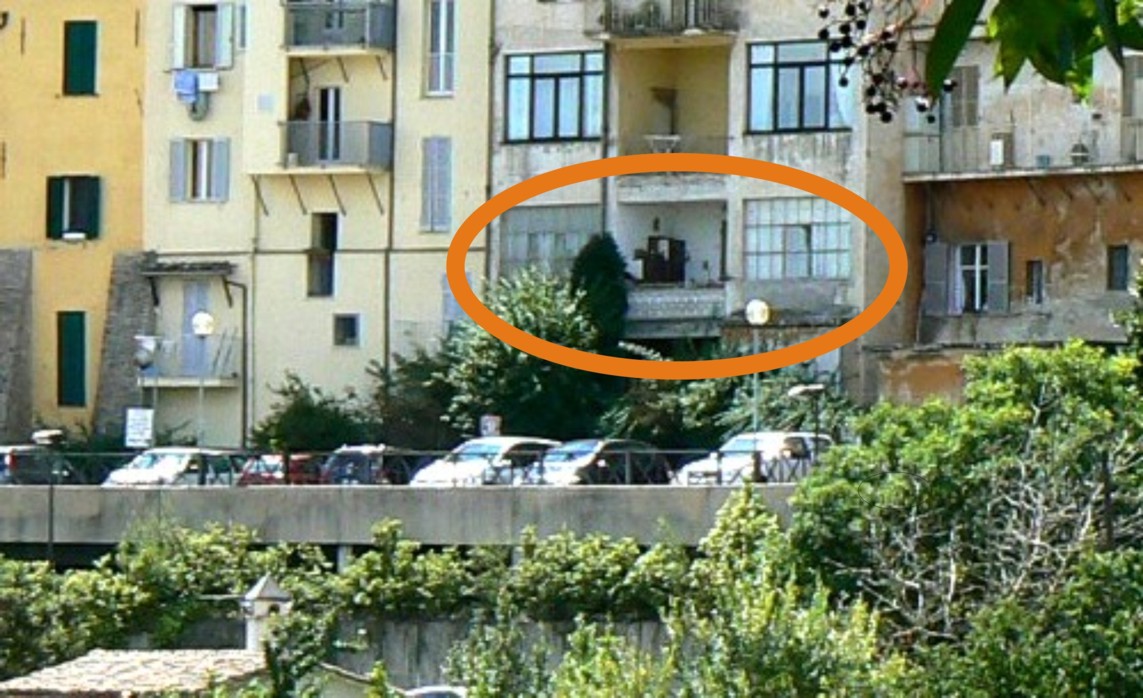
Here it is again in relation to the cottage
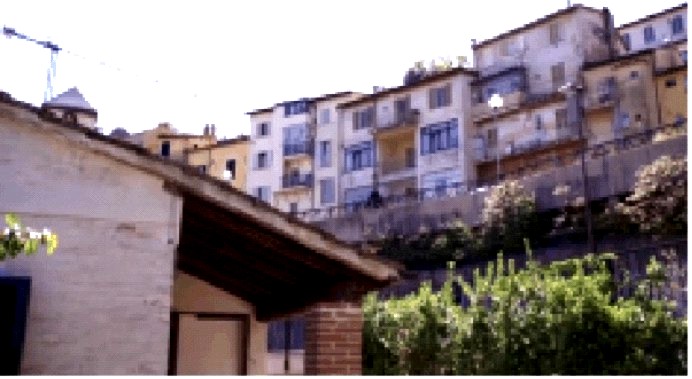
In the first picture Nara’s first floor flat is shown circled. In the second, it is obvious that only the roof of the cottage would be visible from the first floor, as indeed she said in her testimony.
There are two further floors above. The top floor is the one to which Ciolino (and Pater Van Sant) gained access, having tried but failed to interest Nara. Nara in her evidence said that there was an apartment above which she rented out and I suspect that this was the top floor. The top floor undoubtedly had double glazing or double casements.
Below is one of the top floor windows. (We can see Ciolino’s reflection in the glass)
And here he is, standing in front of the same window whilst conducting his experiment with a couple of kids running along the road outside -
As we shall see it really was quite pointless conducting off-the-cuff sound experiments from there with the double casement shut tight
Nara said that her daughter also lived in the building so either the second floor was a separate conversion for her daughter or first and second were shared and the second was where their bedrooms were. That’s actually immaterial as it is the first floor that really interests us.
Here is a close up of the first floor. We can be sure because we can see Nara and the co-presenters of the Channel 5 documentary standing on the balcony.
We can see how large the windows are on either side of the balcony. As to the window on the right it is also apparent that this has been blocked up save as to four panes in the middle so that now there is only that smaller window there.
Let us now look at that window from the inside.
“One went up, one went over there” is Nara explaining to the Italian TV reporter the sounds she heard.
Clearly then she is standing inside her bathroom and the bathroom window looks over the car park. Indeed we can see her succulent plants on the inside window ledge as she stated in her evidence. Also, if we look closely, we can see that her wall is tiled or wall-papered with a tile design befitting a bathroom. Probably that wall is also made of little more than plasterboard.
One thing is quite certain though and that is that the window, which opens in the middle, is not double glazed.
Nara’s understanding however seems to be rather different. To her “double glazing” is (as she said to Dalla Vedova) “two panes in each side and opening in the middle”.
We can also infer that the large window to the left of the balcony belongs to her dining room. What she said, in effect, was that she was traversing the first floor (from left to right) from her dining room to her bathroom (being both on the same side, as she says). She heard the scream in her dining room.
The window there does not appear to be blocked off as it is to the right. Indeed I think we can see full length drapes or net curtains but certainly one would expect a larger window there and again, clearly, it is not double glazed.
So again, why would it be physically impossible for her to have heard a sound, particularly a scream, coming from the cottage?
It couldn’t be because it was too far away. We can see that from the pictures but also here is a handy GoogleMap calculation of the distance from her place to the far side of the cottage.
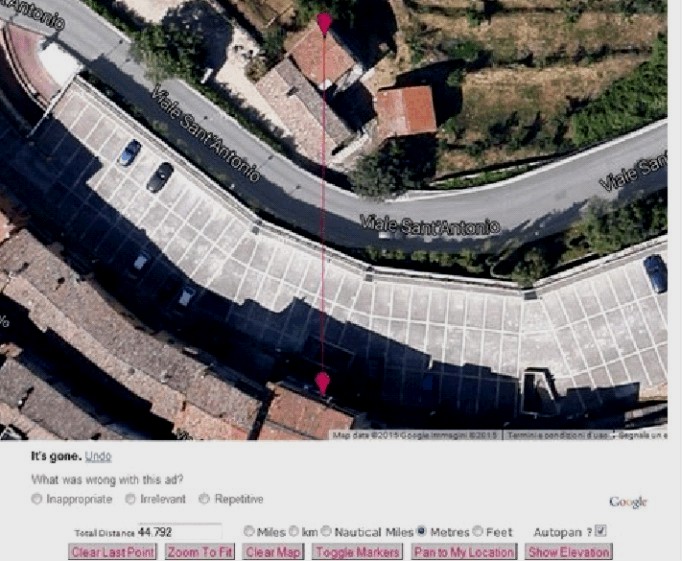
So that’s, say, 45 metres. Or 49 yards. Not far at all. Thanks to Yummi for bringing that up on pmf.org.
We should also remember that it was the 1st November which is a religious holiday in Italy in remembrance of the dead and therefore background noise was quieter than usual. It was also probably sometime around 11pm and the back of Nara’s property looks out on what is a natural amphitheatre in which noise will echo.
Nara Capezalli in fact came across as a compelling witness to what she heard that night and there is no way at all that it was physically impossible for her not to have heard that scream. Nor the metal stairs (”..makes a tremendous noise at night””¦.) just off to the right of her property and immediately below it.
On a personal note I was recently driven nuts by a manhole cover that had come loose in the road outside my bedroom window. Cars constantly drove over it and the noise kept me awake. The top floor of the car park would probably also act like a sounding board and the noise made by the stairs may also have come up through the stairwell we see immediately in front of her property. I am not so sure about the sound of gravel on the cottage forecourt being crunched underneath but already I am more than prepared to believe Nara on that score as well. Why not?
Finally, as we await the Cassation Motivation (whenever!) I seem to remember that at least one appeal point was the failure of the lower courts to accede to a defence request for audio tests to be conducted from Nara’s property.
Bearing in mind that Judge Marasca reportedly has stated that the ground for overturning the Nencini convictions was insufficient and contradictory evidence one wonders whether Cassation will say that a test was required, in the absence of which Nara’s testimony can be thrown into a pot along with other evidence somehow deemed “insufficient”?
If they do then watch out for them getting the double glazing issue quite wrong as well.
Posted by James Raper on 07/26/15 at 03:11 AM •
Permalink for this post •
Archived in Various hypotheses, Various scenarios, The officially involved, Police and CSI, Evidence & Witnesses, Other witnesses, Trials 2008 & 2009, Massei prosecution, Hoaxes against Italy, 3 No evidence hoax, Hoaxes Knox & team, 15 Single alibi hoax, Hoaxers from 2007, More hoaxers •
Comments here (24)
Thursday, May 14, 2015
Updates: Sollecito’s Trial For Vilipendio And Diffamazione, Knox’s Trial For Calunnia #2
Posted by Peter Quennell

Knox and Sollecito have each been indicted in Florence BY PROSECUTORS on charges that bear no resemblance to UK or US slander or libel cases.
They are each essentially charged for lying to poison public opinion against officials, and Sollecito against the system, to try to win themselves illegal breaks at their murder trial and appeals. Knox in court in 2009, and Sollecito in his book in 2012.
The weekly magazine Oggi is also on trial for jubilantly publishing some of Knox’s numerous lies.
Yesterday in a Florence court a new court translation of the passages from Sollecito’s book fully quoted here were accepted by the presiding judge. They differed little if at all from what the prosecutor filed last year and brought the defenses no joy. Right now both the defenses seem stuck.
And on June 9th the calunnia trial against Knox will start in a Florence court. It would be smart for her to be there, as Sollecito usually is. As mentioned above, Knox is already indicted.
It is not clear who her lawyers will be. Sollecito had to field a new team. Ghirga and Dalla Vedova both helped Knox with her defamatory book and with her defamatory email to Judge Nencini in December 2013 in which Knox ludicrously claimed she had been tortured (for the mundane truth read here) and like Bongiorno and Maori they could feel they have conflicts here.
On June 16 Dr Mignini will testify in the Oggi trial in Bergamo north-east of Milan where Oggi is based against the editor Umberto Brindani and the reporter Giangavino Sulas for publishing illegal claims made in Knox’s 2013 book.
At that hearing Knox’s book may finally become the subject of charges on the same lines as Sollecito’s book. Italian legal opinion is not supportive of the pair or the sleazy moves that led to Cassation giving them a break
That break looks increasingly temporary now. Sollecito could face big fines and Knox could face up to six years. Brighter bulbs would have realized it is best not to confront Italian courts.
Posted by Peter Quennell on 05/14/15 at 03:18 AM •
Permalink for this post •
Archived in Defendants in court, Amanda Knox, The officially involved, Police and CSI, The prosecutors, Trials 2008 & 2009, Massei defense, The Massei Report, The legal followups, Knox followup, Knox-Marriott PR, Amanda Knox #2 •
Comments here (30)