

Category: Amanda Knox
Thursday, December 21, 2017
Knox & Sollecito: How From Their Very First Questionings The Cracks & Fissures Start To Appear #2
Posted by KrissyG

Minimetro at left foresightedly located provides quick 2 mile trip up to the center.
1. The Much Mischaracterized Interview Context
You’ve read the PR-driven meme that Perugia investigators zoomed in way too quickly on Amanda Knox?
And also on Raffaele Sollecito? No, probably not Raffaele. He is a really big nuisance in proving any malicious targeting. Hard to manufacture a reason to zoom in on an Italian male with a rich and connected father and mafia ties.
Say that investigators were doing little else but ferociously framing Amanda Knox, as John Douglas, Steve Moore and Michael Heavey have claimed again and again (and even so advised the Department of State).
Well-trained American investigators will say they are lucky to average upward of a dozen sessions a week with people of possible involvement. If Douglas, Moore and Heavey have it right, what is your best guess here? Five? Seven? Maximum ten?
Okay. Take a look. Amazing, right? And there were many more still in progress. Interviewing went on for weeks. They are all loaded on the Case Wiki. Never recorded, as the PR lie has it? No, literally everything was captured.
Unfair zooming-in? These depositions prove quite the opposite. Right through to the fourth and ultimate session on 5 November, the investigators were mainly in the mode of spreading the net wider and wider. Seeking still others maybe involved.
2. Analysis Of Knox’s First Statement Continues
Remember this is still the same day Meredith’s body was discovered. We are still on the 2 November deposition which sets narrow limits on what Knox could credibly claim later. (Path dependency, for scientists.)
Maybe Douglas, Heavey and Moore would have missed them?! But I’ll point out more Knox claims that for competent law enforcement would be big red flags. Points that dont match up with Knox down the road, and points that don’t match up with Sollecito.
This morning, around 10-11am, I returned to my house alone to have a shower and change my clothes, and in this circumstance I noticed that the entrance door of the apartment was wide open whereas the doors to the rooms inside the house were all closed, at least the ones to Filomena’s and Meredith’s rooms, although I didn’t check if they were locked, whereas the one to Laura’s room was ajar and my door was open as usual.
Why would she say the door of the apartment was wide open? Remember, we only have Knox’ word for this. We know it needed a key to lock it. In Honor Bound, Raff says this applied both coming in and going out. Imagine for a minute the real reason for returning was to continue tidying up. The aim had been to finally leave the cottage with the door left flapping open (as though by an unknown intruder). If it had been locked, then the conclusion would be it must be Knox, as she and Meredith were the only house mates around that weekend. So, of course, she has to claim it was open. Distancing herself.
She says she “˜didn’t check if they were locked’ (Filomena’s and Meredith’s rooms). But why would they be locked. This indicates an awareness that Meredith’s room was locked. To explain why she didn’t spot it then, we have the made-up-on-the-spot event, which turns out to be a non-event. Rather like Gubbio. They were going to “˜go to Gubbio’, but then they didn’t go.
We see from Knox’ statement, she wants to tell the story as though she really was innocent. She has to imagine and play role what an innocent person would do. The door was hanging open. She was only there because she wanted to shower and change to go to Gubbio Ah, but what about Meredith’s locked door? Didn’t try it to see if it was locked. Which of course it was. Perhaps Knox has psychic powers to foresee that it might be found to be locked in the future. Pre-empting and forestalling the tricky question of Meredith’s closed door.
These things seemed really strange to me because, like I already said, it is customary for all of us to always close the entrance door with a key since that is the only possible way to close it. So I started to call [the names of] the girls aloud, but without getting an answer. At that moment I thought that maybe one of the girls had gone out to throw the trash into the bins, or to go to see our neighbors, the boys, who occupy the apartment below ours and with whom we hang out.
Knox claimed she didn’t know Laura and Filomena were away for the weekend until Filomena told her on the phone after she rang her at midday on 2 Nov 2007, a couple of hours later. But seriously, if there are three possible housemates around, wouldn’t one just call, “˜Hello! Anybody home?’
Truth is, Knox doesn’t want to say she knew Meredith was the only one around, as the next question would be, “˜So what happened when you called Meredith’s name and knocked on her door, and tried the handle’.
Meredith home alone, would be a real reason to panic. The realisation “˜Meredith might be hurt inside’ mustn’t come ““ for script purposes ““ until after Knox has - in her story - had a shower, changed and gone back to Raff to tell him of her strange experience. She has to account for going back to his abode and ringing Filomena from there. Rather than ring him from the cottage, she has to walk there and then walk back with him. After a leisurely breakfast, of course.
Still imagining herself in the role of innocent, she has to dream up why, if she thought all housemates were around they didn’t seem to be after all, so here comes the precluding: “˜I thought that maybe one of the girls had gone out to throw the trash into the bins, or to go to see our neighbors’.
I remember having closed the front door of the apartment, but I didn’t lock it with the keys, and I went to the bathroom located near to my room, the one that only me and Meredith usually use, to have a shower, when I noticed drops of blood on the floor and a bigger blood stain on the bath math and other blood stains on the sink as if someone had smeared it with a bloody hand. This thing seemed a bit strange to me because we girls are all fairly clean and tidy, and we clean the bathroom [immediately] after we have used it. At first I thought that the blood on the sink could be mine because I did some ear piercings about a week ago, so I immediately checked in the mirror and touched my ear. Then I touched the blood on the sink but seeing that it was not removed immediately, that is, it was not recent, I thought it could be some girl’s menstrual blood and because it disgusted me, I did not attempt to clean it.
Reason for not raising the alarm or becoming concerned? I thought it could be some girl’s menstrual blood and because it disgusted me, I did not attempt to clean it.
Again, a clever lie (or so she thought) whilst expressing her disgust at Meredith’s life blood, it would “˜explain’ why she thought nothing was amiss, just a bit strange (she reasons). As Meredith was the only other person who used that bathroom, we note the careful avoidance of using her name and the use of “˜some girl’ instead. Remember, at this stage, she is not to know anything has become of Meredith. Could be anybody’s blood, is the message, with an innocuous cause (albeit “˜disgusting’.)
No mention of padding back to her room on the “˜disgusting’ bathmat to fetch a towel after the shower, which seems to be a story that evolved later, when her lawyers told her of the five isolated luminol prints in the hallway identified as “˜compatible’ with hers and Raff’s.
Immediately after this I went to the other bathroom, where I usually dry my hair, and after having dried it, I noticed that there were feces in the toilet, that is, someone had used it to relieve themselves, but they had not flushed afterwards. This thing also seemed strange to me for the reasons that I have already stated, and so I avoided flushing it myself.
Again we have the liar’s ready explanation as to why the toilet was left in a disgusting state, even though at this stage, she wasn’t spooked enough to think there was anything to be concerned about. No, the real reason it was “˜strange’, was that according to Knox, nobody who visited the cottage would ever have not flushed the loo. So that explains why it dawned on her when they realised there had been a burglary that this faece must be the burglar’s. She ”˜avoided flushing it’ herself, she explains to police, because she had some kind of uncanny intuition it didn’t belong to anybody in the house, nor their friends.
As for Knox shock at the poop, Sophie Purton testified to the court:
One thing in particular that I remember very well regards Amanda’s habits in the bathroom. Meredith said that Amanda often did not flush the toilet. [This] annoyed her and she wanted to do something about it but did not know what to do without creating problems, not wanting to create embarrassing situations.
Same complaint by those in prison with Knox. She does on:
Later I took the mop, which was located inside a closet, and I left my house to go to my boyfriend’s house to clean his room [kitchen] because we had soiled it the previous night. I remember that when I left, around 11.30 am, but I’m not sure about the precise time as I didn’t look very carefully at the clock, I closed the door of the apartment with a turn of the key.
In Knox’ court testimony and police interviews, her favourite refrains are “˜I wouldn’t know what time it was, as I don’t look at the clock’. One wonders how appropriate this type of sarcasm is in front of murder detectives and a panel of judges. As Francesco put the time of the pipes leaking at before 8:42 and Knox put it back considerably later, changing it from 9:30, to 10:00 and then to 11:00 pm, we see her dilemma. She has to say she only took the mop to Raff’s that morning or she’s admitting she returned to the cottage on the night of the murder.
After arriving at the house of my boyfriend, who lives alone in an apartment near my house and to be more precise in Corso Garibaldi number 110, we stayed there for about an hour, for the time it took to clean the kitchen and have some breakfast, after which we returned to my house together. I want to point out that I immediately told my boyfriend about the strange things that I had detected in my house, and he urged me to call one of the girls.
Immediately? That came and went. Here it’s all action, systems go. The ditzy Knox needed caring Raff to get her to start worrying. So first two calls to Meredith’s phones. Then Filomena. She again has to be told to “˜ring Meredith’, this time by Filomena. So she dutifully rings Meredith again, this time, just a quick couple of seconds each. Been there, done that.
And I did indeed first call [emphasis added] Filomena to ask her if she knew anything about the blood I had found in the bathroom, and she replied that she knew nothing about it as she had slept at her boyfriend’s, Marco’s, house the previous night, and the following morning, that is, this morning, she had gone directly to work without going home first. After Filomena, [emphasis added] I phoned Meredith three times and to be more precise, the first time I called her, I called her English cell phone number 00447841131571, which is the first phone number Meredith gave to me, and which I saved first to my phone card; the phone rang several times, and at one point I heard the line disturbances and interruption of rings. So I tried to contact her on the phone with the number 3484673711, and also this time the phone rang but no-one answered. I tried calling her for the third time with the first cell phone number again, but also this time without getting an answer.
I didn’t call Laura because Filomena had told me in the previous phone call that she had gone to Rome, but I don’t remember if Filomena told me when she had left. So I haven’t seen Laura since the afternoon of October 31st this year. At this point, I returned to my house with my boyfriend, worried about Meredith, because she was the only one whose whereabouts I didn’t know of.
As we know, this call was 12:11 yet Knox & Sollecito didn’t actually get to the cottage until circa 12:35, when by coincidence the postale police arrived and Filomena rang Knox again. This time, she was told of her smashed window. Knox and Sollecito were so “˜worried about Meredith’ it took over twenty minutes to carry out what should be a five-minute walk.
Knox doesn’t tell police that the first call she made, after having switched off her phone 20:45 the night before, was at 12:08 to Meredith’s two phones, before she ring Filomena. So a clear lie, that it wasn’t until Filomena mentioned it that it occurred to her to ring Meredith. She didn’t realise, either, that police could discover just how long she rang for. We see it is a nonsense “˜no-one answered’ if they only rang for three seconds or less. Another sleight of hand, changing the chronology, which takes on a different light when the true time line comes to light.
When I got to my house, around 1 pm, I opened the front door, which I found locked, and entered the apartment. I began to open the doors of the rooms occupied by the other girls. First, I opened Filomena’s bedroom door, that is the first room nearest to the entrance, and together with Raffaele we found that the window, with two shutters, was open and the window glass was broken. I don’t remember if both glasses were broken or only the other one. Broken glass was scattered on the floor, inside the room, near the window. Scared, I thought it could be that a thief had entered the house, and then I quickly glanced around to check that everything was in order, and that nothing had been removed. So I headed to Laura’s room and also there I opened the door and checked that everything was in order. I want to point out that I didn’t go inside the rooms, that I just had a quick look, from the door.
Immediately after that I went into my room, and even there I didn’t notice anything / nothing was different, after which I headed to Meredith’s room, but I couldn’t open the door because it was locked.
Given, having just rang Meredith’s phones three times, and now being told by Filomena that she and Laura were both away for the weekend, you’d think Meredith’s room would be FIRST priority. Instead, in her account, Knox checks the other two instead, even though Sollecito stated Filomena’s door was wide open when he arrived. Laura’s door was “˜ajar’ and had a drawer hanging out, and surprise, surprise, Knox’ hunch about Meredith’s door being locked, turns out to be correct, but she only finds out now, some two hours later.
Knox goes to her room, on a dark November day, and doesn’t notice her table lamp is missing (it is on the floor of Meredith’s room) and she would have had to dry herself after the shower (she claims) and change in the dark, as the room had very little natural light.
At that point I looked out from the bathroom terrace, leaning forward to try and see the window of Meredith’s room, but I couldn’t see anything, after which I returned to the door to look through the keyhole and I could only see Meredith’s handbag on the bed. I retraced my steps to take another look at all the rooms without, however, entering any of them and without noticing anything unusual. Immediately after that I entered the first bathroom near the entrance to the apartment where I very quickly looked around without paying close attention to whether the feces were still inside the toilet.
Knox keeps telling the police she didn’t enter any of the rooms, as though she was being carefully to not contaminate any evidence nor disturb the mise en scene the police see set out before them.
At that point while Raffaele remained in the apartment, I went down to the downstairs students’ apartment, and above all to talk with Giacomo hoping he would have news of Meredith’s whereabouts, but no-one answered the door. After I had returned to the apartment, Raffaele decided to call his sister for advice on what to do, and immediately after that call he called, I don’t know if it was the state police (Polizia) or Carabinieri, to come to the house, and in the meantime, I contacted Filomena at her cell phone number 3471073006 to inform her we had found the window panes in her room broken, and that Meredith’s room was locked. She replied that she would join me at once.
So now, the lead up to the discovery of the body is in full swing. Filomena is on her way, and so are the police. Once again liar Knox changes the chronology and the correct order of things. Note how here, Raff calls his sister (a very brief 39 seconds) before Knox claims she contacted Filomena to tell her of the broken window. Firstly, this would place Raff’s call at 12:35, and we know it was actually 12:47. Secondly, Knox only called Filomena once, and that was at 12:11. Filomena had to ring Knox ““ for the third time ““ at circa 12:35, when she was informed of the mayhem in her room. Police later found out the real time of Sollecito’s call.
Raffaele, who was worried about Meredith’s safety, tried to break the door to her room by kicking it without success, and immediately afterwards we saw the plainclothes police arrive. After they showed us their identification cards, they inquired about our particulars and our cell telephone numbers. Then they asked us what had happened. We told them about the window we had found with the shattered glasses, about the blood stains found in the bathroom, and about Meredith’s room that was strangely locked. The policemen asked us questions about the people who occupied the house and about the telephone calls made, and in the meantime a friend of Filomena whom I know as Marco, and two other friends of hers I didn’t know, arrived. At that point Filomena began to talk to the policemen, and while I stood aside in the kitchen, the others together with the policemen headed for Meredith’s room and broke down the door. I can’t specify who really proceeded to break down the door. At that point I heard Filomena screaming and saying “a foot, a foot” while the police officers ordered us all to go outside the apartment.
At that point while Raffaele remained in the apartment, I went down to the downstairs students’ apartment, and above all to talk with Giacomo hoping he would have news of Meredith’s whereabouts, but no-one answered the door. After I had returned to the apartment, Raffaele decided to call his sister for advice on what to do, and immediately after that call he called, I don’t know if it was the state police (Polizia) or Carabinieri, to come to the house, and in the meantime, I contacted Filomena at her cell phone number 3471073006 to inform her we had found the window panes in her room broken, and that Meredith’s room was locked. She replied that she would join me at once.
At that moment I learned from my boyfriend that inside Meredith’s room, in the wardrobe there was a girl’s body covered with a sheet, and the only thing you could see was a foot. None of those present mentioned the name of Meredith, and as I left the house immediately after that without having seen the body, I can’t state whether it’s her.
What’s interesting is what Knox omits. She fails to mention calling her mother at 3:57 am Seattle Time, soon before Luca kicked open the door at circa 13:05.
These “additionallys” are likely answers to further impressive and unexceptionable questions by the police.
Additionally: There are four Italian students living in the apartment on the lower floor of my house, and we often gather together to play the guitar; together with them we also went out a few times to go for a dinner, and once we went to a disco. Meredith and I went out more times together with all the four boys than the other two (Laura and Filomena). These guys are respectively called Giacomo, Marco, Stefano and the fourth, with whom I personally speak very little, I seem to remember is called Riccardo. I know that one of the four guys, to be precise, Giacomo, is Meredith’s boyfriend. In fact, Meredith sometimes slept at Giacomo’s house and sometimes Giacomo came to our house to sleep with Meredith. I want to point out that the two didn’t very often go out together as Meredith went out with her English friends while Giacomo, from what Meredith told me, preferred to spend more time at home.
Additionally: Regarding the house keys, I can say that they are available to each of us, but I don’t know that other outsiders would be in possession of any copies of them, including Raffaele, my boyfriend. I’m sure Filomena gave no key to Marco, her boyfriend, since every time he arrives at our house he always knocks at the door very loudly. Laura doesn’t have a boyfriend, whereas regarding Meredith, I can say that knowing her I don’t think she had given keys to Giacomo even if I can’t definitely rule it out.
Additionally: Meredith and Giacomo had only been seeing each other for a few weeks, and as for their relationship, Meredith herself told me that it was going well, she never talked about any quarrels with Giacomo, whom I moreover find a very quiet guy. As I’ve already said, she went out very often with her English friends, and they used to attend the disco pub “Merlins”. Once I went there too, and another time we went to another disco pub. Both times there were just us girls.
Additionally: Meredith and I did not celebrate Halloween together, in that I, that evening, was at the “Le Chic” pub, but not for work, but I know she went to “Merlins” with her English friends and without Giacomo, as she told me herself just yesterday. She told me that she had a lot of fun. She did not tell me about any new acquaintances made that evening. From what I know she always went out with the same friends, including me, or with Giacomo and his friends. She usually did not go out alone in the evening.
Additionally: I can describe Meredith as a girl of 21 years or age, of English nationality, about 1.70cm (5’7’‘) tall, thin build, olive complexion, black hair smooth and long, brown eyes. I don’t think she had any particular marks such as tattoos or other marks on her body. The last time I saw her, she was wearing white jeans and a short, light, pale-colored jacket.
Her email to her address book contacts came some 36 hours later, and we can see how she attempts to consolidate what she told the police. This becomes a script which she commits to memory in strict chronological order as is in the manner of a liar, in order to keep track of their falsehoods.
Posted by KrissyG on 12/21/17 at 11:33 PM •
Permalink for this post •
Archived in Defendants in court, Amanda Knox, Raff Sollecito, Evidence & Witnesses, Questionings, Trials 2008 & 2009, Prelim hearings, Hoaxes against Italy, 1 Ital justice hoax, 2 Italian mileu hoax, 9 Mignini v Knox hoax, 11 No court bent hoax, Hoaxes Knox & team, 16 Interrogation hoax, Hoaxers from 2007, Knox-Marriott PR, Raff Sollecito PR, Heavey, Bremner, Bruce Fischer, Steve Moore, Saul Kassin, Amanda Knox #2, Raff Sollecito #2, John Douglas •
Comments here (10)
Monday, December 18, 2017
Knox & Sollecito: How From Their Very First Questionings The Cracks & Fissures Start To Appear
Posted by KrissyG
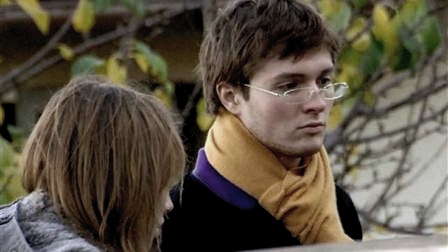
“Now I say… and then you say… and then I say… and then you say”
Reference the caption above: that’s the last time they talked before their first questionings.
Each day the cracks and fissures got worse. Would any cop not get suspicious?! Three days later, Sollecito separates with a bang and proclaims that Knox had made him lie.
That sure went well. Next murder Knox may do alone… A good primer for this post is this guide on how to read lies.
Here’s my take on the Recorded Statement taken from Amanda Knox 2 Nov 2007 in Part 4 of our previous post below. It is timed at 3:30pm. Mignini arrived about 3:00.
It could be the Squadra Mobila (the Flying Squad attached to the Carabinieri) took statements at the scene as Knox had to wait at the Questura quite a while before she was spoken to and got home late.
I have only processed three or four paragraphs so far (so this could turn into a whole series). What jumps out at me is the following statement:
Around 5 pm I left my house together with Raffaele to go to his house where we stayed the whole evening and the night.
In Sollecito’s own statement of 2 Nov 2007, in Part 5 of the previous post, he states:
At about 4:00 pm, Meredith left without saying where she was going, while we stayed at home until about 17.30. After that hour, Amanda and I took a little trip to the center to go to my house where we stayed until this morning.
So, from having been at Via della Pergola for lunch, during which time, Sollecito joined her and Meredith had got out of bed after arriving home in the early hours, and according to Knox and Sollecito, still had the remains of vampire makeup on her chin, was wearing her ex-boyfriend’s jeans, and had gone out at four, “˜without saying where she was going’, the pair claim to have gone straight to Raff’s apartment in Via Garibaldi, “˜at about five’. In Sollecito’s earliest account, it was to go to his house via the centre.
The next written record we have comes from Knox email home to 25 people in her address book on Sunday 4 Nov 2007, in the early hours circa 36 hours or so after Meredith’s body was found.
meredith came out of the shower and grabbed some laundry or put some laundry in, one or the other and returned into her room after saying hi to raffael. after lunch i began to play guitar with raffael and meredith came out of her room and went to the door. she said bye and left for the day. it was the last time i saw her alive. after a little while of playing guitar me and raffael went to his house to watch movies and after to eat dinner and generally spend the evening and night indoors. [sic]
Many believe this was Amanda writing out a “˜script’ to “˜get her story straight’. One thing about liars, is that they stick rigidly to a set chronology to make it easier to remember their lies.
The next written record is Sollecito’s first written statement to the police:
Raffale Sollecito: November 5th 2007 at 22:40 in the offices of the Flying Squad of the Perugia Police Headquarters
QA Around 16:00 Meredith left in a hurry without saying where she was going. Amanda and I stayed home until about 17:30-18:00.
QA We left the house, we went into town, but I don’t remember what we did.
QA We stayed there from 18:00 until 20:30/21:00. At 21:00 I went home alone because Amanda told me that she was going to go to the pub Le Chic because she wanted to meet some friends.
For the first time we are made aware that the pair went somewhere after leaving Via della Pergola at between “˜5:30 and 6:00’ according to Raffaele’s statement, this glides neatly into Popovic’s visit at 6:00pm at Raff’s abode. No visible gaps in the timeline here.
Next comes Knox’ handwritten statement to the police:
Amanda Knox Handwritten Statement to the police 6 Nov 2007
“˜Thursday, November 1st I saw Meredith the last time at my house when she left around 3 or 4 in the afternoon. Raffaele was with me at the time. We, Raffaele and I, stayed at my house for a little while longer and around 5 in the evening we left to watch the movie Amelie at his house.’
So Knox says they left at 5:00 ““ sticking to her scripted story as she set out in the email home, whilst Raff makes it an hour later. So, we are led to believe, they didn’t stay in town long at all, and in any case, ”˜I don’t remember what we did’.
This is a big flag. When people say, “˜I don’t remember’, they are telling you they recall an event, but are unable to retrieve it from their memory. In fact, they do not even try, not even when elite detectives are carrying out a crucial murder investigation of your girlfriend’s own roommate. A person who was not involved will say, “˜I don’t know’ when asked a straight question, not “˜I don’t recall’.
Sollecito sticks to his script: “˜We left via della Pergola, five-thirty to six’:
Raffaele Sollecito 7 Nov 2007 PRISON DIARY
“˜An amusing thing I remember is that Meredith was wearing a pair of men’s jeans which belonged to her ex”boyfriend in England. She left quickly around 4 pm, not saying where she was going. Meanwhile, Amanda and I stayed there until around 6 pm and we began to smoke cannabis.
My problems start from this moment because I have confused memories. Firstly, Amanda and I went to the centre going from Piazza Grimana to Corso Vannucci passing behind the University for Foreigners and ending up in Piazza Morlacchi (we always take that road). Then I do not remember but presumably we went shopping for groceries. We returned to my house at around 8 “ 8:30 pm and there I made another joint and, since it was a holiday, I took everything with extreme tranquillity, without the slightest intention of going out since it was cold outside.
Note the signifier, informing the reader, “˜it was cold outside’ embellishing the lie, “˜therefore we could not have gone out that night’.
So, whilst Raff on 7 Nov 2007 has jotted in his PRISON DIARY (which of course he is aware the authorities will be reading avidly), they were out between “˜six and eight’, Amanda writes to her lawyers a couple of days later adhering firmly to her script.
Amanda Knox Letter to her Lawyers 9 Nov 2007
Around 3 or 4 Meredith left the house wearing light-colored clothing, and all she said was “Ciao”. She didn’t say where she was going. I continued playing guitar and after a while Raffaele and I left my house, probably around 5pm.
We went to his house and the first thing we did was get comfortable. I took off my shoes etc. I used his computer for a little while to write down songs I wanted to learn for the guitar, I listened to some of Raffaele’s music at this time.
Note the inclusion of irrelevant and trivial detail, “˜I took off my shoes’. A liar loves to gild the lily.
click image for larger version
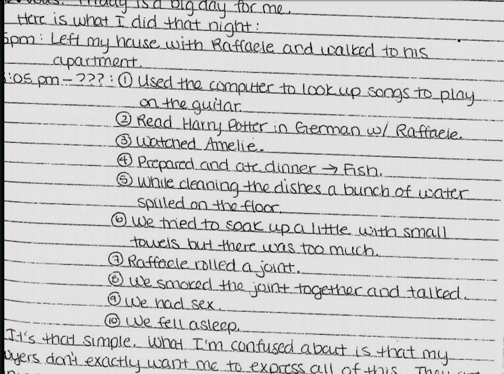
Then comes Knox’ next written affirmation of what she did the day of the murder:
Page 1223 PRISON DIARY ““ AMANDA KNOX 27 Nov 2007
Here is what I did that night:
5pm: Left my house with Raffaele and walked to his apartment.
5:05pm - ???:
(1) Used the computer to look up songs to play on the guitar.
(2) Read Harry Potter in German w/Raffaele.
(3) Watched Amelie.
(4) Prepared and ate dinner ““ Fish.
(5) While cleaning the dishes a bunch of water spilled on the floor.
(6) We tried to soak up a little with small towels but there was too much.
(7) Raffaele rolled a joint.
(8) We smoked the joint together and talked.
(9) We had sex.
(10) We fell asleep.It’s that simple.’
Did you spot, she remembers her lines, despite her problems with amnesia? Still no mention of going into the old town. When people use qualifies such as, “˜That’s about it’, or “˜It’s as simple as that’, there’s another flag they have just told you a lie. Note the triple question mark as if she is unsure it took half an hour to arrive at Raff’s, in case anyone pulls her up on it sometime in the future. Again bells and whistles, the liar’s toolkit.
Raffaele helpfully offers us an insight in his book several years later as to why he revealed ““ even if Amanda never does ““ they went into town in his police statement of 5 Nov 2007.
From Honor Bound 2012 Andrew Gumbel and Raffaele Sollecito write:
(P 17) It was the last time I ever saw [Meredith Kercher].
Amanda and I smoked a joint before leaving the house on Via della Pergola, wandered into town for shopping before remembering we had enough for dinner already, and headed back to my place.
P53 (in the Questura 5 Nov 2007)
I mentioned [to police] Amanda and I had gone out shopping, something I had apparently omitted in my previous statements. [note the plural].
So, we see, Raffaele has not voluntarily offered the information “˜we went into town’ either, on the afternoon of 1 Nov 2007. He concedes he only proffered it, because the police brought it up. When asked the purpose of the trip, he claims they went “˜shopping’, but on not being able to prove they bought anything nor state which shops the pair frequented, he had to retract this half-lie, by now adding to his 6 Nov 2007 official police statement, later, that once there, they suddenly realised ”˜we had enough for dinner already’.
So, we are led by this to conclude the purpose of the expedition into the old town was “˜shopping for dinner’, when before, it was to “˜to go to my house where we stayed until this morning.’
It is bizarre and a symptom of lying for someone to say they did something, but then didn’t do it, when asked to elaborate. Raff omits to even mention to police going into the old town, and Knox persistently does not mention it at all. He only mentions it when detectives ask him why he omitted to. He then “˜suddenly remembers’ this “˜unimportant detail’ and tells them they were there to shop. But wait. They suddenly do not do any shopping at all, whilst in the old town, because once there, they realise they ”˜already had’ provisions for the evening meal. Amanda Knox makes clear this evening meal was FISH. Yet she claims she couldn’t remember exactly what she did at Raff’s, for at least three weeks. Fishy indeed.
I don’t know about you, but if I head into town to buy food or clothes, once there, I don’t suddenly think, “˜Hang on a minute, what am I doing here, I already have bread/a dress at home!’
Surely, I would buy something anyway, or at least browse around, perhaps use my John Lewis voucher and go for a coffee and cake.
Astonishingly, years later, Knox still deceives us in this matter:
In Waiting to be Heard 2013 Amanda Knox resolutely omits the detail of “˜going into the old town’:
(P61) Sometime between 4:00pm and 5pm we left to go to his place.’
There then follows filler sentences about how “˜we wanted a quiet cozy night in’.
Then comes the type of deception liars love to use: they pad out their tall tales with irrelevant guff.
“˜As we walked along, I was telling Raffaele that Amélie was my all time favourite movie.
“˜Really?’ he asked. “˜I’ve never seen it’
[Forgetting completely, forensic police discovered he’d downloaded the movie way back on 28 Oct 2007 {by coincidence, no doubt}].
“˜Oh my God,’ I said, unbelieving. “˜You have to see it right this second. You’ll love it’
The narrative then completely jumps to:
Not long after we got back to Raffaele’s place, his doorbell rang. [Enter first alibi Jovanna Popovic, whom Raff states appeared at 6:00pm].
A whole hour is omitted. One whole hour to get back to Raff’s, just around the corner, four to ten minutes away at the outside.
From all the embellishments, fabrications and outright lies, we see that what happened between 4:00pm and 9:00pm and where the pair went, is significant. Some say, they obviously went to score drugs. However, they openly admit to smoking a joint. In fact, they go to pains to emphasise it. They have no inhibitions talking about having sex. Therefore, the trip into the old town which took up to two to five hours of their time is rather more sinister than some kind of coyness or embarrassment about buying some dope.
In his statement to police on 5 Nov 2007, Sollecito changes his story and claims he came home alone at ‘20:30/21:00’. As we now know, the pair both switched off their phones together, between 20:45 and 21:00, so we can be sure this time is supremely salient. Meredith was on her way back around then. From Knox not ever mentioning the trip into town, it could be she indeed never did go into town, and that Raff went alone.
Raffaele Sollecito complains in his book “˜the police were out to get me’ by catching out his anomalies. However, I was watching a tv programme a few days ago, about a murder case, and detectives had to puzzle out from scratch who was the culprit. The detectives explained to the viewer, when someone comes in for questioning, all they have is that person’s face value account. They then check out the details, and then, if they discover falsehood and deception in the interviewee’s story, that is what makes them suspicious. So Raff and Amanda have only themselves to blame police suspected them.
I believe the pair followed Meredith and stalked her movements that night, hence the concealment of their true motive for being out between 4:00 and 9:00.
Popovic has a story that she had to pick up a suitcase from the station, and then didn’t have to after all, so either she really did see Knox at home at six, as claimed, or it was “˜a friend helping out with the alibi’. See “˜the event that is a non-event’ -type of lie, as above. Who knows what that was about. Popovic claims to have spoken to the pair at between 5:30 and 5:45 and again at about 8:40. I personally remain sceptical of her testimony, as I do of his father’s, Francesco, whose claimed account of the 8:42 telephone conversation directly contradicts Knox’ and Sollecito’ with regard to dinner and the pipes flooding, supposedly happening before the murder.
We do know, as James Raper points out, as per Massei - “at 18:27:15 [6.27 pm] on the 1/11/07, there was human interaction via the “VLC” application, software used to play a multimedia file for a film “Il Favolso Mondo Di Amelie.avi”, already downloaded onto Sollecito’s computer laptop via P2P (peer to peer) some days earlier.”
We also know there was human interaction when the film “˜crashed’ (as it was finished?) at 9:10 because someone clicked on the error message to close it. I do not think this starting and finishing the film proves anything. I have always viewed Amélie as a contrived alibi.
Lies can work both ways. I don’t believe either Francesco or Popovic. The supposed testimony of these two “˜alibi witnesses’ were used directly against Sollecito when his compensation claim was thrown out.
Posted by KrissyG on 12/18/17 at 03:12 AM •
Permalink for this post •
Archived in Defendants in court, Amanda Knox, Raff Sollecito, Evidence & Witnesses, Questionings, Trials 2008 & 2009, Prelim hearings, Hoaxes against Italy, 1 Ital justice hoax, 2 Italian mileu hoax, 9 Mignini v Knox hoax, 11 No court bent hoax, Hoaxes Knox & team, 16 Interrogation hoax, Hoaxers from 2007, Knox-Marriott PR, Raff Sollecito PR, Heavey, Bremner, Bruce Fischer, Steve Moore, Saul Kassin, Amanda Knox #2, Raff Sollecito #2, John Douglas •
Comments here (23)
Wednesday, August 17, 2016
Bad News For Knox - Buzz From Italy Is Spurious ECHR Appeal Will Probably Fail
Posted by Our Main Posters
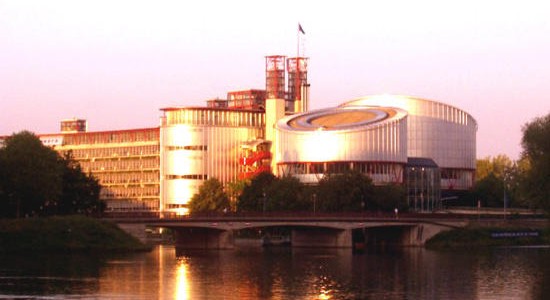
[The European Court Of Human Rights in Strasbourg France]
One major misrepresentation out of the Knox campaign in recent months was that the ECHR had already agreed to entertain her appeal.
See here and here and here (wow) and here (wow!).
We have posted repeatedly that the ECHR had “accepted” nothing - a processing clerk had merely asked prosecution and defense for actual hard facts “acccidentally” omitted from defense lawyer Dalla Vedova’s submission documents.
Had Dalla Vedova acted ethically and truthfully, there would have been no need at all for this stage.
We explained especially that Knox’s team had never lodged a complaint with any Italian court as Italian law requires and so due process in Italy prior to involving the heavily burdened ECHR had not even begun.
And that pre-emptively the Italian Supreme Court itself had already forcefully ruled that Knox had no ECHR case.
All this was known to Knox and her lawyers and PR but they continued to lie to the world anyhow.
Now the buzz is that detailed Italian government submissions to the ECHR have killed all prospects for Knox’s fraudulent appeal.
The absence of any effective comeback to the ECHR from Knox lawyer Dalla Vedova is understandable - by not filing any complaint in Italy first on behalf of Knox he might have been breaking Italian law requiring such a complaint if deemed credible.
Posted by Our Main Posters on 08/17/16 at 11:29 AM •
Permalink for this post •
Archived in Defendants in court, Amanda Knox, Hoaxes Knox & team, 15 Single alibi hoax, 16 Interrogation hoax, 24 ECHR appeal hoax •
Comments here (24)
Monday, May 23, 2016
Carlo Dalla Vedova, Is ECHR Made Aware Italian Law REQUIRES Lawyers To First File Local Complaints?
Posted by Our Main Posters
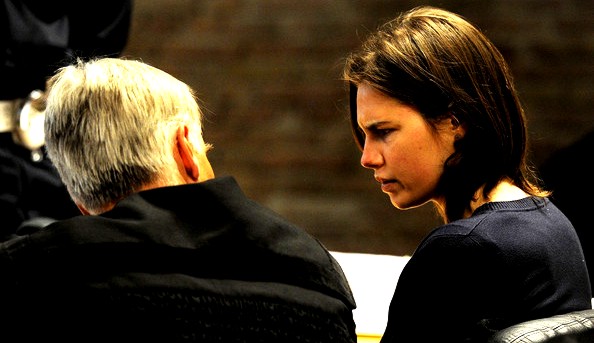
Carlo Dalla Vedova,
You are aware of this, right? It is not optional: if Italian clients credibly claim police abuse, their lawyers MUST lodge a complaint.
This is a serious requirement in Italian law, which looks to protect the client while heading off innuendo and frivolous appeals years down the road. Under the principle of infedele patrocinio (betrayal of the interest of the client), if you really believed Knox’s varying claims that she was abused, it seems you’d have no choice but to lodge a formal complaint.
Not only was no formal complaint that we know of ever filed by you, and so no investigation ever begun, summaries of your ECHR case by Cassazione and by ECHR itself make no mention of any process having been followed. They specifically ask you about this.
The ECHR quotes in full a letter to you from Amanda Knox dated 9 November 2007 claiming at length that police abuse explained why she was “confused” at the so-called “interrogation” of 5-6 November 2007.
But the ECHR seems to have not been made aware that you never passed this letter on to any prosecutor or any judge. In fact, you provide it as evidence only now. Why was this not made clear?
And even more daunting for your appeal, your legal colleague Luciano Ghirga at Rudy Guede’s trial late in 2008 specifically said this - in effect, the exact opposite of your current claim.
“There were pressures from the police but we never said she was hit.”
Now the ECHR in its first response to your submission is asking some questions of fact. It has addressed this first question to you.
1. Has the applicant exhausted the domestic remedies available to her to complain about the violation of Article 3 of the Convention, concerning the slaps (scappellotti) allegedly suffered, and under Articles 6 §§ 1 and 3 a), c) and e) and 8 of the Convention?
It appears that no, Knox the applicant never did initiate the formal process to seek a remedy through Italian law. The point is one that ends the ECHR appeal process all by itself if the answer is no.
- (1) because of the obvious status of inadmissibility of the application under the ECHR rules (no domestic remedy was first attempted),
(2) because of its damaging probative value for assessing the credibility of the version of facts provided by the applicant.
You will of course know of the legal provisions under Italian law about which the ECHR may not yet be aware:
- (1) the crimes of beating (cp 581), or physical violence or threat (cp. 610-612) require the victim to file a complaint in order to allow prosecution of the charge, otherwise investigation cannot be initiated;
(2) the Ethics Code of lawyers requires a defence attorney to file a charge if he/she collects a claim by a client under detention, and to properly inform the client about the necessity to file a complaint;
(3) if a lawyer is informed by a client under detention that the same client suffered violence or offence by authorities, and does not take proper legal steps, the lawyer would commit the extremely serious criminal offence of infedele patrocinio (betrayal of the interest of client) besides breaching the Ethics Code;
(4) a defence attorney is also required to object any irregularity of breach of the code that could be suffered by the client, namely, in any particular case, if the applicant’s current claims had been made at the time, the lawyers should have denounced the breach of Procedure Code claiming that a prosecution interrogation had taken place (thus, that would mean breaching the Procedure code that prevents prosecution from questioning a suspect prior to his/her appearance before a judge)
So, in summary, no formal complaint ever seems to have been filed allowing local investigations to begin. And the failure to initiate the procedure for domestic remedy by the applicant on this claim could be a crime under Italian law if Knox had insisted on it.
And it would seem to render the request inadmissible on this point. It also undermines any possible credibility of the claim itself. Regardless of whoever dropped the ball here, lawyer or client, it does not bode well.
Posted by Our Main Posters on 05/23/16 at 02:24 PM •
Permalink for this post •
Archived in Defendants in court, Amanda Knox, The officially involved, The defenses, The legal followups, Knox followup, Hoaxes Knox & team, 16 Interrogation hoax, 24 ECHR appeal hoax, Amanda Knox #2 •
Comments here (17)
Monday, May 02, 2016
Revenge “On” The Knox: Judges Bruno And Marasca Of The Supreme Court Strike Back
Posted by Chimera
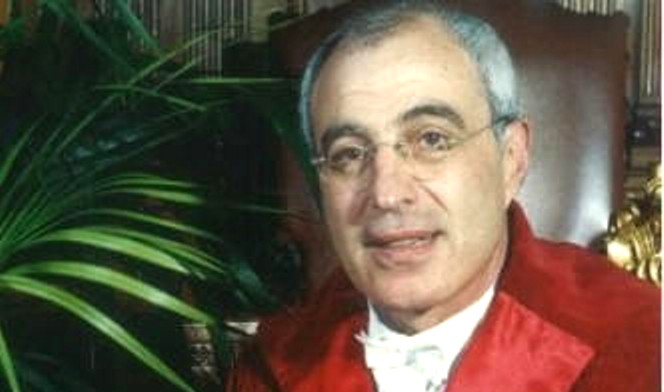
Judge Bruno the drafter of the seriously bizarre Fifth Chambers report “Who, me?!!!”
1. Overview Of The Post
We have posted both multi-part analyses of the Amanda Knox book (extended 2015 edition) and also multi-part analyses of the 2015 Supreme Court verdict attempting to apply closure to the case.
Primarily because they both make so much up and leave so much out, both efforts appear to Italian lawyers and observers and our own team to have fallen far short.
Worse, as I demonstrate here, Knox and the Supreme Court were not even on the same page. They used different arguments which tend to cancel one another out.
In effect the report of Judges Bruno and Marasca late in 2015 pulled the rug out from under Knox’s book published a few months before.
2. Arguments Of The Supreme Court
The final report from the 5th Chambers of Cassation was released in September 2015, several months late, with rumors swirling in Rome that it was proving a tough task.
Our five critique series were put together by (1) the Perugia prosecution, (2) Machiavelli, (3) Catnip, (4) James Raper (the longest of those four), and (5) in draft by Olleosnep.
From James Raper critique Part 1
The Fifth Chambers argued as follows:
1. The standard of “beyond any reasonable doubt” was not met due to insufficient and/or contradictory evidence - pursuant to Article 530, section 2 of the Italian Code of Criminal Procedure.
2. Multiple attackers upheld. Guede was guilty with others unknown.
3. The break-in in Romanelli’s room was staged.
4. Amanda Knox was present in the cottage at the time of the murder but there is insufficient evidence that she played a participatory role.
5. The DNA profile of Meredith Kercher on the knife and the DNA profile of Raffaele Sollecito on the bra clasp have “no probative or circumstantial relevance”
6. “Motive is not irrelevant” and motive was not established.
7. No selective cleaning.
8. No purpose would be served in remanding the case back to the 1st instance court of appeal (as had occurred on appeal against acquittal)
From James Raper Critique Part 5
The Fifth Chambers argued as follows:
1. Knox was present in the cottage at the time of the murder but in a non-participatory role. Very probably (if this is not a held fact) she had scrubbed Meredith’s blood off her hands in the small bathroom.
2. Sollecito was very probably there as well, but it cannot be known when.
3. There was certainly an assailant (and perhaps more than one) in addition to Guede.
4. There was a staging of the break-in in Filomena’s room.
While this seems (in a very tortuous way), to assert an “insufficient evidence” finding rather than an “innocence” finding, the findings of the 5th Chambers are now considered final, unless they are overturned.
That being said, these findings directly refute the bulk of Knox’s book “Waiting to be Heard”
3. Arguments of Amanda Knox
Our 12-part series taking apart the claims in Knox’s book can be found here.
(1) Chapter 5, 6: The Evening and Morning After Meredith Died
Knox Version (A): AK/RS were at his apartment, watching Amelie, smoking pot, reading Harry Potter and f***ing. AK returned to her home late the next morning.
Knox Version (B): AK was in the kitchen while PL was murdering Meredith
Knox Version (C): AK was in the kitchen while PL was murdering Meredith, and RS was probably there
Knox Version (D): AK has no clue what was going on, and doesn’t remember anything.
Version (A) is the story AK told in her book and on television—though the details are flexible. Versions (B), (C), and (D) are the 3 statements she made November 5th/6th.
However, the truth Bruno and Marasca think is closest to the truth (pun intended), is version (C), with Guede as the killer instead of PL.
Other courts: Pre-Trial Judge Micheli (October 2008), Trial Judge Massei (2009), Appeal Judge Nencini (2014) all found that Knox was not only involved, but that she personally killed Meredith. Even if you accept the Cassation ruling that AK wasn’t actually involved, the final ruling did place her at the crime scene, and RS probably so.
Bullshit level: COMPLETE
(2) Chapters 7, 8, 9: The Ensuing Investigation
AK goes on and on in WTBH about how she was trying to help the police. She complains about how she was subjected to repeated and very lengthy interviews. However, she never shared any of the insider information she had about that night. The police officers involved noted that she and RS seemed particularly unhelpful.
Bullshit level: COMPLETE
(3) Chapters 10, 11: The Knox Interrogation Hoax
AK goes on in great detail especially in Chapter 10 about how she was lured to the police station, and brutally interrogated. In her December 2013 email to Judge Nencini, she refers to it as “torture”.
Interesting how she remembers it with such lurid detail.
As AK points out, there is no recording or video
All of the officers involved give “very” different accounts
AK claims to be traumatized and have her memory go blank
AK’s performance was convincing enough to make Judge Claudia Matteini (November 2007) believe PL was the killer. But since then ....
(a) the 3 judge panel headed by Judge Massimo Ricciarelli (November 2007);
(b) the 5 judge Cassation panel headed by Judge Torquato Gemelli (April 2008);
(c) pre-trial Judge Paolo Micheli (October 2008);
(d) trial jury headed by Judge Giancarlo Massei (December 2009);
(e) appellate jury headed by Hellmann/Zanetti (October 2011);
(f) Cassation panel headed by Judge Chieffi (March 2013);
(g) appellate jury headed by Judge Alessandro Nencini (January 2014);
(h) Cassation panel headed by Bruno/Marasca (March 2015)
.... have ALL ruled that AK framed PL, and that she did it willingly, and wasn’t tricked or coerced.
Bullshit level: COMPLETE
(4) The Afterword: Everything After Hellmann’s Ruling
AK triumphantly declares that Cassation (2015) found her and RS innocent. But once again, AK releases her book prior to the Cassation report. Idiot.
AK does misrepresent far more than just the 2015 Cassation findings in the Afterword. More on that later.
Bullshit level: COMPLETE
(5) Understanding the Bruno/Marasca Ruling
At a minimum, Chapters 5, 6, 7, 8, 9, 10, 11 and the Afterword of “Waiting to be Heard” are complete bullshit.
Considering that these bogus claims are repeated throughout the book, it can reasonably be inferred that much of the rest is made up as well.
This is not me talking. This is referencing the Bruno/Marasca ruling, which as it stands, is final.
(6) Author’s Note
This is a lot of speculation on my part, (as Andrew Gumbel would say “hearsay and speculation abound”), but feel free to comment
The B/M report can be understood in one word: finality. They don’t want any one else looking at it.
(A) B/M rule “insufficient evidence” rather than “innocent” hoping to placate the Italian public.
(B) B/M sabotage AK’s ECHR appeal chances, as they don’t want another court looking to carefully at it
(C) B/M ruling essentially says “just short of guilty” to stop AK/RS from crowing about their innocence.
(D) B/M ruling claims AK/RS lied and obstructed to ward off any potential wrongful imprisonment lawsuit.
(E) B/M do strongly imply AK/RS are guilty to try to give a “moral win” to the Kerchers.
(F) B/M appear to bend over backwards to acquit, trying to look “incompetent, at worst”, rather than corrupt.
(6) The problem is: Bruno and Marasca haven’t taken into account the personalities of everyone involved
(a) The Hellmann/Zanetti ruling (October 2011) stunk of corruption, so Italy would be immediately suspicious of anything remotely similar.
(b) AK’s ECHR appeal seems to warded off for now, but AK seems hell bent on going ahead anyway.
(c) AK/RS did start parading around again, and AK re-released her book
(d) RS and Papa Sollecito sued anyway.
(e) Far from giving a “moral win”, this ruling and the accompanying report just leave a bad taste.
(7) Bullshit in WTBH (Beyond Bruno/Marasca)
Chapter 1: Before Leaving Italy
Questions For Knox: Why The Huge Lie About Your ZERO Academic Intentions In Europe?
Chapter 2: Federico Martini (a.k.a. Cristiano)
US And UK Media Wrongly Attribute Italian Report Of Knox/Cocaine-Dealer Link To Trial Prosecutors
Multiple: Capanne Chapters
The Amanda Knox Book: Good Reporters Start To Surface Amanda Knox’s False Claims In Droves
Chapter 31-35: The Hellmann Appeal
A Summary Of The Cassazione Ruling On Annulment Of The Knox-Sollecito Appeal
4. Final Thoughts
I stand by my claim that WTBH is 90-95% bullshit.
Fair to say, Bruno and Marasca would likely agree.
Posted by Chimera on 05/02/16 at 08:41 PM •
Permalink for this post •
Archived in Defendants in court, Amanda Knox, The officially involved, Supreme Court, Appeals 2009-2015, Cassation 2015, Hoaxes against Italy, 1 Ital justice hoax, Hoaxes Knox & team, Hoaxers from 2007, Knox-Marriott PR, Amanda Knox #2 •
Comments here (29)
Thursday, March 31, 2016
On April 26 Possible Sentences For Oggi For Publishing Defamations By Knox
Posted by Peter Quennell
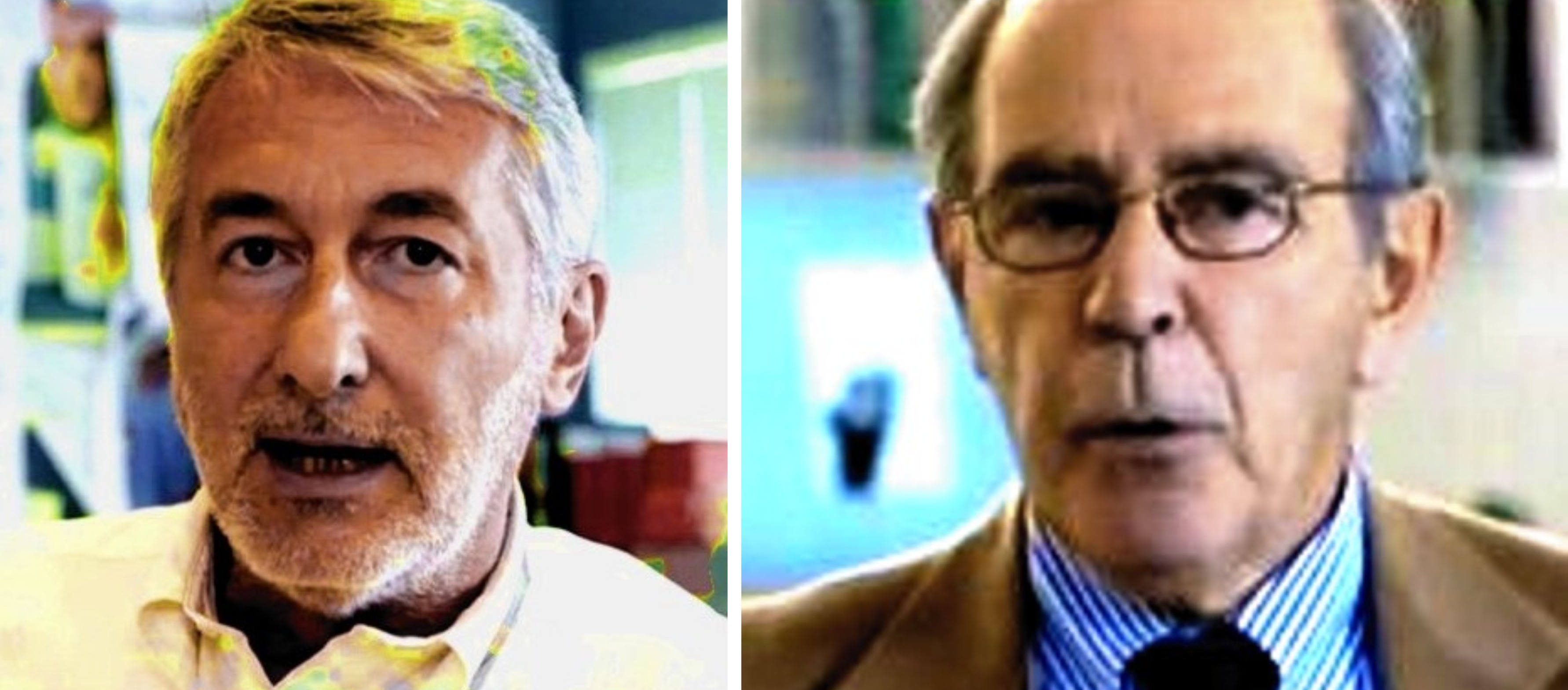
Umberto Brindani, editor of Oggi, and Giangavino Sulas, veteran crime reporter
Outcome: OGGI caved, as it really had no defense (other than that Knox had extensively lied), and this was settled out of court.
This is still highly worth a read as it lists Knox’s false claims in Part 2 and all our rebuttals in Part 3.
OGGI seems to have steered clear of the case since. Smart move.
1. New Court Development In Italy
The Italian mafias have used three main weapons against the judiciary: bribes, slanders, and blowing them up.
As a result judges and prosecutors are protected in various ways. One is to make it a felony crime to maliciously defame them to try to throw trials off-course.
We are 1/3 of the way through Chimera’s elucidation of the 100 or so criminal felonies in Knox’s book, and the other two posts will follow next.
The first of what could be numerous trials of those who published them and repeated them is now approaching its climax.
This is the trial of Umberto Brindani, the editor of the weekly magazine Oggi, and Giangavino Sulas, a veteran crime reporter on his staff.
They have put up what amounts to zero defense, and on tuesday the chief prosecutor requested the judge to impose prison sentences of six years. Even if those sentences are minimised under Italian rules and no time will be served, each will still have a criminal record for life.
A guilty verdict bodes badly for Amanda Knox and her book agent Bob Barnett, her publishers, her lawyers, and her fellow-travelers, who could then all be easy targets for Italian prosecutors in future trials.
The foolish and uncomprehending Joel Simon of the Committee for the Protection of Journalists, who knows nothing about WHY Italian prosecutors are protected from criminal defamations, could also find himself in the crosshairs.
Here below, from our posts of 12 May 2013, are Oggi’s paraphrasings of Knox’s claims (translation by Catnip) and our own rebuttals of those same claims.
2. Knox’s Defamatory Claims In Oggi
Amanda Knox: The American girl’s sensational story
Chilling. No other adjectives come to mind after having read Waiting to be Heard, finally released in the United States. An extremely detailed and very serious charge against the police and magistrates who conducted the investigation into the murder of Meredith Kercher.
Immediately after the crime, Amanda recounts, and for entire days and nights, they had interrogated the American girl and placed her under pressure to make her confess to a non-existent truth, without officially investigating her, denying her the assistance of a lawyer, telling her lies, even prohibiting her from going to the bathroom and giving her smacks so as to make her sign a confession clearly extorted with something similar to torture.
And now the situation is very simple. There are only two choices: either Amanda is writing lies, and as a consequence the police officers and magistrates are going to have to sue her for defamation; or else she is telling the truth, and so they are going to have to go, not without being sanctioned by the CSM [the magistrates’ governing body] and the top brass of the Police. The third possibility, which is to pretend that nothing has happened, would be shameful for the credibility of our judicial system.
Amanda Knox has written her Waiting to be Heard memoir with the sense of revulsion and of relief of someone who has escaped by a hair’s breadth from a legal disaster, but has got her sums wrong. Cassation has decided that the [appeal] proceedings have to be redone and the hearings should be (re)commencing in October before the Florence Court of Appeal.
In a USA Today interview, Ms Knox has not excluded the possibility of “returning to Italy to face this battle too”, but it would be a suicidal decision: it’s likely that the appeal will result in a conviction, and the Seattle girl will end up in the black hole from which she has already spent 1,427 days.
In this way Waiting to be Heard risks being the “film” on which Amanda’s last words are recorded about the Mystery of Perugia, her definitive version.
We have read a review copy. And we were dumbfounded. Waiting to be Heard is a diary that has the frenetic pace of a thriller, written in a dry prose (behind the scenes is the hand of Linda Kulman, a journalist at the Huffington Post), even “promoted” by Michiko Kakutani, long-time literary critic at the New York Times.
The most interesting part does not concern the Raffaele Sollecito love story (which Amanda reduces it to puppy love: “With the feeling, in hindsight, I knew that he… that we were still immature, more in love with love than with each other”), and whoever goes looking for salacious details about the three Italian boys Amanda had casual sex with, one night stands, will be frustrated (Ms Knox describes those enounters with the nonchalance of an entomologist disappointed with his experiments: “We undressed, we had sex, I got dressed again with a sense of emptiness”).
There are no scoops about the night of the murder and even the many vicissitudes endured during the 34,248 hours spent in Capanne prison ““ the [claimed] sexual molestations suffered under two guards, the unexpected kiss planted by a bisexual cellmate, the threats made by another two prisoners ““ remain on the backdrop, like colourful notations.
Because what is striking and upsetting, in the book, is the minute descriptions, based on her own diaries, on the case documents and on a prodigious memory, of how Ms Knox had been incriminated (or “nailed”).
COME IN KAFKA. A Kafkian account in which the extraordinary naivety of Amanda (the word naïve, ingénue, is the one which recurs most often in the 457 pages of the book) mixes with the strepitous wickedness of the investigators decided on “following a cold and irrational trail because they had nothing better in hand”.
Devour the first 14 chapters and ask yourself: is it possible that the Police and Italian justice work with such incompetence, ferocity, and disdain for the truth? You place yourself in her situation and you scare yourself: If it happened to me? You’re in two minds: is it a likely accusation, or a squalid calumny, the version of Amanda?
Because in reading it you discover that in the four days following the discovery of Meredith Kercher’s body (on 2 November 2007), Amanda was interrogated continuously, and without the least of procedural guarantees [=due process].
She changes status from witness to suspect without being aware of it.” No one had told me my rights, no one had told me that I could remain silent”, she writes. When she asked if she had the right to a lawyer, the Public Prosecutor, Giuliano Mignini, had responded like this: “No, no, that will only worsen things: it would mean that you don’t want to help us”. Thus, the Public Prosecutor, Giuliano Mignini.
For a long period of time, Ms Knox, who at the time spoke and understood hardly any Italian at all, mistook him for the Mayor of Perugia, come to the police station to help her.
Then, with the passage of time and of the pages, the assessment changes: Mignini is a prosecutor “with a bizarre past”, investigated for abuse of office (he was convicted at first instance, but Cassation annulled the verdict on the grounds of lack of jurisdiction: the case will be held in Torino ““ ndr) and with the hunger to fabricate “strange stories to solve his cases”.
Mignini “is a madman who considers his career more important than my liberty or the truth about the killing of Meredith”. On the phone, the Perugian prosecutor reacts with aplomb: “First I will read the book and then I will consider it. Certainly, if it really calls me “˜mad’ or worse, I think I will file suit”.
BEING IN PRISON IS LIKE CAMPING Amanda goes looking. When the officers mysteriously bring her along to the crime scene inspection of the apartment below the one in which she and Meredith were living in, Ms Knox put on the shoe protectors and the white forensics gloves and called out Ta-dah! spreading her arms “as if I was at the start of a musical: I wanted to appear helpful”.
When they dragged her in handcuffs into Capanne Prison, she believed what the Police would have told her, and that was they would hide her for a couple of days to protect her (from the true killer, one presumes) and for unspecified bureaucratic reasons. “In my head I was camping: “˜This won’t last more than a week in the mountains’, I told myself,” writes Amanda.
They take her money off her, and her credit cards, licence and passport, and she draws strength from repeating to herself that “surely they’re not going to give me a uniform, seeing that I’m a special case and that I’ll be here for only a little while”.
But it’s the account of the notorious interrogation that takes the breath away. Around ten in the evening on her last day of freedom, Ms Knox accompanies Raffaele to the police station (he was called in, also without a lawyer, by the Police) and is thrown into a nightmare which she populates with many faces: there is Officer Rita Ficcara, who gives her two cuffs on the head (“To help you remember,” she would say); there’s another officer who advises her: “If you don’t help us, you’ll end up in prison for 30 years”; Mignini arrives and advises her not to call a lawyer; super-policewoman Monica Napoleoni dives in and bluffs: “Sollecito has dropped your alibi: he says that on the night of the murder you had left his apartment and that you had told him to lie to “˜cover you’”.
And a crescendo of yelling and intimidations that lasts from 11 at night until 5.45 in the morning. Seven hours “produce” two confessions that, exactly because they are made without a defence lawyer, cannot be used in the proceedings, but forever after “stain” the image of the accused Knox: Amanda places herself at the scene of the crime and accuses Patrick Lumumba.
RAFFAELE CONFIRMS THE ACCUSATIONS An account of the horror is confirmed by Sollecito in his memoir, Honor Bound, Raffaele writes of having heard “the police yelling at Amanda and then the cries and sobs of my girl, who was yelling “˜Help!’ in Italian in the other room”, and of having being threatened in his turn (“If you try to get up and go, I’ll punch you till you’ll bleed and I’ll kill you. I’ll leave you in a pool of blood”, another officer had whispered to him).
Published lines which have passed right under the radar of the Perugian investigators: “No legal action [against the interrogators] has been notified to us,” Franco Sollecito, Raffaele’s dad, tell us. For having recounted the sourness of her interrogation in court, Amanda was investigated for calunnia: the trial will take place in Florence. This one, too, will be a circumstantial case: it’s the word of two young people against that of the public prosecutor and the police.
The recording of the interrogation would have unveiled which side the truth stands on. But it has gone missing.
3. Our Rebuttals Of Knox’s Claims
- Knox was NOT interrogated for days and nights. She was put under no pressure in her brief witness interviews except possibly by Sollecito who had just called their latest alibi “a pack of lies”.
- Knox WAS officially investigated in depth, after she surprisingly “confessed” and placed herself and Patrick at the scene. Prior to that she’d been interviewed less than various others, who each had one consistent alibi.
- Knox herself pushed to make all three statements without a lawyer on the night of 5-6 November 2007 in which she claimed she went out from Sollecito’s house, met Patrick, and witnessed him killing Meredith.
- Far from Knox being denied a lawyer, discussions were stopped before the first statement and not resumed, in the later hearing she was formally warned she needed one; she signed a confirmation of this in front of witnesses.
- Prosecutor Mignini who Knox accuses of telling her a lawyer would hurt her prospects when she claims she asked for one was not even in the police station at that interview; he was at home.
- She was not prohibited from going to the bathroom. At trial, she testified she was treated well and was frequently offered refreshments. Her lawyers confirmed this was so.
- She was not given smacks by anyone. Over a dozen witnesses testified that she was treated well, broke into a conniption spontaneously, and thereafter was hard to stop talking.
- There is no evidence whatsoever that Knox was subject to “something similar to torture” and as mentioned above only Sollecito applied any pressure, not any of the police.
- There is nothing “suicidal” about returning to Italy to defend herself at the new appeal. Sollecito did. She risks an international arrest warrant and extradition if she doesn’t.
- There is no proof except for her own claims of sexual molestations in prison; she is a known serial liar; and she stands out for an extreme willingness to talk and write about sex.
- Many people have testified she was treated well in prison: her own lawyers, a member of parliament, and visitors from the US Embassy were among them; she herself wrote that it was okay.
- She may have based her account on her diaries and “prodigious memory” but the obviously false accusation against the prosecutor suggests that much of the book was made up.
- The investigators had a great deal of evidence against Knox in hand, not nothing, and they were not ever faulted for any action; they helped to put on a formidable case at trial in 2009.
- “Police and Italian justice work with such incompetence, ferocity, and disdain for the truth” is contradicted by a very complete record prior to trial which was praised by the Supreme Court.
- Mr Mignini has NO bizarre past at all. He is widely known to be careful and fair. He would not have been just promoted to first Deputy Prosecutor General of Umbria otherwise.
- He was put on trial by a rogue prosecutor desperate to protect his own back from Mignini’s investigations; the Supreme Court has killed the trumped up case dead.
- There was nothing “mysterious” about Knox being taken to the crime scene to see if any knives were gone, but her wailing panic when she saw the knives was really “mysterious”.
- Knox never thought she was in prison for her own protection; she had signed an agreement at the 5:00 am interview confirming she did know why she was being held.
- Monica Napoleoni did not “bluff” that Sollecito had just trashed their joint alibi; he actually did so, because his phone records incriminated him; he agreed to that in writing.
- There was no crescendo of “yelling and intimidations that lasts from 11 at night until 5.45”. There were two relatively brief sessions. Knox did most of the talking, named seven possible perps, and drew maps.
- There was zero legal requirement to record the recap/summary interview, no recording has “gone missing” and many officers present testified to a single “truth” about what happened.
Posted by Peter Quennell on 03/31/16 at 04:39 PM •
Permalink for this post •
Archived in Defendants in court, Amanda Knox, The legal followups, Knox followup, Hoaxes Knox & team, 15 Single alibi hoax, 16 Interrogation hoax, Hoaxers from 2011, Amanda Knox #2 •
Comments here (7)
Friday, February 26, 2016
Surprising Similarities Between Sammy The Bull Gravano And The Ex-Perps In Meredith’s Case
Posted by Chimera
Overview
This piece is about Salvatore (Sammy the Bull) Gravano, an admitted serial killer.
He had a career in the mafia, and was the underboss and hitman for the notorious mob boss John Gotti. Although his is a case about organized crime, there are many similarities between Gotti v Gravano, and Knox v Sollecito v Guede.
Some Gotti/Gravano history
John Gotti was a captain in the Gambino crime family (named after Carlo Gambino), based in New York, NY. A serious problem emerged for him when several members of his ‘‘crew’’ were indicted for drug dealing.
These indictments included his younger brother, Gene Gotti, and Angelo Ruggiero, a childhood friend. The policy within the crime family for many years had been ‘‘deal-and-die’‘.
The upper leadership of the mob had figured that drug dealing was too high profile a crime, and that the extra police attention was not worth it. True, this was extremely hypocritical, as the bosses collected their cut of all income, knowing that a large portion of those proceeds came directly from drugs.
The drug indictments suddenly meant that John Gotti was in danger.
Though not personally implicated, he thought he might also be killed on the assumption that he approved of the alleged dealing. He decided to strike first, to save his own neck by having then boss Paul Castellano ‘‘rubbed out’‘. Gotti solicited the help of Salvatore (Sammy the Bull) Gravano, who was known as a prolific killer.
Paul Castellano had inducted Gravano into the mob in 1978. However, Gravano had no qualms about killing his ‘‘friend’’ since Gotti offered him even more: a promotion to ‘‘capo’’ or to ‘‘captain’‘.
Gravano helped Gotti set up the hit for December 16, 1985. With Castellano (and driver Tommy Billoti who was at the time underboss) dead, the family was temporarily leaderless. Gotti got himself voted in, and took over the Gambino family.
Castellano wasn’t the only ‘‘friend’’ that Gravano murdered, or would later murder. Gravano murdered Robert di Bernardo—a business partner, Louie Molito—a childhood friend, and others. He then took over any assets that they had. Some ‘‘friend’‘.
For the next several years, Gotti deliberately put himself into the spotlight. He managed to win 3 criminal trials, and seemed untouchable. However, in 1990, his mouth got him into trouble, and the FBI recorded Gotti implicating himself and other Gambino associates on murder and other crimes.
Gotti also made many nasty insults towards Gravano, now his underboss.
Gotti, Gravano, and Frank LeCasio (then the 3rd in command) were arrested December 11, 1990. All were held without bail. When Gravano finally heard the tapes of what Gotti had been saying about him, he turned and became a ‘‘mob rat’‘. Gotti and LeCasio were convicted of murder, racketeering and other crimes, and received life without parole.
Gravano, however got a deal that would put Karla Homolka to shame: 5 years for 19 murders. True, he could have served 20 for racketeering, but the judge cut it far below that.
For the complete interview, please see the YouTube video at the top here. This was shot in the 1990’s and converted to digital, so the quality is not that great. Here are a few more for background. The third one, the movie ‘‘Gotti’’ is fairly accurate, though off on some points.
- More on Sammy Gravano.
- More on the Gambino Family.
- More on John Gotti.
Gambino family highlights
(1) Albert Anastasia (underboss to Vincent Magino) made his ‘‘friend’’ disappear. Anastasia then took over.
(2) Carlo Gambino (underboss to Albert Anastasia) had his ‘‘friend’’ shot in a barbershop. Gambino then took over.
(3) Carlo Gambino made sure the ‘‘best qualified person’’ took over when he had a heart attack. He hand picked his brother-in-law Paul Castellano to succeed him.
(4) Paul Castellano’s underboss, Neil Delacroce, died of cancer. Castellano hand picked his buddy, Tommy Bilotti, to become new underboss.
(5) John Gotti and Salvatore (Sammy) Gravano, had their ‘‘friend’’ Paul Castellano shot dead in public. Gotti took over.
(6) While in prison, John Gotti made sure the best qualified person succeeded him as boss. He hand picked his son, John Jr.
So…. murder and nepotism seem to be how the top spots get filled in the mafia.
Excerpts From the Video
2:55 (Gravano) You can relate me to a soldier in Vietnam who killed hundreds of people. I was a soldier of Cosa Nostra. I am a hitman.
No. You are just a slimeball who kills for money.
3:25 (Gravano) Here I am
3:30 (Sawyer) They have said that you are the single most important witness ever to testify against the mob.
3:36 (Gravano) I think I am.
3:39 (Sawyer) So there’s a word you use, for people who turn ...
3:42 (Gravano) Who cooperate. You trying to goat me into the word? Rat? Is that the word?
3:51 (Sawyer) That’s the word. So are you a rat?
3:53 Gravano) I look at it as ‘‘I was betrayed. I betrayed him.’‘
3:59 (Sawyer) Double crosser?
4:01 (Gravano) Loud sigh ... master double-crosser. John’s a double-crosser. I’m a master double-crosser. We played chess, and he lost.
Gravano had in the past sneered at the idea of people testifying. However, when it is his turn, he dismisses it as a game.
4:30 (Gravano) Power has a way, where you can believe for a while that you can walk on water. And I think this is what happened to him.
And people who can walk away from 19 murders? What are they thinking?
5:25 (Sawyer) Were you Gotti’s friend?
5:30 (Gravano) His pit bull. And his friend.
5:42 (Sawyer) What was the reason, the real reason you cooperated? Or was it just to save your skin?
5:48 (Gravano) I was just tired of the mob, and tired of fighting. It was a door out of the mob. You know I watched the David Karresch incident, and I would say to myself: ‘‘how could these people get so brainwashed? Are they crazy? Are they nuts?’’ And then I look at myself in the mirror and I say ‘‘brainwashed?’’ Here I am on orders, killing people left and right. And I’m calling them brainwashed.
6:18 (Sawyer) There was a book written about you that you said you had a characteristic of committing murder with the non-chalence of someone pulling open the tab on a can of beer. That was about all that it phased you, or about all it took.
6:30 (Gravano) As far as being a hitman goes, I was actually good at it.
6:36 (Sawyer) Because you were fast, and lethal?
6:39 (Gravano) And loyal. If I was on your case, I dropped everything.
6:45 (Sawyer) Look at this list. There are ... how many?
6:49 (Gravano) 19
6:51 (Sawyer) Serial killers don’t have 19.
6:53 (Gravano) We’re worse than they are.
Okay, which is it? You turned on Gotti because it was a chess game? Or you did it because you were tired of the mob and the games? It can’t be both.
7:00 (Gravano) We only kill ourselves. What are you worried about? The public seems to like what we do. Look at John Gotti. If I have 19, forget about what he has. When he wanted a hit, he wanted it done yesterday. He would sent me to supervise it, or to control it, make sure the job got done. And I obviously did. When you’re the boss, and you’re giving orders, you’re credited with all of it, even if you’re not on the street.
Gravano is pulling the ‘‘John was even worse’’ card here. And he seems somewhat proud of what he has done. Sicko.
17:55 (Gravano) I remember something that surprised me is that I had no remorse at all. None. I didn’t feel sorry for him in the least. I felt power. I felt like my adrenaline in my body was completely out of control.
18:09 (Sawyer) You were excited?
18:13 (Gravano) I guess it’s like an animal going after its prey.
18:35 (Gravano) Everything changed. .... At a club, oh, no Sammy, you don’t have to wait in line. You can come right in.
18:40 (Sawyer) You were a player?
18:45 (Gravano) I was out of the minor leagues. I was in the major leagues.
No comment needed.
Other parallels with our pair
- Gravano is of Italian-American descent.
- Knox is American.
- Sollecito is Italian.
- Gravano was paid $1.5 million for ‘‘his’’ book called Underboss.
- Knox was paid $3.8 million for ‘‘her’’ book called Waiting to be Heard.
- Sollecito was paid $950,000 for ‘‘his’’ book, called Honor Bound
- Gravano tried to ‘‘cash in’’ on his murders by admitting what he had done.
- Knox/Sollecito tried to ‘‘cash in’’ on Meredith’s murder
- ’‘Gravano’s’’ book was really written by Peter Maas.
- ’‘Knox’s’’ book was really written by Linda Kuhlman.
- ’‘Sollecito’s’’ book was really written by Andrew Gumbel.
- The families of Gravano’s victims are outraged he is cashing in on the notoriety of his crimes.
- The Kercher family is outraged AK/RS are cashing in on the notoriety of their crimes.
- Gravano got an interview from Diane Sawyer.
- Knox’s first (of many) interviews was with Diane Sawyer.
- Sollecito’s first (of several) interviews was with Katie Couric.
- Gambino boss John Gotti was referred to as ‘‘John Gotti’‘.
- Sammy Gravano was referred to as ‘‘John Gotti’s Hitman’‘.
- Amanda Knox is referred to as ‘‘Amanda Knox’‘
- Raffaele Sollecito is referred to as ‘‘Amanda Knox’s Italian Ex-Boyfriend’‘
- Gravano has no problems airing personal details about his ‘‘friend’’ John.
- Knox has no problems airing personal details about her ‘‘friend’’ Meredith.
- Gravano criticizes Gotti’s public lifestyle, then after his deal becomes a media whore.
- Knox claims she wants to live in peace, but becomes a media whore to sway public opinion, and sell ‘‘her’’ book.
- Sollecito claims he was just dragged into Knox’s case, but becomes a media whore for the same reasons as Knox.
- Gravano blames Gotti for destroying the Gambino family, even though he was the one who testified at trial.
- Knox seems to blame Meredith for her own death, even though she stuck the knife in (well, she had it coming).
- Gravano (at least he claims) to have rigged Gotti’s racketeering trial to ensure an acquittal (or at worst a hung jury)
- Knox’s and Sollecito’s case was rigged by Hellmann/Zanetti and Marsca/Bruno to ensure an acquittal.
- Gravano was psychologically evaluated before leaving prison, and the results were disturbing.
- Knox and Sollecito were psychologically evaluated in prison, and the results were disturbing.
- Gravano smeared other mob associates for getting involved with drug trafficking.
- Knox smeared others (especially in her book) for drug use.
- Gravano’s drug smears were hypocritical as he was later brought to justice for drug trafficking.
- Knox’s drug smears were hypocritical, as she was into drugs, and slept with a dealer (Federico Martini) for drugs.
- Gravano’s most depraved act (outside of murder), was marrying a woman whose brother he had killed (Nick Scibetta).
- Knox’s most depraved act (outside of murder), was continuing her sex-for-drugs deal even after Meredith’s death.
- Sollecito’s most depraved act (outside of murder), was his various bride shopping efforts to avoid extradition.
- Warning signs? Gravano murdered his business ‘‘friends’‘, so betraying Gotti was no real surprise.
- Warning signs? Knox staged a break in, wrote rape stories, and threw rocks at cars, so violence in her home was no real surprise.
- Warning signs? Sollecito had supposedly attacked a classmate with scissors, so stabbing someone was no real surprise.
- Collateral damage? Gravano was prepared to kill innocent bystanders during the December 16, 1985 hit on boss Paul Castellano.
- Collateral damage? Knox framed an innocent person (Lumumba), and tried to pin it all on accomplice Rudy Guede.
- Collateral damage? Sollecito helped to pin it all on Guede, and cost his sister Vanessa her career with the Carabinieri.
A Final Thought:
Knox liked the Beatles. Here is ‘‘Working Class Hero’’ by John Lennon.
.... There’s room at the top
They’re telling you still
.... But first you must learn how to
Smile as you kill
.... If you want to be like all
The folks on the ‘Hill
Posted by Chimera on 02/26/16 at 07:17 PM •
Permalink for this post •
Archived in Various hypotheses, The psychology, Defendants in court, Amanda Knox, Raff Sollecito, The legal followups, US etc related •
Comments here (7)
Friday, January 15, 2016
Beyond The Italian And UK Media Reports That Knox Was Found Not Guilty Of Calunnia II
Posted by Our Main Posters
Knox with Rita Ficarra who Knox accused of hitting her.
UK media are reporting that the case was about slander, in effect a civil case by those who consider themselves damaged.
But in fact this was calunnia, which is more serious, a false accusation of a crime to a justice official, in this case the claim Knox made on the stand that she was forced to finger Patrick.
We are told this is key context which the UK reporting leaves out.
- 1. The original complaint was made (the rules required it) by those who were accused before the 2009 trial ended with a verdict of Knox’s guilt.
2. Preceding Knox on the stand had been all of those she accused. So to court-watchers in Italy her testimony was not a convincing show.
3. Knox was thereafter found guilty for essentially the same crime, with a sentence set at three years by Judge Hellmann and endorsed by the Fifth Chambers of the Supreme Court.
In effect, justice had been served for the false claims. Italian justice officials still have a big shot at worse claims in Knox’s book.
Under the Statute Of Limitations, as the book was added-to and re-issued in 2015, that opportunity exists for another five years.
Posted by Our Main Posters on 01/15/16 at 02:21 PM •
Permalink for this post •
Archived in Defendants in court, Amanda Knox, The officially involved, Police and CSI, The legal followups, Knox followup, The wider contexts, Italian context •
Comments here (18)
Friday, December 18, 2015
Knox Calunnia Trial #2: Judge Receives Arguments Of Prosecution And Knox; Verdict In New Year
Posted by Our Main Posters
Court in session 7 September in Florence with Knox a no-show
1. Latest Development
We are informed that the final arguments to the judge by both sides have been submitted in writing.
We will summarise and/or fully translate them, hopefully next week. Next step is the verdict from Judge Boninsegna, which may come early in the New Year.
Below is a reposting of the background to this unusual case, and Machiavelli’s reports from the court on 7 September.
Such trials are very rare. Usually it is only organized crime figures that in the course of a trial impugn police and prosecutors who in Italy are much respected. Defendants rarely even get on the stand, and if they do so, they invariably follow the advice of defence counsel to not dig themselves in any deeper.
In contrast, Knox pretty well went haywire. NOBODY in Italy has ever believed her. Not her own lawyers, nor multiple hearings & trial judges, or the skeptical media, or the watching population, or Hellmann & Zanetti, or even Marasca & Bruno… Not even Curt Knox! He failed to turn up to give scheduled defense testimony that could have helped Amanda Knox last September.
Gee, thanks, Curt….
And she has left her own lawyers handicapped, as they had publicly counseled Knox to stop escalating her claims about illegal coercion at her “interrogation” on 5-6 November 2007.
Their filing probably needs to be especially careful to avoid their own liability.
2. Background To Calunnia Trial
This trial focuses on the claims of Amanda Knox at trial in 2009. Charges for malicious claims in her book will fall to another court, probably also in Florence. Oggi is already on trial for republishing some of them.
There seems no parallel in US or UK legal history to this - to a defendant testifying prolifically for two days to crimes by investigators, in spite of even more days of prior testimony which all pointed the other way.
Seemingly under strong pressure from her own family Knox willingly took a huge legal risk which her own lawyers had warned her about again and again, sometimes publicly, over nearly two years.
They never ever lodged even one complaint. Nor did the US Embassy in Rome, which monitored all sessions in court, and often checked her out (as did Italian MP Rocco Girlanda) in prison at Capanne.
The Massei court and the watching audience in Italy (read here and here) bought none of it. Knox still served three years for framing Patrick. Not even Judge Hellmann bought into her claims. Certainly not the Supreme Court.
The current trial in Florence was preceded by an investigation by Florence prosecutors, who bring the charges and argue them because Knox impugned officers of the justice system in their official roles.
Prior to today the prosecutors’ investigation report had only been released to Knox’s defense. So we don’t yet know if the charges extend beyond Knox’s claims of having been abused into a false “confession” on 5-6 November 2007.
Post #1 of our ongoing Interrogation Hoax series points toward what investigators testified to at trial.
Four months later Knox contradicted them at length as summarised in our two posts here and here: “The Amanda Knox Calunnia Trial In Florence: What It Is All About”
3. Machiavelli Reports From Trial 7 September
1. Tweets from the Florence court:
16. Zugarini was present throughout the interrogation and described when #amandaknox started to cry, remembered her peculiar hand-ear gestures.
15. Napoleoni testified #amandaknox was brought a chamomille when she started crying at 01:45, the interrogation was immediately stopped.
14. Napoleoni and Zugarini said they “cuddled” Knox because she was a 20-year old girl.
13. Both Mignini and Zugarini described having had impression that #amandaknox was feeling “relieved of a burden” after accusing Lumumba.
12. Mignini said Knox was not clearly a suspect to him by the 05:45 interrogation.
11. Witnesses had inaccurate memory on some details, but were convergent on some peculiar details.
10. Napoleoni said she did not enter interrogation room, she called Rita Ficarra out to talk to her.
9. Zugarini said, as for her knowledge, Knox was not told that Sollecito withdrew her alibi.
8. Zugarini said called interpreter only to ask #amandaknox more precise questions about people in her phone contact list.
7. Zugarini said #amandaknox was able to explain herself in Italian. They called an interpreter to translate what police had to say.
6. Testimony of Mignini was descriptive and framed thing in law. Mostly talked at length explaining alone, prosecutor listened.
5. In today’s hearing, Mignini talked 2 hours, confirmed arrived at 3am, police interview was over, he asked no questions of AK.
4. Napoleoni was precise and synthetic. Zugarini longer and IMO more interesting on many details.
3. Mignini and Judge Boninsegna appeared irritated by Dalla Vedova’s remarks.
2. Long hearing of Mignini at trial against Amanda Knox for calunnia. Napoleoni & Gubbiotti followed, then Zugarini
1. Testimony of some of the investigators accused by Knox and the lead prosecutor Dr Mignini [image above] is being taken in court.
[Reporting from the Florence court sometimes requires a wait to get to a place where mobile phones can connect to the outside.]
2. Emailed report following day (8 September):
No Knox calunnia session required today as last Friday and yesterday both sides completed their witness list.
Amanda Knox and Curt Knox chose not to testify.
Now Judge Boninsegna has ordered each side to prepare their arguments within three months (7 December).
The verdict is likely to arrive in the New Year.
Posted by Our Main Posters on 12/18/15 at 02:25 PM •
Permalink for this post •
Archived in Defendants in court, Amanda Knox, Trials 2008 & 2009, Knox on stand, The legal followups, Italian related, Hoaxes against Italy, 2 Italian mileu hoax, 3 No evidence hoax, 9 Mignini v Knox hoax, Hoaxes Knox & team, 16 Interrogation hoax, Hoaxers from 2007, Knox-Marriott PR •
Comments here (2)
Thursday, November 05, 2015
A Critique In Five Parts Of The Fifth Chambers Motivation Report By Judges Marasca And Bruno #1
Posted by James Raper
Image is of busy Rome at night
The Fifth Chambers Motivation Report
I will be critiquing the final 34 pages of the Motivation Report, the decisions and verdict parts.
This is the 54 page report released by the Fifth Chambers of the Italian Supreme Court late in September. For a full translation of the Report which can be referred to or downloaded please click here.
Key Decisions Of The Court
These are the eight main decisions I found In The Report -
- 1. The standard of “beyond any reasonable doubt” was not met due to insufficient and/or contradictory evidence - pursuant to Article 530, section 2 of the Italian Code of Criminal Procedure.
2. Multiple attackers upheld. Guede was guilty with others unknown.
3. The break-in in Romanelli’s room was staged.
4. Amanda Knox was present in the cottage at the time of the murder but there is insufficient evidence that she played a participatory role.
5. The DNA profile of Meredith Kercher on the knife and the DNA profile of Raffaele Sollecito on the bra clasp have “no probative or circumstantial relevance”
6. “Motive is not irrelevant” and motive was not established.
7. No selective cleaning.
8. No purpose would be served in remanding the case back to the 1st instance court of appeal (as had occurred on appeal against acquittal)
I am going to examine the 34 pages in which Marasca-Bruno present their rationale for the above. These pages also include reasons for the dismissal of various appeal submissions, which are of no interest to this critique.
Central to the acquittals is of course the claim that that the evidence was insufficient and/or contradictory and I shall look closely at how the Report sets out to demonstrate this.
We shall discover that a number of these co-called contradictions are not plausibly inherent in the trial evidence or in previous reports but are in fact the result of illogical reasoning, dogmatic assertion, indeed simply plucked from the air, by the 5th Chambers itself.
My Own Overall Reaction To The Report
My overall reaction to the Report is that it is quite unlike any other reasoning I have seen produced by a court of law.
It smacks of a desperate attempt to bring home an incomprehensible verdict.
The language and the dogmatic assertions, unsupported by any evidence, are quite startling.
The competence of the investigators, the forensic service and the judges who have adjudicated previously in the case, is called into question, frequently in a preposterous way.
I suspect that the Report was written with a view to the media being able to lift headlines from it, and many such potential headlines are to be found loaded towards the front of the Report. The busy tabloid editors dream.
Indeed the Report (when it actually has anything to say) is akin to opinion based journalism; inadequately researched and ill-considered.
There is a substantial amount of ponderous, self indulgent, and obfuscatory “scholastic” waffle in the Report. It forms a turgid barrier (like thick treacle) for the reader and, of course, the Courts’ affirmation that Knox was present when the murder was committed is only to be found deep into the Report.
Remove this waffle and padding however and the illogical and self -defeating nature of the reasoning stands out.
It is odd that some of the lengthy legal citations appear to conflict with the point that the Court is trying to make.
The Report challenges, if not overturns, some settled and well understood legal concepts in criminal law and natural justice and violates aspects of the Italian Code of Criminal Procedure. This must be of some concern to the Italian judiciary in general.
If ever there was a Supreme Court judgement that needed to be referred by the Italian President to the Council of Magistrates for review, this is it.
My Critique Of The Decisions Part #1
On The Nencini Appeal
So, let’s start. We begin with Marasca-Bruno setting the stage for their play (which as it progresses, bears a marked resemblance to Hamlet).
The Report claims that the Nencini appeal was -
“conditioned by the prospect of the factual profile unexpectedly included in the sentence of annulment ( i.e annulling Hellmann); such that the stringent and analytical evaluation of the Supreme Court might unavoidably force one towards affirming the guilt of the two accused. Misguided by this basic misunderstanding, the same judge is drawn into logical inconsistencies and obvious errors of judgement that are here reported.”
The Report refers to “the troubled and intrinsically contradictory path” of the history of the trial, by which, of course, they mean the acquittals at the Hellmann appeal.
“An objectively wavering process, whose oscillations, however, are also the result of clamorous failures, or investigative “amnesia” and culpable omissions of investigative activity. Had they been carried out these would, in all probability, have led to a picture, if not of certainty, to at least of tranquil reliability, pointing to either the guilt or innocence of today’s accused. Such a scenario, intrinsically contradictory, constitutes in itself, already, a first and eloquent signal of an investigation that was never capable of reaching a conclusion that was beyond any reasonable doubt.”
There are many carefully crafted layers of deception, supposition and “begging the question” in the above two quotes.
The first is that there was a factual profile (without stating what this was) emerging from the sentence of annulment.
That would not be true since all that the Supreme Court 1st Chambers did was annul Hellmann’s verdicts having accepted the prosecution’s grounds of appeal, one of which, incidentally, was that Hellmann was riddled with examples of “begging the question”, a trait which Marasca and Bruno are by no means averse to themselves.
That left the judicial process with the factual profile that emerged from the Massei trial, modified, if at all, by trial evidence from Hellmann.
Marasca-Bruno also quite arbitrarily assert that Nencini was “conditioned” and “misguided” by the terms of the annulment.
Whatever errors Nencini may have made in his Report (and there were a few) I can only find one (see later) that could have been potentially significant, an error in law, that is certainly censurable, but it is highly subjective and offensive to assert that these were conditioned by and a consequence of the annulment, or imply that they had an impact on the verdict. That assertion is simply begging the question and is clearly an affront to the appeal judge.
It is, of course, perfectly true that the Hellmann annulment came with a request from the 1st Chambers of the Supreme Court for the Florence appeal court to consider, (to paraphrase), “within it’s broadest discretion, the possibility of determining the subjective positions of Guede’s co-conspirators within a range of hypothetical situations, from premeditated intent to kill to an unwanted sex game that got out of control”.
To be clear, being asked to consider someone’s subjective position is not just an invitation to consider motive but more broadly an invitation to consider that person’s understanding of the nature and consequences of his interaction, or non-interaction, with a situation.
As it happened Nencini demonstrated latitude and independence in considering an entirely different and just as likely, if not more so, hypothesis. The hypothesis was not an affirmation of guilt, let alone proof, but was an element in the picture, and was certainly not forced upon the court by the terms of the annulment.
Marasca-Bruno may not have cared much for Nencini’s hypothesis (see later) but they can hardly, to be consistent, deplore the motivation given that they come up with (be it on little evidence) a subjective and puzzling scenario of their own for Knox (see the end of this critique) that leaves a lot of questions begging.
Equally begging the question is that the Hellmann acquittals were the consequence of an investigation that was never capable of reaching a conclusion that was beyond reasonable doubt. Marasca-Bruno also seem to accept, they certainly imply, that even an annulled verdict is evidence of reasonable doubt. Again there is no logical connection for that given that the verdict - they accept this - was correctly annulled..
All these assertions require to be demonstrated. Are they?
On The Claimed Media Impact
Next the Report claims that the media impacted on the conduct of the investigation and the judicial proceedings. There was “an unusual media clamour” of an international nature that -
“led to a sudden acceleration of the investigation, in the frantic search for one or more guilty people to placate international opinion, and certainly did not help lead to the truth”¦”¦”¦”¦”¦”¦”¦”¦media attention led to “prejudicial reflexes”, “procedural deviations”, generating “illicit noise” in the provision of information. This is not so much from the late discovery of witnesses, as of the raiding of the trial by the impromptu propulsion of detainees with proven criminal records, who are certainly not people averse to moments of pathological lying”¦”
The media, take note. But it is the investigators that are once again being called to account here.
Marasca-Bruno do not identify the point at which the aforesaid sudden acceleration is supposed to occur but I would hazard a guess that it was when the investigators discovered the body of a girl who had been brutally murdered. The only propulsion required would be the perfectly natural need to identify and detain the perpetrators, and not what the media was saying about the case.
Marasca-Bruno do not produce one convincing iota of evidence that the investigators were unduly influenced by the media attention rather than the evidence they were obtaining.
There is, of course, more than a nod to the defence PR myth of a Rush to Judgement about the above. However it is overlooked that there was a period of 7 months between the arrest of Knox and Sollecito and the prosecution notifying all concerned that they were ready to press charges.
Marasca-Bruno are, of course, perfectly right about Alessi and Aviello but omit to mention their names and that these were witnesses called by the defence. The media had nothing to do with that, but rather the evidence of multiple attackers.
Thus ends the setting of the stage for a play within a play.
We should now be aware that there is something rotten in the State of Denmark, with which a theatrical Marasca-Bruno, the personifications of Hamlet, are about to grapple. Nencini becomes Claudius who, as revealed by a supernatural apparition, had murdered Hamlet’s father (Hellmann).
On Multiple Attackers
We now come to a clear and unequivocal endorsement of multiple attackers. Well done.
And then, and here I somewhat reluctantly have to agree, Marasca-Bruno identify an error in law in the Nencini Report.
Nencini referred to Guede’s appearance at the Hellmann appeal when Guede was questioned as to the letter he wrote in response to the allegation concerning him made by Alessi. In this letter, read out to the court, Guede wrote “I hope that sooner or later the judges realize my complete lack of involvement in what was a horrible murder of Meredith a lovely wonderful young woman, by Raffaele Sollecito and Amanda Knox.”
Guede had not specifically said as much before and when cross-examined on the matter he declined to answer, referring the court to his previous statements. Nencini’s error was to treat the letter and those previous statements, in as much as they contained accusations placing Knox and Sollecito at the cottage at the time of the murder, as admissible circumstantial evidence.
That, however, is expressly excluded by the rule that states that incriminatory statements made by a witness of another are inadmissible unless the witness submits to cross-examination on them.
It should, however, be remembered that Guede did not give evidence at the Massei trial (nor were his previous statements admitted) and so it cannot be said that the error was that significant in the context of the evidence as a whole.
On The Trial Process
Having set the stage and dealt with points of law Marasca-Bruno now turn to the “merit of the trial process” which, of course they have already, and without merit, managed to sully.
Particularly this involves looking at the “Motivational structure of the ruling under appeal”.
“Discrepancies, inconsistencies and errors in judgement do not escape notice.”
They then proceed to set these out.
1. The Issue Of Motive
“Erroneous, in the first place, is the assertion regarding the substantive irrelevance of ascertaining the motive for the murderous act. This cannot be accepted in the light of the unquestioned doctrine of this regulating court, relating to the relevance of motive as the glue that links the various elements of which proof is made, especially in circumstantial cases such as the one at hand”
Well, Nencini did not maintain that motive was irrelevant, or even substantially irrelevant, per se. What he did say was this -
“Regarding motive, first it is necessary to quote the teaching of the Court of Legitimacy on whose opinion the precise indication of a motive for the crime of murder loses relevance when the attribution of responsibility to a defendant derives from a precise and concordant evidentiary framework (see Supreme Court, section 1 Criminal Sentence No. 11807, 12th February 2009).”
Marasca-Bruno ignore the above but quote another bit of law which, to paraphrase it, because it becomes complicated in translation, states that motive, whilst capable of constituting an element, has to be congruent with and capable of pointing all the elements of the evidence in a single direction, in a clear, precise and convergent manner, failing which any motive so postulated attains an air of ambiguity unable to fulfill it’s purpose.
Marasca-Bruno continue -
“”¦..which as we shall see shortly, (such purpose) cannot be maintained in the case at hand, in the face of a body of evidence which is ambiguous and intrinsically contradictory.”
If my paraphrasing is correct, then this does not contradict Nencini. Indeed the quotes, taken together, are complimentary and encapsulate what just about every criminal lawyer understands to be correct about the relevance of a motive in criminal proceedings. Nencini is not erroneous. Motive is not central. It is an element which may be useful. Futile and trivial motives are difficult to pin down to a specific cause. There are, indeed, glues other than motive, which fulfill the same purpose, such as the behaviour, lies, inconsistencies and contradictions referable to the words and actions of the accused themselves.
Finally, on motive, Marasca-Bruno make another point.
Guede had a sexual motive but this cannot be extended to others. To demonstrate the point they present the following argument, but here, again, I encounter a difficulty with the translation into English, and so I paraphrase:
“If it would be manifestly illogical (ed: as it would be) to hypothesize the involvement of Romanelli and Mezetti in the murder, and in complicity with a complete stranger, then it is equally illogical not to extend the same argument to Sollecito who had never met Guede.”
According to M-B, Nencini’s failure to advance this argument is a judicial error.
However I can quite understand why he did not advance it.
Firstly, the argument is based on Guede’s sexual motive and the implied premise that gender and sexual assault are related, which does render the involvement of Romanelli and Mezetti unlikely but does not help Sollecito.
Secondly, the lack of a link to Guede, in either case but particularly in Sollecito’s case, has nothing to do with whether or not the hypothesized perpetrator would in fact possess such a motive. Thirdly there is a link anyway, Knox,
The argument might conceivably operate on another plane, leaving aside sexual motive. Would anyone commit murder with a stranger? Well it happens in fact, particularly if there is a party who can link the strangers together.
The reason, of course, why one cannot hypothesize the involvement of Romanelli and Mezetti in the murder is that they both had proven alibis, whereas Sollecito did not, and that would seem to be the more pertinent fact.
It is a suggestive argument but one that is flawed. In any event it is not significant and Marasca-Bruno are not averse from making significant judicial errors themselves, as we shall see.
***
Please click here for the next post.
Posted by James Raper on 11/05/15 at 03:39 PM •
Permalink for this post •
Archived in Defendants in court, Amanda Knox, Raff Sollecito, The officially involved, Supreme Court, Appeals 2009-2015, Cassation critiques, J Raper critique •
Comments here (15)