

Category: Amanda Knox
Sunday, February 15, 2015
Journalist Andrea Vogt Highlights Non-Damning Nature Of Rome Embassy Cables About Knox
Posted by Peter Quennell

Ambassador to Italy David Thorne with Secretary of State John Kerry
1. US Freedom Of Official Information And Politics
Since 1967 the US Federal Government has had to provide certain official information to requesting citizens and organizations.
Most of those are watchdog groups and reporters. The relevant rules are quite elaborate, and can be read here and here.
About half of all information requested is handed over fully, about 3/8 is handed over with excisions and withholdings, and about 1/8 is not handed over at all, with summary reasons for the refusal. This can then be appealed or alternately brought to the attention of someone in Congress.
If a powerful congressman or committee staffer picks up the ball then the information can flow quite magically.
If the information can embarrass the presidential administration the other party can gleefully extract the information, if necessary with the issuing of a subpoena. The news media will usually pick this up and run with it, especially if a Congressional committee decides to ask questions or hold hearings.
We reckon that our readership and the case-watchers in general extend right across the political spectrum from left to right. No easy trick and we have always been quite pleased with this. It is usually impossible to tell what the political position of any poster or emailer is.
Same with the US media. Fox News cable news is generally thought to be right-wing and MSNBC left-wing and CNN tries to make it in the middle. But all three have had left-wingers and right-wingers on their shows supporting either Italy and justice or the anti-justice anti-Italy misinformation Knox campaign.
In other words support by Americans for Italian justice or for giving Knox a pass has had nothing to do with party lines. But that could change some.
Right now the presidential administration is on its back foot, as the other party controls both the houses of Congress. The Secretary of State and the Ambassador in Rome both work for the administration, and can be called to account by that Congress.
Knox happens to live in a city and state which largely goes along with the presidential party and administration. Senator Patty Murray and Senator Maria Cantwell are in the presidential party as is Mayor Ed Murray of Seattle.
Senator Cantwell is STILL the only influential politician who has taken a public stance anti-Italy; nobody from the opposite party ever has.
In 2009 Cantwell was sharply rebuffed and her facts corrected by the State Department and CNN’s legal analyst and even by some pro-justice Seattle voters..
In October 2013 Cantwell flashed in and out of a bizarre misinformation panel perhaps embarrassed to be associated with it.
Bottom line? The presidential administration and party does not seem in a strong position to refuse to hand over any documents, or without very strong reason to take a pro-Knox anti-Italy position.
We are not guaranteeing that this case will become a political football. But it could. If it does, the Knox gang will have only weak political allies (if any) and what the Rome Embassy reported to the State Department 2007-2015 is really going to matter.
How does all this relate to what Andrea Vogt has recently encountered?
2. Andrea Vogt And The Cables From The Rome Embassy
Andrea Vogt in effect holds a giant lever. She has long pursued her right as an American journalist to surface what the consular officers in the Rome Embassy who watchdogged the 2009 trial and 2011 and 2013 appeals and Knox’s stint in prison had been reporting back to the State Department in Washington.
Releases of copies of cables in 2010 showed “no cause for concern” over Knox’s treatment and copies of cables in 2011 showed likewise.
There was zero official paper trail helpful to a Knox fight against extradition. That was despite a very nasty effort by Knox forces to lean on the Embassy and the State Department by complaining directly to President Obama.
Now Andrea Vogt is reporting on the Freelance Desk in “Update Feb 13 2015” on her experience with a new batch of cables.
Oddities to our eyes are that (1) in this batch, some requested cables were not released; and (2) a cable in October 2011 at the end of the Hellmann appeal wrongly declared “case closed”.
Passages of special interest have been highlighted here by us.
Many may view the cables as just routine bureaucracy, which in large part they are, but I believe they are important documents to add to the public record for two reasons.
First, they show insight into how American citizens in trouble abroad are supported (or not, depending on your viewpoint) by their government.
Second, they contribute transparently to the established written government record, clarifying diplomatic aspects of the case that until now have remained hidden while the saga played out solely in Italian courtrooms and the media.
The results of this second batch of FOIA requests were of particular importance due to the grave accusations being launched against the Italian police and members of its judiciary by members of Knox’s family, supporters and public relations team during the period of her incarceration.
The question at hand: was Amanda Knox abused, mistreated or robbed of a fair trail in Italy? How closely was the state department monitoring the case and what did embassy officials do, or not do, as it evolved?
The answer, first revealed in this first batch of embassy cables released to me in 2012 and dating back from 2007-2009, is that embassy and state department personnel actively monitored the case and provided aid from the very first days after her arrest. Other state and federal documents that I published back in 2010 ... show how Washington State’s congressional delegation, namely Sen. Maria Cantwell, was also involved.
This second batch of FOIA-requested embassy cables was released to me in late 2014 in response to another more extensive FOIA request made in 2012 (a two-year lag time is not unusual for broad requests)...
In brief, these new cables shows that the trend of close state department monitoring of the case was constant, with consular involvement up until the day (Oct 11, 2011) that the U.S. Ambassador Thorne in Rome sent a cable to the secretary of state in Washington D.C., officially declaring the matter “case closed.”
The communications are noteworthy because they bust a number of media myths about Amanda Knox’s release and immediate departure from Italy after her release in 2011, namely that the U.S. embassy did not receive her in the hours immediately post release for consular services, as she was traveling on a valid U.S. passport.
The other interesting point is that though the case was far from over in Italy, once Amanda Knox was off Italian soil, it no longer considered the case to be of interest. “With the verdict of Oct. 3 overturning Amanda Knox’s prior conviction, her immediate release from prison and her subsequent departure from Italy today, Post considers this case closed. THORNE.”
For American citizens abroad, it is a welcome reminder that the embassy works on citizens’ behalf, as are the four documents released with excisions that show Knox was regularly visited by consular officials every six weeks and brought reading materials.
It is worth noting that the only persons to publicly report to have regularly visited Knox in prison to bring her reading materials were those associated with the Fondazione Italia USA, namely Italian parliamentarian Rocco Girlanda and Corrado Maria Daclon, the two men also present with her in the car that drove Knox out of prison the night she was acquitted.
Coincidence or are these the consular visits the cables refer to?
As soon as Knox was out of the country, the embassy declared “case closed,” perhaps not expecting that her trials would continue. Those who have followed the case know that the acquittal that prompted her release was later annulled in its entirety by Italy’s Supreme Court, which called for a second appeal trial to be held in a separate venue: Florence….
For the British and Italian authorities, and family members of Meredith Kercher who have patiently waited out the Italian legal system, perhaps the “case closed” cable jumped the gun. Once an American citizen is out of the country where he or she is in trouble, what duty does the embassy have to keep following legal developments that involve an American not physically in the country?
Did the embassy re-open the case later once the Supreme Court quashed the acquittal or is it “out of sight, out of mind,” and once an American in trouble abroad is no longer abroad, the embassy in that country can effectively wash its hands of the matter? Is it still considered “Case Closed”?
As the possibility of an extradition process hangs in the balance with the upcoming March 25 supreme court decision, the documents may provide some additional material for legal scholars to consider.
As the State Department letter points out, there are still 11 documents that fall under the umbrella of my initial FOIA request that have not been released that require further coordination.
Based on the content of my 2012 request, I believe these may be documents relating to then Sen. John Kerry and the U.S. Committee on Foreign Relations, of which he was chairman from 2009-2013 [ed note: and Senator Cantwell was a committee member] and to which specific FOIA requests were made, and for which I have not yet received response.
I have scanned and uploaded the 2-page FOIA response and 5 released cables (Oct 2011, June 2011, March 2011, November 2010, September 2010) below…
Andrea Vogt included images of those six seemingly mundane documents she received below the report, praises the Embassy and State, and voices no suspicions.
Amazingly, not one other American reporter has pursued this obvious angle. Still, in a political fuss, all those many others described in Part 1 above could also choose to do so.
Posted by Peter Quennell on 02/15/15 at 05:11 PM •
Permalink for this post •
Archived in Defendants in court, Amanda Knox, News media & movies, Excellent reporting, The wider contexts, N America context, Hoaxes against Italy, 1 Ital justice hoax, Hoaxes Knox & team, 13 AK persona hoax, Hoaxers from 2007, Knox-Marriott PR •
Comments here (12)
Friday, February 13, 2015
The Sollecito Trial For “Honor Bound” #7: Why It Also Threatens Amanda Knox
Posted by Peter Quennell

Cover of the New York Post (owned by a probably gleeful Rupert Murdoch) this week
We will soon be posting several hundred easy-to-disprove lies we have identified by Knox.
Late March Cassation will probably rule that Knox needs to go back and serve her time, and if so between then and late-year there will probably be an attempt at a big media fuss.
But lying to the US media and public in the next few months is going to be a more-than-normally dangerous game.
Brian Williams is the news anchor for the NBC network’s nightly news, who was often a guest on late-night comedy TV, where he made himself look super-sized.
William was just outed by soldiers who had complained that he lied when he said a helicopter he was in in Iraq took shots and was forced down. That was another helicopter in a companion group out of sight.
He’s now suspended, without pay, and his contract does not let him talk. Death by 1000 cuts and (like Sollecito and Gumbel) without making things worse he cannot talk back.
Williams was long suspected of lying about his experiences when Hurricane Katrina hit new Orleans in 2005.
Williams had made several questionable claims in interviews and a documentary: He witnessed a suicide at the Superdome in New Orleans, saw a body floating by his hotel in the French Quarter and had contracted dysentery from accidentally ingesting floodwater.
Throughout Thursday, Williams was pounded by bloggers and newspaper columnists, who noted that he hadn’t reported the suicide when he was on assignment in New Orleans, that the French Quarter had largely remained dry during the hurricane and that there were no reported outbreaks of dysentery.
Today the reports get worse: it seems Williams also lied about being on a flight with some Navy SEALS as well. And there is said to be worse to come.
And who is entangled in this bad news? Bob Barnett, Williams’ lawyer, who brokered Williams’ $10 million a year contract a few weeks ago. He also brokered Amanda Knox’s book full of lies to the US.
Bob Barnett will not want to see Knox and her dishonest team draw attention to this by telling the US media and public yet more easy-to-disprove lies. Defending one big-time liar will be more than enough.
By the way, the big expose of Gumbel’s lies is still ahead. Those by Preston, Heavey, Fischer, Moore, etc, too. Knox should maybe dump them all, and give up her foolish fight.
When one is in a deep hole, the best advice is to stop digging, right now.
Posted by Peter Quennell on 02/13/15 at 02:11 PM •
Permalink for this post •
Archived in Defendants in court, Amanda Knox, Raff Sollecito, The legal followups, Sollecito followup, Knox followup, Hoaxes Knox & team, Hoaxes Sollecito etc, Amanda Knox #2, Raff Sollecito #2 •
Comments here (15)
Tuesday, January 13, 2015
The Scale Of Evil By Forensic Psychologist Professor Michael Stone Of Columbia University NYC
Posted by Mark
1. Who Is Dr Stone
Dr Stone is increasingly on American TV and in American courts as demands for better answers to heinous crimes grow.
He has published a lot and is a partner in a research clinic in New York. These are Dr Stone’s professional credentials as posted on Psychology Today.
Dr. Michael Stone is a professor of clinical psychiatry at Columbia. His specialty is personality disorders - most especially “borderline personality disorder.” But in recent years he has concentrated as well on the extremes of personality, as shown by persons who show antisocial, psychopathic, and sadistic traits. This led to an interest in the kinds of people committing murder - spanning the spectrum from jealousy murders to serial killers and torturers. Recently he served as the host of the Discovery Channel show, “Most Evil,” for which he was sent around the country interviewing serial killers and murderers of other types.
This experience, plus his research over the past twenty years, led to his writing The Anatomy of Evil (appearing in July of 2009). The book explores the “why” factor: what are the inborn and environmental factors that cause certain people to commit murder and, at the extreme end, to behave with uncommon cruelty toward their fellow man. Modeled after Dante’s Inferno, the book progresses from the least to the most “evil” crimes, and contains a chapter devoted to recent contributions from neuroscience toward understanding the mind of the psychopath.
2. Interviews On Radio And TV
In the video above, how Dr Stone explained his scale of evil on a Canadian interview show, and below how he explained it on American National Public Radio.
Perhaps no surprises for Americans in the names of the killers in the examples. How they divide up confirms some postings we have had here before. For one thing, most don’t fit in the full-blown psychopathic group (Group 4).
Introduction
Columbia University professor Michael Stone knows evil. He’s a forensic psychologist “” the type of expert that provides testimony on the mental state of accused murderers when a declaration of insanity can mean the difference between life and death row.
Inspired by the structure of Dante’s circles of hell, Stone has created his own 22-point “Gradations of Evil” scale, made up of murderers in the 20th century. “I thought it would be an interesting thing to do,” he says.
His scale is loosely divided into three tiers. First are impulsive evil-doers: driven to a single act of murder in a moment of rage or jealousy. Next are people who lack extreme psychopathic features, but may be psychotic “” that is, clinically delusional or out of touch with reality. Last are the profoundly psychopathic, or “those who possess superficial charm, glib speech, grandiosity, but most importantly cunning and manipulativeness,” Stone says. “They have no remorse for what they’ve done to other people.”
Stone hopes the scale could someday be used in prosecutions. “The people at the very end of the scale have certain things about their childhood backgrounds that are different,” he says, from those who appear earlier in the scale. And because the scale follows a continuum of likelihood a killer will kill again, courts may be able to better categorize the risks posed by releasing a psychopath.
Conspicuously absent from Stone’s scale are wartime evil-doers. “My scale is a scale for evil in peacetime,” he says. That’s because assessing wartime evil from a criminal-psychological standpoint is more complicated because of factors like culture, history and religion.”
And in war, there are often two sides. Take Hitler, Stone says. “He thought we were evil, we thought he was evil.” But, he adds, “in that particular case, we were right.”
The Scale Of Evil
1. NOT EVIL
1. Justified Homicide
The least malevolent: Those who have killed in self-defense and do not show psychopathic features.
Cheryl Pierson
Long Island native Cheryl Pierson had been repeatedly molested by her father after her mother died. He was a domineering man with rigid and bizarre rules “” for example, he insisted she eat three items on her dinner plate incrementally in a clockwise rotation; if she didn’t he would become violent. In desperation at age 17, she paid a classmate $400 to kill her father. She was sentenced to six months in jail for what was, in Stone’s words, “in effect a self-defense killing.”
2. IMPULSIVE MURDERERS
People who are not really psychopaths, not subject to routine unspeakable acts without remorse. “Ordinary people that get caught in some terrible situation,” Stone says.
2. Jealous Lovers, Non-Psychopathic
Though egocentric or immature, evildoers in this category committed their crimes in the heat of passion.
Jean Harris
School director Jean Harris led an exemplary life before she became romantically involved with “Scarsdale Diet” doctor Herman Tarnower. But when she found another woman’s panties in his dresser, she snapped. Harris shot her lover to death in a crime of passion “” and was sentenced to 10 years in prison.
3. Willing Companions Of Killers
Still far from psychopathic, some have antisocial traits and an aberrant personality. They’re often driven by impulse.
Cindy Campbell
Jack Olsen’s 1987 book Cold Kill describes Cindy Campbell as a manipulative, chaotic woman. She claimed she was the victim of incest and was accused of enlisting her lover, David West, to kill her parents in their sleep. Both she and West were convicted of murder.
Susan Cummings. Larry Morris/AFP/Getty Images i4. Provocative “Self-Defense”
These people kill in self-defense, but they aren’t entirely innocent themselves; they may have been “extremely provocative” toward their victim.
Susan Cummings
A shy, tomboyish daughter of a billionaire arms trader, Susan Cummings fell in love with an Argentine polo player, Roberto Villegas. But after two years together, they fought: She was stingy and began to refuse sex; he would get angry and verbally abusive. Finally she shot him to death in her kitchen in 1997. Originally charged with first-degree murder, she was ultimately convicted of voluntary manslaughter and sentenced to 60 days in jail.
5. Desperate Measures
These are traumatized, desperate killers of abusive relatives or others “” but they lack “significant psychopathic traits” and are genuinely remorseful.
Susan Wyche
Susan Wyche was a topless dancer who married and had a child with Jeff Wright, a successful carpet salesman from Houston. He used cocaine, had affairs, gave Susan herpes and was physically abusive. In 2003, she reached a breaking point, and in a fit of rage stabbed him 193 times. Portrayed as a battered wife by the defense and a vicious seductress by the prosecution, she was given a relatively light sentence: 25 years. A new punishment hearing is set for October.
6. Hot Heads
Killers who act in an impetuous moment, yet without marked psychopathic features.
Issei Sagawa
Born in Japan, Issei Sagawa was pampered by his mother, but became highly irritable and prone to tantrums. In high school, he developed cannibalistic fantasies, and in 1981 he was accused of carrying one out in Paris. His victim: a Dutch student named Renee Hartevelt. He lured her to his apartment, shot her to death, sexually assaulted the body and then began eating her muscle tissue. He was declared legally insane in France and sent back to Japan, where he was released from a mental institution in 1986. He’s now a minor celebrity and has written books and magazine articles about his experience.
7. Narcissists
Highly narcissistic killers who are often possessive, not distinctly psychopathic, but “with a psychopathic core.” They typically kill loved ones or family members out of jealousy.
Prosenjit Poddar
In 1968, college student Prosenjit Poddar met Tatiana Tarasoff at a dance class in California. They dated briefly but she rejected him. Poddar then told his therapist about wanting to kill her. His therapist wanted to commit him to hospital, but Poddar convinced campus police he was not dangerous. In the summer of 1969, after she returned from a vacation, Poddar stabbed Tarasoff to death with a kitchen knife. Poddar was convicted and deported back to India after his conviction was overturned. Her parents sued the campus police for failing to warn that their daughter was in danger. This led to the famous Tarasoff decision, which ruled physicians now must warn potential victims of a psychiatric patient.
8. Fit of Rage
Non-psychopathic people, who live with an underlying, smoldering rage, then kill when that rage is ignited.
Charles Whitman
In 1966, ex-Marine Charles Whitman gunned down his wife and his mother, then ascended a tower at the University of Texas and began shooting people with a rifle. He killed 14 people and wounded 32, before being shot and killed by police. His early life was plagued by physical abuse by his father. A UT psychologist who met with Whitman before the murders described him as “oozing with hostility.” An autopsy revealed that he had a brain tumor, which may have contributed to his rage.
3. SEMI-PSYCHOPATHS
Those who show a “fair number” of psychopathic traits “” grandiosity, superficial charm, or general lack of remorse.
9. Jealous Lovers, Psychopathic
The scale’s first foray into psychopathic territory, these killers are jealous lovers but with marked psychopathic features.
Paul Snider
Paul Snider “discovered” Dorothy Stratten when she was working at a Dairy Queen at age 17. He became her manager and steered her to Playboy magazine, where she became Playmate of the Year in 1980. They married, but their relationship soon deteriorated, and she became involved with film director Peter Bogdanovich. In a jealous rage, Snider lured her to his apartment and shot her to death with a rifle before killing himself. Bob Fosse made a film about her tragic life, Star 80.
10. “In The Way” Killers, Not Fully Psychopathic
Killers of witnesses or people who are simply “in the way.” These evildoers are egocentric, but not totally psychopathic.
John List
Born in 1925, John List was described as rigid, joyless, angry and a neighborhood crank. A failed accountant with poor executive ability, he kept losing jobs, yet bought a big house for his wife and three children “” which he couldn’t afford. Caught between his indebtedness and his monstrous pride, he decided to kill his family. In 1971, he shot and killed his mother, wife and children, and fled to Colorado under an assumed name. He was at large for 18 years, until an image constructed by a forensic anthropologist was broadcast on America’s Most Wanted. He died in prison in 2008 at age 82.
11. “In The Way” Psychopaths
Psychopathic killers of people “in the way.” Premeditation is not usually a major factor in their killings.
Jeffrey MacDonald
An Army Green Beret doctor named Jeffrey MacDonald began showing signs of violence and hatred of women in his adolescence. In 1970, was accused of killing his wife and daughters, and then staging the scene to look like a cult slaying in the mold of Charles Manson. MacDonald was convicted of murder, but his case “” the subject of the book Fatal Vision “” has dragged on for four decades. In August 2010, his lawyers filed a brief in federal court asking for a new trial and claiming that DNA evidence could prove MacDonald’s innocence.
12. Power-Hungry And Cornered
Power-hungry psychopaths who kill when “cornered,” or placed in a situation they wouldn’t be able to escape with their power intact.
Jim Jones
Born in 1931, Jim Jones was attracted early on to a Pentecostal religious group that practiced “speaking in tongues.” He later became a charismatic leader of the Peoples Temple. Grandiose and fanatic, as well as psychopathic and paranoid, he gathered a large group of followers and moved with them to Guyana. In 1978, U.S. Rep. Leo Ryan and his entourage went to Guyana to investigate; he and four others were shot and killed. Cornered, Jones told his followers to commit group suicide. In all, 914 people died, 276 of them children. He also took his own life.
13. Inadequate And Rageful
Murderers with shortcomings that follow them throughout life, who also express psychopathic impulses and are prone to rage.
Karla Faye Tucker
Karla Faye Tucker was born the illegitimate daughter of prostitute and abused drugs since she was 9. She married at 16 “” by which time she had already had a hysterectomy for pelvic inflammatory disease. She divorced at 20. In 1983, she and boyfriend Daniel Garrett invaded the apartment of Jerry Lynn Dean while the two were high on methadone, valium, heroin and alcohol. Tucker and Garrett killed Dean and the woman he was with, using a hammer and pickaxe. After 14 years on death row, she was executed in 1998. She was the first woman executed in Texas since the Civil War.
14. Schemers
Ruthlessly self-centered and psychopathic, schemers stop at nothing to deceive, con and steal.
Sante Kimes
Sante Kimes was born in 1934 and soon became a self-trained con artist. Briefly married to Lee Powers, she had a son, Kenny. Many more thefts followed, along with use of numerous aliases. She made her son into a kind of slave; the two became “grifters” “” accomplished at stealing. In 1998 she and her son conned their way into the good graces of Irene Silverman, a wealthy Fifth Avenue widow in New York City. They got her to sign over her property and then killed her, disposing of her body. Kimes is a classic psychopath, and is considered responsible for other murders besides that of Silverman. She and her son are serving life sentences.
15. Cold-Blooded Spree
Murderers who kill multiple people calmly and with a psychopathic motive. Often pathological in their denial of guilt or inability to confront reality.
Charles Manson
Charles Manson was born in 1934 to a troubled family. At a young age, he began stealing, ending up in reformatories then jail and prisons. In his 30s he began to attract a following of waif-like women who were in his thrall. Then in 1969 he had his group invade the home of pregnant actress Sharon Tate, killing her, her unborn baby and four friends. Later they killed Rosemary LaBianca, scrawling “Death to Pigs” in her blood around the house. He received the death penalty, later commuted to a life term in Corcoran Prison in California.
4. PSYCHOPATHS
Fully psychopathic by every modern definition.
16. Vicious Psychopaths
Those who commit multiple vicious acts that may also include murder, rape or mutilation.
Miyazaki Tsutomu
Born in 1962 into a wealthy Japanese family, Miyazaki Tsutomu had a congenital hand defect, such that he was unable to hold his hands palm-up. He was ostracized as a child and began to lurk around young girls, stalking them. In 1989, he kidnapped and murdered four young girls, mutilated their bodies and drank the blood of one victim. When his crimes were discovered, his father committed suicide out of shame. Miyazaki coldly regarded that as “just punishment” for not raising him correctly. He was executed in Tokyo in 2008.
17. The Sexually Perverse
Serial killers with some element of sexual perversion in their crimes. In males, rape is usually the primary motive and killing follows to hide the evidence. Torture is not a primary motive.
Ted Bundy
Ted Bundy was born in 1946, performed well in school and was acutely shy. His sexual homicides began in earnest in 1974, near his alma mater, the University of Washington. He worked his way down to Florida, luring, raping and killing at least 28 girls en route. He escaped from a Colorado prison in 1977, and continued killing until identified and apprehended (thanks to bite marks that matched his teeth) in 1978. He was executed in Florida in 1989.
18. Torturing Murderers
Though psychotic, they do not typically prolong their torture. Murder, not torture, is their primary motivation.
Gary Ridgeway
Gary Ridgeway, a.k.a the “Green River Killer,” grew up in Washington state. He was troubled by his sexual attraction to his mother and of his feelings of lust and humiliation. He’s one of the serial killers showing the famous childhood “triad” of bed-wetting, fire-setting, and animal torture. He began serial killing of prostitutes in earnest after a third divorce in 1982. Some investigators believe he may have killed as many as 90 women, subjecting some to bondage or necrophilia. He’s now serving 48 life sentences plus 480 years.
19. Non-Homicidal Psychopaths
Psychopaths who fall short of murder, yet engage in terrorism, subjugation, intimidation or rape.
Gary Steven Krist
Gary Steven Krist had served prison time for robbery and fraud in three different states before he was 18. Out of prison in 1968 at age 23, he planned a ransom kidnapping. His victim was Barbara Mackle. Krist buried her underground, allowing her to breathe using a tube, while he awaited a $500,000 ransom from her father. She was rescued after 83 hours buried alive. He was sentenced to life in prison, but was paroled and later convicted of importing cocaine into the United States. He’s in a federal prison in Florida, with a planned release in November 2010.
20. Murdering Torturers
Psychotic (legally insane) and primarily motivated by their desire to torture.
Joseph Kallinger
From a young age, Joseph Kallinger’s foster family abused him so severely that at age 6 he suffered a hernia inflicted by his foster father. He was psychotic and schizophrenic, and when he married and had children, he was equally brutal. In 1972 he was held on charges of child abuse but was later released. In 1974, he and his 13-year-old son Michael began to break into houses in Philadelphia, Baltimore and New Jersey, where they terrorized and tortured four families, and then sexually assaulted and killed a 21-year-old nurse. Finally arrested, he was sentenced to life, and then sent to a mental hospital where he died in 1996 at age 59.
21. Pure Torturers
Not all torturers murder. These psychopaths (evaluated to be in touch with reality) are preoccupied with torture “in the extreme,” but never convicted of murder.
Cameron Hooker
Cameron Hooker was born in 1953. As he grew older he read pornography, particularly that which portrayed women being tortured. He married his wife, Janice, in 1975. He fantasized about having his own sex slave and allegedly reached an agreement with his wife that she could have a baby if he could have a sex slave. After the birth of their child, Hooker kidnapped 20-year-old Colleen Stan in 1977 and kept her captive for seven years. She was whipped, strangled, burned, electrically shocked and raped. For much of that time, she was locked inside a box for 23 hours a day. She and Hooker’s wife fled together in 1984. He was convicted and sentenced to 104 years in prison.
22. Psychopathic Torture-Murderers
Defined by a primary motivation to inflict prolonged, diabolical torture. Most in this category are male serial killers.
Jeffrey Dahmer
Born in 1960 in Milwaukee, Jeffrey Dahmer was sexually molested by a neighbor when he was 8. At 10, he was decapitating animals and mounting their heads on stakes in the backyard. At 17 he committed his first murder, a male hitchhiker whom he bludgeoned, strangled, dismembered and buried. After a failed stint in the Army, his serial killing began in earnest in the late 80s, ending up with at least 17 victims “” all males, some homosexual, like Dahmer. Finally arrested in 1991, he was convicted the next year of 15 murders and sentenced to 936 years in prison. In 1994, another inmate at the Columbia Correctional Institution in Wisconsin bludgeoned Dahmer to death with a bar from a weight machine.
Posted by Mark on 01/13/15 at 04:56 AM •
Permalink for this post •
Archived in Various hypotheses, The psychology, Defendants in court, Amanda Knox, Raff Sollecito, 13 AK persona hoax •
Comments here (3)
Tuesday, December 16, 2014
Knox Interrogation Hoax #17: Fifth Opportunity Knox Flunked: RS Supreme Court Appeal
Posted by Our Main Posters

Media outside the Cassation back entrance waiting for news of the ruling
1. Where This Series Stands
Dozens of people have very aggressively gone to bat for Knox over her “interrogation” and still do.
They trust that one or other of her versions of the 5-6 November 2007 police-station session is right.
We have been demonstrating the rock-solid evidence that Knox and her supporters have lied and lied and there will be more evidence of this to come.
We’ve shown in this series that Knox insisted on being there; she was merely helping to build a list; she was treated kindly and taken for refreshments; she was the only one overheard by anyone to raise her voice, when she screamed about Lumumba “He did it!”; it was Sollecito not the police saying that she had been lying and had made him lie; and there is documentary evidence that the police investigators who sat with Knox told the truth.
Coming soon, we are going to post hundreds of very nasty claims by Knox shills, all sparked by and never reigned in by Knox.
2. The Pre-Trial Hurdles Knox Failed
Do you know how many major opportunities before her 2009 trial started Knox was given to get the murder charges dropped? This is not something Knox supporters trumpet about, if they even know.
In fact there were six, and Knox dismally failed them all.
In 2007 there were (1) the Matteini hearing and (2) the Ricciarelli hearing in November and (3) the Mignini interview in December. And in 2008 there were (4) the separate Knox appeal and Sollecito appeal to the Supreme Court in April, and (5) the first Micheli hearings in September, and (6) the second Micheli hearings in October, which dispatched Knox and Sollecito for trial.
In all six instances Knox’s team also had the opportunity to get the charges against Knox for calunnia against Lumumba dropped.
3. Sollecito’s appeal to the Supreme Court
In Knox Interrogation Hoax #16 we described the fourth pre-trial hurdle Knox failed to make. That was her appeal to the Supreme Court against the Matteini and Ricciarelli rulings that much evidence pointed to her and for the safety of others she needed to be kept locked up.
Knox hadnt really lifted a finger to deflect suspicion away from Sollecito and the same thing applied in reverse from 2007 right through to 2014 with the one bizarre exception of Sollecito’s book.
Catnip kindly provided this translation below of Cassation’s ruling on Sollecito’s appeal in April 2008 that much evidence pointed to him too and for the safety of others he also needed to be kept locked up.
If Sollecito had not fingered Knox at his own interrogation on 5-6 November 2007 which set her fireworks off, here was his second chance after his memo to Judge Matteini to set things straight and get her off the hook.
So did he? No. He again left Knox dangling in the wind.
Summary: Held: the decision to continue pre-trial prison detention for the suspect was reasonable.
THE REPUBLIC OF ITALY
IN THE NAME OF THE ITALIAN PEOPLE
THE SUPREME COURT OF CASSATION
SECTION 1 CRIMINAL DIVISIONComprised of the most Honourable Justices:
Dr Torquato GEMELLI - President -
Dr Emilio Giovanni GIRONI - Member -
Dr Maria Cristina SIOTTO - Member -
Dr Umberto ZAMPETTI - Member -
Dr Margherita CASSANO - Member -have pronounced the following
JUDGMENT
on the appeal lodged by:
(1) RS, born on X, against Order of 30/11/2007 Liberty Court of Perugia;
having heard the relation made by Member Emilio Giovanni Gironi;
having heard the conclusions of the Prosecutor-General Dr Consolo for its rejection;
having heard the defence advocates G and T (substituting for advocate M).
REASONS FOR THE DECISION
The order referred to in opening confirmed, at the Re-examination stage, the one by which the GIP [the Preliminary Investigation Magistrate] had applied pre-trial prison detention of RS for participation in the murder of MSCK, the which occurring in Perugia on the evening of the 1st of November 2007 by means of a cutting weapon, in an alleged context of sexual assault by a group, in which there would have taken part, in addition to S, his girlfriend AK and a RHG, who had left behind a palm print on the bloodied pillow on which the victim’s body was resting and whose DNA was found on the vaginal swab taken from the body of the same and on faecal traces found in a bathroom of the house that the victim was sharing with Ms AK and two Italian students.
The picture of circumstantial evidence specifically concerning S consists of the identification of a print left in haematic material present at the scene of the crime of a sports shoe held to be compatible, because its dimensions and configuration of the sole, with the type of footwear, “N” brand size 42.5, used by the suspect; of the recovery ““ in the kitchen of his house ““ of a kitchen knife bearing traces of Ms AK’s DNA on the handle and on the blade traces of Ms MK’s DNA; and of the collapse of the alibi put up by the young man (having been disproven by technical investigations carried out), in which, as asserted by him, he had interacted with his computer during the hours in which, according to the forensic pathologist’s reconstruction, the criminal fact would have occurred, that is between 22:00 and 23:00 of the 1st November 2007; from the investigations carried out up until now it would appear, in fact, that the last interaction with the machine on 1 November occurred at 21:10 and that the subsequent one took place at 5:32 the day after, when S also reactivated his mobile phone, acts witnessing thereby an agitated and sleepless night. Equally disproven was that the young man had received a phone call from his father at 23:00 on the night of the murder, it resulting, instead, that said call had happened at 20:40.
Against S, caught at the time of arrest with a switchblade initially considered compatible with the wounds found on the neck of the victim, would line up, in addition, the mutability of the stories given to the investigators by the same and by his girlfriend, having initially maintained they had remained the whole evening and night in the young man’s house, later to state, instead, that at a certain point Ms AK would have left to meet the Ivorian [sic] citizen PDL, manager of a pub in which Ms AK was undertaking casual employment, she making a returning to her boyfriend’s house only around one in the morning.
It must, finally, be added that the same Ms AK had, amongst other things, initially referred (not confirming, in any case, the thesis in confused and contradictory subsequent versions) to having taken herself to her own house with L, where this latter (he also was struck with a custody order, later revoked after the previously mentioned identification of G’s DNA) had had sexual relations with Ms MK, and to having, while she herself was in the kitchen, heard her friend scream, without, further, remembering anything else of the subsequent events, up until the occurrences of the day after, marked by the discovery of traces of blood in the small bathroom next to Ms MK’s room and culminating in the discovery of the body, after the intervention of the forces of law and order (the police appear, in particular, to have intervened prior to the call to 112 effected by S); in particular, the young woman was specifically pointing out not being able to remember whether S were also present in the victim’s house on the occasion of the events just described.
The Re-examination Court concluded recognizing, for the purposes of maintaining pre-trial detention, the persistence of all the types of pre-trial exigencies mentioned by Article 274 Criminal Procedure Code.
The S defence has indicated an appeal, on the grounds of, with new reasons as well:
““ reference to Ms AK alone of the circumstantial evidence constituted by the presence of biological traces from her and from the victim on the knife found at S’s house;
““ absence, at the scene of the crime, of biological traces attributable to the suspect [ndr: note, this was before the bra-clasp tests had been done];
““ arbitrary transference onto S of the weighty circumstantial evidence against Ms AK, on the unfounded assumption that the pair could not have been anything but together at the moment of the homicidal fact;
““ inexistent evidential value of the phases relative to the discovery of the body;
““ absence of blood traces from the soles of the “N” shoes worn by the suspect even at the moment of his arrest;
““ absence of any evidential value of merit, alleged failure of the alibi, constituting the use of his computer, of which the falsity has not in any case been ascertained, of the lack of interaction by the subject with the machine after the last operation at 21:10 not permitting the inference that the computer was not, however, engaged in downloading files (being, to be specific, films);
““ irrelevancy of the mistake revealed between the indicated time of the phone call to the father furnished by S and the actual time of the call, given the uncertainty of the time of death of the victim, depending on the time, otherwise uncertain, of the consumption of the dinner (according to various witness statements coinciding with 18:00), it being well able, therefore, for the time indicated by the forensic pathologist (23:00) to be revised backwards to 21:00, a little before which time the witness P had referred to having made a visit to S, finding him at home and not on the verge of going out;
““ interpretability of the so-called unlikelihood of the versions supplied by the suspect as attempts to cover for (aid and abet) another subject;
““ attribution of the victim’s biological traces found on the knife seized at S’s house to chance contamination not related to the homicidal fact;
““ insufficiency of the pre-trial exigencies, having diminished in a probative sense after the return to Italy of G; those relating to risk of flight lacking in specificity and concreteness; and with reference to the conventional content of blogs posted on the internet by the suspect, those relating to danger to society illogically reasoned;
““ missing appearance of the young man’s walk, via security cameras installed along the route that the aforesaid would have had to traverse to go from his house to that of the victim’s.
THE APPEAL IS UNFOUNDED
As regards what this Court is permitted to appreciate, not being able here to proceed with a re-reading of the investigative results nor with an alternative interpretation of the factual data referred to in the custody order, the appellant defence substantially contests the recognition, as against S, of the necessary requisite of grave indicia of culpability. The question thus posed and submitted for scrutiny by this bench of the well-known limits of the competence of the court of merit, it must be held that the finding expressed by the Re-examination judges concerning the gravity of the frame of circumstantial evidence is not susceptible to censure.
Not upheld, in the first place, is the defence submission according to which the knife bearing the genetic prints of Ms AK and of Ms MK found in S’s house would constitute a piece of evidence relevant solely as against the young woman, even if privy of traces attributable to the suspect, the utensil has as always been found in the young man’s house, and the testimony acquired up until now has led to the exclusion that it formed part of the inventory of the house inhabited by the victim, and which, at the time, and until proved to the contrary, must be held to be the same available for use by the suspect and which had been used in MK’s house, there being contested no access by her to S’s house.
Given the multitude of group contributive possibilities, the fact is not significative, then, in itself being a neutral element, that on the scene of the crime there are no biological traces attributable to S, to which, in any case, is attributable the “N” brand shoe print considered compatible, by dimensions and sole configuration, with the footwear worn by the suspect at the time of arrest. Although having the same impugned order excluded, at the time, the certainty of the identification constitutes as, in any case, a certain datum that the print in question had been made in haematic material found in Ms MK’s room by a shoe of the kind and of the dimensions of those possessed by the appellant, while it remains to be excluded that this could have originated from G’s shoe, who wore a size 45 and, therefore, dimensions notably larger. The revealed coincidence, notwithstanding the residual uncertainty on the identification, assumes particular valency in relation to the restricted circle of subjects gravitating to the scene of the homicide, with not even Ms AK, who made admissions about her presence on site at the same time as the execution of the offence, excluding the presence of her boyfriend in the victim’s house in the same circumstance; nor can it be held that the print could have been left by S the following morning, he never having claimed to have entered into the room wherein the body was lying.
It does not answer, therefore, to verity that, as against the young man, there had been recognized, by a phenomenon of transference, items of circumstantial evidence in reality pointing solely to Ms AK.
The last finding held unfavourable to S is constituted by the failed proof of the alibi constituted by the argument of the suspect as having remained at home on the computer until late at night; it being a matter of, properly speaking, an alibi failing up till now and not of a false alibi and the defence, correctly, does not refute the technico-judicial valency of the circumstantial evidence, but it remains, in any case, acquired into the case file that the accused had not been able to prove his absence from the locus of the crime at the same time. An item up until now assumed as certain is, instead, the fact that S had interacted with his computer at 5:32 the morning following the murder, at around the same time reactivating his own mobile phone, a contradiction of the assumption of a waking up only at 10:00 and a symptomatic tell-tale of a more or less sleepless night; likewise as symptomatic was held to be the nearly simultaneous cessation of telephonic traffic as much by Ms AK, in his company the evening of 1 November 2007.
The proof of a permanent stay in his house by the suspect can, all told, be considered as acquired up until 20:40 ““ coincident with P’s visit ““ who confirmed his presence, or up until 21:10, the last interaction time on the computer, but this does not cover the time of the homicide, located between 22:00 and 23:00.
As for the proposed argument that S’s conduct were interpreted as aiding and abetting, this does not result, in the event, as being supported by anything emerging from the investigations and its plausibility cannot be verified by the judges of merit.
In conclusion, the Re-examination Court’s evaluation as to the gravity of the circumstantial evidence picture are removed from the audit of this court.
There remains, finally, the finding that for what concerns the pre-trial exigencies, those of a probative nature are not able to be considered as ceasing from the sole fact of G’s re-entry into Italy (amongst other things significantly never invoked in the statements by the suspect and by his girlfriend, who instead co-involved L in the proceedings), given the existence of an investigative picture in continual evolution, in which the positions of the various protagonists so far remain unclear, the changing versions of which are marked by reticence and mendaciousness (the same suspect had, in truth, admitted to having, at least initially, told “˜a load of balls’); but the permanence of pre-trial exigencies had been held reasonablely even under the aspect of flight risk, in relation to the gravity of the charges and of the potential sanctions, not to mention danger to society, given the revealed fragility of character and the specific personal traits of the subject, ““ which would narrowly evaluate as innocuous youthful stereotypes ““, in a context the more connoted by the noted habitual use of drugs.
FOR THESE REASONS
Rejects the appeal and sentences the appellant to payment of costs of the proceedings. Article 94 para 1 ter, and activating provisions, Criminal Procedure Code, applies.
Rome, 1.4.2008.DEPOSITED IN THE REGISTRY ON 21 APRIL 2008
Posted by Our Main Posters on 12/16/14 at 06:02 PM •
Permalink for this post •
Archived in Defendants in court, Amanda Knox, The officially involved, Police and CSI, The prosecutors, Supreme Court, Evidence & Witnesses, Trials 2008 & 2009, Prelim hearings, Hoaxes against Italy, 9 Mignini v Knox hoax, Hoaxes Knox & team, 15 Single alibi hoax, 16 Interrogation hoax, Hoaxers from 2007, Knox-Marriott PR, Hoaxers from 2011, Amanda Knox #2 •
Comments here (7)
Tuesday, November 18, 2014
Knox Interrogation Hoax #16: Fourth Opportunity Knox Flunked: Gemelli Supreme Court Appeal
Posted by Our Main Posters
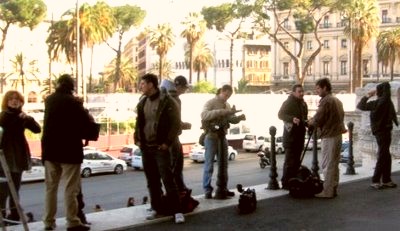
Media outside the Cassation back entrance waiting for news of the ruling
1. Where This Series Stands
Dozens of people have very aggressively gone to bat for Knox over her “interrogation” and still do.
They trust that one or other of her versions of the 5-6 November 2007 police-station session is right.
We have been demonstrating the rock-solid evidence that Knox and her supporters have lied and lied and there will be more evidence of this to come.
We’ve shown in this series that Knox insisted on being there; she was merely helping to build a list; she was treated kindly and taken for refreshments; she was the only one overheard by anyone to raise her voice, when she screamed about Lumumba “He did it!”; it was Sollecito not the police saying that she had been lying and had made him lie; and there is documentary evidence that the police investigators who sat with Knox told the truth.
Coming soon, we are going to post hundreds of false claims made by Knox shills, all sparked by and never reigned in by Knox.
2. The Pre-Trial Hurdles Knox Failed
Do you know how many major opportunities before her 2009 trial started Knox was given to get the murder charges dropped? This is not something Knox supporters trumpet about, if they even know.
In fact there were six, and Knox dismally failed them all.
In 2007 there were (1) the Matteini hearing and (2) the Ricciarelli hearing in November and (3) the Mignini interview in December. And in 2008 there were (4) the separate Knox appeal and Sollecito appeal to the Supreme Court in April, and (5) the first Micheli hearings in September, and (6) the second Micheli hearings in October, which dispatched Knox and Sollecito for trial.
In all six instances Knox’s team also had the opportunity to get the charges against Knox for calunnia against Lumumba dropped.
As you will have seen in previous posts, Knox’s team pussyfooted about without conviction in the few brief instances when the 5-6 November session was discussed. In the Mignini hearing of 17 December 2007 they eventually advised her it would be in her best interests to shut up.
This post covers the third hurdle, specifically why in April 2008 the First Criminal Section of the Supreme Court ruled that for reasons of evidence and psychology Knox and Sollecito should remain locked up and the judicial process against them should go forward.
Please consider this meticulous (and for the pair, damning) statement, which denied their release, in light of a couple of explanations which follow in Part 4 below.
3. Catnip Translation: Gemelli Report On Knox
Shown in bold in the statement on Knox below are:
(1) the defense appeal against the use of Knox’s 5-6 November statements framing Lumumba (reason given was ONLY no lawyer being present - a need which Knox herself had shrugged off when she herself insisted on writing out the 1:45 am and 5:45 am and noon statements) and there is zero mention of abuse;
(2) Cassation’s reasoning why the first 2 Knox statements (the 1:45 and 5:45) can indeed be used, in the “sub-trial” addressing the calunnia against Patrick, and the third (scribbled around noon) can be used in the main trial.
In neither statement is there any ruling of “illegal” regarding any actions by any interrogators. The Knox shills often falsely claim there was.
The Judgment
REPUBLIC OF ITALY
IN THE NAME OF THE ITALIAN PEOPLE
THE SUPREME COURT OF CASSATION
FIRST CRIMINAL DIVISION
Comprised of the Most Honorable Justices
Dr Torquato GEMELLI ““ President
Dr Emilio Giovanni GIRONI ““ Member
Dr Maria Cristina SIOTTO ““ Member
Dr Umberto Zampetti ““ Member
Dr Margherita CASSANO ““ Member
has pronounced the following
JUDGMENT
on the appeal lodged by AMK born on X
against the Order of 30/11/2007 Liberty Tribunal of Perugia
having heard the relation [legal analysis] made by the Counsellor [Judge] Margherita Cassano
having heard the conclusions of the Prosecutor-General Dr S Consolo who has prayed the rejection of the appeal
HAVING FOUND IN FACT
1. With the order of 30 November 2007 the Perugia Court, as constituted under Article 309 Criminal Procedure Code, rejected the submission to review lodged by AMK and, as a consequence, confirmed the precautionary prison custody measures disposed in her matter on the 9th November 2007 by the GIP of the same Court in relation to the offences of aggravated wilful homicide in company and in sexual assault by a group, committed on the day of 1 November 2007 against MSCK.
2. According to the reconstruction put forward by the judges of merit, on the 2nd November 2007, around 12:35, the State Police, to whom had been signalled the discovery in the garden of a house of two mobile phones, both resulting to be in the service of the American [sic] citizen MSCK, intervened at an apartment in Via della Pergola in use by Ms K and AMK and two Italian women. At the place were found AMK and her boyfriend RS, the which declared they were expecting the arrival of the Carabinieri, called by them after having discovered that the window of one of the rooms of the habitation presented with broken glass.
The crime scene inspection immediately carried out inside the apartment led to the discovery in the bedroom occupied by Ms K, locked under key, of the body of the woman, which, at the level of the head, was immersed in a lake of blood, was dressed only in two tops pulled above the breast and was covered with a blanket. Beneath this latter was found the print of a shoe in haematic material, collected, besides in the room of the offence, also in a small bathroom adjacent to the same. In a second bathroom, used by the two Italian lessees of the apartment, were found faeces and other natural biological residues. The autopsy immediately carried out permitted the establishment of the cause of death, collocatable around 22 hours of the day of 1st November 2007, to have been due to a haemorrhagic shock from vascular lesions to the neck from an edged blade and that the instrument used to restrain her was constituted of a pointed instrument capable of penetration and with a sharpened profile capable of cutting tissue.
The victim’s body did not present unequivocal signs of sexual assault even though there were found things of some medico-legal interest, in the sense of the observed anal dilation of two-three centimetres, the discovery of minute ecchimoses on the posterior part of the anal ring (otherwise compatible with situations of constipation) and, above all, mauvish marks on the inner face of the labia minore, suggestive of a sexual rapport carried out with haste and occurring a little before the death.
3. The Court had found that grave indicia of guilt as against the suspect were constituted by the following elements:
(a) the autopsy results and the medico-legal report;
(b) the discovery of a knife with dimensions of 14cm for the handle and of about 17 for the blade, seized from inside a drawer of cutlery located in the kitchen of the home of S, carrying, on the handle, traces of DNA referable to Ms K and, on the blade, traces of DNA ascribable to the victim;
(c) statements made by persons informed of the facts, FR and LM, housemates of the victim, who without contradiction excluded that the seized knife were part of the their apartment’s endowment and made mention that Ms K, on the day of the fact, was wearing a top, which has not yet been found;
(d) outcome of the technical tests carried out on a pair of shoes, N brand, size 42.5, property of S, evidencing a perfect correspondence between the aforesaid footwear and the print found at the location of the homicide, as well as on the door of the Via della P apartment which did not present signs of forced entry;
(e) results of technical tests carried out on the palm print found on the pillow on which the victim had been placed and resulting as belonging to RHG, a citizen of the Ivory Coast, nicknamed “˜the Baron’, known to AMK;
(f) presence of RHG’s DNA on the vaginal swab taken from the cadaver during the autopsy and on the fragment of toilet paper taken from inside the larger bathroom of the apartment, where faeces had been found, resulting as being from G;
(g) outcome of biological tests carried out on the blood found in the apartment’s small bathroom, in use by the victim and Ms K, which permitted the establishment that to the victim were attributable the bloodstains present on the mat, to Ms K those found on the washbasin, and to both of the women the blood traces found on the bidet;
(h) statements made by the American [sic] citizen RCB, the which, having returned home to her country a few days after the fact, referred to the Authorities that Ms K, while waiting to be interviewed by the Police on the morning of the 2nd November 2007, had told her of having seen M’s body on a wardrobe (or reflected on a wardrobe) with a blanket on top of her and of having seen her friend’s foot after a police officer had opened the door, circumstances conflicting with the modality of intervention at the apartment;
(i) statements made by the friends of MSCK, the which without contradiction said that the woman had spent the afternoon of the 1st November 2007 in their company and had left their house in the company of SP, who, reaching her own domicile in Via del L around 20:55, had parted from the victim, whose apartment in Via della P was less than 10 minutes’ distance from Via del L;
(l) statements made by FR and PG, contacted by A after ascertaining that the front door of their house was open, that there were blood stains and that the window of MSCK’s room presented with broken glass
(m) statements made by S on the 2nd, 5th and 6th November regarding his movements both alone and with AMK between the day of 1 November 2007 and the following 2 November, in regards to what was found inside the Via della P apartment, to the call for help to law enforcement, not to mention the reference to the search for strong emotion contained in various of his writings posted on his blog;
(n) statements made on 6 November 2007 at 1:45 by Ms K which indicated L, entranced by M, as the author of the murder after a sexual relation with the victim;
(o) spontaneous statements made by Ms K on 6 November 2007 at 5:45 from which it emerged that L and M had gone to her room, that, at a certain point, M had started to scream, such that A, so as not to hear, had put her hands on her ears, that maybe S was also present in the house;
(p) contents of the account written by Ms K which repeated having heard M scream, to having removed herself into the kitchen and of having blocked her ears with her hands so as not to hear her friend’s scream and of having seen blood on S’s hand during the dinner that had taken place around 23:00 hours on the day of 1 November 2007 in S’s apartment;
(q) contents of a recorded conversation in prison on 17 November 2007 relating to a discussion between Ms K and her parents in the course of which the woman, amongst other things, said “It’s stupid, because I can’t say anything different, I was there and I can’t lie about this, there is no reason to do it”;
(r) tests carried out on the computer and on the mobile phone used by S, from which it emerged that, contrary to the defensive stance of the suspect, his computer had not been used during the night and had been activated only at 5:32 on 2 November 2007 and that, likewise, his mobile phone also had been off during the night and had been first used at dawn on 2 November 2007.
The Re-examination judges concluded recognizing, for continuing the precautionary custody measure, the continuance of all the typologies of precautionary requirements mentioned under Article 274 Criminal Procedure Code.
4. Against the cited order there has been submitted an appeal to Cassation, through her lawyers, by AMK, the which, also by means of a defence memorandum, alleges:
(a) violation of Article 309 paragraph five Criminal Procedure Code with reference to the omitted transmission to the Re-examination Court of the statements made by the suspect RHG arrested in Germany in the execution of a European Arrest Warrant, constituting, contrary to what was adopted by the Re-examination Court, an element favourable to the suspect, relevant for the indication of the author of the offence, identified as an individual of the male gender and, contrary to what as held by the Court, fully usable, given the basis of their acquisition into evidence under Articles 22 and 28 of the law on international judicial representation in criminal matters of 23 December 1982;
(b) Violation of Article 250 paragraph seven, and 357 paragraph two, Criminal Procedure Code, being placed at the foundation of the custody order and of the subsequent provisioning by the Re-examination Court, which indicative elements, the statements made by Ms K on 6 November at 1:45, without defence safeguards, the “spontaneous statements” made at the time of 5:45 hours, are not classifiable as such, given the procedural status invested on her in the meantime, all acts fully non-usable inasmuch acquired in patent violation of Article 63 Criminal Procedure Code;
(c) Violation of law, deficiency and manifest lack of logic in the reasoning with reference to the picture of circumstantial gravity, having regard: (a) to the personality of the suspect, a young foreigner with unblemished record, with a perception of reality altered by cannabis use, a substance which also may have been influencing her excessive and dreamlike behaviours; (b) to the seriously lacunose character of the translation of passages of the suspect’s hand-written account, analysed in a partial manner; (c) to the not unambiguous reading of the contents of the recorded conversation of 17 November 2007 between the suspect and her parents in prison; (d) to the non-probative nature of the DNA traces found on the seized knife, of the suspect’s blood stains on the mat and basin in the small bathroom of the apartment occupied by, amongst others, the victim and Ms K;
(d) Lack and manifest illogicality in the reasoning with reference to the considered circumstantial value, as against the suspect, of the results of tests carried out on the vaginal swab and on the knife in custody, with an un-reasoned devaluation of the considerations put forward by the defence;
(e) lack and manifest illogicality of the reasoning, distortion of the fact with reference to the considered presence of the suspect on the location of the fact and to her contribution purportedly made to the consummation of the offence;
(f) violation of law, deficiency and illogicality of reasoning as to the configurability of the precautionary requirements, given: (1) the absence of a specific danger in evidentiary acquisition even in the light of investigative developments which have evidenced Ms K’s extraneity to the commission of the offence and have allowed the acquisition of statements by fellow-suspect G; (2) the lack of an objective risk of flight in the light of international cooperation between Italy and the USA which would permit, once the suspect’s responsibility has been definitively ascertained, full judicial cooperation; (3) the lack of danger of repetition of the offences.
Observes as of law.
The Appeal Is Unfounded.
1. With reference to the deduced violation of Article 308 paragraph five for omitted transmission to the Re-examination Court of elements appearing favourable to the person placed under investigation (in the type of statements made by G to the German Judicial Authority in the ambit of European Arrest Warrant procedure), this Bench observes as follows.
For “elements in favour of the person placed under investigation” must be understood to mean those objective results, of probative value, suitable for being of positive influence in the evaluative complex of the custody picture (Cass., Sez. IV, 22 giugno 2005, rv. 231749) and in the concrete usable for exculpating the suspect (Cass., Sez. I, 26 settembre 2000, Corrente, rv. 217611) and not information that resolves itself into mere reformulations of the prosecutorial hypothesis or in the advancing of alternative hypotheses (Cass., Sez. Un. 26 settembre 2000, Mennuni).
In line with this interpretative stage there are to be excluded from the enumerated elements appearing favourable and as a consequence obligated to be transmitted to the Re-examination Court, under Article 309 paragraph five Criminal Procedure Code, statements made, as in the case under examination, in the ambit of an extradition procedure against the fellow-suspect who limits himself to giving his own defensive version and to affirm his own extraneity to the facts, without however releasing the other accused subjects from the same crime. It is, therefore, under this profile that the defence petition does not merit granting, it is rejected, rather, by the Re-examination Court on the basis of the erroneous assumption that RHG’s statements were unusable through omission with respect to due process, in reality assured by the German Judicial Authority, which ““ in conformity with the principles contained in the decision-framework of the Council of Ministers of the Union of 13 June 2002, relating to European arrest warrants and the handover procedure between member States (2002/584/GAI) ““ have, amongst other things, pre-emptively made the suspect informed: (1) of the European arrest warrant and its contents, even to the ends of allowing him to consent, if necessary, to the handover; (2) of the right to legal and interpretive assistance during the procedure.
2. With reference to the second appeal ground by the defence, the Court observes that circumstantial statements are characterized by a different usability regime under a subjective aspect. In the case in which these originate from a person against whom there already is sustained circumstantial evidence as regards the same crime, that is to a crime connected with or tied to the one attributed to a third party, the same cannot be used not only against themselves, but neither in relation to co-accused in the same crime (or of those accused of connected or related crimes).
The regime of absolute unusability under Article 63 paragraph two Criminal Procedure Code is, instead, to be excluded in the case in which the declarant, whether called to respond, in the same or another matter, for a crime or for crimes attributed to others, which have no procedural ties with the one for which they are being proceeded against, with respect to which the person assumes the character of witness.
In fact, in the first case, due to the close connection and interdependence between the fact itself and the other one, there arises the necessity to also safeguard the declarant’s right to silence; in the second case, the declarant’s extraneity and indifference with respect to the facts in cause renders them immune to possible sanctions carried out by the investigative bodies (Cass., Sez. Un. 13 febbraio 1997, Carpanelli).
On a par with these principles, the statements made by AMK at 1:45 on 6 November 2007, ““ at the end of which the interview was suspended and the woman was placed at the disposition of the relevant judicial Authority, revealing circumstantial evidence against herself ““, are usable only contra alios, while the “spontaneous statements” from 5:45 are not usable, neither against the suspect nor against other subjects accused of participation in the same crime, inasmuch as they were made without due process safeguards by a person who had formally assumed the status of suspect.
On the contrary, the account written in English by Ms K and translated into Italian is fully usable, under Article 237 Criminal Procedure Code, since it is a document originating from the suspect, who had been its spontaneous material author for a defence purpose. The disposition under examination allows attribution of probative relevance to the document not only as regards it and its representative contents, but also in the strength of its particular ties, which tie it to the suspect (or accused), thereby illuminating the review of admissibility which the judge had held to be in operation.
3. The fourth, fifth and sixth grounds of the petition also lack merit. The circumstantial evidence picture specifically concerning AMK is based, in the first place, on the autopsy results, evidencing multiple contusions and ecchimotic areas on various parts of the body (nose, lip, oral cavity, cheek, mandibular and sub-mandibular region, upper and lower limbs, inner face of labia minore, abdomen, dextral latero-cervical region), an ample dilation, in the order of two to three centimetres, of the anal ring with the presence of small ecchimoses, a large wound, disposed obliquely, in the caudal-lateral sense, fully diastased, with sections of underlying tissue right to the cartiliginous layer in the left latero-cervical region, the complete sectioning of the upper right thyroidal artery, the fracture of the hyoid bone in proximity of the left median. The medico-legal tests, carried out after the necroscopic examination of the body of the victim, permitted the confirmation that the cause of death, around 22:00 hours on 1 November 2007, is ascribable to meta-haemorrhagic shock from the vascular lesion on the neck from an edged blade, occasioned by a pointed implement, capable of penetration, and with a sharpened edge able to cut tissues. The anal dilation, the observation of minute ecchimoses on the posterior part of the anal ring and, above all, the mauvish marks on the inner face of the labia minore, are suggestive of a sexual rapport carried out hastily, before the victim had had time to produce adequate lubrication, occurring in a time period proximate to that of the observation, but in any case before death, by reason of the ecchimotic lesions and their colour.
The impugned provision highlights that the complex of these medico-legal conclusions assumes a particular evidential value, in the event that place in correlation with other elements: (a) the statements made by the friends of MSCK, who without contradiction stated that the woman had spent the evening of [1] November 2007 in their company, had started to dine with them from 18:00 hours onwards and had left the house in company with SP, who, reaching her home in Via del L around 20:55, had parted from the victim, whose apartment in Via della P was less than ten minutes’ walk from Via del L; (b) the outcome of the search effected at the house of RS, romantically linked to AMK, which permitted the discovery and seizure in the apartment’s kitchen, from the cutlery drawer, of a knife, having an approx. 14cm long blade and 17cm handle. The knife, not forming part of the inventory of the house occupied by AMK, MSCK and two Italian women (cf on the matter, the statements made, as persons informed of the facts, by FR and LM), presented traces of DNA on the handle attributable to AMK and on the blade traces of DNA ascribable to the victim.
Weighing against the suspect, in the opinion of the judges, there are, in addition, even in their mutability, statements by RS, who, after firstly having claimed to have remained home all evening and night with his girlfriend, stated, afterwards (cf. Interviews of 5 and 6 November 2007) that, at a certain time, Ms K had left and had come back to his house at only around one in the morning.
The judges of merit have underlined the strict correlation found between the interviews given by S on 5 and 6 November 2007, and the following further elements: (a) statements made by citizen RCB, who, returning to her country of origin, referred to the relevant Authorities the confidence received on 2 November 2007 from AMK regarding the position of the victim’s body and its condition, circumstances that, contrary to the stance of the suspect, she could not have been able to perceive on the occasion of the intervention by the police at the apartment, an intervention that unfolded in a way irreconcilable with the version furnished by Ms K to the friend; (b) statements made by persons informed of the facts FR and LM, who said that Ms K, the day of the fact, was wearing a top, which has not been found since.
The impugned provision, with logically reasoned argumentation, observes that the content of these declarative acts appears even more significant when evaluated also in the light of the written account produced by the suspect, containing relevant references to M’s scream on the night of the fact, to her reactions, consisting of huddling in the kitchen with her hands over her ears, to the presence of a man, to traces of blood noted by her on RS’s hand during the dinner that took placed at 23:00 on 1 November 2007.
Under the same lens appearing imbued with unequivocal circumstantial value is the contents of the recording, effected on 17 November 2007 inside the prison where Ms K found herself restricted to and between the woman and her parents, in the course of which there was pronounced by the accused the following words: “It’s stupid, because I cannot say anything else, I was there and I cannot lie about this, there is no reason to do so”;
These elements must, in their turn, be inserted into a larger circumstantial evidence context, cross-correlated by the identification of a print left in haematic matter present on the scene of the crime from a sports shoe, held to be compatible, by its dimensions and configuration of the sole, with the type of footwear brand “N” used by the suspect and by the failure of the alibi put forward by the young man, being demolished by the technical investigations that were carried out, by which, as he asserted, he had interacted with his computer in the hours in which, according the medico-legal reconstruction, the criminal fact would have occurred, just as also remained demolished that the young man had received a phone call from his father at 23:00, it resulting, instead, said call had occurred at 20:40.
From the same perspective, light has been shone, with precise and logical reasoning, on the circumstance that in the course of the evening of 1 November 2007, almost at the same time, telephonic traffic for AMK and RS ceased, after the latter had received a call on his mobile phone from his father at 20:40, of which reference has been made earlier and, in addition, that S, contrary to what was by him stated, did not spend the night of 1 and 2 November 2007 sleeping, it having been ascertained that the computer and mobile phone at his disposal were reactivated at dawn on 2 November 2007.
The judgment reasons, further, on the concourse aspect of the consummation of the homicide and sexual assault, on the basis: (1) of the outcome of the technical tests carried out on the palm print found on the pillow on which the victim had been placed, and it results as belonging to RHG, known to AMK; (b) of the presence of RHG’s DNA on the vaginal swab taken from the cadaver during the autopsy and on the fragment of toilet paper collected from inside the larger bathroom in the apartment, where there had been found faeces, resulting to have been G’s; (c) of the outcome of biological tests carried out on the blood found in the smaller bathroom of the apartment in use by the victim and by Ms K, which permitted the finding that the blood stains on the mat were referable to the victim, those found on the basin to Ms K, and to both the women the blood traces found in the bidet.
The Court, with thorough and logical reasoning, has illustrated, with full reference to the factual circumstances ““ inasmuch such are unreviewable in this seat of legitimacy ““ the reasons for the attribution of pregnant circumstantial value to the elements above recalled, proving the presence on the scene of the consummation of the homicide and sexual assault of AMK, RS, RHG (these last two both known to Ms K), has explained, with articulate and logically correct reasoning, the reasons for which they cannot find agreement with the defence deductions in terms of erroneous interpretation and reading of the recorded conversation of 17 November 2007, of the account written by Ms K on 6 November 2007, of the results of biological and medico-legal tests, of the unreliability of the technical investigations carried out on the computer and mobile phone belonging to S, and has at length examined, including in the light of aspects formulated by the defence, the entire case file, explaining the reasons of its unequivocal value.
So, the argumentative development of the judgment reasoning is founded on a coherent critical analysis of the circumstantial evidence and on its cohesion in an organic interpretative framework, in the light of which the attribution to said elements of the requisite of gravity appears supplied with adequate logical and judicial plausibility, in the sense that they have been considered drivers, with a high level of probability, with respect to the theme of investigations concerning the responsibility, amongst others, of AMK, as to the crimes put against her.
From which, given the evaluation carried out the Re-examination Court on the level of inference of the circumstantial evidence and, therefore, on the more or less demonstrative character of the same in terms of probabilistic qualification of guilt even if not of certainty, it has to be highlighted that the impugned order exceeds the threshold of legitimacy demanded by this Court, whose bench cannot hold itself back from a checking of the respect of rules of logic and of conformity with legal canons which govern the appreciation of grave indicia of guilt, as prescribed by Article 273 Criminal Procedure Code for the ordering of provisions restricting personal liberty, without being able to draw on the intrinsic consistency of the evaluations reserved to the judges of merit.
4. Unfounded, finally, are the censures formulated by AMK’s defence, on the matter of custody requirements, the Re-examination Court having correctly evaluated them, with reference to the parameters to which letters (a), (b), (c) of Article 274 Criminal Procedure Code apply the extreme gravity of the crimes carried out, having had regard to their nature and their method of consummation, the negative personality of the suspect, which emerges from the outcomes of the investigations and from the served case conduct, the specific and binding requirements relevant to the investigations in relation to the clear and present danger for [evidence] acquisition and probative genuineness, considering the necessity for completing the testing and of proceeding with the gathering of other means of declarative proof, the outcome of the handover to Italian authorities, of RHG, as well as allowing corroborations to be made, also permeates the current contrast between the different versions so far furnished of what happened, the clear danger of flight, taking into account the foreign citizenship aspect of the suspect and of the penalty of more than two years’ imprisonment, impacting on the outcome of the recognition of her criminal responsibility.
5. Refusal of the appeal leads in law to the appellant ordered to pay procedural costs.
The Registry will provide for its carrying out as prescribed by Article 94 paragraph 1-ter, and actuating provisions Criminal Procedure Code.
FOR THESE REASONS
Rejects the appeal and orders the appellant to pay procedural costs. Disposes transmission via the Registry a copy of the provision to the Director of the penitentiary institution per Article 94 paragraph 1-ter, and actuating provisions Criminal Procedure Code.
So decided in Rome, in Chambers, 1 April 2008.
DEPOSITED IN THE REGISTRY 21 APRIL 2008
4. Catnip Translation: Gemelli Report On Sollecito
Summary
Held: the decision to continue pre-trial prison detention for the suspect was reasonable.
THE REPUBLIC OF ITALY
IN THE NAME OF THE ITALIAN PEOPLE
THE SUPREME COURT OF CASSATION
SECTION 1 CRIMINAL DIVISION
Comprised of the most Honourable Justices:
Dr Torquato GEMELLI - President -
Dr Emilio Giovanni GIRONI - Member -
Dr Maria Cristina SIOTTO - Member -
Dr Umberto ZAMPETTI - Member -
Dr Margherita CASSANO - Member -
have pronounced the following
JUDGMENT
on the appeal lodged by:
(1) RS, born on X, against Order of 30/11/2007 Liberty Court of Perugia;
having heard the relation made by Member Emilio Giovanni Gironi;
having heard the conclusions of the Prosecutor-General Dr Consolo for its rejection;
having heard the defence advocates G and T (substituting for advocate M).
REASONS FOR THE DECISION
The order referred to in opening confirmed, at the Re-examination stage, the one by which the GIP [the Preliminary Investigation Magistrate] had applied pre-trial prison detention of RS for participation in the murder of MSCK, the which occurring in Perugia on the evening of the 1st of November 2007 by means of a cutting weapon, in an alleged context of sexual assault by a group, in which there would have taken part, in addition to S, his girlfriend AK and a RHG, who had left behind a palm print on the bloodied pillow on which the victim’s body was resting and whose DNA was found on the vaginal swab taken from the body of the same and on faecal traces found in a bathroom of the house that the victim was sharing with Ms AK and two Italian students.
The picture of circumstantial evidence specifically concerning S consists of the identification of a print left in haematic material present at the scene of the crime of a sports shoe held to be compatible, because its dimensions and configuration of the sole, with the type of footwear, “N” brand size 42.5, used by the suspect; of the recovery ““ in the kitchen of his house ““ of a kitchen knife bearing traces of Ms AK’s DNA on the handle and on the blade traces of Ms MK’s DNA; and of the collapse of the alibi put up by the young man (having been disproven by technical investigations carried out), in which, as asserted by him, he had interacted with his computer during the hours in which, according to the forensic pathologist’s reconstruction, the criminal fact would have occurred, that is between 22:00 and 23:00 of the 1st November 2007; from the investigations carried out up until now it would appear, in fact, that the last interaction with the machine on 1 November occurred at 21:10 and that the subsequent one took place at 5:32 the day after, when S also reactivated his mobile phone, acts witnessing thereby an agitated and sleepless night. Equally disproven was that the young man had received a phone call from his father at 23:00 on the night of the murder, it resulting, instead, that said call had happened at 20:40.
Against S, caught at the time of arrest with a switchblade initially considered compatible with the wounds found on the neck of the victim, would line up, in addition, the mutability of the stories given to the investigators by the same and by his girlfriend, having initially maintained they had remained the whole evening and night in the young man’s house, later to state, instead, that at a certain point Ms AK would have left to meet the Ivorian [sic] citizen PDL, manager of a pub in which Ms AK was undertaking casual employment, she making a returning to her boyfriend’s house only around one in the morning.
It must, finally, be added that the same Ms AK had, amongst other things, initially referred (not confirming, in any case, the thesis in confused and contradictory subsequent versions) to having taken herself to her own house with L, where this latter (he also was struck with a custody order, later revoked after the previously mentioned identification of G’s DNA) had had sexual relations with Ms MK, and to having, while she herself was in the kitchen, heard her friend scream, without, further, remembering anything else of the subsequent events, up until the occurrences of the day after, marked by the discovery of traces of blood in the small bathroom next to Ms MK’s room and culminating in the discovery of the body, after the intervention of the forces of law and order (the police appear, in particular, to have intervened prior to the call to 112 effected by S); in particular, the young woman was specifically pointing out not being able to remember whether S were also present in the victim’s house on the occasion of the events just described.
The Re-examination Court concluded recognizing, for the purposes of maintaining pre-trial detention, the persistence of all the types of pre-trial exigencies mentioned by Article 274 Criminal Procedure Code.
The S defence has indicated an appeal, on the grounds of, with new reasons as well:
reference to Ms AK alone of the circumstantial evidence constituted by the presence of biological traces from her and from the victim on the knife found at S’s house;
absence, at the scene of the crime, of biological traces attributable to the suspect [ndr: note, this was before the bra-clasp tests had been done];
arbitrary transference onto S of the weighty circumstantial evidence against Ms AK, on the unfounded assumption that the pair could not have been anything but together at the moment of the homicidal fact;
inexistent evidential value of the phases relative to the discovery of the body;
absence of blood traces from the soles of the “N” shoes worn by the suspect even at the moment of his arrest;
absence of any evidential value of merit, alleged failure of the alibi, constituting the use of his computer, of which the falsity has not in any case been ascertained, of the lack of interaction by the subject with the machine after the last operation at 21:10 not permitting the inference that the computer was not, however, engaged in downloading files (being, to be specific, films);
irrelevancy of the mistake revealed between the indicated time of the phone call to the father furnished by S and the actual time of the call, given the uncertainty of the time of death of the victim, depending on the time, otherwise uncertain, of the consumption of the dinner (according to various witness statements coinciding with 18:00), it being well able, therefore, for the time indicated by the forensic pathologist (23:00) to be revised backwards to 21:00, a little before which time the witness P had referred to having made a visit to S, finding him at home and not on the verge of going out;
interpretability of the so-called unlikelihood of the versions supplied by the suspect as attempts to cover for (aid and abet) another subject;
attribution of the victim’s biological traces found on the knife seized at S’s house to chance contamination not related to the homicidal fact;
insufficiency of the pre-trial exigencies, having diminished in a probative sense after the return to Italy of G; those relating to risk of flight lacking in specificity and concreteness; and with reference to the conventional content of blogs posted on the internet by the suspect, those relating to danger to society illogically reasoned;
missing appearance of the young man’s walk, via security cameras installed along the route that the aforesaid would have had to traverse to go from his house to that of the victim’s.
The appeal is unfounded.
As regards what this Court is permitted to appreciate, not being able here to proceed with a re-reading of the investigative results nor with an alternative interpretation of the factual data referred to in the custody order, the appellant defence substantially contests the recognition, as against S, of the necessary requisite of grave indicia of culpability. The question thus posed and submitted for scrutiny by this bench of the well-known limits of the competence of the court of merit, it must be held that the finding expressed by the Re-examination judges concerning the gravity of the frame of circumstantial evidence is not susceptible to censure.
Not upheld, in the first place, is the defence submission according to which the knife bearing the genetic prints of Ms AK and of Ms MK found in S’s house would constitute a piece of evidence relevant solely as against the young woman, even if privy of traces attributable to the suspect, the utensil has as always been found in the young man’s house, and the testimony acquired up until now has led to the exclusion that it formed part of the inventory of the house inhabited by the victim, and which, at the time, and until proved to the contrary, must be held to be the same available for use by the suspect and which had been used in MK’s house, there being contested no access by her to S’s house.
Given the multitude of group contributive possibilities, the fact is not significative, then, in itself being a neutral element, that on the scene of the crime there are no biological traces attributable to S, to which, in any case, is attributable the “N” brand shoe print considered compatible, by dimensions and sole configuration, with the footwear worn by the suspect at the time of arrest. Although having the same impugned order excluded, at the time, the certainty of the identification constitutes as, in any case, a certain datum that the print in question had been made in haematic material found in Ms MK’s room by a shoe of the kind and of the dimensions of those possessed by the appellant, while it remains to be excluded that this could have originated from G’s shoe, who wore a size 45 and, therefore, dimensions notably larger. The revealed coincidence, notwithstanding the residual uncertainty on the identification, assumes particular valency in relation to the restricted circle of subjects gravitating to the scene of the homicide, with not even Ms AK, who made admissions about her presence on site at the same time as the execution of the offence, excluding the presence of her boyfriend in the victim’s house in the same circumstance; nor can it be held that the print could have been left by S the following morning, he never having claimed to have entered into the room wherein the body was lying.
It does not answer, therefore, to verity that, as against the young man, there had been recognized, by a phenomenon of transference, items of circumstantial evidence in reality pointing solely to Ms AK.
The last finding held unfavourable to S is constituted by the failed proof of the alibi constituted by the argument of the suspect as having remained at home on the computer until late at night; it being a matter of, properly speaking, an alibi failing up till now and not of a false alibi and the defence, correctly, does not refute the technico-judicial valency of the circumstantial evidence, but it remains, in any case, acquired into the case file that the accused had not been able to prove his absence from the locus of the crime at the same time. An item up until now assumed as certain is, instead, the fact that S had interacted with his computer at 5:32 the morning following the murder, at around the same time reactivating his own mobile phone, a contradiction of the assumption of a waking up only at 10:00 and a symptomatic tell-tale of a more or less sleepless night; likewise as symptomatic was held to be the nearly simultaneous cessation of telephonic traffic as much by Ms AK, in his company the evening of 1 November 2007.
The proof of a permanent stay in his house by the suspect can, all told, be considered as acquired up until 20:40 ““ coincident with P’s visit ““ who confirmed his presence, or up until 21:10, the last interaction time on the computer, but this does not cover the time of the homicide, located between 22:00 and 23:00.
As for the proposed argument that S’s conduct were interpreted as aiding and abetting, this does not result, in the event, as being supported by anything emerging from the investigations and its plausibility cannot be verified by the judges of merit.
In conclusion, the Re-examination Court’s evaluation as to the gravity of the circumstantial evidence picture are removed from the audit of this court.
There remains, finally, the finding that for what concerns the pre-trial exigencies, those of a probative nature are not able to be considered as ceasing from the sole fact of G’s re-entry into Italy (amongst other things significantly never invoked in the statements by the suspect and by his girlfriend, who instead co-involved L in the proceedings), given the existence of an investigative picture in continual evolution, in which the positions of the various protagonists so far remain unclear, the changing versions of which are marked by reticence and mendaciousness (the same suspect had, in truth, admitted to having, at least initially, told “˜a load of balls’); but the permanence of pre-trial exigencies had been held reasonablely even under the aspect of flight risk, in relation to the gravity of the charges and of the potential sanctions, not to mention danger to society, given the revealed fragility of character and the specific personal traits of the subject, ““ which would narrowly evaluate as innocuous youthful stereotypes ““, in a context the more connoted by the noted habitual use of drugs.
FOR THESE REASONS
Rejects the appeal and sentences the appellant to payment of costs of the proceedings. Article 94 para 1 ter, and activating provisions, Criminal Procedure Code, applies.
Rome, 1.4.2008.
DEPOSITED IN THE REGISTRY ON 21 APRIL 2008
Posted by Our Main Posters on 11/18/14 at 06:46 PM •
Permalink for this post •
Archived in Defendants in court, Amanda Knox, The officially involved, Police and CSI, The prosecutors, Supreme Court, Evidence & Witnesses, Trials 2008 & 2009, Prelim hearings, Hoaxes against Italy, 9 Mignini v Knox hoax, Hoaxes Knox & team, 15 Single alibi hoax, 16 Interrogation hoax, Hoaxers from 2007, Knox-Marriott PR •
Comments here (24)
Wednesday, October 29, 2014
Knox Interrogation Hoax #15: At 5:45 AM Session Knox Told Her Rights - Repeats Fake Murder Charge
Posted by Our Main Posters
Dr Mignini examines Knox July 2009 on the “interrogation” at her own initiative
1. Overview Of This Post
Post #1 includes an overview of the entire series and links to all posts up to this one.
Knox has repeatedly claimed that Dr Mignini was present at the informal summary/recap session led by Inspector Rita Ficarra, the actual purpose of which was merely for Knox to suggest a few possible leads the police might interview.
He wasn’t there, though. And he has repeatedly explained that at the second session ending with a second insisted-upon statement by Knox at 5:45 AM, his entire role was to read Knox her rights, and to advise her to say no more until she had appointed lawyers. (Regardless, she then insisted on dictating that second statement.)
Dr Mignini more than anyone else at the central police station that night developed a complete overview of how the two sessions had proceeded.
THREE TIMES Knox willingly put herself under his questioning (December 2007, January 2008, July 2009) to attempt to shake this. While his questioning was formal, polite and quite mild, Knox’s recollection of 5-6 November was scrambled or devious (some think she and RS were both high on hard drugs).
So by the end of those sessions Knox seems to have made a complete disbeliever of Dr Mignini, swayed few if any in Italy, and certainly did not sway the judges of the trial court or any appeal court.
But few English-language reporters other than Andrea Vogt, John Follain and Barbie Nadeau have interviewed and reported Dr Mignini in depth fairly, and there are a number of English-language reporters to whom he kindly gave time who mangled what he lucidly and fairly explained to them.
2. Dr Mignini Attempts Explanation To Biased Linda Byron
In July 2009 Dr Mignini wrote an acerbic email to Linda Byron of Seattle TV to attempt to straighten out her own understanding, and although she seemingly tried to hide it, we captured it and translated and posted in full his explanation.
Dear Ms Byron,
I hope we will be able to meet and discuss sometime in person, since some of the issues you have examined, specifically the Florentine proceedings against myself and Dr Giuttari, are way too complex to be described in just a few words. I will try to give a short answer here.
To begin with, there is no relationship between the events that are the subject of Spezi’s and Preston’s book and the murder of young Ms Kercher beside the fact that I am the one person dealing with both the Narducci proceedings (connected to the Monster of Florence case) and the Meredith Kercher murder.
These two are totally different events, as well as wholly unrelated to each other, and I am not able to see any type of analogy.
Furthermore, while the precautionary custody order for Spezi has been voided by the Tribunale del Riesame of Perugia, exclusively on the grounds of insufficient elements of proof, the precautionary custody order for Knox was firmly confirmed not only by the Tribunal of Riesame in Perugia,, but above all by the Sixth Section of the Court of Cassazione, which has declared the matter decided and closed.
About the “sacrificial rite” issue, I have never stated that Meredith Kercher was the victim of a “sacrificial rite”.
It should be sufficient to read the charges to understand that the three defendants have been accused of having killed Ms Kercher in the course of activities of a sexual nature, which are notoriously very different from a “sacrificial rite”.
The Monster of Florence investigations have been led by the Florentine magistrates Adolfo Izzo, Silvia della Monica, Pierluigi Vigna, Paolo Canessa and some others.
I have never served in Florence. I have led investigations related to the case since October 2001, but only with regard to the death of Dr Francesco Narducci, and just a superficial knowledge of those proceedings [Dr Narducci drowned or was drowned] would suffice to realize that I never spoke of a “sacrificial rite” which in this case doesn’t make any good sense.
About the defense lawyer issue. Mr. Preston was heard as a person claiming information about the facts (in effect a witness), but after indications of some circumstances against him surfaced, the interview was suspended, since at that point he should have been assisted by an attorney, and since according to the law the specific crime hypothesis required the proceedings to be suspended until a ruling on them was handed down.
All I did was to apply the Italian law to the proceedings. I really cannot understand any problem.
In the usual way, Knox was first heard by the police as a witness, but when some essential elements of her involvement with the murder surfaced, the police suspended the interview, according to Article 63 of the penal proceedings code.
But Knox then decided to render spontaneous declarations, that I took up without any further questioning, which is entirely lawful. According to Article 374 of the penal proceedings code, suspects must be assisted by a lawyer only during a formal interrogation, and when being notified of alleged crimes and questioned by a prosecutor or judge, not when they intend to render unsolicited declarations.
Since I didn’t do anything other than to apply the Italian law applicable to both matters, I am unable to understand the objections and reservations which you are talking about.
Secondly, I have told you that explaining the nature of the accusations against me is a complex job.
In short, it has been alleged that I have favored Dr Giuttari’s position, who was investigated together with two of his collaborators for a (non-existent) political forgery of a tape recording transcription of a conversation between Dr Giuttari and Dr Canessa.
The latter was giving vent to his feelings, telling Dr Giuttari that the head prosecutor in Florence (at the time) was not a free man in relation to his handling of the Monster investigations.
A technical advisor from the prosecutor’s office in Genoa had tried to attribute that sentence to Dr Giuttari, without having previously obtained a sound test from him, only from Dr Canessa.
I decided, rightly and properly, to perform another technical test on that tape for my trial (I have a copy of it, and the original transcripts of the recording).
I had the technical test performed by the Head of the Sound Task Force of the RIS Carabinieri in Rome, Captain Claudio Ciampini.
If Giuttari had lied, Captain Ciampini would have certainly said so. But his conclusions from the analysis were that that sentence had been pronounced by Dr Canessa. And by the way, this is clearly audible.
I then deemed it appropriate to interrogate the technical adviser from Genoa, in the sphere of the investigations led by me, since the people under investigation were thoroughly but inexplicably aware of the development of the investigation of Dr Giuttari.
The technical advisor from Genoa had made some absolutely non-credible declarations, and I had to investigate him.
The GUP from Genoa, Dr Roberto Fenizia, by means of a non-contested verdict on 9 November 2006, acquitted Dr Giuttari and his collaborators, because the alleged crimes had never occurred.
Therefore, I am accused for doing a proper and due investigation, without even the consideration that I have spared some innocent people from a sentence. I leave any further evaluation up to you.
As for the phone tappings, they had been fully authorized or validated by the GIP. [Those charges are now thrown out.] Explain to me how they can be considered wrongful. I haven’t been able to understand this yet.
This is the story of that case in short, and I am certain the truth will prevail.
None of us is guaranteed not to be subjected to unjust trials, especially when sensitive and “inconvenient” investigations have been conducted.
When accusations are serious and heavy in Italy, a magistrate that has been investigated or charged suffers heavy consequences.
There are appropriate bodies in charge to intervene according to the current laws, but the Florentine penal proceeding so far hasn’t affected me at all, perhaps because everybody ““ and specifically those professionally working on the matter - have realized that such penal proceedings have been anomalous, to use a euphemism.
As to my possibility to appeal any conviction, the Italian law provides for it, and I don’t need to say more.
I will make some closing remarks on the different jurisdictions.
Indeed there are differences between the [UK and US] common law jurisdictions and those of continental Europe, including the Italian one, which like any other jurisdiction has its flaws but also its merits, of which I “˜m becoming more aware as I carry on.
Furthermore, both jurisdictions are expressions of the juridical culture of the Western world, and this is something that shouldn’t be disregarded.
I don’t think I need to add anything else, except that these issues would need to be discussed in a personal conversation in order to delve further into the matter.
Sincerely
Giuliano Mignini
3. Dr Mignini Attempts Explanation To Biased Drew Griffen
In mid 2011 a similar thing happened. Drew Griffen of CNN was given a three-hour on-camera interview - and sarcastically broadcast cherrypicked and mangled responses from Dr Mignini. Again we obtained Dr Mignini’s full statement, and Skeptical Bystander posted the whole thing in three long parts, with translation by Clander, Yummi, Jools, Thoughtful, TomM and Catnip.
Again, highly worth reading.
In the first 20 minutes of the second hour of the interview, Drew Griffen tried to give Dr Mignini a hard time over the so-called Knox interrogation. Drew Griffen was abysmally informed of the testimony at trial we have been posting and had no idea of the substance of Knox’s one interview on 5-6 November or the fact that this was merely a recap/summary session not ever requiring recording.
Dr Mignini had not himself testified at trial, and he led the testimony of others present on 5-6 November very fairly and without defense protests about any bias. And Dr Mignini is not under oath here. However this 20-minute segment is important, for it reinforces that Knox was treated extremely fairly and she had no genuine reason for complaint about it.
0’40’’ English question [Translator’s note: These words are in English in the Italian transcript of which this document is a translation.]
0’48’’ CNN: You didn’t interrogate Amanda?
0’50’’ Mignini: Oh, the police interrogated her. I was told about it. I wanted to explain this. I remember that I had gone to sleep and the director of the flying squad, Dr. Profazio, called me, because he tells me: “There are developments; Raffaele in fact has denied what he had said before”. So I went down and the head of the flying squad told me what had happened. At some point they tell us that Amanda has made this statement.
And thus her interrogation as a person informed of the facts was suspended by the police in compliance with Article 63 of the Italian Code of Criminal Procedure [c.p.p. - Codice di Procedura Penale], because if evidence appears that incriminates the person, the person being questioned as a person informed of the facts can no longer be heard, and we must stop. “Everyone stop! There must be a defense attorney [present]”. And thus the police stopped and informed Amanda, who had placed herself on the scene of the crime and who said that she had accompanied Lumumba and let him in and that then Lumumba, in the other room, allegedly committed a sexual act and killed Meredith. This is what she said.
2’11’’ Then I was called, I was informed about this, I went to Amanda who, I remember how she was, what she looked like, I remember her very well, she remained imprinted in my memory, I still remember then two things about Amanda that struck me at the time: first, she looked like she was relieved of a burden and second, she was like, and this is another detail that was impressive, it seemed as if she was terrified of Lumumba.
20’48’’ Then I, as I had in some way to, let’s say”¦ this police interrogation had been suspended. At that point I remember that”¦ they made me notice that Amanda, because she wanted to go on talking, I remember she had, like a need to. So I told her: “you can make statements to me; I will not ask questions, since if you make a spontaneous statement and I collect it, I will collect your statement as if I were in fact a notary”. She then repeated [her story] to the interpreter, who was Mrs. Donnino, I remember there was a police woman officer who wrote the statement down [verbalizzava], I did not ask questions. She basically repeated what she had told the police and she signed the statement. Basically I didn’t ask Amanda questions. Not before, since the police asked them and I was not there, and not after, since she made spontaneous statements. Had I been asking her questions, a defense attorney should have been there. This is the procedure.
05’24 CNN: She had an interpreter during the whole time?
05’26’’ Mignini: Yes.
05’29’’ CNN: She says no.
05’32’’ Mignini: Look the interpreter was there, when I heard her there was the interpreter. The interpreter Anna Donnino, who is an interpreter for the police; she was hired by the police.
Just like I believe that there was [before], I do not have the minutes now, but yet now this is a fact, it is undisputed that there was an interpreter.
06’02’’ CNN: Amanda Knox says she was interrogated for 14 hours”¦
06’11’’ Mignini: No, look, absolutely not. At 1 a.m., the minutes of Nov 6th has started at 1 a.m. and I arrived, 14 hours that cannot be, we are really”¦ that’s absolutely impossible. So the minutes were done at one o’clock, then the minutes of the spontaneous declaration was taken at 5.45, it maybe lasted half an hour because no questions were asked. She made her statements; they were translated; then at around 8 a.m., I think, at approximately 8, I drew up the detention order. Thus it is”¦ well, she had been heard earlier, so she had been questioned as a person informed of the facts at around one forty-five a.m. She had previously been heard by a female police officer, but [that’s] because she had gone voluntarily to the police and she reported that, she said things quite relevant to the investigation of Raffaele and was heard by the inspector [Rita] Ficarra. However this [event] ... I was not there, I do not know [about it]. But remember, there are the minutes. Then the minutes in which she was questioned as a person informed of the facts starts at 1:45 of November 6, and cannot have lasted 14 hours ... in no way whatsoever. Then she was arrested at around 8 a.m. or at about 9 a.m. or so.
08’16’’ Mignini: Look, I remember what I saw when I saw her personally, because she said, I told her: “you can make, if you deem it [necessary], a spontaneous statement, because Italian law provides for this. If a person is aware that he/she is suspected [under investigation], may request to speak before a magistrate, it happened many times, they came also to me, and they say “I want to make a statement”. Very well, I listen. If I listen, I wanted this to be highlighted”¦. to be clear, I listen and that’s all, and I ask no questions, the defense attorney may be not present. But if I ask questions and I object to the facts [of your answers], it is like an interrogation and thus we would need a defense attorney.
09’10’’ CNN: was [Amanda Knox] scared?
09’11’’ Mignini: Well, I recall this feeling that I had in that moment which, [as] I am explaining to you, in the spirit in which I am doing this interview, to explain to you the acceptance [adozione] of our requests [provvedimenti], what was, why the trial went in a certain way. [Translator’s note: The Italian in the CNN transcript is nearly incomprehensible. We have provided the foregoing on a best effort basis.]
09’36’’ She was, she seemed to me like she was uplifted, freed of a weight, and terrified of Lumumba. That’s an impression that has stayed with me, yet I don’t understand. I remember that there was a policeman who was called, from the SCO [Servizio Centrale Operativo] in Rome, who made an impression on me because he was very fatherly. She was crying as though freed of a great weight, and he was trying to console her. I remember there was also a policewoman who, well, she”¦[missing word?] and I’m sure that.. [missing word?] .. well, all that picture how it was described later”¦ at that moment it wasn’t like that. Right then, there was a situation in which I was trying to console her, to encourage her, because actually we believed that she had told the truth.
11’03’’ CNN: No one hit her?
11’06’’ Mignini: No, look, absolutely not. I can state this in the most positive way, and then, let’s say”¦ I wasn’t there when she was being questioned by police, the rooms are quite far away”¦ you don’t know but I was”¦ it’s quite far, there’s a corridor, and I was with the director, Dr. Porfazio, and she was being questioned in a different place. I also remember that passing through, I also saw Sollecito who was alone in a different room; he was also being questioned, as I recall. I don’t exclude”¦well”¦it’s clear that I wasn’t there, but I don’t believe that anything whatsoever happened, and in my presence absolutely not.
11’55’’ On the contrary, there was an attitude of”¦ I mean they gave her [some] ... [missing word?] then she was like, you know, like someone crying from a sense of liberation, as though she had been freed. That was the attitude.
12’51’’ CNN: Why wasn’t there any video or transcript of those hours?
13’00’’ Mignini: Look, that’s, I was at the police station, and all the”¦let’s say”¦when I made investigations in my own office, I taped them. I taped them, we have an apparatus for that, and I transcribed them. For example, there’s the interrogation of the English girls, Meredith’s friends, it was all taped. The interrogations of Amanda in prison were taped, and then transcribed, and we have the transcripts of”¦ But in a police station, at the very moment of the investigation it isn’t done, not with respect to Amanda or anyone else. Also because, I can tell you, today, even then, but today in particular, we have budget problems, budget problems that are not insignificant, which do not allow us to transcribe. Video is very important”¦I completely agree with you that videotaping is extremely important, we should be able to have a video recording of every statement [verbale di assunzione di informazioni] made Because what is said is very important, but it’s maybe even more important how it is said, the non-verbal language. Because from the non-verbal language you can [missing words].
15’14’’ Mignini: It isn’t only Amanda, it’s always like that. But I wanted to say that I agree with him that it’s fundamental, only there’s a problem, especially when the witnesses are so numerous, and in fact just recording, I mean recording the sound, isn’t enough according to me.
15’38’’ CNN: It doesn’t cost much, he says.
15’40’’ Mignini: Well we have significant budget problems, that’s what it is.
15’38’’ CNN: So in the end, you did get a confession. But then, everything that was written in the confession became a lie?
16’16’’ Mignini: But then, there was the fact that she placed herself at the scene of the crime, and Lumumba wasn’t there, together with the three of them, the two of them, but Rudy was there, according to the facts that emerged later. But the fact of having accused”¦and she’s even accused of calumny in regard to Lumumba, was an element that was very important from the point of view of her legal position at the trial. Why accuse someone of participating in a crime, placing yourself at the scene of a crime? Because with those declarations, she placed herself at the scene, at the place of the crime. And she placed someone there who was a complete stranger to it. Why did she do that? There is one detail that’s particularly significant. Above all when Lumumba was arrested and no one ““ if it hadn’t been for the Public Prosecutor’s Office that conducted the investigation, and that is mandated to seek elements in favor of the accused, Lumumba would have stayed in prison. But we investigated, and we saw that Lumumba wasn’t involved, that he was the object of calumny and so he was freed and the case against him was archived.
18’15’’ CNN: Was she asked to imagine what might have happened?
18’24’’ Mignini: No, absolutely not. Either you saw a person or you didn’t. I can’t ask someone what they imagine because it would be a question that doesn’t mean anything, that I even don’t understand.
This really does finish our posting of the case for the prosecution on this “interrogation” issue, though at least half a dozen other investigators provided supportive testimony which we have not yet quoted.
Next, how all of the Italian courts up to Cassation concluded that Knox’s claims were unsupported, contradictory, and damaging, and how her three-year prison sentence served was well justified.
Posted by Our Main Posters on 10/29/14 at 07:40 PM •
Permalink for this post •
Archived in Defendants in court, Amanda Knox, The officially involved, Police and CSI, The prosecutors, Evidence & Witnesses, Hoaxes against Italy, 9 Mignini v Knox hoax, Hoaxes Knox & team, 15 Single alibi hoax, 16 Interrogation hoax, Hoaxers from 2007, Knox-Marriott PR •
Comments here (22)
Wednesday, October 22, 2014
The Hundreds Of DNA Samples Taken And Analyses Done, Shown In Table Form
Posted by Olleosnep
1. Even Excluding DNA, There’s Massive Evidence
The DNA Spreadsheet will open using Microsoft Excel or alternatives such as the free OpenOffice. Please note the table is very wide.
Contrary to foolish claims elsewhere, there’s a great deal of evidence implicating not only Guede but also Knox and Sollecito in the brutal murder of Meredith Kercher.
The bulk of the evidence is circumstantial, and encompasses different categories of evidence, such as: wounds sustained by Ms. Kercher; ear and eye witnesses; footprints; shoeprints; fingerprints and lack thereof; blood patterns; evidence that Ms. Kercher was moved after she died; misplaced items in her room and in the cottage; evidence of partial clean-up; cellphone records; computer evidence; evidence of staged break-in; lack of evidence of actual break-in; statements by all three defendants; lack of alibis; lies by Knox and Sollecito; etc.
A lot of the most critical evidence has been repeatedly reviewed by many different judges involved in the case, from Judge Micheli to Judge Nencini, and led to the unanimous verdict at trial now confirmed by Appeal Judge Nencini.
2. The Massive DNA Evidence Is Equally Conclusive
We have carried nearly five dozen DNA posts previously on the Scientific Labs work in 2007-09, the discredited judges’ consultants work in 2011, and the Carabinieri Labs work in 2013.
They go to prove that some of the most damning evidence comes from the DNA traces found on hundreds of samples tested by the Forensic Genetics department of the Italian Scientific Police squadron in Rome. The department was presided over by the biologist Dr. Stefanoni at the time [seen above left with Prosecutor Comodi] who acted as the department’s principal technical director.
The results of Dr. Stefanoni’s work were collected in several reports issued by her lab during the 2008-2009 investigation and trial phases. Of these reports, two reports in particular comprise a “˜survey’ of the work performed by her lab at the time: the “Genetic Tests” report (GT), and the “Stato Avanzamento Laboratorio” report (SAL). Both reports are available on the Meredith Kercher Wiki.
These two reports are notable for highlighting the large quantity of testing done and the significant number of objects and items sampled. In addition, the reports not only look at items with blood traces, but also traces of skin cells, feces, semen, and above all, hair traces, an aspect of the evidence that has been largely glossed over in the testimony and in the motivation reports.
3. For The First Time A Complete DNA Roadmap
In order to better understand the extent of the work and types of the tests performed, I have taken the data that can be gleaned from these two reports and placed them into a single spreadsheet, in order to create a kind of “˜database’ of the testing and analyses done.
This spreadsheet uses the GT report as a basis, followed by additional information obtainable from the SAL report.
The spreadsheet is basically a list of each sample, object and/or test done by Dr. Stefanoni’s team. These include tests done for DNA analysis, testing done for Y haplotype analysis and hair sample analysis. In the SAL report, it is shown that a few samples were tested multiple times. The list also includes some objects which were not analyzed at all, or were only analyzed up to a point.
It should be noted that there are a few difficulties with the reports. The GT report references an associated photographic report that has not been made available. The GT report is also missing a couple of pages and the descriptions of the results are at times inconsistent. Other times it can be tricky to follow exactly what tests were done. Because the report is a black and white scan of an original likely printed in color, some of the information in the tables is difficult or impossible to read. And some traces are missing result tables altogether.
The SAL report is also incomplete. The luminol samples at the cottage and all the samples taken at Guede’s apartment are missing, as are other samples. The scanned pages in the PDF are out of order, making cross-checking with the GT report tedious. The SAL report does not have all the test data indicated in the GT report. For instance, the human antibody tests noted in the GT report are not indicated in the SAL report. The data in the SAL report is often not as complete as one might think. As an example, all hair samples were logged and assigned a sample number. But those hairs that had no DNA extracted, do not have a date of when they were analyzed. Presumably they were all analyzed as a set for each item, given that the sample number is frequently numerically sequential (i.e. 47084, 47085, 47086, etc.). But it’s not possible to say with certainty when the hairs were reviewed from the report.
Nevertheless the GT and SAL reports do have significant information that is of interest to the case. Hence the spreadsheet.
4. Some Guidance For The Use Of The Spreadsheet
Spreadsheets can be useful for presenting various pieces of data together “˜at a glance’. But the real power of spreadsheets for this type of data is that rows can be sorted in order to group similar pieces of data together, allowing one to get a overview of subsets of data.
So, for instance, if one wanted to order all the rows by “˜sample number’ to see the sequence of how they were processed in the lab, one need only highlight all the rows (done by clicking on row number 5, holding down the “˜Shift key’ and paging down to the bottommost row), then go to menu option “˜Data’ and then “˜Sort’ and select the column or columns to sort by- “˜AF’ in the case.
Or perhaps one wants to sort by “˜DNA yielded’ and “˜building’ to see where someone’s DNA was found. Simply select all the rows again, select the menu option “˜Data’ and then “˜Sort’, and select the first column as “˜DNA yielded’ (or column AD), then select as the second column as “˜building (or column F).
To return to the original order, select all rows again and sort on column A.
Note that the first four rows in the spreadsheet are “˜locked’, in order to allow the column headers to be always visible. If one wants to unlock these rows, select the whole spreadsheet by clicking on the upper left corner of the window where the column header labels and row numbers meet. Once the whole spreadsheet is selected, go to “˜View’ option and select “˜Unfreeze panes’. For Excel version 2007 and higher, click on the little arrow to the right of “˜freeze panes’ button on the menu bar, and there will be the option to unfreeze panes.
If one is handy with Access, or any other database program, it should be possible to import the spreadsheet into that database program, allowing one to perform more powerful “˜queries’.
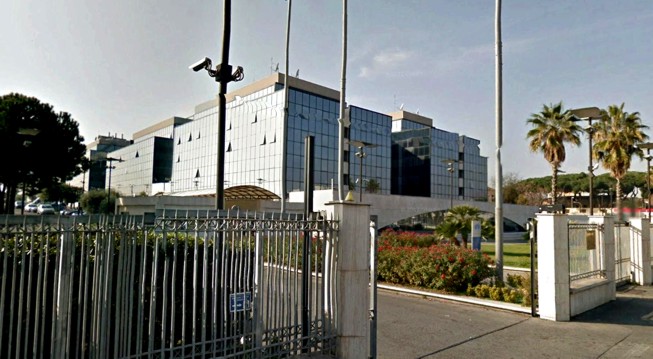
The Rome headquarters of the Scientific Police which work closely with the FBI
5. Explanations Of Some Of The DNA Data
The data in each column was obtained directly or indirectly obtainable from the two reports by Dr. Stefanoni’s team.
1) Column “˜A’ allows one to resort rows to their original order, which is based on the order of the “˜item number’ noted in the GT report.
2) “˜Item number’ refers to the actual piece of evidence, whether an object sampled onsite or an object that was bagged and taken to the lab, as noted in the GT report.
3) “˜Original item label’ is data provided in the first pages of the GT report, as a way to tie the evidence item back to evidence markers used at the crime scene, and visible in some of the crime scene photos.
4) “˜Page in attached photo report’ indicates that there is an adjunct “˜photo report’ Dr. Stefanoni provided that has not yet been released, and likely has photos of the evidence items “˜in situ’. This information is also noted in the beginning item lists in the GT report.
5) “˜Sample date’ is based on the dates noted in the beginning list in the GT report, indicating when the evidence item was sampled or taken from the crime scene. This is sometimes difficult to read, due to the fact that the report was apparently printed in color and the black and white scan hides or obscures some text and graphics.
6) Columns F-K are location and object data, obtainable from the descriptions in the GT report, especially the first pages that provide a list of where evidence samples were obtained. I broke this data down into various categories to allow different possibilities of grouping the data.
7) “˜Sample obtained’ indicates the type of biological substance that was assumed to contain DNA. This was first obtained from the GT report, and later corrected with the data from the SAL report, which has a more consistent description of what the sample was assumed to be.
8) Columns M through AC list data either directly reported in the GT and SAL reports, or interpretable from them. Column M notes if an item was analyzed or not. In the GT report, unanalyzed items are noted in the beginning list as “˜not analyzed’ though not consistently. In the SAL report, they are noted as having 0 samples.
9) “˜Trace number’ was obtained from GT report, though on a few occasions, the actual number is not clear. Note that the number “˜starts over’ for each evidence item. Sometimes the trace number is sequential, independent of whether it is blood or hair or skin cells. Items having the most traces are those that were “˜heavily’ sampled, including Sollecito’s sneakers, the duvet, Ms. Kercher’s sweat jacket, her jeans, the kitchen knife, the kitchen sponge, etc.
10) “˜Additional trace info’ is additional information noted from both reports about a specific sample.
11) Column P “˜revealed in luminol?’ indicates with a “˜yes’ those samples obtained during luminol analysis. What often gets overlooked is that luminol analysis was performed not only at the cottage, but in Sollecito’s car, Sollecito’s apartment and Guede’s apartment. Notable here is that 14 different samples were obtained from luminol analysis at Sollecito’s apartment. While the DNA data yielded was meager, what is important is not the actual data yielded, but the number and location of samples investigated, including samples from door handles, and different locations like the bathroom, bedroom and kitchen. There was certainly a suspicious amount of blood, bleach or turnip juice at Sollecito’s place!
12) “˜Date of extraction’ comes from the SAL report, though, as mentioned above, it is not consistently reported for every trace or sample analyzed. This indicates when DNA processing occurred on a sample. This column is important to look at when discussing the issue of lab contamination. If one performs a sort on this column and on the “˜sample number’ column, one can clearly see that samples were processed in batches, often a week or two weeks apart. So for instance, claims that the sample 36B happened due to contamination at the lab is really not possible, given that Ms. Kercher’s DNA was analyzed one week earlier (11/5/07 and 11/6/07) and sample 36B is the only sample to contain Ms. Kercher’s DNA from all the samples analyzed on 11/13/07. Similarly, Sollecito’s DNA and Guede’s DNA are only found once each of all the items analyzed on 12/29/07, yet the last time Sollecito’s DNA had been analyzed was on 12/17/07, 12 days earlier. So the likelihood of lab contamination seems extraordinarily small, just from the dates of when samples were analyzed.
13) “˜TMB test positive’ was originally obtained from the GT report. Again because that report is likely in color, a number of tables have either missing graphics or are missing tables altogether. Fortunately the SAL report has duplicated this data consistently.
14) “˜Human antibody test positive?’ is obtained from other tables in the GT report, almost always paired with the TMB table. In some cases where the table data is illegible, I’ve placed a “?” in front of an assumed result. Curiously, this test is not shown in the SAL report.
15) “˜Cat antibody positive?’ is from the GT report, shows that the basement apartment blood samples were all made a by cat, which Dr. Stefanoni comments on in her Massei testimony.
16) Apparently they also ran “˜dog antibody’ testing as well, as is noted in the GT report.
17) “˜DNA extraction done?’ indicates if a decision was made to extract DNA. This was inferred from the GT report. Notable here is that even with samples having cat antibodies, Dr. Stefanoni does the DNA extraction anyway to make sure no human DNA is in the sample.
18) “˜Quantity extracted’ comes from the SAL report. This refers not to the amount of DNA extracted, but specifically to the amount of liquid (50, 100 or 150 microliters) filtered through the Qiagen Bio Robot EZ1 machine. This machine actually filters or purifies the sample, removing all other biological materials like cells, bacteria, etc. leaving only actual DNA molecules which can then be processed. This extraction process is also the quantification process, where from a 50 microliter sample a certain amount of DNA is found and quantified.
19) “˜Human DNA found during quantification’ was inferred from the GT report. It should be noted that for Dr. Stefanoni’s team, DNA analysis involved finding DNA useful for comparison. This means that Dr. Stefanoni was not looking for a sample of any human DNA, but a sample sufficiently “˜complete’ to be able to compare it with others samples. So it was likely often the case that a trace might have snippets and pieces of DNA, but these pieces were either too small or too fragmented to be useful for any profile comparisons. So “˜No’ in this column means not so much that no DNA was found at all, but that no DNA was found that could be useful for comparison.
20) “˜Decision to amplify and analyze’ was obtained from the GT report. Sometimes it is explicitly mentioned in the description of the results in the GT report. Other times, it can be inferred from the lack of tables.
21) “˜Concentrate sample with Speed VAC 110’ means that where “no human DNA was found” (i.e. when no DNA was found sufficiently complete or in sufficient amounts useful for comparison), Dr. Stefanoni decided to process the sample further in an effort to “˜bring out’ whatever DNA there might be. This was done using a “˜concentrator’, which dries the samples and vacuums them, thereby reducing sample fluid to make any DNA present more easily found by the subsequent DNA processing equipment.
22) “˜STR amplification’ is the DNA copying process whereby any DNA found is copied millions of times to obtain samples that can be adequately rendered by capillary electrophoresis. The process Dr. Stefanoni used is described specifically in the GT report for evidence items 12 and 13.
23) In some cases “˜Y chromosome amplification’ is also done. While this may be done at the same time by the same machine, I took any Y chromosome amplification to be a separate test, since per the GT report, it sometimes yielded different results. In a few cases, it is not clear from the GT report if Y chromosome amplification was done on only one sample, or on all the samples of an evidence item. In those cases, I assumed all the samples.
24) “˜Capillary electrophoresis’ is where DNA is rendered through a chemical/electrical process that tags DNA particles with fluorescence. These fluoresced particles are then read by the software of the machine and mapped onto a graph that shows DNA particles as “˜peaks’, which are an indicator of quantity of DNA found. The software of the machine then produced graphs of the peaks obtained and it is these graphs that Dr. Stefanoni and her team used for profile comparison.
25) “˜DNA yielded’ is what is indicated in the GT report and is based on Dr. Stefanoni’s comparison of the DNA profile(s) shown by capillary electrophoresis to index DNA samples she had of Sollecito, Lumumba, Guede, Knox and Ms. Kercher.
26) “˜Egram number’ is taken from the GT report.
27) The “˜sample number’ was taken from the GT and further completed by the SAL report, which has the sample numbers for all samples, whether they were analyzed for DNA or not. The sample numbers are useful for indicating what was happening at the Dr. Stefanoni’s lab. As an example, if one does a sort on column Q (Date of extraction) and column AF (sample number) one can see that between 11/5/07 and 11/6/07, there is gap of 129 samples that were likely performed for another case. The last sample analyzed on 11/5/07 was 47082, and on 11/6/07, the next sample number is 47211. So presumably her lab ran 129 additional DNA tests on samples related to other cases between these two runs. Generally the sample numbers increase sequentially by date, but there are a few exceptions. One in particular is sample 47821, which appears as the last sample on 11/23/07, though samples starting on 11/26/07, three days later, start with sample number 47711. This implies that samples were probably numbered in batches (by sticking numbered labels on tubes or bags) and not necessarily right before extraction or other machine processing was done.
28) “˜Compatibility notes’ are extra comments noted by Dr. Stefanoni in the GT report.
29) “˜Likely substance containing DNA’ is interpretable from the GT and SAL report and the results of the testing done.
30) Finally there are columns related to hair analysis. “˜Type of hair’ comes from the SAL report, and it is sometimes, but not consistently or legibly, noted in the GT report.
31) “˜Hair color’ provides a description of the hair color. Notable is that the hair description is quite consistent, with black, blonde, chestnut, light chestnut, red chestnut being the more significant categories. This is available in both the GT and SAL report and both reports match.
32) “˜Hair length;’ is obviously the length of hair analyzed. I’m not sure how this was done since the machinery used is not indicated in either report. Again, this is in both reports, and again the data matches in both reports.
33) “˜Hair width’ is the diameter of the hair in micrometers, and is available in both reports.
34) “˜Hair marrow’ is found only in the SAL report, and presumably describes the condition of the very core of the hair.
35) “˜Hair end condition’ indicates whether the end of the hair is “˜cut’, a “˜point’, frayed or otherwise. This is found in both reports.
36) “˜Bulb phase’ relates to the particular phase of hair growth, with DNA apparently present in the hair bulb only during the initial growth phases of the hair. This too is found in both reports.
37) “˜Hair remarks’ are any comments related to hair samples.
38) Lastly, the “˜remarks’ column contains my notes on a particular sample or test, indicating discrepancies or explanations of what I was able to understand.
As noted above, the SAL report does not contain data for all the samples. Per Dr. Gino’s testimony in the Massei trial on 9/26/09, additional SAL sheets were apparently released that indicate that TMB tests were done on the luminol samples at the cottage and that these tests were negative. However it should be noted that TMB is less sensitive than luminol, so it is possible that a luminol sample could be in blood, which however is too diluted to be registered by a TMB test.
6. More Commentary On the DNA Extracted From Blood
1) DNA is only found in white blood cells, not red blood cells
2) The luminol reacts with the iron in red blood cells, not white blood cells
3) Red blood cells outnumber white blood cells by roughly 600 to 1
4) Even if DNA is found it may be not usable for comparison
So just because there is a positive luminol or TMB result does not mean that DNA can be found.
7. More Commentary On The Resulting Statistics
At the bottom of the spreadsheet are some interesting statistics, which I won’t reiterate here, except to note a few things.
a) 227 different objects or site objects were sampled/ obtained for analysis. 30 of these were not analyzed at all. From the remaining 197 objects and site objects sampled, 484 separate tests were set up for analysis, with 93 of these consisting of hair analysis. Of these 484 tests, 193 of them yield DNA data useful for comparison (40%).
b) Of the 193 tests that were “˜successful’, 100 tests yielded DNA compatible only with Ms. Kercher’s DNA (over 50%- again keep in mind their may have been other DNA but it may have been too small or too fragmented to be useful for comparison). Nine additional tests (comprising seven samples) yielded DNA compatible with Ms. Kercher’s DNA mixed with either Knox’s, Guede’s or Sollecito’s DNA. 27 tests had DNA compatible with Guede’s DNA; 18 tests had DNA compatible with Knox’s DNA; 11 more tests had DNA compatible with Sollecito’s DNA. Nine other tests yielded DNA compatible with a mixture of Knox’s and Sollecito’s DNA. 17 tests yielded DNA of unknown men and women (i.e. unmatchable by Dr. Stefanoni), and two tests were of samples obtained from Lumumba.
c) Of the nine tests yielding Ms. Kercher’s DNA mixed with others, five of these yielded DNA compatible with a mixture of Kercher’s and Knox’s DNA. They were all samples found in blood or potential blood- notably: three in the bathroom, one on the corridor floor in a luminol revealed bloody footprint, one in a luminol revealed blood stain in Romanelli’s room.
d) Returning to the discussions about contamination, it is notable that, whether the contamination occurred during site collection or in the lab, one might expect to find bits of contamination occurring here and there over 193 tests. Yet nearly all the arguments involve contamination about two samples, out of 193 tests. Over 50% of the tests that had useful DNA yielded Ms. Kercher’s DNA. If site collection, transport and/or lab procedures were so poor, one would expect to find Ms. Kercher’s DNA in other places as well. Yet very few samples have her DNA mixed with others, and conversely, very few other samples have other mixed DNA. Only nine samples have mixes of Sollecito and Knox’s DNA, eight of which were all obtained at Sollecito’s apartment or from Sollecito’s things (including a pocket knife), and one was obtained from a cigarette butt at the cottage. If contamination was so rampant, why does it occur on only two samples out of 193, (and curiously only on the two most damning samples)?
e) Continuing along the same lines, 118 samples were obtained from Sollecito’s apartment. Of these, 49 were not analyzed, (many were hairs not having bulbs in the right phase). Of the remaining 66 samples that were analyzed, only one, the one the blade of the kitchen knife, had Ms. Kercher’s DNA. And 41 yielded no usable DNA. So if there was contamination, or worse, direct framing of evidence by the lab, certainly there would be more of Ms. Kercher’s DNA amongst those 66 samples, in order to achieve an ironclad case. Yet there is only one sample out of 66 that had Ms. Kercher’s DNA.
f) Similarly, 224 tests were done on objects taken from the upper apartment. Of these 56 were not analyzed for DNA and an additional 61 that were analyzed, did not yield anything useful. Of the remaining 107 tests, only 3 had Sollecito’s DNA (a trace on the cigarette butt, and a trace on the bra clasp having Sollecito’s DNA as well as his Y chromosome.) Surely if there was rampant contamination or worse, direct framing of evidence, one would expect to find more of Sollecito’s DNA in Ms. Kercher’s room. Yet only one sample had his DNA and Y chromosome- the bra clasp.
g) Conversely, it is rather odd that Sollecito’s car was sampled in 16 locations (actually 19 samples were taken but only 16 analyzed), and none of those samples revealed his DNA. Did he ever drive his car?
8. And Finally More Commentary About The Hairs
Guede had black hair. From photos of Nov 2, 2007, Knox had blonde hair and Sollecito had chestnut to light chestnut hair. Meredith Kercher had chestnut to reddish chestnut hair.
93 hairs were found and analyzed. Seven of these were either animal hair or fibers. The remaining 86 hairs were, per the SAL report, all human. Seven of these hairs were black in color. Of the seven, six were short (4 cm or less) and one was long. Of the six short black hairs, four were found on the duvet covering Ms. Kercher, one was found on her mattress cover, and one was found on a sponge (containing fourteen other hairs) at Sollecito’s apartment. It is very likely these short black hairs were Guede’s, and if so, how it one of his hairs get on a sponge at Sollecito’s apartment.
Similarly, 21 blonde hairs were found, ranging from 4 cm to 20 cm. Of these, fifteen were found at Sollecito’s apartment, either on a sponge in the kitchen, or on a sweater. The other six were found at the cottage, with three being found on the duvet, one found inside the small bathroom sink, one found on a mop, one found on Ms. Kercher’s purse and one found on Ms. Kercher’s mattress cover.
Assuming the blonde hairs were Knox’s hair, it is difficult to imagine how they might wind up on Ms. Kercher’s purse and mattress cover.
There were four light chestnut hairs found. One, measuring 9 cm, was found on the kitchen sponge at Sollecito’s apartment. The other three light chestnut hairs were found on Ms. Kercher’s bra (2 cm), sweat jacket (7.5 cm) and the towel found under Ms. Kercher’s body (20 cm).
35 chestnut colored hairs were found, ranging from 1.5 to 30 cm in length. The vast majority were in Ms. Kercher’s bedroom. Two chestnut colored hairs (5 cm and 8 cm) were on the kitchen sponge at Sollecito’s house. It should be noted that three chestnut colored hairs yielded Ms. Kercher’s DNA, measuring 15, 18 and 23 cms.
So even from the hair evidence, it seems that hair having Knox and Sollecito’s color were on Ms. Kercher’s more intimate objects, while Guede’s and Ms. Kercher’s hair apparently were on a sponge in the kitchen at Sollecito’s apartment. In other words, an object used in a clean-up, and in a room that also had five luminol revealed samples.
Even the hair evidence points to Guede, Sollecito and Knox having acted together in the murder of Ms. Kercher.
Posted by Olleosnep on 10/22/14 at 07:00 AM •
Permalink for this post •
Archived in Defendants in court, Amanda Knox, Raff Sollecito, The officially involved, Police and CSI, Evidence & Witnesses, DNA and luminol, Hoaxes against Italy, 3 No evidence hoax, 4 No firm DNA hoax, Hoaxes Knox & team, Hoaxes Sollecito etc, Hoaxers from 2007, Knox-Marriott PR, Raff Sollecito PR, Hoaxers from 2011, Amanda Knox #2, Raff Sollecito #2 •
Comments here (35)
Thursday, October 16, 2014
Knox, Tied In Knots By Her Own Tongue: Translation Of The 17 Dec 2007 Interview With Dr Mignini #4
Posted by Machiavelli, Catnip, Kristeva

Inmate-chefs at Capanne Prison, from which Knox was making a bid for release
1. Getting Up To Speed On This Fourth Post
How much serious questioning was Knox subjected to prior to this voluntary interview six weeks after her arrest?
In fact, none. In the early days of November, after Meredith was found dead, she had several less-formal “recap/summary” sessions with investigators on possible leads (as did many others), which the defenses conceded without argument at trial were simply that and no more.
So these were the first serious questions put to Knox - politely, and Knox is essentially not argumentative throughout
The transcript was in the evidence pile and all judges except Hellmann seem to have studied it hard. This was also the first-ever interview of Knox by Dr Mignini, as prosecutor appointed to the case. He had seen her twice at the house and heard her at her strong insistence early on 6 November.
But they had never before really talked.
Prior to this, Knox had already emanated over a dozen differing versions of what she wanted to claim took place and the police and prosecutors and Supervising Magistrate Claudia Matteini had tried to make sense of those.
2. Our Translation Of Approximately The Fourth 40 Minutes
This is the fourth 40 minutes of the voluntary interview which lasted in total about three hours. For a full understanding it would really be best to read (1) our first post and comment thread and (2) our second post and comment thread. and (3) third post and comment thread.
Transcript of Interview 17 December 2007: Statement of Interview Of Ms Amanda Knox (cont)
PM Mignini: After having talked, after you were heard at the Questura, did you go away or did you wait?
Knox: The first day I was questioned I was there for hours”¦ maybe 14”¦
Interpreter: The first time it seems to her that she had been there a very long time, 14 hours
PM Mignini: But questioned
Knox: No, maybe they questioned me for 6 hours but I stayed at the Questura a very long time”¦
Interpreter: It must have been more or less 6 hours that Amanda was questioned but staying in the Questura must have been about”¦
PM Mignini: But was there”¦ were you in the waiting room?
Knox: Yes the whole time together with everyone else we were there in the waiting room”¦
Interpreter Yes, yes together with the other ones
PM Mignini: And who were the other people?
[82]
Knox: The housemates, and later others arrived”¦ After quite a long time our neighbors arrived, after a while some people Meredith knew arrived, her friends
Interpreter: Her housemates and then other people who arrived later, the neighbors after a while”¦ and after, Meredith’s friends arrived, the people Meredith knew”¦
PM Mignini: But did you speak to them? Did you exchange any confidences?
Knox: Yes we were all there and I said “it appears that Meredith’s body was found in a closet”
PM Mignini: Who said that?
Knox: I remember talking to her friends and I remember telling them that it appeared the body had been found inside a closet”¦
Interpreter: She remembers having said it to Meredith’s friends
PM Mignini: But friends, who? You must tell us the name”¦ a name even just the name”¦
Knox: I remember having talked to Sophie”¦ But I don’t know the name of the other friends
PM Mignini: A certain Natalie? From London
Knox: The name sounds familiar but I don’t think I could recognize her face
Interpreter: She can’t tie the name to her face but”¦
PM Mignini: And what were you saying? What kind of comments were you making?
[83]
Knox: I told them what I knew, I told them that I had arrived home and found the door open, and told them what I knew”¦
Interpreter: She told what she knew that she had arrived home and found the door open
PM Mignini: Did you ever see, did you see in those moments the wound on Meredith’s neck?
Interpreter: Up to the moment?
PM Mignini: In that moment.
Knox: I never saw Meredith dead, I never saw her dead body”¦
Interpreter: No, she never saw her dead
PM Mignini: Ok, but was there anyone that night who said, anyone who said that she had died quickly? Did someone else say that she must have suffered for a long time”¦ was there anyone who said this?
Knox: Nobody of the people I talked to knew what had happened”¦
Interpreter: No, none of the people she talked to said something”¦ knew what had happened
PM Mignini: Did you come to know, did you ever come to know, and if yes, when, in what moment, Meredith had died”¦ that is, if Meredith’s death was immediate or if it was prolonged, if there was a death agony”¦ if yes, when did you find that out?
Knox: The only time when I heard of this was when Luciano [Ghirga] was describing the wound and how deep it was”¦ What kind of wound it was and he said “maybe she died slowly because no big vein had been struck”
Interpreter: So, the first time you had heard talking about the wound and how she died”¦ when was it with Luciano?
Lawyer: The morning of the 8th
[84]
PM Mignini: So, after the 6th…
Lawyer: The morning of the 8th
PM Mignini: The morning of November 8th
Lawyer: After the arrest validation [hearing]
Interpreter: And there she found out that no vital vein was directly struck and therefore”¦
PM Mignini: You say that she came to know on the 8th from the lawyer.
Lawyer: From the lawyers.
PM Mignini: From the lawyers, sorry.
Lawyer: We always came all together
PM Mignini: Either one or the other [of you] could have told her”¦ so”¦ [talking to Knox] I formally notify [for the record, a contradiction] that an Erasmus student and a colleague of this student, they said, on this past December 10th that on the night of the second in the Questura, while having”¦ a girl called Natalie, I won’t tell you her last name but she”¦ she was a friend of Meredith, she had noticed that you were talking at length with Sollecito, and at a certain point, in response to a comment made by one of these girls that they hoped Meredith had died without suffering, you instead said ” with those kind of wounds the death would not have come fast and that therefore Meredith must have died after a certain period of time”. I’ll reread it to you if you’d like, ok?
Knox: The police told me that her throat was cut, and what I know about that topic, I mean when they cut your throat, it is terrible and I heard that it’s a horrible way to die”¦
Interpreter: Yes the police had told her that Meredith’s throat was cut and what Amanda knew is that it’s an agonizing way to die”¦
[85]
PM Mignini: But this is something we found out after, we too found it out only later”¦ not right away”¦
Knox: The police told me that her throat had been cut.
Interpreter: The police had told her that her throat had been cut.
PM Mignini: Who from the police? Excuse me I’d like to know”¦ cutting the neck, it can happen in many ways, vital veins can be struck and might also not be struck, therefore one thing is about cutting the throat, and another is about the way how to cut it and therefore make it so that the death occurs instantaneously, or cause a death with agony. On the evening of the second, if it’s true, according to these results, on the evening of the second you knew that, with those kind of wounds, she must have suffered an agony”¦ and the police didn’t know that”¦
Knox: I thought that a death by cutting the throat was always slow and terrible”¦
PM Mignini: The autopsy was made on the fourth, two days later
Interpreter: What she thought was that cutting the throat was always a slow death in general
PM Mignini: It’s not like that”¦not necessarily”¦ anyway, who from the police told you about the neck wound? Tell us.
Knox: It was probably the interpreter”¦the first interpreter was the person I talked to the most”¦ all information I had came more or less from him”¦
Interpreter: Probably the translator/interpreter
PM Mignini: Therefore, therefore he told you while you were being heard”¦
Lawyer: She was in there 12 hours
[86]
Knox: When I was in there I was talking to the police and they told me that her throat was cut”¦ the whole conversation was between me and the interpreter. It was him who must have told me, a long time has passed but I think it was like that”¦
Interpreter: Directly from the interpreter, indirectly from the police
PM Mignini: So [it was] when you were questioned. Not before.
Interpreter: No, before she was questioned she didn’t know how she was”¦
Knox: No, when I was home the way she died”¦
PM Mignini: Before being questioned”¦ you were questioned until 15:30, until what time have you been heard? You were being heard since 15:30, until what time were you being heard?
Knox: I don’t know it was a long questioning”¦
Lawyer: She had been heard in the presence of an interpreter, maybe the interpreter”¦
PM Mignini: It was D’Astolto”¦ Fabio D’Astolto
Lawyer: The interpreter was present from the beginning or only from the questioning onwards?
PM Mignini: Yes, well he was a policeman acting as an interpreter, translating. Fabio D’Astolto. Assistant D’Astolto. When and how, in what terms did D’Astolto express himself, this translator what did he tell you?
Lawyer: When?
PM Mignini: When and what did he tell you
Knox: I don’t remember when but I asked him how she died
Interpreter: She doesn’t remember when but she asked him how she was killed”¦
PM Mignini: And he pointed out to you the wound on the neck. The wound on the neck and that’s all. Fine. This translator.
[87]
Lawyer: [to the Prosecutor] You referred to an Erasmus student who had said that on December 10th. Ms. Natalie would have said this.
PM Mignini: Yes
Lawyer: And is the Erasmus student indicated [in the records]?
PM Mignini: It is indicated
Lawyer: Do we have a name?
PM Mignini: Capruzzi, Filippo and the other one is a certain, a colleague of his, Chiara, Maioli.
Lawyer: So it was two Erasmus students
PM Mignini: Two Erasmus students who confirmed this confidentiality from this English girl. Some”¦ this is the December 10th hearing report”¦ ok
Lawyer G. She clarified if she had talked with the interpreter, with someone before”¦
Lawyer C. We have clarified that the interpreter was not an interpreter but was a police officer who speaks English and that apparently was present from the beginning and therefore at this point…
PM Mignini: Wait.. one moment”¦ did you, did you”¦ did you see this person who was translating at the house?
Knox: No
Interpreter: No
PM Mignini: Perfect
Lawyer: She was approximately 12 hours in the Questura and at some time she heard the first… let’s call it questioning but it was a long time, and before the questioning she heard of this wound on the neck, is that right?
[88]
PM Mignini: During the questioning, you said before, during the questioning so much as this policeman translator was present, therefore”¦ no I’m very sorry, who did you hear this from? The translator? The policeman
Interpreter: About the wound? The first time?
PM Mignini: The wound
Knox: I think so
Knox: The first time?
PM Mignini: Yeah
Interpreter: I think the interpreter the first time
PM Mignini: And it would be this D’Astolto”¦ so this D’Astolto told you, please excuse me you told me this “it was D’Astolto” now”¦ therefore this D’Astolto told you this during the course of the questioning?
Knox: I think so”¦
Interpreter: Yes, she thinks so
PM Mignini: Ok, one more thing, so the”¦ you did, the morning of the”¦ actually no, the night between the fifth and the sixth of November, you did, let’s say partially modify your previous declarations, so then you modified your previous declarations and you made a specific accusation against Patrick Dia Lumumba known as Patrick. You said that you were supposed to meet with Patrick, that you met with Patrick at the basketball court of Piazza Grimana, that you went to Meredith’s house, to your house, and then he had sex with Meredith, then you heard a scream and you accused him even if in terms you say “confusedly” of killing Meredith. Isn’t that so? Why did you make this accusation? “¦ Now remember, I was hearing you, I was present, you were crying, you were
[89]
profoundly upset, and you were as if relieved when you made this statement.
Lawyer: Maybe she was stressed?
PM Mignini: Well, stressed or not, in any case she was very she made these declarations
Lawyer: You asked her a question “Why did you make these declarations”?
PM Mignini: Well I also have to”¦
Lawyer: Eh these are opinions
PM Mignini: I am saying that you made a declaration not in a detached way, in other words in a very involved manner, why did you make these statements?
Knox: I was scared, I was confused, it had been hours that the police that I thought were protecting me, and instead they were putting me under pressure and were threatening me.
Interpreter: She was scared, she was confused, it had been hours that the police were threatening and pressuring her.
PM Mignini: Yes, tell me, go on
Knox: The reason why I thought of Patrick was because the police were yelling at me about Patrick”¦ they kept saying about this message, that I had sent a message to Patrick”¦
Interpreter: The reason why she thought of Patrick was because the police was asking her who was this Patrick to whom she sent, with whom there was this exchange of messages, they were asking her insistently.
Knox: That was the worse experience of my life
Interpreter: The worse experience of her life
[90]
Knox: I had never been more confused than then
Interpreter: She had been so confused or scared
PM Mignini: But in the following memoriale [spontaneous statement around noon 6 November] that you wrote before going to prison, basically you don’t retract this accusation. Even if in terms, still in terms let’s say of uncertainty, between dream and reality, in other words in such a way “¦ still you didn’t “¦ I believe that in this memoriale you say “I still see this image in front of me” and then you see yourself while hearing it, you say that in that first memoriale you wrote “you hear Meredith’s screams and you put your hands over your ears”. Why do you have this image? Your ears”¦ the scream”¦ it’s not like it’s changing much after all isn’t that so?
Lawyer: No, but she says she was very confused”¦ she was under a lot of stress
PM Mignini: Yes, but why does it basically remain the same, this one”¦
Knox: Yes, I imagined these things”¦
Interpreter: Imagined this scene
Knox: I was so scared and confused
Interpreter: I was so scared and confused
Knox: that I tried to imagine what could have happened. The police told me that I was probably not remembering well. So I thought of what could be another answer and therefore I imagined it”¦
Interpreter: She tried to think of what could have happened since the police was saying that probably she didn’t remember well. And therefore she imagined this scene, trying to think how it could have happened
PM Mignini: Well, you, I just tell you, I tell you only that this Dia Lumumba, this Patrick, only comes up in your statements, he wasn’t, he has never been indicated previously in the slightest, I mean why did you, why did you almost feel…
[91]
...forced to, so you say, to give this name? While this name had never been, you had never mentioned him previously”¦ in the statements of the 2nd, the 3rd”¦. Why only at a certain point di this Patrick pop up? I’m telling you, do you realize”¦ excuse me, eh? “¦ excuse me”¦.
Knox: They were telling me “why did you send this message to Patrick, this message to Patrick!”
Interpreter: Because they were always insisting about this message to Patrick and because”¦
PM Mignini: Well because there’s the message so [it’s] the message but it’s just that, it’s not that there was an attitude, I mean it’s not like there was any reference to a message according to what emerges from the statements. In fact there was a message that you”¦ since there had been an exchange of messages right before the time of the murder between you and this person it’s normal that the police would want to know why, what this message meant, this”¦ therefore it’s not something”¦ why did you threw yourself in this kind of”¦ ? While you had, you had the possibility to”¦?
Knox: Because I thought that it could have been true
Interpreter: Because she thought it could have been true”¦
PM Mignini: It could have been true?
Lawyer: Why?
Knox: When I was there, I was confused”¦
PM Mignini: [to the lawyers, ed.] No, no, excuse me, at this point no, I’m sorry. Not the lawyers. The defense can intervene against me but against the person investigated…?
Lawyer Ghirga: But there was no question”¦ Prosecutor there was no question
PM Mignini: It could be true. What does it mean?
[92]
Lawyer Ghirga: There was no question
PM Mignini: What? I am asking the question.
Lawyer Ghirga: Then ask it.
PM Mignini: What does it mean, how “˜could it be true’? What?
Lawyer Ghirga: What could be true?
PM Mignini: Excuse me, lawyer
Lawyer Ghirga: It’s like the phone call with her parents
PM Mignini: What could be true
Lawyer Ghirga: It’s like the phone call with her parents
PM Mignini: “¦Lawyer Ghirga”¦ what”¦?
Lawyer Ghirga: [seems to Knox] What do you want to say then? Let’s ask her”¦
PM Mignini: Excuse me, I am asking the questions, I am asking them now
Lawyer Ghirga Yes of course
PM Mignini: Then after you can”¦ I am asking her”¦
Lawyer Ghirga: Yes of course, we will ask them too”¦
PM Mignini: Lawyer”¦ she is saying “it could have been true””¦
Lawyer: What?
PM Mignini: “it could have been true”. She was telling me why did she accuse Lumumba of this fact? “It could have been true” is what she answered. Gentlemen, here”¦
Knox: I said it because I imagined it and I thought that it could have been true”¦
Interpreter: She said because she had imagined it and therefore she thought it could have been true.
[93]
PM Mignini: Look, listen”¦ listen, why did you imagine it?
Knox Why?... Because I was stressed
PM Mignini: Why didn’t you imagine”¦
Lawyer: No she was answering
PM Mignini: Yes; what did you want to say?
Interpreter: Because she was under stress”¦
Knox: Knox: Why? I was stressed, I was scared, it was after long hours in the middle of the night, I was innocent and they were telling me that I was guilty
Interpreter: Because they were saying that she was guilty
PM Mignini: Who was saying it? Guilty who’”¦.
Interpreter: After hours”¦
Lawyer: Excuse me, prosecutor, if we can correctly compile this translation, these words that were said in English at the right moment
PM Mignini: She is crying, we acknowledge, I’m sorry, we acknowledge that the”¦ investigated is crying.
Interpreter: Because she was stressed, scared under pressure after many hours, she was”¦ in the middle of the night, they had reached the middle of the night and because they were saying that Amanda was guilty.
PM Mignini: Who was saying that she was guilty?
Interpreter: The police
Lawyer: The police was accusing her
Interpreter: The police was accusing Amanda
[94]
PM Mignini: Why”¦ why did you accuse Lumumba and not others? How many people did you know who could”¦
Knox: Because they were yelling Patrick’s name”¦
Interpreter: She accused Patrick and not others because they were always talking about Patrick, suggesting”¦
PM Mignini: The police, the police couldn’t suggest…
Interpreter: Yelling Patrick’s name
PM Mignini: Excuse me, what was the police saying?
Interpreter: What did the police tell you?
Knox: The police were telling me that “˜we know that you were at the house, we know that you left the house’, and the moment before I said Patrick’s name they put.. someone was showing me the message that I had sent on the phone
Interpreter: The police said that they knew that Amanda was inside the house, and when she went in, when she went out, that she was inside the house, and while they were asking her this someone showed her Patrick’s message on the phone.
PM Mignini: But this is”¦ But this is normal. You”¦ there was this message”¦ I’m sorry, I’m very sorry. There’s a murder here. There’s a girl whose throat is slit, there was a phone number, there was a call that had been made, you were being heard. There was a call that had been made to you on the night of the murder from this person, you replied to this call in a way that could have been interpreted, according to the meaning in Italian “will see you”. Eh, so what is more normal than to insist? The police are doing their job. They insist to know, what did that mean, what was the, what relationship was there between you and Lumumba. This is normal.
[95]
Knox: I didn’t understand why they were insisting that I was lying”¦ they kept telling me that I was lying”¦
Interpreter: She didn’t understand why they were insisting that she was lying.
PM Mignini: Why are you”¦?
Interpreter: The police was insisting that she was lying.
PM Mignini: But why did you accuse, then if it was like this…. Again you are, you are crying again, for a long while since you started, I put in the record, I put in the record that”¦ it’s been ten minutes that you have been crying. Why did you accuse a person that, today, you’re telling us he is innocent, but earlier you just told us “it could be true” what does “it could be true” mean? You have told me “it could be true”.
Lawyer: The subject is missing
PM Mignini: No the subject is there, because I asked the question. Why did you accuse Lumumba?
Lawyer: Can we suspend a moment please?
PM Mignini: What reason?
Knox: It means that in the moment when I told Patrick’s name, I thought that it could have been true.
Interpreter: In the moment in which she said Patrick’s name, in that moment, she thought it could have been true.
Lawyer Ghirga: We ask for a suspension”¦ she is calm, you say she is crying, and we think she’s not.
PM Mignini: I put that in the record it because I could see the tears, she was crying and I could hear her too.
[96]
Lawyer: It was not ten minutes long
PM Mignini: Well, even more, maybe
Lawyer: maybe, no less
PM Mignini: Let’s interrupt, break off.
Lawyer: You asked her six times”¦
PM Mignini: For Heaven’s sake, let’s interrupt, break off.
(interruption)
[from this point on Amanda declares her right to remain silent]
PM Mignini: So, at 15:12 lawyer Luciano Ghirga resumes the interrogation
Lawyer Ghirga: In the name of the defensive collegium we submit a reason to confer personally, privately, we mean alone together with our client, for a time not longer than ten minutes.
PM Mignini: So, the Public Prosecutor is pointing out that the interrogation had already been suspended and it’s 15: 13 now, pointing out that the interrogation was suspended several times, and the last time for, how long? Ten minutes on request of the defence, and the defence will be allowed to fully have counsel with the person under investigation at the end of the interrogation. [The Public Prosecutor] orders to proceed, orders to go forward with the investigation procedure. So now I would like”¦
Lawyer Ghirga: If you may, ask to the suspect, to the person under investigation, whether she intends to go on or to invoke her right not to answer”¦?
PM Mignini: This is a”¦ it’s a”¦ it’s a”¦ she decided to answer questions at the beginning. Now if she decides to make a statement where she says “I don’t want to answer any more” she’ll be the one who says it, and it’s not that I must ask now, that question was done at the beginning of the interrogation. If now she wants to say”¦
Knox: I prefer not to answer any more”¦
[97]
Lawyer Ghirga: What did she say?
Interpreter: She doesn’t want to answer anymore.
PM Mignini: So, at this point, at 15: 15, on a question asked by the defence lawyers, about whether the person under investigation intends to go on answering or not”¦
Lawyer Ghirga: To your questions
PM Mignini: To a question by lawyer Ghirga”¦ yes, well, Lawyer Ghirga asked her that
Lawyer: He didn’t first ask the question
Lawyer Ghirga: But what question did I ask?
Lawyer: We told you to ask her…
PM Mignini: Yes, you asked me, and I did follow the request. But”¦
Lawyer Ghirga: She made a declaration, and we took note, unfortunately, about forbidden suggestions”¦ but on what request”¦?
PM Mignini: Now at this point, at 15: 15 the defence lawyers… Let’s put like this, the defence lawyers ask this Prosecutor about whether he intends to ask the person under investigation if she intends to go on answering questions, but then, after my decision, Lawyer Ghirga said”¦
Lawyer Ghirga: Who said? You said
PM Mignini: You asked her, I put in the record what happened, it’s recorded anyway, this is what I perceived you asked her, and she answered “I do not intend to answer”, she said, and then the interpreter…
Lawyer Ghirga: I asked whether she intended to make a statement, and she made a statement
PM Mignini: You indicated that to her, it changes nothing, doesn’t change”¦ I must only put in the record what happened. The public prosecutor points out that…
[98]
...the warning about the right not to answer was explained to the person under investigation at the beginning of the interrogation, as provided by the Code, and that same [person under investigation] declared she wanted to answer. It is not possible now to invoke the duty to inform the suspect about her right, because such requirement has been already fulfilled. Anyway the person under investigation can, if she decides to, declare that she doesn’t want to answer any more. Such option has been shown to the person under investigation by lawyer Ghirga.
Lawyer: ...by the defence lawyers
PM Mignini: By the defence lawyers, to the person under investigation. What do you want to do?
Lawyer: What do you mean by “It was shown?”
PM Mignini: It was shown, because you said”¦ I need to put in the record what happened. The lawyer… Facing my warrant which I described, the notice was provided at the beginning of the interrogation as the code requires. She said “I want to answer, I do not intend to invoke my right not to answer”. That answer had been given already, I informed her, and she answered. Now to this, at this point, however, I said nothing prevents her from wanting, from declaring “at this point I do not intend to answer any more”. I put it in the record and I don’t ask why, at that point, at that point.
Lawyer: You should not put in the record “the defence lawyers have shown”¦”
PM Mignini: “at that point”
Lawyer: We did not show anything, we asked to be allowed to, well”¦ and you said no.
PM Mignini: So”¦ lawyer, lawyer?
Lawyer: And you said no, and we didn’t have the possibility to show her…
[99]
PM Mignini: Lawyer Ghirga”¦ Lawyer Ghirga”¦
Lawyer: that she might invoke her right to not answer. It’s not that it’s we who’ve shown this possibility this is what I want to explain”¦
PM Mignini: Lawyer Ghirga told her something, so…?
Lawyer Ghirga: No, no, I only said, if you could give us a ten minutes suspension
PM Mignini: You told her something, now come on”¦ I need to put that on record
Lawyer Ghirga: what did I say”¦
PM Mignini: You have shown, I don’t know if the other lawyer did too, you told, Lawyer Ghirga, you told the person under investigation about… You said, if you can, if I remember correctly, we’ll hear her again”¦
Lawyer Costa: It was me who told her, Mr. Prosecutor
PM Mignini: So I understood Lawyer Ghirga… Lawyer Giancarlo Costa declares he explained that, I didn’t say anything else
Lawyer Costa: ... To Ms. Amanda Knox to use her right to invoke her right not to answer
PM Mignini: ... And she herself declares so, she is supposed to declare what she wants
Lawyer: She has already said that
PM Mignini: Let’s repeat it since with this superimposition of voices”¦ the interpreter will translate faithfully word-by-word what you say.
Knox: At this point I don’t want to answer any more
Interpreter: At this point she doesn’t want to answer any more
PM Mignini: So “at this point I don’t want to answer any more”. We put on record that the current transcript was recorded entirely.
[100]
Lawyer Costa: Mr Public Prosecutor, we lawyers may renounce to our own time terms of deposit if Your Honour would give us a copy
PM Mignini: Yes, no problem”¦ at 15: 22. The parties demand a transcription, I mean the defence lawyers request the transcription of the recording.
Posted by Machiavelli, Catnip, Kristeva on 10/16/14 at 10:31 PM •
Permalink for this post •
Archived in Defendants in court, Amanda Knox, The officially involved, The prosecutors, The defenses, Trials 2008 & 2009, Prelim hearings, Hoaxes against Italy, 9 Mignini v Knox hoax, Hoaxes Knox & team, 16 Interrogation hoax, Hoaxers from 2007, Knox-Marriott PR, Hoaxers from 2011, Amanda Knox #2 •
Comments here (30)
Sunday, October 05, 2014
Knox Interrogation Hoax #14: Third Opportunity Knox Flunked: Requested Interrogation By Dr Mignini
Posted by Machiavelli, Catnip, Kristeva
1. Our Translation Of Knox’s Key Interview
At her request Dr Mignini interrogated Amanda Knox, her first true interrogation under Italian law, on 17 Dec 2007.
This was about six weeks after her arrest. If Knox had explained away the charges against her, she could have been on her way home.
Read our translations for how it finally emerged. There is some context in Part 2 below.
Knox, Tied In Knots By Her Own Tongue: Translation Of The 17 Dec 2007 Interview With Dr Mignini #1
Knox, Tied In Knots By Her Own Tongue: Translation Of The 17 Dec 2007 Interview With Dr Mignini #2
Knox, Tied In Knots By Her Own Tongue: Translation Of The 17 Dec 2007 Interview With Dr Mignini #3
Knox, Tied In Knots By Her Own Tongue: Translation Of The 17 Dec 2007 Interview With Dr Mignini #4
Part 2: Context Of The Interview
Dozens of people have very aggressively gone to bat for Knox over her “interrogation” and still do. They trust that one or other of her versions of the 5-6 November 2007 police-station session finally stands up.
This interview was sought-after by Knox, seeing this as her last best chance to get herself off the hook before trial and to avoid remaining locked up. This lasted about three hours, until Knox’s lawyers interrupted to got her to clam up.
All of the trial judges and appeal judges and lay judges had clearly studied this document hard. Also prosecutors and the Knox and Sollecito defense counsel periodically refer to it.
As you will have seen in previous posts, Knox’s team pussyfooted about without conviction in the few brief instances when the 5-6 November session was discussed.
In this Mignini hearing of 17 December 2007 they eventually in effect advised her it would be in her best interests to shut up.
Posted by Machiavelli, Catnip, Kristeva on 10/05/14 at 11:36 PM •
Permalink for this post •
Archived in Defendants in court, Amanda Knox, Raff Sollecito, The officially involved, Police and CSI, Supreme Court, Trials 2008 & 2009, Prelim hearings, Hoaxes Knox & team, 16 Interrogation hoax, Hoaxers from 2007, Knox-Marriott PR, Hoaxers from 2011, Amanda Knox #2 •
Comments here (0)
Saturday, September 13, 2014
Those Channeling Funding To RS And AK Should Definitely Take Note Of This
Posted by Our Main Posters
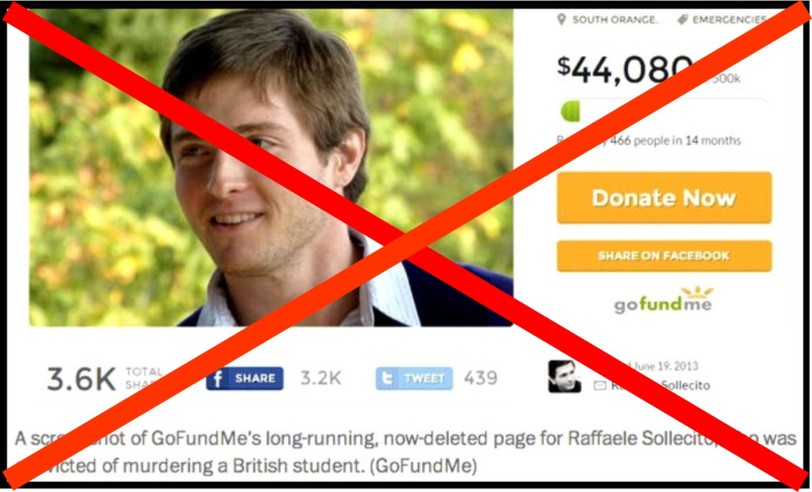
GoFundMe has dropped this page of Sollecito’s which was soliciting funds under false pretenses
The increasingly tough American bloodmoney laws (Son of Sam laws) were described here and here.
These laws are operable at the federal level and in most states. The tendency is for the laws to be made more and more tough, and to spread the net of who could be charged more and more widely.
Book publishers and TV networks have armies of lawyers who usually step in smartly to stop them being party to illegal money flows. All American TV networks have codes of ethics which prevent fees being paid that reward a crime.
The bloodmoney net could be spread widely in the Perugia case if the Republic of Italy requests the invoking of these laws against Knox, Sollecito, their families, and the in-it-for-the-money opportunists such as Sforza, Fischer, and Moore.
Their PR help also appears to be at risk, along with the shadow writers, book agents and publishers of the two books.
Sollecito might have got a blessing in disguise then when GoFundMe the private-purposes fundraising site closing down his begging page (image above) after around $40,000 had been conned from the sheep.
GoFundMe did that as part of a move to keep the company and the site away from controversy and the long arm of the law. This move is fairly typical of a broad trend on the internet as courts increasingly sentence harrassers, abusers, swindlers and money-grubbers to tough terms.
Making money out of crime has never been a walk in the park, and anything gained rarely goes very far.
Trying to make money illegally is fundamentally why OJ Simpson (images below) is serving a term for armed robbery east of Reno in Nevada - and in that case he considered the property he was robbing at a Las Vegas casino hotel was actually his own.
In his case his wife and a friend were found slashed to death at her home a mile or two from his. Simpson nearly fled the country before trial, then he won an acquittal at criminal trial, and then he was convicted at a wrongful-death civil trial. Wikipedia explains.
On February 5, 1997, a civil jury in Santa Monica, California, unanimously found Simpson liable for the wrongful death of and battery against Goldman, and battery against Brown. Daniel Petrocelli represented plaintiff Fred Goldman, Ronald Goldman’s father. Simpson was ordered to pay $33,500,000 in damages. In February 1999, an auction of Simpson’s Heisman Trophy and other belongings netted almost $500,000. The money went to the Goldman family.
To avoid ever making any of the required payments to the Goldman family, Simpson squirreled assets and income away.
The items he wanted back at the point of a gun at the Palace Station hotel and casino would have been worth a lot. But instead this foolish financial crime could cost him up to 33 years.
Our take is that Sollecito may have squirreled away some of his gains, and Knox may have squirreled away much more. US law enforcement is capable of finding those payments if asked and if Knox’s family and paid help don’t press her to cough up.
Hopefully it will be made to sink into that Knox’s panhandling (she is still at it via her website via Paypal) was not such a good idea.

Posted by Our Main Posters on 09/13/14 at 03:21 AM •
Permalink for this post •
Archived in Defendants in court, Amanda Knox, Rudy Guede, The officially involved, The legal followups, Knox-Marriott PR, Raff Sollecito PR, Amanda Knox #2, Raff Sollecito #2 •
Comments here (22)