
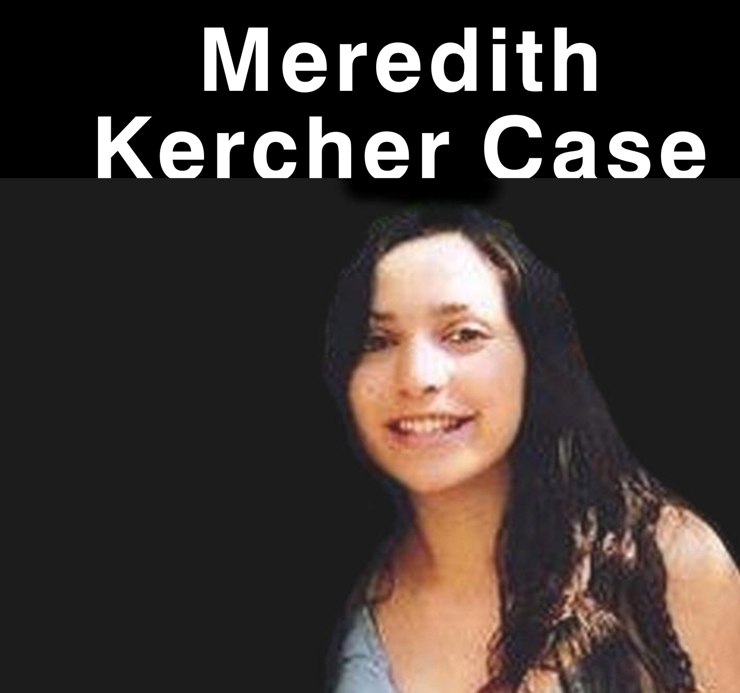
Judge Massei's report on the sentencing of Amanda Knox and Raffaele Sollecito can be read online, printed out, or downloaded here
Category: Facts presented
Tuesday, July 20, 2010
That Widely Watched LA7 TV Interview With Giuliano Mignini - Herewith A Full English Translation
Posted by ziaK
This is a translation of the YouTube video posted by my fellow poster True North two weeks ago.
Many readers asked for a translation of what Mr Mignini said in that interview, and True North, who has pretty good Italian but is not a professional translator, requested some help from the translation team. The sound of the video is not always crystal clear but this appears to accurately reflect what was said.
Male interviewer: In the biological evidence, is there any one item which is the one which you consider, especially in terms of the trial, to have had the most value?
Giuliano Mignini: I think that, in terms of the trial, the most important were the knife, the bra hook and also the biological traces in the bathroom. From the point of view of the trial, the knife certainly links the two defendants and the victim. Therefore it was (interrupted).
Andrea Vogt: There was low copy number, and that’s not normal, is it, to use DNA when there’s low copy number?
Giuliano Mignini: However, I hold that those traces were nonetheless indisputable traces. That is, there was not an absolute huge amount, in terms that are perhaps more understandable [ndt: to an Italian speaker, “low copy number” is not necessaryily understandable, because it is an English term]. The trace might be really high, with a high quantity, or it may be very low, but however the trace may be, it was never reasonably explained in any other way. That knife was never touched by the victim. She was never (inaudible: possibly “at Raffaele’s”] during the period that the two young folk, the two defendants, knew each other. It was a very short period: we think the relationship was (inaudible) or a week.
Male interviewer: Certainly. However, (inaudible) limited, either a contamination in the place of the crime or a contamination in the laboratory? This is not meant as a criticism of the work, however it is a danger that we technicians have which we must confront.
Giuliano Mignini: Yes. Well, that point about the knife comes from the specific questions of Professor Finsi himself, and of the Superintendant (Parebiochi?), and it was clearly shown that that knife was collected with absolute… that is, there was no possibility of exposure to contact [with the victim?]. Because it was found in Raffaele’s house and it was take with all precautions. This was shown in (inaudible). I was keen to show that (inaudible) that knife.
Andrea Vogt: Also the hook was very controversial because you found it 46 days after.
Giuliano Mignini: Yes, yes. I know. I understand. This, alas, can happen when there are places that are so full of objects, full of… When one is doing an analysis of this type, it can happen that (inaudible) is moved. However, it remained within that room. And (Andrea Vogt interrupts). And then, if there is contamination, that means that Sollecito’s DNA was somewhere within that room. We’re still there (i.e. at the same conclusion). I think that all the evidence was limited [ndt: to the one place?], and the first findings were of an investigative nature. In particular, that includes the numerous contradictions made by Knox. Which were then repeated during the investigation, during the interrogation in jail, and in my opinion also during the questioning and counter-questioning in court.
Andrea Vogt: I want to talk a bit about the motive.
Giuliano Mignini: As a first impression of the [inaudible: crime?] it was clearly, it appeared clearly to be a crime of a sexual nature. It was extremely clear. A young woman, killed in that way, and almost completely stripped/naked.
Male interviewer: Excuse me, but on the contrary, at times I have heard attributed (inaudible) a different reason, a fight which ended badly, and then instead a transformation of the crime to put forward the idea that it was a sexual murder. Also because, in fact, the position of Rudy, who was however found guilty, also from the beginning changed a bit. There’s his responsibility.
Giuliano Mignini: Also Rudy gave indications which then changed a bit. Rudi too, for example, said that there was an appointment with Meredith. Then in later interrogations he said that Meredith had asked for him to be there, and (Male interviewer interrupts: The reconstruction [by Nabil?]: what could have happened?). Yes, according to me, there was a situation, a progressive situation of disagreement between the two girls. That seems undeniable to me.
Links in right column Crime hypotheses, Prosecution's case, Facts presented, The three defendants, Amanda Knox, Reporting on the case, Best reporting, Truth on Mignini
Permalink for this post • Tell-a-Friend • Perugia MF Forum • Comments here (10)
Tuesday, July 06, 2010
First Of Three Excerpts In Italian from LA7 Program On Meredith’s Case
Posted by True North
Thanks to TJMK poster Cesare Beccaria for the video links. We posted some background last Friday.
The male reporter asks Prosecutor Mignini what was the most damning evidence in this case? Mignini replies: the knife, the bra clasp, and the mixed blood traces in the bathroom.
Mignini stands firm when answering Andrea Vogt’s repeated question of what about “the low copy numbers?” He asserts that it was indisputably Meredith’s DNA on the knife. There was never any transfer or contamination of DNA on the knife because Meredith never touched it nor had she ever been to Sollecito’s house.
While admitting that the bra clasp had not been retrieved until 46 days later, there was never any transfer or contamination of DNA on the clasp. He stresses that the bra clasp never left Meredith’s room and yet still had plenty of Sollecito’s DNA on it.
*********
Added: As suggested in Comments below, there seems very good reason to translate all of Mr Mignini’s remarks, and we will be posting a full transcript of this video one day this week.
Links in right column The legal participants, The prosecutors, Truth on Mignini, Prosecution's case, Facts presented, Reporting on the case, Best reporting
Permalink for this post • Tell-a-Friend • Perugia MF Forum • Comments here (15)
Sunday, October 11, 2009
Our Take On The Case For The Prosecution: #5 Defendants’ Claims Shown To Be A Mass Of Contradictions
Posted by The Machine

[Above: Perugia’s central police station]
Preamble
This series is a summary of the prosecution’s case in about ten parts, with a commentary on matters of key significance.
The material has been reordered so that evidence presented at several points in the trial can be described in one post here. Sources used are the many published reports, some transcripts made of the testimony and the mobile phone records of Amanda Knox and Raffaele Sollecito.
The first four posts were on the DNA evidence, the luminol-enhanced footprint evidence, and Raffaele Sollecito’s and Amanda Knox’s various conflicting alibis.
Now we look at at the many contradictory statements of Amanda Knox and Raffaele Sollecito brought out by the prosecution.
The prosecution showed that not only are they contradicted by one another. They are contradicted by telephone and computer records, by closed-circuit TV footage, and by the corroborated testimony of several witnesses.
One question that Judge Massei and Judge Cristiana and the six members of the jury will now be asking themselves is: if Amanda Knox and Raffaele Sollecito are innocent and had nothing to hide, why did they lie so repeatedly?
Knox’s and Sollecito’s lawyers have had the unenviable task of trying to explain all their contradictions away.
Sollecito’s lawyers have argued that he lied out of confusion and fear. Knox’s lawyers have argued that she dramatically changed her version of events because she was hit and mistreated by the police on 5 November 2007. Neither of these claims stood up to close scrutiny.
And the prosecution made it overwhelmingly apparent to the judges and the jury that Knox and Sollecito each lied deliberately and repeatedly to various people even before they were suspects and even before Knox was questioned on 5 November.
It was made intensely obvious that Knox and Sollecito’s versions of what they did on 1 November had very little in common with each other, especially in that part of the evening when they both claim they couldn’t remember very much because they were suffering from cannabis-induced amnesia.
There is no convincing scientific evidence that shows that cannabis can cause such dramatic amnesia. Skunk cannabis can cause extreme psychotic episodes and murders have occurred as a result. Long term use of cannabis can affect short-term memory and users might have difficulty recalling a telephone number. But wipe out whole chunks of an evening from anyone’s memory banks? The proof simply isn’t there..
1-A) The afternoon of 1 November 2007 according to Raffaele Sollecito
Sollecito told investigators that Knox and he had left the cottage on Via della Pergola at 6.00pm and that they went for a walk downtown. They passed through Piazza Grimana, Piazza Morlacchi and the main fountain in Corso Vannucci.
1-B) The afternoon of 1 November 2007 according to Amanda Knox
Knox told investigators it was an hour earlier at 5.00pm and that they went straight to Sollecito’s apartment.
2-A) The evening of 1 November 2007 according to Raffaele Sollecito
Raffaele Sollecito first claimed in an interview with Kate Mansey from the Sunday Mirror that he and Amanda Knox were at a friend’s party on the night of the murder.
Sollecito said that he downloaded and watched the film Amelie during the night. However, computer expert Mr Trotta said that the film had actually been watched at around 6.30 pm.
On 5 November Sollecito told police that Knox went to meet friends at Le Chic at around 9pm and that she didn’t return until about 1am:
“At 9pm I went home alone and Amanda said that she was going to Le Chic because she wanted to meet some friends. We said goodbye. I went home, I rolled myself a spliff and made some dinner.”
Sollecito claimed that he had spoken to his father at 11pm. Phone records show that there was no telephone conversation at this time. Sollecito’s father had called him a couple of hours earlier at 8.40pm.
Sollecito claimed that he was alone and surfing the Internet from 11pm to 1am. No technical evidence of this was introduced. computer specialists have testified that his computer was not used for an eight-hour period on the night of Meredith’s murder
The Kercher’s lawyer, Franco Maresca, pointed out that credible witnesses had really shattered all of Sollecito’s alibi for the night of the murder.
2-B) The evening of 1 November according to Amanda Knox
Amanda Knox told the police that she hadn’t replied to Diya Lumumba’s text message. The police knew full well that this wasn’t true because they already had her mobile phone records that proved that she had texted him.
“After that [finding out she wasn’t required at Le Chic] I believe we relaxed in his room together, perhaps I checked my email.” But no internet activity at all was proven at Sollecito’s apartment beyond the early evening.
“One thing I do remember is that I took a shower with Raffaele and this might explain how we passed the time. In truth, I do not remember exactly what day it was, but I do remember that we had a shower and we washed ourselves for a long time. He cleaned my ears, he dried and combed my hair.”
But Sollecito made no mention of taking a shower with Amanda Knox on the night of the murder.
In Amanda Knox’s handwritten note to the police she claimed that she and Sollecito ate around 11.00pm:
“One of the things I am sure that definitely happened the night on which Meredith was murdered was that Raffaele and I ate fairly late, I think around 11 in the evening”
But Knox testified at the trial that she and Sollecito ate around 9.30pm. “After we ate Raffaele washed the dishes but the pipes under his sink broke and water flooded the floor.”
3) The early hours of 2 November
Both Knox and Sollecito claim that they woke up late on 2 November. However, their mobile phone records show the mobiles were turned on at approximately 6.02am. Sollecito also used his computer at 5.32am. The Italian Supreme Court remarked that his night must have been “sleepless” to say the least.
4) The afternoon of 2 November
At 1208pm, Amanda Knox called Filomena and said she was worried about the front door being open and blood stains in the small bathroom. Knox claims that she made this call from Sollecito’s apartment.
However, in his prison diary, Raffaele describes the same conversation as taking place at the cottage.
Knox claimed that when she called Meredith’s Italian phone it “just kept ringing, no answer”.
Her mobile phone records show this call lasted just three seconds, and the call to the UK phone lasted just four seconds. (Meredith’s WeAnswer Call service, which prides itself on how quickly it answers its customers’ calls, boasts that their average speed-of-answer is 5.5 seconds. There were no messages left.)
At 12.34pm Amanda and Filomena again spoke on their phones. Filomena said, “We spoke to each other for the third time and she told me that the window in my room was broken and that my room was in a mess. At this point I asked her to call the police and she told me that she already had.”
The prosecution introduced records to show that Knox and Sollecito didn’t actually call the police until 12.51pm.
In her email to friends in Seattle on 4 November, Amanda Knox says she called Meredith’s phones after speaking to Filomena. Knox’s mobile phone records prove that this was untrue.
In the email, Amanda also claims that she called Filomena back three quarters of an hour later – after Raffaele finished calling the police at 12:55pm. But cellphone records show that Knox never ever called Filomena back at all.
Sollecito and Knox both claimed they had called the police before the postal police had turned up at the cottage and were waiting for them. Sollecito later admitted that this was not true, and that he had lied because he had believed Amanda Knox’s version of what had happened.
He said he went outside “to see if I could climb up to Meredith’s window” but could not. “I tried to force the door but couldn’t, and at that point I decided to call my sister for advice because she is a Carabinieri officer. She told me to dial 112 (the Italian emergency number) but at that moment the postal police arrived.
He added: “In my former statement I told you a load of rubbish because I believed Amanda’s version of what happened and did not think about the inconsistencies.” (The Times, 7 November, 2007).
The CCTV cameras in the car park record the arrival of the postal police at 12.25pm which corroborates Sollecito’s admission that he had spoken rubbish.
Knox’s email to friends in Seattle describes the decision to call the police as something implelemnetd byn herself and Sollecito, after she had tried to see through Meredith’s window, and after Raffaele had tried to break down Meredith’s door.
Knox’s mobile phone records show that she called her mother at 12:47pm, but she makes no mention of this call in her email. (This call was very extensively analysed by fellow poster Finn MacCool and he showed a fascinating progression in both Amanda’s and her mother’s recollection of that call.)
Edda Mellas claims that she told Amanda to hang up and call the police – but Amanda made no mention of this advice from her mother in describing their decision to call the police.
Amanda Knox testified that she couldn’t even remember phoning her mother, which will be very difficult for the court to believe. Phoning her mother when it is well after midnight in Seattle to tell her mother that she thought somebody had broken into her home and that her housemate was missing seems an unlikely thing to forget.
Amanda Knox told the postal police that Meredith always kept her door locked. Filomena strongly disagreed with her, and told the postal police the opposite was true.
The prosecution also made it obvious to the court that Amanda Knox and Raffaele Sollecito, like Rudy Guede, changed their stories to fit new facts as they became known:
When Sollecito was confronted with the mobile phone records on 5 November, he immediately admitted that they hadn’t called 112 before the postal police arrived.
After initially denying it, Knox readily admitted that she was at the cottage when Meredith was killed when she found out that Sollecito had stopped providing her with an alibi.
Despite this changing of their stories to take into account the latest known facts, Knox’s and Sollecito’s versions still contained numerous contradictions. Sollecito’s final alibi contains several apparent lies, and Amanda Knox accused Diya Lumumba of killing Meredith while making no mention of Rudy Guede.
In Conclusion
The reasons Amanda Knox’s and Raffaele Sollecito’s lawyers have given for them lying - namely false memories, confusion and fear – seem very unlikely to fly with the court.
Repeated evidence was introduced to show that Meredith’s other flatmates and friends all behaved radically differently, and told what were obvious truths that matched up repeatedly and resulted in not a single major contradiction. All were checked out in this careful fashion and then allowed to go on their way.
Only the defendants’ claims failed to coincide or match with everything else.
Again, and again, and again.
Links in right column Prosecution's case, Facts presented, Hearings and trials, RS + AK trial, The three defendants, Raffaele Sollecito, Amanda Knox
Permalink for this post • Tell-a-Friend • Perugia MF Forum • Comments here (8)
Tuesday, August 18, 2009
Our Take On The Case For The Prosecution: #4 Amanda Knox’s Multiple Conflicting Alibis
Posted by The Machine
Preamble
This series is a summary of the prosecution’s case in about ten parts, with a commentary on matters of key significance.
The material has been reordered so that evidence presented at several points in the trial can be described in one post here. Sources used are the many published reports and some transcripts made of the testimony.
The first three posts were on the DNA evidence, the luminol-enhanced footprint evidence, and Raffaele Sollecito’s various conflicting alibis.
Now we look at the various conflicting alibis that Amanda Knox has given for the night in question.
A summary overview
In the case of Sollecito, when confronted with evidence that conflicted with his second alibi, he seems to have done a real u-turn and settled on the one that has him alone at his apartment for a long period on the night in question.
But his final alibi continues to give his defense problems up to this day, and they have essentially been unable to shore it up firmly.
Knox seems to be in the same boat. She also seems to have done an extreme u-turn, and the results of that u-turn have left her defense with an untidy situation that is still not noticeably shored up.
Her first alibi was to the effect that she was with Sollecito all night at his place, through to around mid-morning on 2 November. That alibi was the one she gave the police on the morning after Meredith was fatally attacked.
When Sollecito himself and the phone-record and computer-record evidence undermined that alibi, Knox gave several versions of a second alibi (not all of them heard by the court) in which she was claiming to have been present at the house while the murder of Meredith took place.
Finally, in her own testimony on the witness stand at trial, she once again settled on an alibi that has her back at Sollecito’s place all night.
This third alibi is undermined by accurate details no-one not present could have known in the several versions of her own second alibi (see below), by Sollecito’s denial that this is what happened (never amended or revoked), and by mobile-phone records, by eyewitnesses, and by the forensic evidence at Meredith’s house.
Now for more detail
Police witnesses indicated that they became suspicious of Amanda Knox and Raffaele Sollecito almost from the moment when Chief Inspector Michele Battistelli and Assistant Inspector Fabio Marzi of the national communication police arrived at the cottage on Friday 2 November to explore why Meredith’s two mobile phones had been discarded the previous night in a garden a kilometer away.
- First, Inspector Battistelli testified that Amanda Knox and Raffaele Sollecito looked “embarrassed and surprised” when the officers found them standing outside the cottage. (Knox and Sollecito told them there had been a break-in, and that they were waiting out for the police to arrive. No prior phone call to the police has been proven.)
- Second, Inspector Battistelli testified that when he inspected Filomena’s room, he immediately thought that this was a staging of a break-in and not a genuine one. There were obvious shards of glass on top of Filomena’s disarrayed clothes on the floor, and nothing appeared to have been stolen - some valuables were there in plain sight.
From the very first few minutes, the police on the scene were alert and watchful of Sollecito and Knox. And when Meredith’s body was discovered very shortly afterwards, they first began considering whether one of her housemates had been involved in Meredith’s murder.
When they soon after questioned Knox and Sollecito, they were presented with confusing statements, which did not seem to credibly account for their movements the previous night or earlier the day after. Also, Knox and Sollecito disappeared into Knox’s bedroom and shut the door for a while - the period during which later evidence suggested they made a flurry of phone-calls to relatives while not actually mentioning that the police were already there in the house.
Rather than immediately arresting Knox and Sollecito, the police officers on the scene testified that they decided to tap Knox’s and Sollecito’s telephone calls, to record their conversations at the police station, and also to have them followed. This surveillance continued for a three-day period, up to Monday night. where they were invited in for further questioning.
In this same period the police examined the phone records of the two. The records of Knox and Sollecito for 2 November provided some definitive proof that Knox and Sollecito had lied to them twice on 2 November.
- First, they had claimed they had slept in at Sollecito’s until after 10am on 2 November, but their phones were proven to be operational prior to that time.
- Second, they had claimed they had called the police emergency 112 number before the national communication police arrived, but there was no evidence of such calls then.
The only evidence of any calls to the police was for the period right after, when the national communication police were already there in the house.
Late on Monday 5 November, the police requested Sollecito to come down to the police station, to be confronted with all this, and to be given an opportunity to explain it away.
Knox came with him. When Knox and Sollecito arrived at the police station, Sollecito was led away to be questioned in another room, and Knox was initially left to her own devices.
The police showed Sollecito the telephone records that proved that he and Amanda Knox had lied to them on Friday 2 November.
As described in the earlier post on his own alibis in this series, this forced a clear about-turn for him
In my previous statement I told a load of rubbish because Amanda had convinced me of her version of the facts and I didn’t think about the inconsistencies.
Sollecito now admitted to the interrogators that he had lied to them earlier. He now put the blame on Knox, saying that she had asked him to lie. He now claimed that she had gone out from his place on the night in question at around 9.00 pm and she had not returned before 1.00 am.
In effect, Sollecito had stopped supporting Knox’s alibi that she had been at his place all night.
Interrogators testified that Amanda Knox was now interrogated in parallel in another room.
In a third room with one-way glass in between the two was Edgardo Giobbi, the head of the national Violent Crimes Unit in Rome, who had come to Perugia for the investigation. Perugia’s chief prosecutor, Mr Mignini, was not present at the first round of interrogations - he was only called in after Sollecito and Knox had each extensively changed their stories for the night in question.
At the start of her interrogation, Knox was informed by the interrogators that Sollecito had just stopped providing her with an alibi, and that he had also just claimed that she had asked him to lie for her.
The interrogators asked her to examine her mobile phone. They asked her if she had responded to the text message from her employer, Diya Lumumba, that she would not be required to work at his bar that night. She claimed that she hadn’t replied, seemingly unaware that the police had her telephone records and already knew that she had replied.
The police now showed her the telephone records that confirmed she had replied, and according to their testimonies on the stand, from this point on Knox largely seems to have lost it.
Officer Rita Ficarra stated on the stand that “she started crying and wrapping her hands around her head, she started shaking it” and then “she said: it was him… Patrick killed her”.
Police interpreter Anna Donnino stated that Knox showed extreme emotional involvement – she was crying and visibly shocked, saying at one point “It was him, it was him. He’s bad’”
Mr Giobbi said that he could hear Amanda Knox shouting when Diya Lumumba’s name was brought up.
All the police witnesses testified under oath that Amanda Knox had voluntarily accused Diya Lumumba of murdering Meredith, and that during the interrogation she had been treated well.
It might appear significant to the court that Knox made no attempt to refute Sollecito’s claim that she wasn’t at his apartment on the night, but instead readily admitted that she was at the cottage when Meredith was killed.
At the same time it might also appear significant that she was prepared to thrown him under the bus in her turn, claiming in one version that Sollecito was also at Meredith’s house on the night.
In fact, Amanda Knox stated on at least three occasions that she was present at the cottage when Meredith was murdered.
Two of the statements were ruled inadmissible by the Italian Supreme Court because Knox was not represented by a lawyer when she made those statements. But Judge Massei in the hearings ruled that another statement, a handwritten note to the police on 6 November which repeats the claim of having been present, could indeed be admitted as evidence at the trial, because she made it voluntarily.
Here for the sake of clarity is a summary of each of the statements. The first and fourth were elaborated on by witnesses at the trial and subjected to cross-examination. The fifth was made on the stand. The other two - widely reported in the media records - were not presented at trial, and so not subject to cross-examination.
Version 1 Witness statement given on 2 November.
Amanda Knox told the police that she spent the whole night with Raffaele Sollecito at his apartment, and she repeated this narrative in an email to family and friends on 4 November:
From the email: “…after a little while of playing guitar me and raffael went to his house to watch movies and after to eat dinner and generally spend the evening and night indoors. we didn’t go out. the next morning i woke up around 1030”
Knox indicated that she couldn’t remember much about what happened at Sollecito’s apartment that night because she was suffering from cannabis-induced amnesia. In her handwritten note to the police, she acknowledged that her inability to fully recall the events on the night of the murder did look incriminating.
“I also know that the fact that I can’t fully recall the events that I claim took place at Raffaele’s home during the time that Meredith was murdered is incriminating”.
Version 2 Witness statement given on 6 November and ruled inadmissible
This is how the Daily Mail reported it on 13 November:
“I can’t remember if my friend Meredith was there or if she came later. We were all separate,” she said.
“He (Lumumba) wanted her (Meredith).
“Yes we were in the house. We were drunk. We asked her to join us.
“Diya wanted her. Raffaele and I went into another room and then I heard screams.
“Patrick and Meredith were in Meredith’s bedroom while I think I stayed in the kitchen.
“I can’t remember how long they were together in the bedroom but the only thing I can say is that at a certain point I remember hearing Meredith’s screams and I covered my ears.
“Then I don’t remember anything else. There is such a lot going on in my head.“
“I can’t remember if Meredith was screaming and if I heard thuds but I could imagine what was going on.’
....Later, she contradicts herself, saying: “I can’t remember if Raffaele was there that night.
“I remember waking up in his bed at his house and that I went back to my house where I found the door open.”
This inadmissible version of events is already markedly different to her first one. She seems to have admitted that she was at the cottage when Meredith was killed, but claimed that Sollecito was also there.
Version 3 Witness statement given on 6 November and also ruled inadmissible
This is the version The London Times reported on 7 November 2007. In this version Amanda Knox is not sure whether Raffaele Sollecito was with her at the house or not.
She seems to have said that she met Mr Lumumba on the evening of November 1 after sending a text message in reply to his with the words “Let’s meet up” (“Ci vediamo”).
“We met around nine o’clock at the basketball court at Piazza Grimana and we went back to my house. I don’t remember if my friend Meredith was already there or whether she came later. What I can say is that the two of them (Meredith and Patrick) went off together.”
She seems to have said she and Mr Lumumba had told Ms Kercher they wanted to “have some fun”. “Patrick wanted her (Ms Kercher),” she said.
“Patrick and Meredith went off together into Meredith’s room while I think I stayed in the kitchen. I can’t remember how long they were in the bedroom together, I can only say that at a certain point I heard Meredith screaming and I was so frightened I put my fingers in my ears. I don’t remember anything after that, my head is really confused.”
“I don’t remember if Meredith called out or if I heard thuds because I was upset, but I can imagine what was happening.” She claimed she had had a lot to drink and had fallen asleep.
She added: “I’m not sure whether Raffaele was there too that evening but I do remember waking up at his house in his bed and that in the morning I went back to where I lived, where I found the door open.”
Version 4 Voluntary handwritten note to police 6 November ruled acceptable by Judge Massei
In this version, which was presented in evidence, Knox claimed that she was both at Sollecito’s apartment and at Meredith’s house on the night in question.
Also for the first time Knox raises the possibility that she might have seen and heard the events at the cottage in a vision.
In my mind I saw Patrik in flashes of blurred images. I saw him near the basketball court. I saw him at my front door. I saw myself cowering in the kitchen with my hands over my ears because in my head I could hear Meredith screaming…
And she concluded the note as follows:
Everything I have said in regards to my involvement in Meredith’s death, even though it is contrasting, are the best truth that I have been able to think.
Preliminary judge Claudia Matteini observed in a statement that the court has received that Knox’s note to the police contained significant elements of truth - in other words, verifiable details:
Finally, looking at the content of the memoir itself, we must admit that its content is very careful. It is certainly not a fantastic and imaginary delirium.”
Knox claimed in the note that there were three people in the cottage when Meredith was killed: herself, Raffaele Sollecito and Diya Lumumba.
The police were already suspecting that Knox and Sollecito were involved in Meredith’s murder, but they testified that they were unaware at this stage that there had been a third person.
It may or may not be a coincidence that Knox named as the third party the only African man other than Rudy Guede who she had encountered in Perugia.
The DNA and footprint evidence appear to corroborate Knox’s claim that she and Sollecito were at the cottage. It also confirms that a third person was involved in Meredith’s murder.
The note seems to suggest that Knox knew Meredith had been sexually assaulted: “Patrick wanted her… I don’t remember if Meredith called out or if I heard thuds because I was upset, but I can imagine what was happening”.
This seems to have been the first mention ever by anyone of a sexual assault on Meredith, and it was made before the results of Dr. Lalli’s autopsy report were presented to the court on 8 November.
It was testified that Knox also revealed other accurate details about Meredith’s murder before the results of the autopsy were made public. She told witnesses on 2 November that Meredith had died “in slow agony”.
Mr Mignini asked Knox on 17 December 2007 how she could possibly have known this if she was not actually there. Knox began to cry, and refused to answer the question.
Knox also claimed that she heard Meredith screaming, and screaming was reported by two of the witnesses, Nara Capezalli and Antonella Monacchia. Each testified that they heard a loud scream on the night Meredith was murdered.
Knox also claimed that she was in Piazza Grimana on the night of the murder. This claim is supported by Antonio Curatolo, who testified that he saw Amanda Knox and Raffaele Sollecito in Piazza Grimana on several occasions that night.
It seems that Knox’s lawyer, Luciano Ghirga, really had no choice but to acknowledge the fact that Knox had made conflicting statements. In remarks to the press:
“All of the lawyers have imposed on Amanda the gravity of her situation, and the gravity of accusing other people. They have all told her that she needs to tell the truth because there have been differences in the statements.”
“We have asked her family to persuade her in the hope that her parents will ask her to tell the truth. There have been differing statements.”
Version 5 Amanda Knox’s own testimony on the stand on June 12 and 13
In her testimony on the stand, Knox simply reverted to the original claim, still not supported by Sollecito, that she had been with Sollecito at his apartment all night and a part of the following morning.
This alibi is undermined by the accurate details she provided in the second alibi that no-one not present could have known (see above), by Sollecito’s own denial that this is what happened, and by mobile-phone records, by eyewitness accounts, and by the forensic evidence at Meredith’s house.
In Conclusion
It now seems, from the testimony on the various alibis presented at trial, that Knox like Sollecito has no credible alibi, and no convincing scenario at all for the night of Meredith’s murder.
And it would appear likely that she has damaged her overall credibility with the court by giving three alibis, including one on the stand, that differed so very markedly.
Links in right column Prosecution's case, Facts presented, Hearings and trials, RS + AK trial, The three defendants, Raffaele Sollecito, Amanda Knox
Permalink for this post • Tell-a-Friend • Perugia MF Forum • Comments here (38)
Wednesday, July 29, 2009
Our Take On The Case For The Prosecution: #3 Raffele Sollecito’s Multiple Conflicting Alibis
Posted by The Machine

[above: Sollecito with his lawyer Giulia Buongiorno; click for a larger image]
Preamble
This series is a summary of the prosecution’s case in about ten parts, with a commentary on matters of key significances.
The material has been reordered so that evidence presented at several points in the trial can be described in one post here. Sources used are the many published reports and some transcripts made of the testimony. The first two posts below were on the formidable DNA and luminol footprint evidence.
In this and the next post we elaborate the testimony relevant to the multiple alibis given by Amanda Knox and Raffaele Sollecito and the circumstances in which they were given.
Following the discovery of Meredith’s body in her house, more than a dozen possible witnesses were quite expeditiously questioned: Meredith’s various English friends, her two Italian housemates, the four boys who lived downstairs, and Amanda Knox and Raffaele Sollecito.
Meredith’s English friends, her two Italian housemates, and the boys downstairs fully cooperated with the police, seemed to be telling the truth, and had alibis that could readily be verified. As a direct result they were all quickly eliminated from the investigation.
In stark contrast, Amanda Knox and Raffaele Sollecito seemed to be obfuscating and appeared reluctant to cooperate with the police, attitudes that were first publicly noted as incriminating by the judges at the Italian Supreme Court.
Knox and Sollecito each made three separate attempts to come up with credible alibis, none of which made total sense or managed to get them off the hook.
Today, we address Sollecito’s. The prosecution undermined them in various ways. Sollecito did not take the stand to repeat any of them, and his occasional interventions in the courtroom did not strengthen any of them.
Raffaele Sollecito’s first alibi
For his first alibi Raffaele Sollecito claimed, in an interview with Kate Mansey from the Sunday Mirror, that he and Amanda Knox were at a friend’s party on the night of the murder. It appears that this is the alibi that Sollecito also first told the police.
As there seems to have been no party, or in any case no party they attended, it would have been difficult for Sollecito to find any witnesses, and so this alibi was quickly superceded.
Raffaele Sollecito’s second alibi
For his second alibi Sollecito now claimed that he was at his apartment throughout the night with Amanda Knox.
This alibi was contradicted by the forensic evidence presented by the prosecution. According to the testimony of the scientific police from Rome, there were six separate pieces of forensic evidence that placed him in the cottage on Via Della Pergola on the night of the murder.
These included an abundant amount of his DNA on Meredith’s bra clasp, and a bloody footprint on the blue bathmat in Meredith’s bathroom which appears to match the precise characteristics of his foot.
Sollecito’s claim that he was at his apartment the whole evening on 1 November was also undermined by Amanda Knox, who claimed in one of her own witness statements that he was also at the cottage when Meredith was killed:
Yes we were in the house. That evening we wanted to have a bit of fun. We were drunk. We asked her to join us. Diya wanted her. Raffaele and I went into another room and then I heard screams.
This alibi was also undermined by an eyewitness, Antonio Curatolo, the watcher in the park above the house, who testified that he saw Sollecito there. And it was undermined by Sollecito himself when he moved to the third alibi below.
In my previous statement I told a load of rubbish because Amanda had convinced me of her version of the facts and I didn’t think about the inconsistencies.
Although Rudy Guede exercised his right to silence when he was called as a witness in the present trial, it should be noted that at his own trial last October and in the stated grounds for his appeal, he has claimed that Amanda Knox and Raffaele Sollecito were both at the cottage on the night in question, and that they were responsible for Meredith’s murder.
Raffaele Sollecito’s third alibi
Sollecito was asked to return to the police station on 5 November to answer some more questions. He was at that time confronted with telephone records that proved that he and Amanda Knox had lied previously.
So for his third alibi, which now cut Amanda Knox loose and implicated her, Sollecito claimed that he was at his apartment all evening, and that for part of the evening Knox was out, from 9 pm to 1 am.
“Amanda and I went into town at around 6pm, but I don’t remember what we did. We stayed there until around 8.30 or 9pm.
At 9pm I went home alone and Amanda said that she was going to Le Chic because she wanted to meet some friends. We said goodbye. I went home, I rolled myself a spliff and made some dinner.”
He goes on to say that Amanda returned to his house at around 1am and the couple went to bed, although he couldn’t remember if they had sex.
This third alibi was undercut by Amanda Knox when she took the stand and testified. She stated that she was with Sollecito at his place all night.
It was also contradicted by the forensic evidence presented by the prosecution: the six separate pieces of forensic evidence that placed him in the cottage on Via Della Pergola on the night of the murder.
This third alibi was also undermined by the telephone records and by the data taken from his computer.
Sollecito claimed that he had spoken to his father at 11 pm. The phone records showed that to the contrary, there was no telephone conversation at this time, though Sollecito’s father had called him a couple of hours earlier, at 8.40 pm.
Sollecito claimed that he was surfing the internet from 11 pm to 1 am. Marco Trotta, a police computer expert, testified that the last human interaction on Sollecito’s computer that evening was at 9.10 pm and the next human activity on Sollecito’s computer was at 5.32 am.
Sollecito said that he downloaded and watched the film Amelie during the night. However, Mr Trotta said that the film had been watched at around 6.30 pm, and it was earlier testified that Meredith returned to the cottage she shared with Amanda Knox at about 9 pm.
Sollecito claimed that he had slept in until 10 am the next day. There was expert prosecution testimony that his mobile phone was actually turned on at 6.02 am. The Italian Supreme Court remarked that his night must have been “sleepless” to say the least.
This alibi was undermined by the eyewitness Antonio Curatolo, the watcher in the park above the house, who testified that he saw Sollecito there.
Sollecito’s difficult situation resulting
Sollecito does not seem to have done himself any favours by exercising his right to remain silent and not to testify at the trial.
As things now stand, he does not have any credible alibi or scenario for the night of the murder. Also it would appear that he has damaged his overall credibility irreparably, by giving three alibis that differed so considerably.
Judge Paolo Micheli had in front of him much of the same evidence. He wrote, in committing Raffaele Sollecito to trial last October, that he considered the triple alibis to be a clear indication of guilt.
There seems to be no obvious reason right now why the present judges and jury would conclude differently.
Links in right column Prosecution's case, Facts presented, Hearings and trials, RS + AK trial, The three defendants, Raffaele Sollecito, Amanda Knox
Permalink for this post • Tell-a-Friend • Perugia MF Forum • Comments here (11)
Wednesday, July 22, 2009
Our Take On The Case For The Prosecution: #2 The Footprint Evidence
Posted by The Machine
Preamble
This series is a summary of the prosecution’s case in about ten parts, with a commentary on matters of key significances.
The material has been reordered so that evidence presented at several points in the trial can be described in one post here. Sources used are the many published reports and some transcripts made of the testimony. The first post, below, was on the formidable DNA evidence.
In this post we now elaborate the footprint evidence, some of which is easily visible and some of which is only apparent with the use of luminol.
Kermit in his Powerpoint series provided us with accurate prior analysis and post analysis of these flootprints and shoeprints, and Kermit also presented a Powerpoint map of the cottage.
1. About luminol
Luminol is a chemical that reacts with the microscopic particles of iron in the blood if a partial but incomplete attempt has been made to clean a bloodstain away.
The blood traces glow a bright blue quite fleetingly in the dark under luminol, just long enough to allow forensic investigators to measure and photograph it.
Luminol evidence can be among the most compelling. If bloodstains show up under luminol, but not to the naked eye, then it is almost a complete certainty that a crime-scene clean-up has been attempted.
Lorenzo Rinaldi is the director of the print-identity division of Italy’s scientific police, the Italian equivalent of Scotland Yard or the FBI. He testified that one visible and three luminol-revealed footprints and a visible shoeprint belonged to the present two defendants, Amanda Knox and Raffaele Sollecito. (Another shoeprint belonged to Guede, convicted last October.)
2. Amanda Knox
Amanda Knox’s footprints were found set in Meredith’s blood in two places in the hallway of the new wing of Meredith’s house. . One print was exiting her own room, and one print was outside Meredith’s room, facing into the room. These bloody footprints were only revealed under luminol.
The fact that there was an absence of any visible bloody footprints from Meredith’s room where Meredith’s blood was to the visible bloody footprint on the blue bathmat in the bathroom that Meredith and Knox shared strongly indicates that some prints were successfully cleaned away altogether.
A woman’s bloody shoeprint which matched Amanda Knox’s foot size was found on a pillow under Meredith’s body. Barbie Nadeau noted the significance of this evidence on The Daily Beast website:
“When the judge asked Rinaldi the size of an unidentified bloody shoeprint found on the pillow below Kercher’s body, he responded, “Between 36 and 38.” The judge then asked Rinaldi what size shoe Knox wears. “The Skecher shoe we sequestered belonging to Amanda Knox corresponds with size 37.”
The significance of the woman’s bloody shoeprint in Meredith’s room is considerable. By itself it debunks the myth that some had propagated for a while, that Rudy Guede acted alone. The bloody shoeprint was incompatible with Meredith’s shoe size.
3. Raffaele Sollecito
Two bloody footprints were attributed to Raffaele Sollecito. One of them was revealed by luminol in the hallway, and the other one was easily visible to the naked eye on the blue bathmat in Meredith’s and Knox’s shared bathroom.
Lorenzo Rinaldi excluded the possibility that the bloody footprint on the blue bathmat was the right size or shape to belong to Knox or Guede instead of Sollecito: “You can see clearly that this bloody footprint on the rug does not belong to Mr. Guede, but you can see that it is compatible with Sollecito.”
Andrea Vogt’s report for the Seattle Post-Intelligencer shows just how meticulous and painstakingly detailed the analysis of the bloody footprints was:
“All the elements are compatible with Mr. Sollecito’s foot,” Rinaldi said, pointing with a red laser to a millimeter-by-millimeter analysis of Sollecito’s footprint projected onto a big-screen in the courtroom. He used similar methods to exclude that the footprint on the bath mat could possibly be Guede’s or Knox’s.
“Those bare footprints cannot be mine,” said Sollecito in a spontaneous statement…. But the next witness, another print expert, again confirmed Rinaldi’s testimony, that the print, which only shows the top half of the foot, matches the precise characteristics of Sollecito’s foot….
Rinaldi’s detailed PPT described methods of image analysis, metric and grid measurement of the ball, toe, heel and arch, as well the particular characteristics of the footprints and shoeprints as well as the actual shoes and feet of Knox, Sollecito and Guede. The three suspects gave their footprints and fingerprints at police headquarters.”
Another print expert also testified that the bloody footprint on the blue bathmat matched the precise characteristics of Sollecito’s foot.
Amanda Knox’s lawyer, Luciano Ghirga, asked Dr. Stefanoni to confirm that other substances like bleach or fruit juice can also react to luminol.
Dr. Stefanoni acknowledged that they do, but pointed out that biologists who work regularly on crime scenes distinguish easily between the bright blue glow of a blood trace and the much fainter glow from other reactive substances.
The next post in this series will be on Friday… Correction! Postponed to Monday. Just too much material.
Links in right column Prosecution's case, Facts presented, Hearings and trials, RS + AK trial, Public evidence, DNA and luminol, The three defendants, Raffaele Sollecito, Amanda Knox
Permalink for this post • Tell-a-Friend • Perugia MF Forum • Comments here (11)
Monday, July 20, 2009
Our Take On The Case For The Prosecution: #1 The DNA Evidence
Posted by The Machine

[Above: Prosecutor Manuela Comodi, click for larger image]
Preamble
Nearly 200 hours over 23 days.
That is how long the prosecution took to present its voluminous case against Amanda Knox and Raffaele Sollecito, including time taken by the defense teams to conduct cross-examinations.
This series is a summary of the prosecution’s case in about ten parts, with a commentary on matters of key significances. The material has been reordered so that for example the DNA evidence presented at several points in the trial can all be described in one post here.
Sources used are the many published reports and some transcripts made of the testimony. All the main witnesses will be named in this series with a brief mention of who they are and their qualifications.
Two past posts that may aid in understanding the DNA testimony are Nicki’s post here and Fiori’s post here. All past DNA posts can be found in this area.
1. The Large Double DNA Kitchen Knife
The double DNA knife is the knife that was sequestered from Sollecito’s apartment. Although there was an imprint of another knife at the scene, and one defense expert argued that there may have been yet another, it remains plausible that this is the weapon that was used to murder Meredith.
Dr. Patrizia Stefanoni was the leader of the forensic team from Rome that carried out all the forensic collections at Meredith’s house. She testified unequivocally about the knife. A small sample of Meredith’s DNA was found to be in a groove on the blade, and Amanda Knox’s DNA was found to be on the handle.
Dr. Stefanoni noted that there were peculiar diagonal scrapes on the knife blade, which suggested that the knife had been vigorously cleaned.
Both Dr. Renato Biondo, the head of the DNA Unit of the scientific police, and the Kerchers’ own DNA expert, Professor Francesca Torricelli, provided independent confirmation that this forensic finding is accurate and reliable.
The defence teams’ forensic experts are not disputing that Meredith’s DNA was on the blade of the knife. Instead they are arguing that the knife was somehow contaminated for the DNA to actually be there.
Dr Stefanoni has firmly excluded this possibility of contamination in transit or in the laboratory. She testified that there hasn’t been a single instance of contamination in her laboratory for at least the last seven years, and every precaution was taken here to ensure that different traces were not mixed.
A police officer who led a search of Sollecito’s apartment added weight to the prosecution’s assertion that the double DNA knife had been cleaned with bleach. He testified that he had been struck by “the powerful smell of bleach”.
When Raffaele Sollecito heard that the scientific police had found Meredith’s DNA on the double DNA knife in his apartment, he did not deny the possibility of the DNA being there.
Instead he made a claim about accidentally pricking Meredith’s hand whilst cooking at his apartment. “The fact that Meredith’s DNA is on my kitchen knife is because once, when we were all cooking together, I accidentally pricked her hand.’’
However Meredith had never been to Sollecito’s apartment and so it seems Sollecito could not have accidentally pricked her hand there whilst he was cooking. In attempting to explain the presence of Meredith’s DNA on the blade, he did so in a way easily disproved and seemed to further implicate Amanda Knox and himself.
2. Sollecito’s DNA On Meredith’s Bra Clasp
An abundant amount of Raffaele Sollecito’s DNA was found on Meredith’s bra clasp, and Dr. Stefanoni has excluded the possibility of any contamination.
This is the bra clasp that was collected some weeks after the first forensic collection and it was conceded that it should have been collected earlier. It was also argued that valid DNA evidence in other cases is often collected weeks or months or even years after the crime when a suspect object is unearthed.
Sollecito’s lawyer Ms Buongiorno is perhaps not surprisingly claiming that this bra clasp was also contaminated in the laboratory. The problem for them is to explain precisely where such an abundant amount of Sollecito’s DNA could have come from, and how it was so firmly imprinted. The only other instance of Sollecito’s DNA at the cottage was found on a cigarette butt in the kitchen, seemingly an unlikely source at best.
It would seem unlikely that the judges and jury will conclude that the bra clasp was contaminated in a strictly controlled laboratory where Dr. Stefanoni follows rigorous laboratory procedures. She is an internationally renowned and very experienced forensic expert and was part of a Disaster Investigations Team which identified disaster victims via their DNA.
Alberto Intini is the head of the Italian police forensic science unit. Andrea Vogt reported as follows in the Seattle Post-Intelligencer on Mr Intini’s testimony about the possibility or otherwise of contamination:
“Alberto Intini maintained that the crime scene had not been contaminated and pointed out that laboratory testing revealed none of the investigators’ prints or biological traces. Mr Intini said “In fact, it is the results that tell you if it was done correctly, and I can tell you that in this investigation there was not even one trace of any of our operators.”
He also pointed out that unless contamination has been proved, it does not exist. “It is possible in the abstract that there could have been contamination, but until this is proved, it does not exist.”
The prosecution demonstrated on the final full day of testimony that Meredith’s bra was actually removed with a knife some time after she had been killed.
Judge Paolo Micheli presided over the fast-track trial of Rudy Guede and committed Sollecito and Knox to trial. In looking at the identical evidence he asked “Who had a reason to come back, cut off Meredith’s bra, and move her body some time later?”
The present judges and jury might conclude differently, but Judge Micheli concluded that it would only have been done by someone who knew about Meredith’s death and had an interest in arranging the scene in Meredith’s room to point away from themselves. He discounted Rudy Guede, who apparently went home, cleaned himself up, and then was seen out on the town.
3. Mixed Samples Of Blood
There were five instances of Amanda Knox’s blood or DNA mixed with Meredith’s blood in three different locations in the cottage in Via della Pergola: the bathroom, the hallway, and Filomena’s bedroom.
Amanda Knox’s blood was found mingled with Meredith’s blood in three places in the bathroom: on the ledge of the basin, on the bidet, and on a box of Q Tips cotton swabs.
Dr. Stefanoni testified that it would have been “strange” that three traces of blood with both Meredith’s and Amanda Knox’s DNA would have been left at different times.
Barbie Nadeau in Newsweek pointed out a reason why the blood stains must have been left on the night of the murder:
“Legal experts who follow this case have suggested that blood evidence cannot be dated and therefore could have been left weeks before the murder. But when Knox testified in her own defense in June, she conceded that there was no blood in the bathroom the day before the murder, effectively dating those blood stains to that night.”
Perhaps Knox had a bloody earring piercing, and maybe a drop landed on a drop of Meredith’s blood. But in three different places? Perhaps it is not surprising that the defence lawyers have not brought up the subject of the mixed DNA in the bathroom in their part of the trial.
Meredith’s blood was found on the top part of the light switch in the bathroom she shared with Amanda Knox. This suggests that it was deposited there when the light was switched on. Meredith’s blood was also found on the toilet lid. There were no DNA or other physical traces of Rudy Guede in that bathroom.
Knox’s DNA and Meredith’s DNA was also found mixed together in a bloody footprint in the hallway of the new wing of the house.
A mixture of Knox’s DNA and Meredith’s blood was also found in Filomena’s room. This seems to be compelling evidence because Knox had never claimed she entered Filomena’s room when she checked the cottage. This room was the scene of the alleged break-in, and there were glass fragments on the floor.
Meredith’s blood had been cleaned up in this room, but it was nevertheless revealed by luminol.
Barbie Nadeau concludes in a Daily Beast report that the mixture of Knox’s DNA and Meredith’s blood in Filomena’s room seems more incriminating than the double DNA knife: “But perhaps more damning even than the knife was Stefanoni’s testimony that a mix of Knox’s DNA and Kercher’s blood was found on the floor in the bedroom of a third roommate, Filomena Romanelli.”
The next post in this series will be on Wednesday.
Links in right column Prosecution's case, Facts presented, Hearings and trials, RS + AK trial, Public evidence, DNA and luminol, The three defendants, Raffaele Sollecito, Amanda Knox
Permalink for this post • Tell-a-Friend • Perugia MF Forum • Comments here (24)
Thursday, June 11, 2009
Powerpoints #13: 150 Questions For The Defendant That Could Finally Give Us The Truth
Posted by Kermit
We at this site in memory of Meredith want above all the truth and the whole truth to come out.
The full story behind this horrific crime of great violence in Italy, and why such a wonderful girl had to die.
Meredith’s terribly suffering family in London have repeatedly said, to them it’s the truth that matters most. They want to know why their daughter and sister was deprived of a lifetime of promise, and why the violence to her had to be so great.
Meredith’s many sad friends in London and Leeds, and in other places in England and around the world - many of whom may now have a life-time of loss and adjustment - also absolutely deserve to get to know.
And millions of decent people in Italy and in England and throughout Europe and increasingly the US are now also seriously asking: why? Exactly what happened that night in Perugia, and need it ever happen again?
Please click here for the Powerpoints, which should open in half a minute, and which over the next day or two we will fine-tune.
These 150 questions, truthfully answered, should bring out all there is to know about this case. They may or may not mirror what the prosecutor has in mind, but we think they would provide all of the picture.
Please go for it, Amanda? For Meredith’s sake. And for her ever-deprived family. And for all those others sadly affected.
Whether or not you were actually involved, truthfully tell us now all that you know.
Links in right column Crime hypotheses, Myths rebutted, Prosecution's case, Facts presented, Hearings and trials, RS + AK trial, The three defendants, Amanda Knox
Permalink for this post • Tell-a-Friend • Perugia MF Forum • Comments here (0)


